Historic Buildings of Massachusetts

  • About
  • Index by Town
  • CT
  • About
  • Index by Town
  • CT

Julius H. Appleton House (1886)
by Dan/February 8, 2011January 21, 2020/Houses, Queen Anne, Springfield, Stick Style

Julius Henry Appleton (1840-1904) of Springfield was president and treasurer of the Riverside Paper Company. According to the Genealogical and Personal Memoirs Relating to the Families of the State of Massachusetts, Vol II (1910):

under his management the business grew from a capacity of two tons a day to twenty-three tons a day when he retired, after continuous service of twenty-seven years, on the formation of the American Writing Paper Company in 1899. […] Mr. Appleton was a prominent member of the South Church. In politics he was a Republican. He was a member of the city council in 1869 and 1874, and in the council of Governor Crane in 1901 and 1902. He served on the state board of health seven years. He was a director of the Springfield City Library, and on his retirement from active business, gave generously to the Holyoke City Library and the City Hospital and House of Providence of that city. As a trustee of the Horace Smith estate he was interested in the distribution of aid to institutions and individuals so quietly that its extent was little appreciated by the general public.

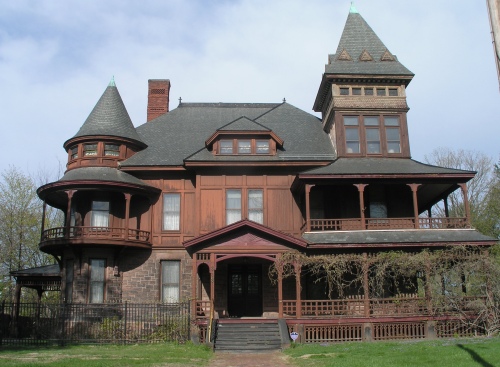
Julius H. Appleton’s Queen Anne/Stick Style house, at 313 Maple Street in Springfield, was built around 1886.
Jeremiah Lee Mansion (1768)

by Dan/January 31, 2011January 22, 2020/Colonial, Houses, Marblehead

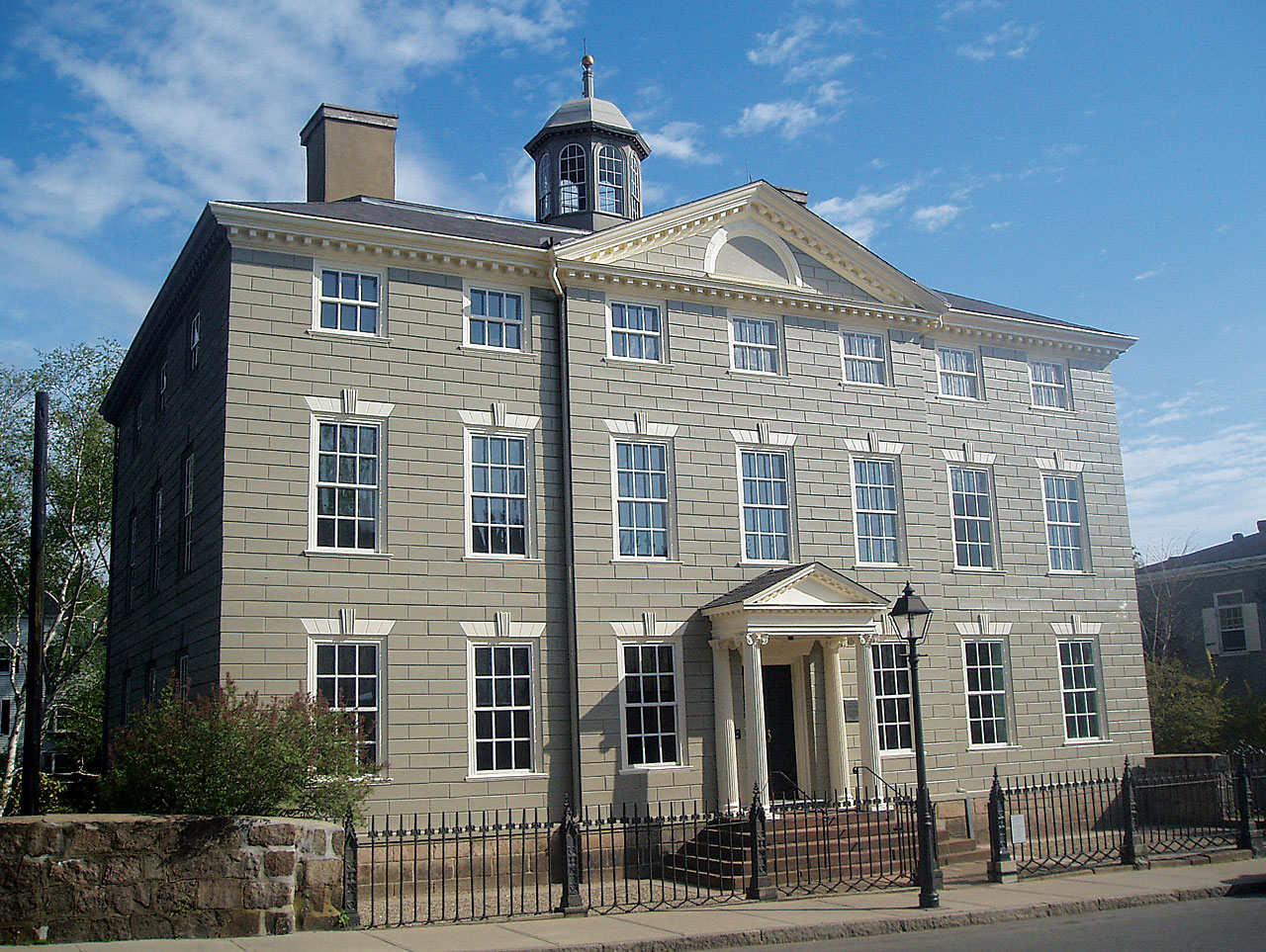
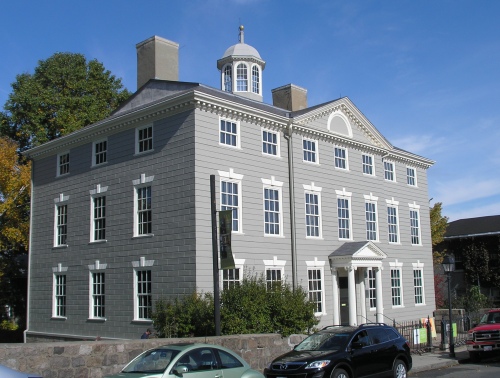
Jeremiah Lee, wealthy merchant and ship owner, built his fabulous Marblehead mansion in 1766-1768. With its lavish interiors and an exterior designed to make this wooden house appear to have a stone ashlar facade, the Jeremiah Lee Mansion in considered to be one of America’s greatest surviving examples of colonial Georgian architecture. Lee died in 1775 and the Mansion remained in the Lee family until 1785, by which time the great merchant’s empire had gone bankrupt. From 1804 to 1904, the Mansion served as the Marblehead Bank, an institution that made remarkably few alterations to the historic building. Since 1909, the house has been owned by the Marblehead Historical Society and is operated as a historic house museum.

Col. William Lee House (1743)

by Dan/January 30, 2011January 22, 2020/Colonial, Houses, Marblehead

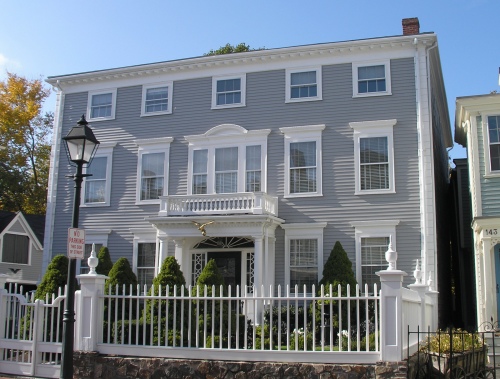
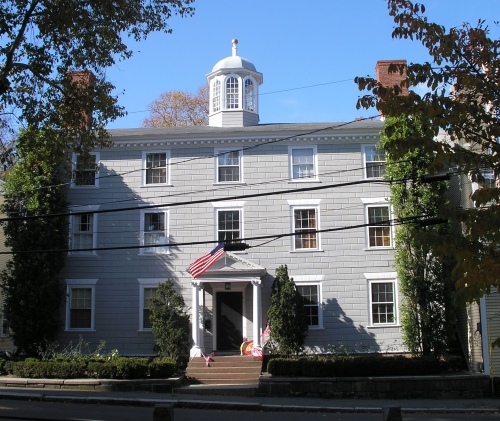
In 1743, Robert “King” Hooper sold land at what is now 185 Washington Street in Marblehead to Justice William Lee, who had plans to build a new house on the site which were not carried out. Instead, the smaller home located on the property was inherited by his grandson, Col. William R. Lee, a merchant and officer in the Revolutionary War, who hired Charles Bulfinch to design an expansion of his home into a mansion that would resemble that of his uncle, Jeremiah Lee. The house features a wood exterior designed to resemble granite.

Gray Manor (1740)

by Dan/January 29, 2011/Colonial, Houses, Marblehead

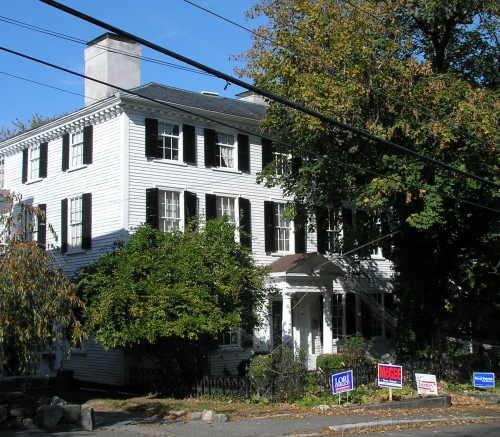
The Georgian-style mansion at 183 Washington Street, across from Abbot Hall in Marblehead, was built around 1740. It has a connection to the Hooper family through Susannah Hooper, daughter of Robert and Mary Glover Hooper. Susannah resided in the house after her marriage to Captain Henry Gallison Gray in 1835. Gray was a shipmaster and later a member of the Massachusetts Senate. The house, traditionally referred to as the Gray Manor, is currently subdivided into multiple apartments.

Nathaniel Hooper Mansion (1754)

by Dan/January 28, 2011January 22, 2020/Colonial, Federal, Houses, Marblehead

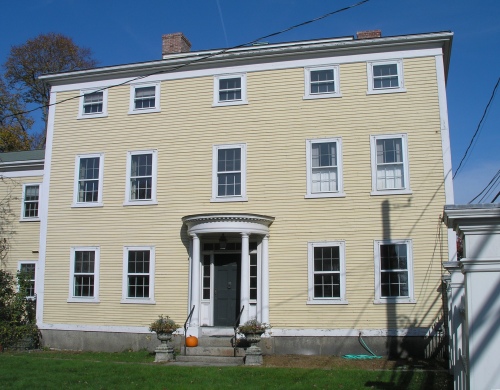
In 1801, Nathaniel Hooper, son of Robert Hooper and brother of Capt. John Hooper, purchased a parcel of land at the foot of Washington Street in Marblehead. A c. 1754 house was already on the property, which Hooper expanded into a Federal-style mansion. According to the Hooper Genealogy (1908), Nathaniel Hooper (1770-1825), “made public profession of his faith in Christ, his Saviour, in 1811, uniting with the Congregational church of Marblehead [the Hoopers had traditionally been Episcopalians]; became a deacon of the church, a man of large generosity and of much public spirit. He was known among the fishermen as ‘The Oracle,’ being very helpful in settling controversies. He represented the town at the General Court 1813-15 and 1822; was a member of the [Massachusetts Constitutional] Convention of 1820.” The Nathaniel Hooper Mansion, at 147 Washington Street, was later owned by the members of Fabens family of Salem. It was acquired by its current owners in 1983 and has been restored.

Capt. John Hooper House (1800)

by Dan/January 27, 2011January 22, 2020/Federal, Houses, Marblehead

Capt. John Hooper was a son of Robert Hooper and Mary (Polly) Ingalls. In 1811, his father deeded John land on Washington Street in Marblehead near his own house. This land included a house built in 1790, but this was replaced around 1815 (or as early as 1800) by John Hooper’s Federal-style mansion at 187 Washington Street. According to the Hooper Genealogy (1908), “He was known at the beginning of the century as ‘John Hooper, 4th;’ the term changed as he grew older. He was a man of great business energy and shrewdness, combined with much regard for equity and public spirit; amassed a large fortune for those days. Was president of the Marblehead Bank a long time. He built the handsome colonial mansion known as ‘The Hooper House,’ on the northern side of the Square, fronting the Common. He represented the town in the General Court 1819-1821.”

Hooper-Parker House (1761)

by Dan/January 26, 2011January 22, 2020/Colonial, Houses, Marblehead

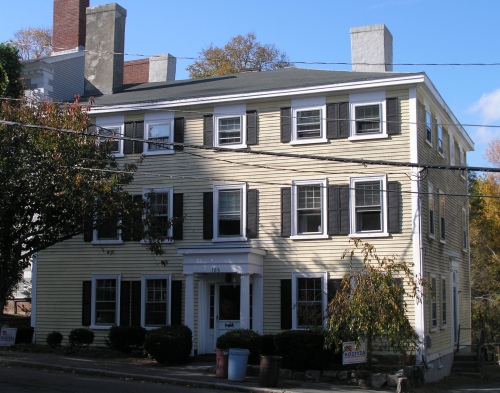
Nathaniel Hooper, successful Marblehead merchant, built a house that was later inherited, at his death in 1760, by his eldest son Robert. In 1761, Robert married Mary (Polly) Ingalls, his next door neighbor. Purchasing the adjacent plot of land from his father-in-law, Robert Hooper expanded his father’s small home into a much larger Georgian-style mansion, known today as the Hooper-Parker House and located at 181 Washington Street. After Robert’s death in 1815, his oldest son, also named Robert, inherited the house and lived there with his wife, Mary Glover, daughter of Capt. John Glover. Mary Glover Hooper was famed as a hostess, entertaining such guests as George Washington and General Lafayette. After Robert’s death in 1843, the house passed to his brother Henry and was later sold to merchant Robert Bridge, who sold it to Rev. Robert B. Parker, Rector of St. Michael’s Episcopal Church from 1922 to 1925. Rev. Parker’s wife Sarah left the house to the SPNEA, which eventually sold the house to a private owner in 1960.

Posts navigation

Older posts
Newer posts
Privacy Policy

Categories

  • Architectural Style (943)
    • Art Deco (9)
    • Byzantine (3)
    • Colonial (177)
    • Colonial Revival (85)
    • Craftsman (6)
    • Egyptian Revival (1)
    • Federal (190)
    • Foursquare (6)
    • Gothic (67)
    • Greek Revival (100)
    • Italianate (82)
    • Mission Revival (2)
    • Mission/Spanish Colonial (1)
    • Modern (2)
    • Neoclassical (56)
    • Octagon (3)
    • Postmodern (1)
    • Queen Anne (46)
    • Renaissance Revival (26)
    • Romanesque Revival (53)
    • Second Empire (26)
    • Shingle Style (12)
    • Stick Style (13)
    • Tudor Revival (8)
    • Vernacular (49)
    • Victorian Eclectic (15)
  • Building Type (943)
    • Apartment Buildings (8)
    • Banks (18)
    • Churches (119)
    • Collegiate (32)
    • Commercial (102)
    • Hotels (16)
    • Houses (508)
    • Industrial (23)
    • Libraries (22)
    • Lighthouses (1)
    • Military (15)
    • Monuments (1)
    • Museums (12)
    • Organizations (39)
    • Outbuildings (17)
    • Public Buildings (50)
    • Schools (23)
    • Stations (5)
    • Synagogues (1)
    • Taverns (21)
    • Theaters (9)
  • Town (943)
    • Adams (11)
    • Agawam (4)
    • Amherst (50)
    • Boston (64)
    • Boylston (6)
    • Cambridge (30)
    • Clinton (21)
    • Concord (15)
    • Cummington (1)
    • Danvers (14)
    • Deerfield (31)
    • Gloucester (18)
    • Granville (10)
    • Great Barrington (2)
    • Hadley (9)
    • Hancock (15)
    • Harvard (32)
    • Holyoke (47)
    • Lenox (5)
    • Lexington (8)
    • Longmeadow (32)
    • Marblehead (40)
    • Marlborough (4)
    • Natick (22)
    • Newton (2)
    • Northampton (68)
    • Peabody (4)
    • Pittsfield (20)
    • Salem (110)
    • Saugus (4)
    • Sheffield (4)
    • South Hadley (8)
    • Southborough (8)
    • Southwick (4)
    • Springfield (67)
    • Stockbridge (19)
    • Stow (1)
    • Sturbridge (18)
    • Sudbury (7)
    • Waltham (11)
    • Watertown (1)
    • Wayland (8)
    • West Springfield (14)
    • Westfield (46)
    • Weston (2)
    • Worcester (26)
  • Uncategorized (1)

Recent Comments

  • Wilber Blackson on South Hadley
  • Tami Speiden on Stockbridge
  • DexGuru on Stockbridge

Tags

Alcott Amherst College Asher Benjamin Back Bay Baptist Beacon Hill Big E Black Heritage Trail bowfront Bulfinch Catholic Congregational Episcopal Freedom Trail Gambrel H.H. Richardson Harvard Hawthorne Historic Deerfield Isaac Damon lit Longfellow mansard Methodist Mount Holyoke Museum Museums NPS Old Sturbridge Village PEM Revolutionary War row houses saltbox Samuel McIntire Shakers Smith College SPNEA Springfield Armory Stephen C. Earle Storrowton Underground Railroad UU Washington William Fenno Pratt Witch Trials

Meta

  • Log in
  • Entries feed
  • Comments feed
  • WordPress.org
Proudly powered by WordPress | Theme: ShowMe by NEThemes.