Historic Buildings of Massachusetts

  • About
  • Index by Town
  • CT
  • About
  • Index by Town
  • CT

Category: Taverns

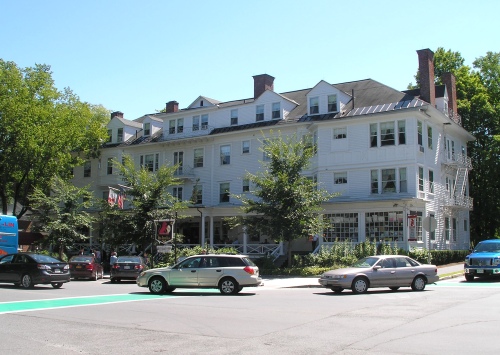
Red Lion Inn (1897)

by Dan/January 22, 2016January 22, 2016/Colonial Revival, Hotels, Stockbridge, Taverns

Red Lion Inn

The famous Red Lion Inn at 30 Main Street in Stockbridge has a long history going back to 1773. The structure grew from its early beginnings through additions. Its current configuration dates to 1897 after it was rebuilt following a fire in 1896.
Jonas Merriam House & Tavern (1807)

by Dan/October 1, 2014/Federal, Harvard, Houses, Taverns

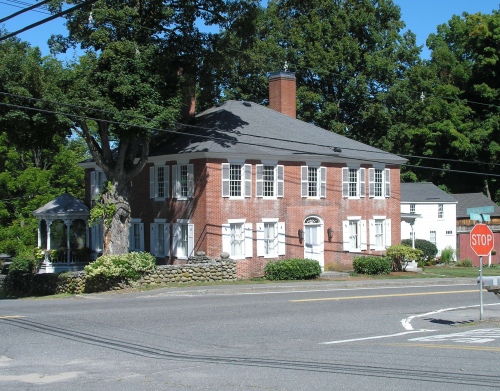
Jonas Merriam House & Tavern (1807)

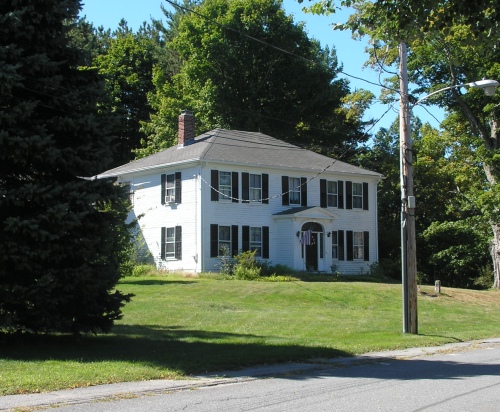
A tavern had long stood at the site where Jonas Merriam built a Federal-style house in 1807 at 1 Elm Street, near the Common, in Harvard. Merriam built the house to also serve as a tavern that would take advantage of traffic expected to pass by on the newly opened Union Turnpike. As described in Vol. 2 of the History of Harvard (1894), by Henry S. Nourse:

When the Union Turnpike was completed and Harvard expected to become a way station on a great thoroughfare between Boston and the upper valley of the Connecticut, Jonas Merriam’s tavern was opened in rivalry with Ezra Wetherbee’s, which faced it across the common. Neither turnpike nor inn rewarded the owners’ hopes, and Merriam removed to Shirley in 1816, selling his estate to Seth Nason.

Seth Nason was a founder of the Evangelical Church and town treasurer from 1825-34. He operated a shop in the house before purchasing the building at the corner of Still River Road and Massachusetts Avenue in 1820. Among later owners of the house was Dr. Augustus Robbins. The Evangelical Church also used it for a time as a parsonage in the mid-nineteenth century. The house has had various owners since then.

Silas Hastings Tavern (1818)

by Dan/October 17, 2013/Boylston, Federal, Taverns

Silas Hastings Tavern

At 701 Main Street, near the town Common in Boylston, is a Federal-style building, believed to have been constructed with bricks made at the Boylston brickyard of Captain John Howe. The building, which has a large ball-room on the second floor, was built in 1818 by Silas Hastings (1780-1833), who operated it as an inn and tavern until his death. The tavern was then run by Hastings’ son-in-law, Elmer Loring, until his death in 1839. After that time, it ceased to be used as a tavern. It was sold by Loring’s widow, Mary-Martha Hastings Loring, (they had married in 1827) to Captain John Andrews in 1844.

Abbott Tavern (1800)

by Dan/September 9, 2013September 9, 2013/Boylston, Federal, Taverns

Abbott Tavern, Boylston

The building at 4 Church Street in Boylston, known as the Abbott Tavern or the Christian House, was built c. 1800 and perhaps has portions built earlier. The property was acquired in 1803 by Capt. Jason Abbott (1772-1843), who operated a tavern there from 1806 to 1809. He later became a blacksmith. Squire Aaron White (1771-1846) acquired the property between 1809 and 1812 and either rebuilt or, more likely, just remodeled the existing tavern to become his mansion house. His wife, Mary Avery White (1778-1860), was an abolitionist and a prolific diarist and letter-writer. Charles Bray of Boston, a building contractor, bought the building in 1863 and also remodeled it. In 1963, it was acquired by the First Congregational Church of Boylston for use as offices and meeting rooms. Continue reading “Abbott Tavern (1800)”

Clapp Tavern (1743)

by Dan/January 17, 2013/Colonial, Houses, Taverns, Westfield

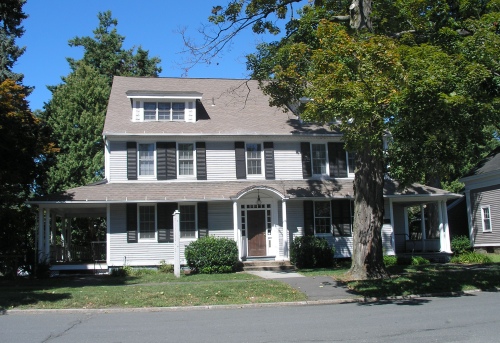
The Clapp Tavern in Westfield has gone through many changes over the years. Ezra Clapp came to Westfield in 1743 and built his house in 1747. From 1766 to the 1790s, the house was used as a tavern and was a meeting place for Westfield patriots during the Revolutionary War. General Henry Knox is said to have stayed at the Clapp Tavern while on his epic journey hauling artillery from Fort Ticonderoga to Cambridge in 1775-1776. In 1800, the house was bought by Samuel Fowler. In 1838, his son, James Fowler, first President of the Hampden National Bank, moved the house west from the corner of Elm and Court Streets to its present site at 53 Court Street to make way for a new house. Judge Homer Stevens had his home and office in the Tavern from 1870 to 1902. He made a number of alterations, including replacing the original central chimney with two smaller ones. A later owner, Zebina Caldwell, a carpenter, added the pent roof in front and the side porches.

David Saxton House (1763)

by Dan/September 21, 2012September 27, 2012/Colonial, Deerfield, Houses, Taverns

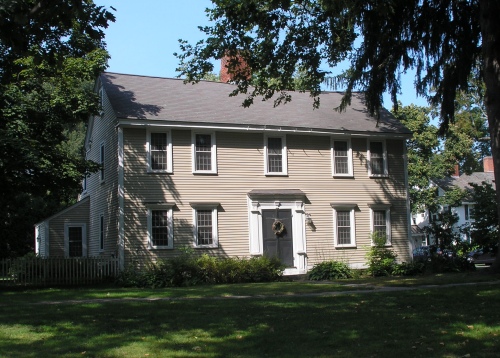
The David Saxton House, on Old Main Street in Deerfield, was operated for a time as a tavern and was a meeting place for Whigs (Patriots) during the American Revolution. As recorded in George Sheldon’s A History of Deerfield, Massachusetts, Vol. 2 (1896):

The big dish of tea made in Boston harbor, December 16th, 1773, stimulated the blood of two continents. David Field was in Boston that day, and when he brought the news there was a jollification meeting at David Saxton’s tavern. When the meeting broke up the mellow Whigs woke the echoes of the night by proclaiming about the town the exploits of those men.

Recent dendrochronology testing has identified the construction date of the house as 1763. I believe this house is the one described by George Sheldon in his book entitled The Little Brown House on the Albany Road (1915).

Solomon Cook Tavern (1795)

by Dan/September 20, 2012September 20, 2012/Colonial, Hadley, Houses, Taverns

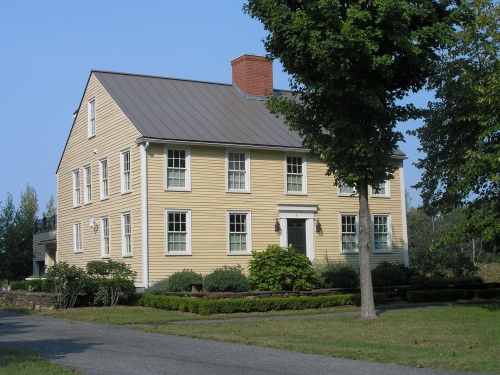
By 1700 a ferry ran across the Connecticut River between Hadley and Hatfield. According to the National Register of Historic Places Nomination for the Boundary Increase of the Hadley Center Historic District, Solomon Cook operated the ferry crossing and a tavern on the Hadley side of the river. In 1795, Andrew Cook purchased a home lot adjacent to the river in Hadley and erected his house (1 West Street) there around 1800. He operated it as a later version of Cook’s Tavern, also called the Ferryman’s Hotel. Other sources refer to the the building as the Solomon Cook Tavern, named for Solomon Cook (Andrew’s brother?), whose wife was Tryphena Newton Cook. The second floor of the tavern had a ballroom with seats built into the wall. In 2006-2007, the old tavern was restored and put on the market. It was sold, but was for sale again a year later.

Posts navigation

Older posts
Privacy Policy

Categories

  • Architectural Style (943)
    • Art Deco (9)
    • Byzantine (3)
    • Colonial (177)
    • Colonial Revival (85)
    • Craftsman (6)
    • Egyptian Revival (1)
    • Federal (190)
    • Foursquare (6)
    • Gothic (67)
    • Greek Revival (100)
    • Italianate (82)
    • Mission Revival (2)
    • Mission/Spanish Colonial (1)
    • Modern (2)
    • Neoclassical (56)
    • Octagon (3)
    • Postmodern (1)
    • Queen Anne (46)
    • Renaissance Revival (26)
    • Romanesque Revival (53)
    • Second Empire (26)
    • Shingle Style (12)
    • Stick Style (13)
    • Tudor Revival (8)
    • Vernacular (49)
    • Victorian Eclectic (15)
  • Building Type (943)
    • Apartment Buildings (8)
    • Banks (18)
    • Churches (119)
    • Collegiate (32)
    • Commercial (102)
    • Hotels (16)
    • Houses (508)
    • Industrial (23)
    • Libraries (22)
    • Lighthouses (1)
    • Military (15)
    • Monuments (1)
    • Museums (12)
    • Organizations (39)
    • Outbuildings (17)
    • Public Buildings (50)
    • Schools (23)
    • Stations (5)
    • Synagogues (1)
    • Taverns (21)
    • Theaters (9)
  • Town (943)
    • Adams (11)
    • Agawam (4)
    • Amherst (50)
    • Boston (64)
    • Boylston (6)
    • Cambridge (30)
    • Clinton (21)
    • Concord (15)
    • Cummington (1)
    • Danvers (14)
    • Deerfield (31)
    • Gloucester (18)
    • Granville (10)
    • Great Barrington (2)
    • Hadley (9)
    • Hancock (15)
    • Harvard (32)
    • Holyoke (47)
    • Lenox (5)
    • Lexington (8)
    • Longmeadow (32)
    • Marblehead (40)
    • Marlborough (4)
    • Natick (22)
    • Newton (2)
    • Northampton (68)
    • Peabody (4)
    • Pittsfield (20)
    • Salem (110)
    • Saugus (4)
    • Sheffield (4)
    • South Hadley (8)
    • Southborough (8)
    • Southwick (4)
    • Springfield (67)
    • Stockbridge (19)
    • Stow (1)
    • Sturbridge (18)
    • Sudbury (7)
    • Waltham (11)
    • Watertown (1)
    • Wayland (8)
    • West Springfield (14)
    • Westfield (46)
    • Weston (2)
    • Worcester (26)
  • Uncategorized (1)

Recent Comments

  • Wilber Blackson on South Hadley
  • Tami Speiden on Stockbridge
  • DexGuru on Stockbridge

Tags

Alcott Amherst College Asher Benjamin Back Bay Baptist Beacon Hill Big E Black Heritage Trail bowfront Bulfinch Catholic Congregational Episcopal Freedom Trail Gambrel H.H. Richardson Harvard Hawthorne Historic Deerfield Isaac Damon lit Longfellow mansard Methodist Mount Holyoke Museum Museums NPS Old Sturbridge Village PEM Revolutionary War row houses saltbox Samuel McIntire Shakers Smith College SPNEA Springfield Armory Stephen C. Earle Storrowton Underground Railroad UU Washington William Fenno Pratt Witch Trials

Meta

  • Log in
  • Entries feed
  • Comments feed
  • WordPress.org
Proudly powered by WordPress | Theme: ShowMe by NEThemes.