Historic Buildings of Massachusetts

  • About
  • Index by Town
  • CT
  • About
  • Index by Town
  • CT

Category: Greek Revival

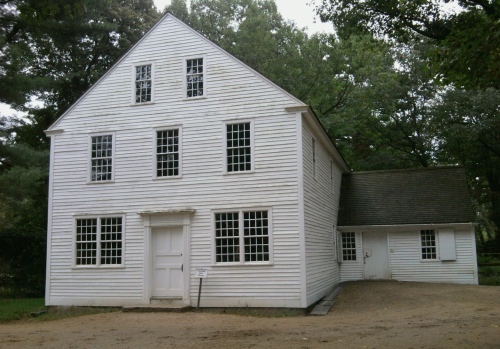
Asa Knight Store (1838)
by Dan/September 30, 2011September 30, 2011/Commercial, Greek Revival, Sturbridge

In the early nineteenth century, Asa Knight operated a general store in the village center of Dummerston, Vermont. In 1826, Knight bought the store, the oldest section of which had been built around 1810, and added a storekeeper’s office. He further expanded the building with a new main wing in 1838-1839. The older section became an ell, attached to the new two-and-a-half story building. By the 1870s, the building ended its period as a store and remained mostly vacant and unmodernized for the next century. In 1972, it was moved to Old Sturbridge Village, restored and restocked to represent a village store of the 1830s. The earliest section, built in 1810, had been removed in 1909 and was reconstructed, based on old photographs and archaeological research.
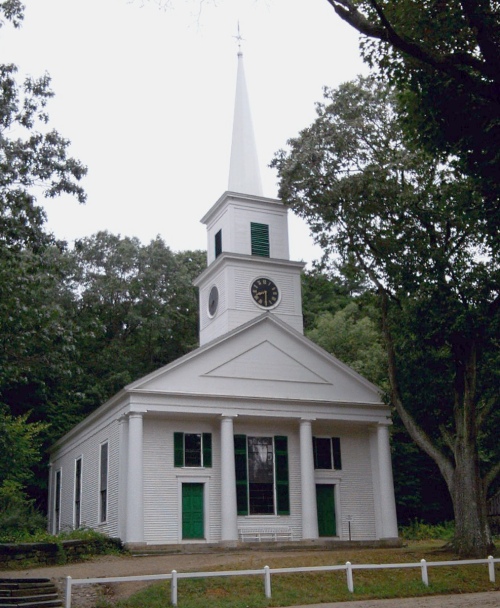
Center Meetinghouse, Old Sturbridge Village (1832)

by Dan/September 25, 2011/Churches, Greek Revival, Sturbridge

The Baptist Church in Sturbridge was organized about 1750 and early on met in a school house, enlarged and converted into a house of worship. A new meetinghouse was erected in 1784. These first two structures were located on Fiske Hill. As described in An Historical Sketch of Sturbridge, Mass. (1838), by Joseph S. Clark, by 1832:

Their first Meetinghouse, by this time was going to decay; and as it stood at an inconvenient distance from many of the Society, in 1832 they erected a new and far more commodious one, in the centre village, on a corner of the old Burying-ground. It was dedicated Jan. 8, 1833, […] The Baptist Society have just completed [1838] the removal of their Meetinghouse to Fiskdale village, about 2 miles from its former location. As this arrangement brings the Sanctuary to the doors of many who have hitherto found it inconvenient to attend Church statedly it is presumed that they will hereafter avail themselves of that privilege.

As mentioned in the 1844 book, History of the Baptist Churches Composing the Sturbridge Association,

During the present year, (1842,) the house, having been struck with lightning, and injured to a considerable extent, has undergone a thorough repair, at an expense of about $300.

In 1947, when the Sturbridge Baptist Society was joining with another denomination, it agreed to give the meetinghouse to Old Sturbridge Village in exchange for an organ in their new church. The 1832 structure was then moved to the Village, where it is referred to as the Center Meetinghouse.

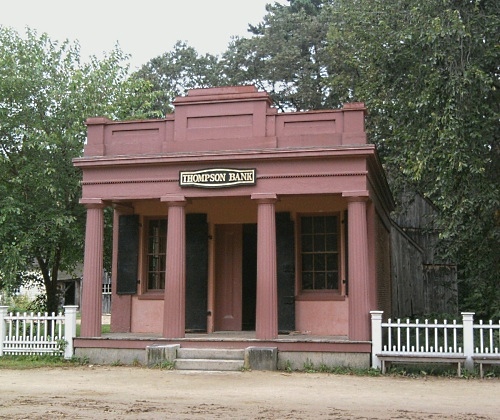
Thompson Bank (1835)

by Dan/September 24, 2011/Banks, Greek Revival, Sturbridge

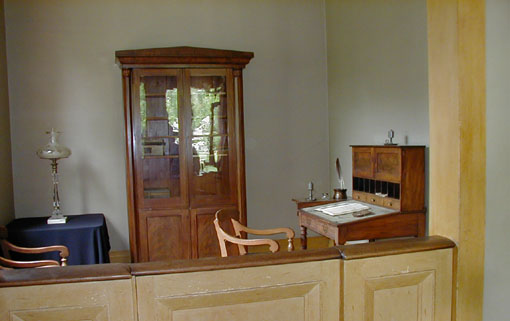
The Thompson Bank was chartered in 1833 and the bank building was constructed in the town of Thompson, Connecticut, in 1835. It served as a bank until 1893 and was moved to Old Sturbridge Village in 1963, where the interior was restored to its original nineteenth-century appearance.

Barrett Hall, Amherst College (1860)

by Dan/September 9, 2011/Amherst, Collegiate, Greek Revival, Italianate

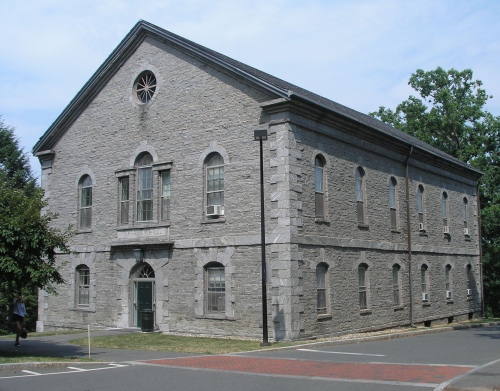
Barrett Hall, on the campus of Amherst College, was built as Barrett Gymnasium in 1859-1860. Amherst College had the first department of Physical Education in the country. Constructed of Pelham granite, the gymnasium was designed by Boston architect Charles E. Parkes and was named for Dr. Benjamin Barrett of Northampton, who made the largest financial contribution towards building and fully equipping it. The building served as a gym until Pratt Gymnasium was built in 1883. In 1907, Barrett Hall was converted to become the home of the modern languages department.

Southwick Congregational Church (1824)

by Dan/August 7, 2011December 9, 2013/Churches, Federal, Greek Revival, Southwick

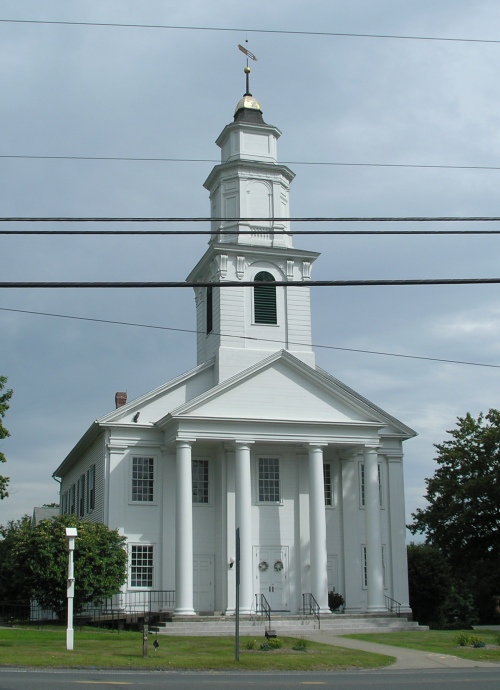
The original meeting house in Southwick of 1773, located in Southwick‘s central village, burned in August 1823 and was replaced with the current meeting house, built in 1824-1825. A Federal/Greek Revival structure, the Southwick Congregational Church is considered to be one of the finest works of its architect, Isaac Damon of Northampton. According to George C. Gardener, writing in The American Architect and Building News (Vol. XLVII, No. 996, Jan. 26, 1895):

Capt. Isaac Damon appears to have been the leading architect of Western Massachusetts from 1812 to 1840, his influence on public and ecclesiastical work being even greater than [Asher] Benjamin’s on domestic. He designed and built at least thirteen churches in this region and nearly all the town-halls and court-houses; his specialty, however, was bridges, and there are several of his drawings still preserved

As the church neared completion, on November 6, 1824, two letters signed by the men working on the church were placed in a box inside one of the columns. These were rediscovered during a restoration in 1950 (see pdf article) and reveal that the workers came, not from Southwick, but from many other towns in the region.

Eugene Field House (1839)

by Dan/August 4, 2011/Amherst, Greek Revival, Houses

Home at various times to such authors as Ray Stannard Baker and Mary Heaton Vorse, the house at 219 Amity Street in Amherst is most associated with Eugene Field, a journalist and writer, best known for his children’s poetry and humorous essays. Field was born in St. Louis (where his birthplace house is now a museum), but after the death of his mother in 1856 he was raised by a cousin, Mary Field French, in the house on Amity Street in Amherst. The house was built in 1839 for by Robert Cutler for French’s father, Thomas Jones.

Helen Hunt Jackson House (1830)

by Dan/July 28, 2011/Amherst, Greek Revival, Houses

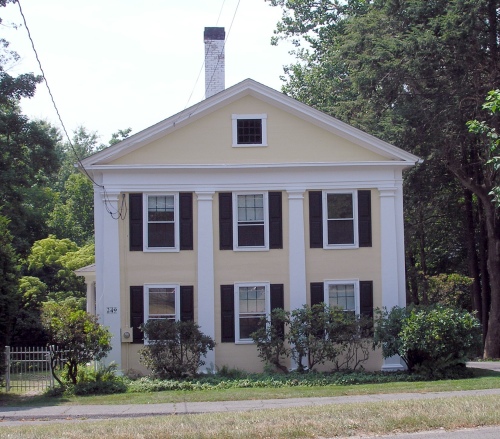
Helen Hunt Jackson, the author of many books and poems, was born Helen Maria Fiske in Amherst in 1830 in a Greek Revival house, built the same year at 249 South Pleasant Street. Her father, Nathan Fiske, was a minister and a professor of Language and Philosophy at Amherst College. A contemporary and classmate of Emily Dickinson, Helen Hunt Jackson was educated at the Ipswich Female Seminary and at the Abbott Brothers’ School in New York City. She was married twice, lost two sons and lived later in life in Colorado. An activist who denounced the treatment of Native Americans by the U.S. government, she detailed the history of broken treaties and called for reform in her book, A Century of Dishonor (1881). Inspired by Harriet Beecher Stowe’s Uncle Tom’s Cabin, she also addressed the issue of the federal government’s mistreatment of Native Americans in her novel, Ramona (1884). Her birthplace was later acquired by Amherst College and is now a private residence.

Posts navigation

Older posts
Newer posts
Privacy Policy

Categories

  • Architectural Style (943)
    • Art Deco (9)
    • Byzantine (3)
    • Colonial (177)
    • Colonial Revival (85)
    • Craftsman (6)
    • Egyptian Revival (1)
    • Federal (190)
    • Foursquare (6)
    • Gothic (67)
    • Greek Revival (100)
    • Italianate (82)
    • Mission Revival (2)
    • Mission/Spanish Colonial (1)
    • Modern (2)
    • Neoclassical (56)
    • Octagon (3)
    • Postmodern (1)
    • Queen Anne (46)
    • Renaissance Revival (26)
    • Romanesque Revival (53)
    • Second Empire (26)
    • Shingle Style (12)
    • Stick Style (13)
    • Tudor Revival (8)
    • Vernacular (49)
    • Victorian Eclectic (15)
  • Building Type (943)
    • Apartment Buildings (8)
    • Banks (18)
    • Churches (119)
    • Collegiate (32)
    • Commercial (102)
    • Hotels (16)
    • Houses (508)
    • Industrial (23)
    • Libraries (22)
    • Lighthouses (1)
    • Military (15)
    • Monuments (1)
    • Museums (12)
    • Organizations (39)
    • Outbuildings (17)
    • Public Buildings (50)
    • Schools (23)
    • Stations (5)
    • Synagogues (1)
    • Taverns (21)
    • Theaters (9)
  • Town (943)
    • Adams (11)
    • Agawam (4)
    • Amherst (50)
    • Boston (64)
    • Boylston (6)
    • Cambridge (30)
    • Clinton (21)
    • Concord (15)
    • Cummington (1)
    • Danvers (14)
    • Deerfield (31)
    • Gloucester (18)
    • Granville (10)
    • Great Barrington (2)
    • Hadley (9)
    • Hancock (15)
    • Harvard (32)
    • Holyoke (47)
    • Lenox (5)
    • Lexington (8)
    • Longmeadow (32)
    • Marblehead (40)
    • Marlborough (4)
    • Natick (22)
    • Newton (2)
    • Northampton (68)
    • Peabody (4)
    • Pittsfield (20)
    • Salem (110)
    • Saugus (4)
    • Sheffield (4)
    • South Hadley (8)
    • Southborough (8)
    • Southwick (4)
    • Springfield (67)
    • Stockbridge (19)
    • Stow (1)
    • Sturbridge (18)
    • Sudbury (7)
    • Waltham (11)
    • Watertown (1)
    • Wayland (8)
    • West Springfield (14)
    • Westfield (46)
    • Weston (2)
    • Worcester (26)
  • Uncategorized (1)

Recent Comments

  • Wilber Blackson on South Hadley
  • Tami Speiden on Stockbridge
  • DexGuru on Stockbridge

Tags

Alcott Amherst College Asher Benjamin Back Bay Baptist Beacon Hill Big E Black Heritage Trail bowfront Bulfinch Catholic Congregational Episcopal Freedom Trail Gambrel H.H. Richardson Harvard Hawthorne Historic Deerfield Isaac Damon lit Longfellow mansard Methodist Mount Holyoke Museum Museums NPS Old Sturbridge Village PEM Revolutionary War row houses saltbox Samuel McIntire Shakers Smith College SPNEA Springfield Armory Stephen C. Earle Storrowton Underground Railroad UU Washington William Fenno Pratt Witch Trials

Meta

  • Log in
  • Entries feed
  • Comments feed
  • WordPress.org
Proudly powered by WordPress | Theme: ShowMe by NEThemes.