Historic Buildings of Massachusetts

  • About
  • Index by Town
  • CT
  • About
  • Index by Town
  • CT

Category: Greek Revival

Goin Bailey House (1839)
by Dan/July 9, 2010January 22, 2020/Greek Revival, Houses, Natick

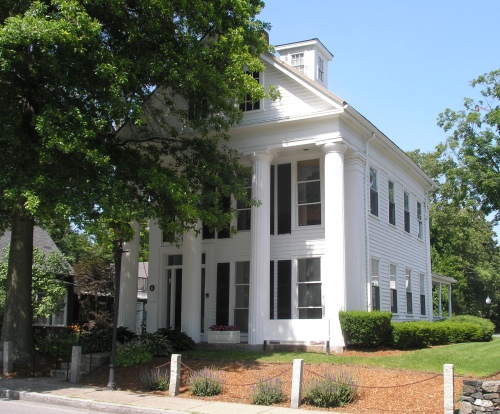
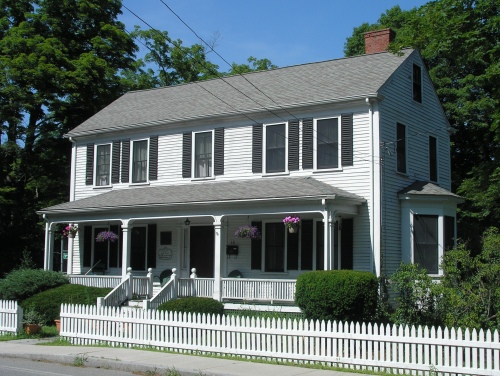
In 1782, Eliakim Morrill (the model for the character Uncle Fly Sheril in Harriet Beecher Stowe’s novel Oldtown Folks) built a tavern in South Natick, which he operated for seventeen years. He was followed by several other owners, until Goin Bailey took charge of it in 1849. In 1872, the original building burned and Bailey built a new hotel on the site, known as Bailey’s Hotel. After Goin Bailey’s death, in 1875, his son Almond Bailey ran the hotel, until 1907, when Mrs. R.G. Shaw bought the building and renovated it under the name of the Old Natick Inn. In 1930, she razed the old hotel and hired Charles Gorely to landscape a park in its place, which she gave to the town in 1932. Adjacent to Shaw Park is the Greek Revival house, built by Goin Bailey in 1839. When Moses Eames built a similar Greek Revival house in the same year on nearby Pleasant Street, he sought to distinguish his home from the Bailey House by adding a cupola and using Doric instead of the Bailey House’s Ionic columns. The Bailey House was occupied by Goin Bailey’s widow after his death and it now contains offices. Continue reading “Goin Bailey House (1839)”
Rev. Horatio Alger, Sr. House (1824)

by Dan/July 8, 2010January 22, 2020/Greek Revival, Houses, Natick

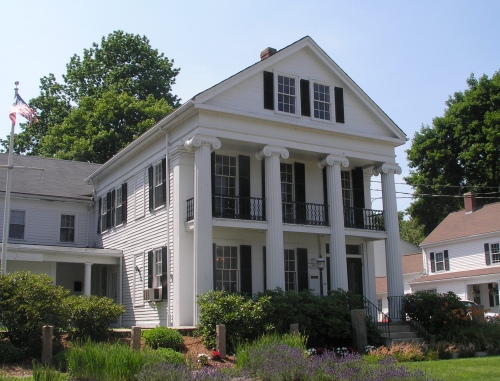
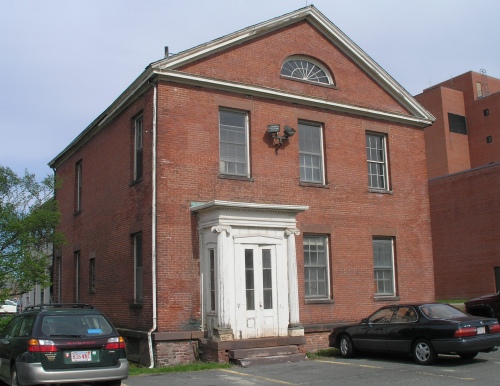
Located on Pleasant Street in South Natick, not far from the Stowe House, is the house occupied by Rev. Horatio Alger, Sr. during the period when he served as minister at Eliot Church. Alger was the father of the popular author, Horatio Alger, Jr. Rev. Alger had been the minister at West Church in Marlborough from 1845 to 1859, before moving to Natick, where he died in 1881. The Alger House was built by Oliver Bacon about 1824 (Bacon had acquired the land from the Bigelow family). In 1869, Bacon sold it to H.H. Hunnewell, a wealthy businessman, philanthropist and horticulturist. Hunnewell bought the house to provide a residence for Rev. Alger, who lived there until he died. In 1909, Hunnewell deeded it to the church as a parsonage.

Master Armorer’s House, Springfield Armory (1833)

by Dan/April 28, 2010April 28, 2010/Greek Revival, Houses, Military, Springfield

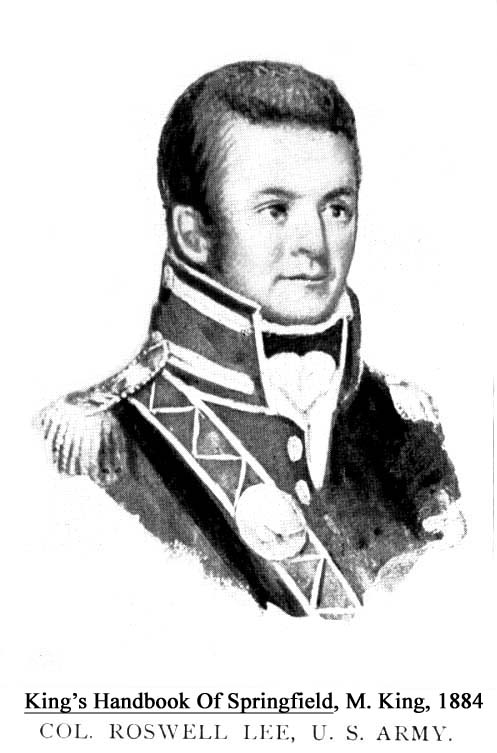
When the Main Arsenal at the Springfield Armory was completed in 1851, it was flanked by two houses, both built earlier: the Paymaster’s House, to the south, and the Master Armorer’s House, to the north. Both of these residences were relocated around 1880. The Paymaster’s House was eventually demolished, but the Master Armorer’s House has survived. It was relocated about 300 feet north of its original site and was rotated and placed on the opposite side of the street. The house was built in 1833, during the tenure of Lt. Col. Roswell Lee as superintendent of the Armory. It later served as an infirmary and as officers’ quarters. The building lost its rear section by the start of the twentieth century and was remodeled by the WPA in 1937.

Commanding Officer’s House, Springfield Armory (1846)

by Dan/April 27, 2010/Greek Revival, Houses, Military, Springfield

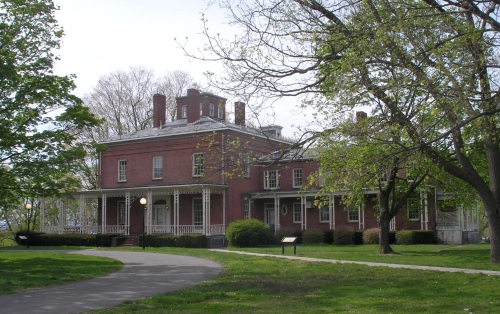
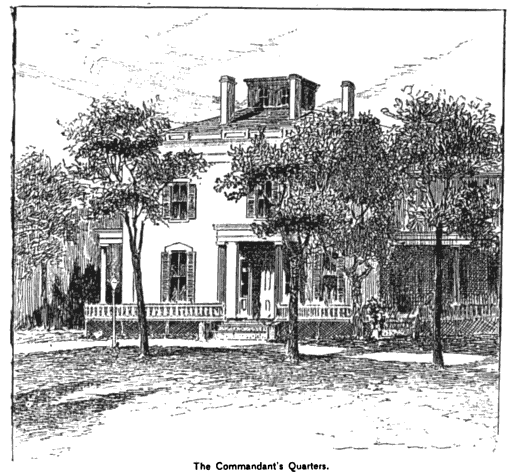
Maj. James W. Ripley became superintendent of the Springfield Armory in 1841 and soon initiated an ambitious building program. The first structure to be completed was the Commanding Officer’s Quarters. He had demolished an earlier Commanding Officer‘s House on the site where the new Main Arsenal was to be built. To replace it, he constructed a fine new CO.’s residence, begun in 1845 and completed in 1847. There were many who opposed Ripley’s reforms of the Armory and he faced much controversy during his tenure. Some considered his new residence to be too extravagant. A series of investigations led to a military court of inquiry in which a major complaint was that he was wasting government funds, but Ripley was eventually exonerated. The house is now used as administrative offices for the Springfield Armory National Historic Site.

Quincy Market (1826)

by Dan/March 24, 2010/Boston, Commercial, Greek Revival

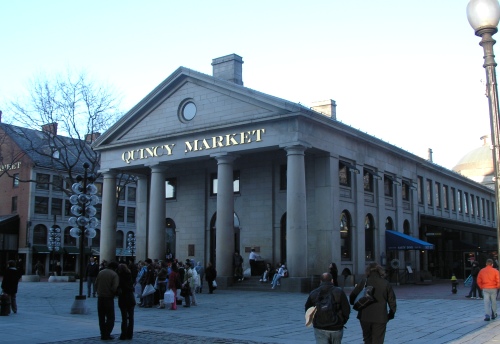
Quincy Market, which stretches 365 feet and led to the opening of six new streets when it was built in 1824-1826, was Boston’s first major project after incorporating as a city in 1822. Named for mayor Josiah Quincy, the building greatly expanded on the market space already available to Boston citizens in the adjacent Faneuil Hall. Architect Alexander Parris planned a Greek Revival style structure, with columns and pediments at each end and a central copper dome. It was the first large-scale use of granite and glass with post-and-beam construction and, when originally built, the Market was right on the harbor’s edge. Two additional long warehouse buildings flank the main structure to the north and south. Quincy Market was restored between 1976 and 1978 to become part of the shopping and dining center called Faneuil Hall Marketplace Continue reading “Quincy Market (1826)”

Daniel Colton House (1829)

by Dan/September 19, 2009September 17, 2016/Greek Revival, Houses, Longmeadow

Daniel Colton House

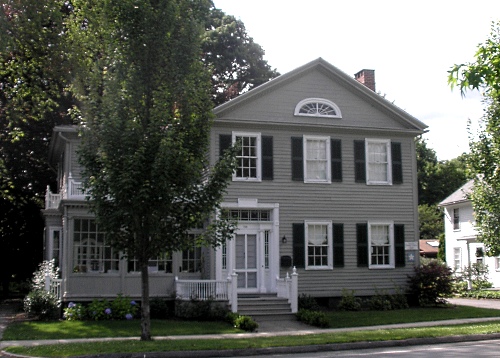
The Daniel Colton House, on Longmeadow Green, was built in 1829 and is a gable-front/sidehall plan house, a layout which first appears in Longmeadow in the 1820s. To the left of the main entrance are various later additions and an older section, which originally housed the shop of Daniel Colton, who was a joiner.

Old Wayland Town Hall (1841)

by Dan/September 1, 2009September 1, 2009/Greek Revival, Public Buildings, Wayland

Old Wayland Town Hall

Proceedings at the Dedication of the Town Hall, Wayland, December 24, 1878; with Brief Historical Sketches of Public Buildings and Libraries, Vol. 1, (1879), contains the following about the building of the Old Town Hall of Wayland:

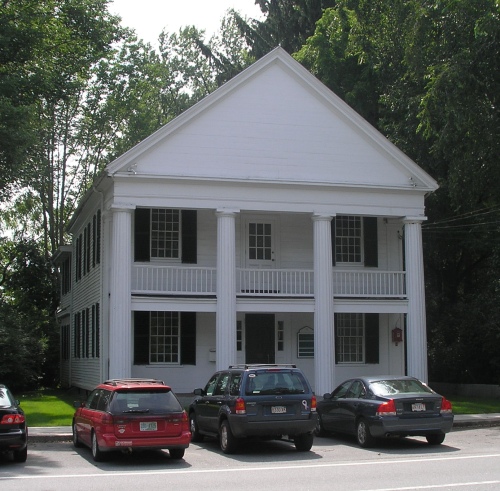
In 1840, the common land on which the old meeting-house had stood having been sold in the mean time to Dea[con] James Draper, he proposed to erect a new building on a part of the same, for the use of the town, to contain a town-hall, a school-room, with anterooms, etc., for the sum of seventeen hundred dollars. His proposal was accepted, and the building was first occupied for town meetings Nov. 8, 1841. Subsequently the hall was used also for an academy, under Rev. L. P. Frost. The library occupied a part of the lower floor, and for this and other public uses it served the town until the erection of the new building in 1878.

The new building was located across the street. The Old Town Hall later served as a grocery store and today houses offices.

Posts navigation

Older posts
Newer posts
Privacy Policy

Categories

  • Architectural Style (943)
    • Art Deco (9)
    • Byzantine (3)
    • Colonial (177)
    • Colonial Revival (85)
    • Craftsman (6)
    • Egyptian Revival (1)
    • Federal (190)
    • Foursquare (6)
    • Gothic (67)
    • Greek Revival (100)
    • Italianate (82)
    • Mission Revival (2)
    • Mission/Spanish Colonial (1)
    • Modern (2)
    • Neoclassical (56)
    • Octagon (3)
    • Postmodern (1)
    • Queen Anne (46)
    • Renaissance Revival (26)
    • Romanesque Revival (53)
    • Second Empire (26)
    • Shingle Style (12)
    • Stick Style (13)
    • Tudor Revival (8)
    • Vernacular (49)
    • Victorian Eclectic (15)
  • Building Type (943)
    • Apartment Buildings (8)
    • Banks (18)
    • Churches (119)
    • Collegiate (32)
    • Commercial (102)
    • Hotels (16)
    • Houses (508)
    • Industrial (23)
    • Libraries (22)
    • Lighthouses (1)
    • Military (15)
    • Monuments (1)
    • Museums (12)
    • Organizations (39)
    • Outbuildings (17)
    • Public Buildings (50)
    • Schools (23)
    • Stations (5)
    • Synagogues (1)
    • Taverns (21)
    • Theaters (9)
  • Town (943)
    • Adams (11)
    • Agawam (4)
    • Amherst (50)
    • Boston (64)
    • Boylston (6)
    • Cambridge (30)
    • Clinton (21)
    • Concord (15)
    • Cummington (1)
    • Danvers (14)
    • Deerfield (31)
    • Gloucester (18)
    • Granville (10)
    • Great Barrington (2)
    • Hadley (9)
    • Hancock (15)
    • Harvard (32)
    • Holyoke (47)
    • Lenox (5)
    • Lexington (8)
    • Longmeadow (32)
    • Marblehead (40)
    • Marlborough (4)
    • Natick (22)
    • Newton (2)
    • Northampton (68)
    • Peabody (4)
    • Pittsfield (20)
    • Salem (110)
    • Saugus (4)
    • Sheffield (4)
    • South Hadley (8)
    • Southborough (8)
    • Southwick (4)
    • Springfield (67)
    • Stockbridge (19)
    • Stow (1)
    • Sturbridge (18)
    • Sudbury (7)
    • Waltham (11)
    • Watertown (1)
    • Wayland (8)
    • West Springfield (14)
    • Westfield (46)
    • Weston (2)
    • Worcester (26)
  • Uncategorized (1)

Recent Comments

  • Wilber Blackson on South Hadley
  • Tami Speiden on Stockbridge
  • DexGuru on Stockbridge

Tags

Alcott Amherst College Asher Benjamin Back Bay Baptist Beacon Hill Big E Black Heritage Trail bowfront Bulfinch Catholic Congregational Episcopal Freedom Trail Gambrel H.H. Richardson Harvard Hawthorne Historic Deerfield Isaac Damon lit Longfellow mansard Methodist Mount Holyoke Museum Museums NPS Old Sturbridge Village PEM Revolutionary War row houses saltbox Samuel McIntire Shakers Smith College SPNEA Springfield Armory Stephen C. Earle Storrowton Underground Railroad UU Washington William Fenno Pratt Witch Trials

Meta

  • Log in
  • Entries feed
  • Comments feed
  • WordPress.org
Proudly powered by WordPress | Theme: ShowMe by NEThemes.