Search
Advertisement
Become a Fan!
Buy My Book! Click Cover Image to Order!
Categories
- Architectural Style (684)
- Art Deco (2)
- Byzantine (3)
- Colonial (157)
- Colonial Revival (58)
- Craftsman (3)
- Egyptian Revival (1)
- Federal (156)
- Foursquare (3)
- Gothic (45)
- Greek Revival (75)
- Italianate (48)
- Mission Revival (1)
- Modern (1)
- Neoclassical (28)
- Octagon (2)
- Postmodern (1)
- Queen Anne (26)
- Renaissance Revival (16)
- Romanesque Revival (33)
- Second Empire (18)
- Shingle Style (9)
- Stick Style (10)
- Tudor Revival (6)
- Vernacular (29)
- Victorian Eclectic (7)
- Building Type (684)
- Apartment Buildings (5)
- Banks (7)
- Churches (82)
- Collegiate (31)
- Commercial (51)
- Hotels (10)
- Houses (403)
- Industrial (10)
- Libraries (12)
- Lighthouses (1)
- Military (13)
- Monuments (1)
- Museums (9)
- Organizations (26)
- Outbuildings (8)
- Public Buildings (33)
- Schools (16)
- Stations (2)
- Synagogues (1)
- Taverns (17)
- Theaters (5)
- Town (684)
- Adams (2)
- Agawam (4)
- Amherst (50)
- Boston (64)
- Cambridge (30)
- Clinton (8)
- Concord (8)
- Cummington (1)
- Danvers (14)
- Deerfield (31)
- Granville (10)
- Hadley (7)
- Hancock (6)
- Holyoke (19)
- Lenox (5)
- Lexington (8)
- Longmeadow (31)
- Marblehead (40)
- Marlborough (4)
- Natick (22)
- Newton (2)
- Northampton (39)
- Peabody (4)
- Pittsfield (4)
- Salem (97)
- Saugus (4)
- South Hadley (8)
- Southborough (8)
- Southwick (3)
- Springfield (50)
- Stockbridge (10)
- Stow (1)
- Sturbridge (18)
- Sudbury (7)
- Waltham (10)
- Watertown (1)
- Wayland (8)
- West Springfield (14)
- Westfield (19)
- Weston (2)
- Worcester (11)
- Uncategorized (1)
- Architectural Style (684)
Recent Comments
- Pat Barnes on Springfield Municipal Group (1913)
- Paul A. Doucette on The Joseph Burnett House (1850)
- Judith on The Joseph Burnett House (1850)
- PCL on Hotel Vendome (1871)
- jennider D on The Joseph Burnett House (1850)
Tags
Alcott Amherst College Asher Benjamin Back Bay Baptist Beacon Hill Big E Black Heritage Trail bowfront Bulfinch Catholic Congregational Episcopal Freedom Trail Gambrel H.H. Richardson Harvard Hawthorne Historic Deerfield Isaac Damon lit Longfellow mansard Methodist Mount Holyoke Museum Museums NPS Old Sturbridge Village PEM Revolutionary War row houses saltbox Samuel McIntire Shakers Shingle SPNEA Springfield Armory Stick Style Storrowton Underground Railroad UU Washington William Fenno Pratt Witch Trials-

Centers And SquaresBlogroll
Links
- Boston Preservation Alliance
- Cape Cod Modern House Trust
- Digital Treasures
- Historic Boston Inc.
- Historic Deerfield
- Historic New England
- Historic Salem Inc.
- Image Museum
- Old Sturbridge Village
- Preservation Massachusetts
- Preservation Worcester
- Salem Preservation, Inc.
- Springfield Preservation Trust
- The Trustees of Reservations
-
Recent Posts
- Friends Meeting House, Adams (1782)
- Meetinghouse, Hancock Shaker Village (1793)
- Trustees’ Office and Store, Hancock Shaker Village (1813)
- Sisters’ Dairy and Weave Shop (1790)
- Brethren’s Shop, Hancock Shaker Village (1813)
- Brick Poultry House, Hancock Shaker Village (1878)
- Brick Dwelling, Hancock Shaker Village (1830)
- Round Stone Barn, Hancock Shaker Village (1826)
- First Baptist Church, Pittsfield (1927)
- Old Berkshire Athenaeum (1876)
- Susan B. Anthony Birthplace (1817)
- William Cullen Bryant Homestead (1785)
- Bray-Hoadley House (1873)
- Dewey Block, Northampton (1912)
- Browne House (1698)
Archives
- May 2013
- April 2013
- March 2013
- February 2013
- January 2013
- December 2012
- November 2012
- October 2012
- September 2012
- August 2012
- July 2012
- June 2012
- May 2012
- April 2012
- March 2012
- February 2012
- January 2012
- December 2011
- November 2011
- October 2011
- September 2011
- August 2011
- July 2011
- June 2011
- May 2011
- April 2011
- March 2011
- February 2011
- January 2011
- December 2010
- November 2010
- October 2010
- September 2010
- August 2010
- July 2010
- June 2010
- May 2010
- April 2010
- March 2010
- February 2010
- January 2010
- December 2009
- November 2009
- October 2009
- September 2009
- August 2009
- July 2009
- June 2009
- May 2009
- April 2009
- March 2009
- February 2009
- January 2009
- December 2008
- November 2008
- October 2008
- July 2008
- June 2008
- May 2008
- April 2008
- March 2008
-

Pages
- Towns
- Adams
- Agawam
- Amherst
- Boston
- Burlington
- Cambridge
- Clinton
- Concord
- Cummington
- Danvers
- Deerfield
- Granville
- Hadley
- Hancock
- Hatfield
- Holyoke
- Lenox
- Lexington
- Longmeadow
- Marblehead
- Marlborough
- Natick
- Newton
- Northampton
- Peabody
- Pittsfield
- Salem
- Saugus
- South Hadley
- Southborough
- Southwick
- Springfield
- Stockbridge
- Stow
- Sturbridge
- Sudbury
- Waltham
- Watertown
- Wayland
- West Springfield
- Westfield
- Weston
- Worcester
- Towns
Meta
Tag Archives: Springfield Armory
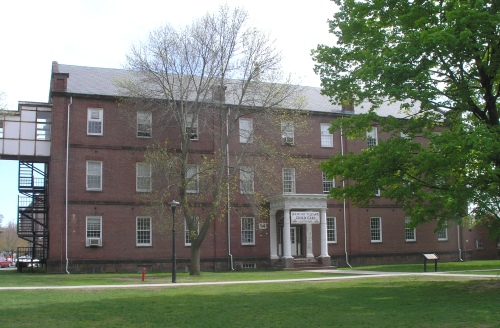
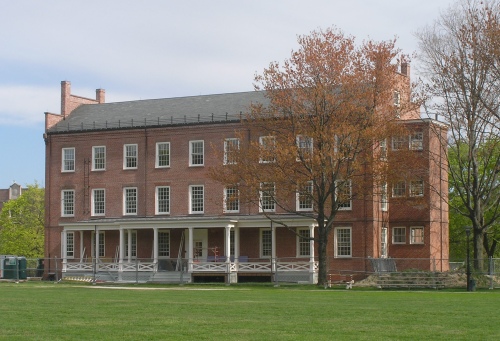
Company Officer’s Quarters, Springfield Armory (1836)
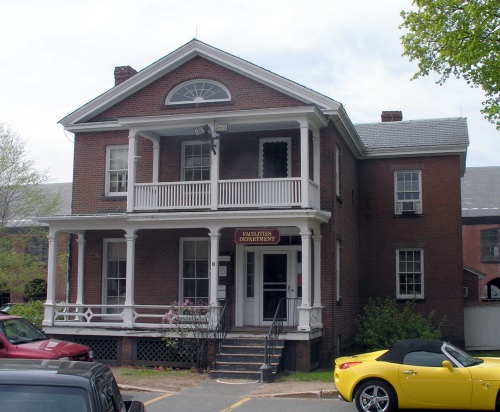
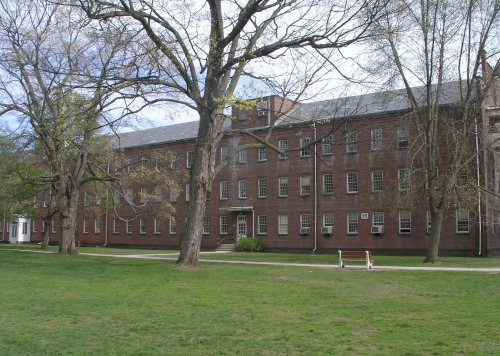
A number of buildings were constructed at the Springfield Armory to serve as Company Officer’s Quarters. Pictured above is one of a pair of adjacent identical structures built in the Greek Revival style in 1836. Next to these is an earlier building, dating to 1833. A fourth one, facing Armory Square, was built in 1880. All four buildings are now part of the campus of Springfield Technical Community College. Scroll or click below to see pictures of the other three buildings: (more…)
Junior Officers’ Quarters, Springfield Armory (1870)

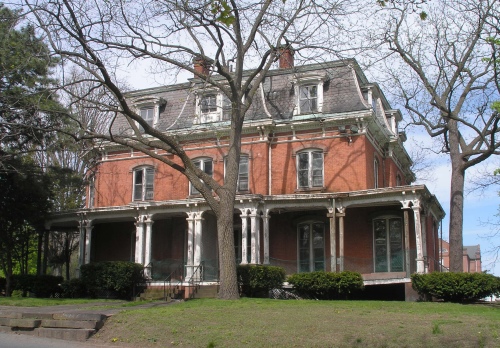
Both civilians and military personnel worked at the Springfield Armory, with the military presence increasing during the Civil War and in the following years. Requiring more housing for junior officers, a duplex house was built for the purpose on Armory Square in 1870. The house is unlike other Armory buildings, having been designed in the Second Empire style with a Mansard roof.
Posted in Houses, Military, Second Empire, Springfield
Tagged mansard, Springfield Armory
Leave a comment
Long Storehouse, Springfield Armory (1863)

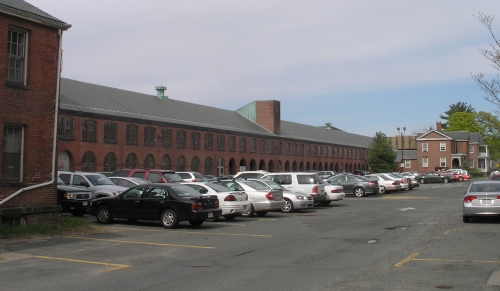
The Long Storehouse at Springfield Armory is a 764-foot structure, built in four stages between 1846 and 1863. It was constructed as part of Maj. James Ripley‘s improvement campaign and was originally a storehouse for the wood used in making gun stocks. The building’s third stage provided stables for the Armory’s horses and the entire structure has also been known as a casern, or cavalry barracks. As described by Albert Harleigh Kirkham in King’s Handbook of Springfield
Whilst digging for the foundations of the long storehouse which stands upon the terrace overlooking Pearl and Worthington Streets, the remains of 12 or more soldiers dressed in regimentals were uncovered. During the 1812 war, the United-States Armory being a Government post, the United-States soldiers were often quartered in the barracks and in the dwelling-houses which were on “public ground.” The houses were commonly occupied by Armorers; but, at a short notice that soldiers were coming, they moved out, and the soldiers moved in, and they remained in these comfortable quarters a longer or shorter time, “according to orders.” A portion of the ground now occupied by the storehouse was then used as a graveyard; and soldiers were often buried there, and buried, too, in their uniforms.
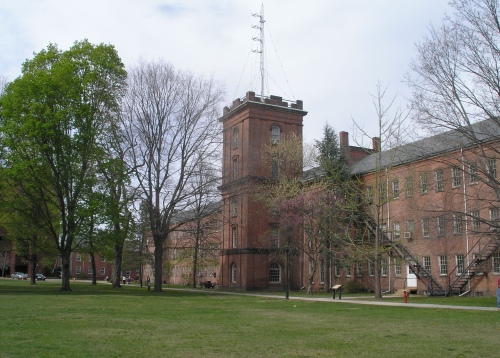
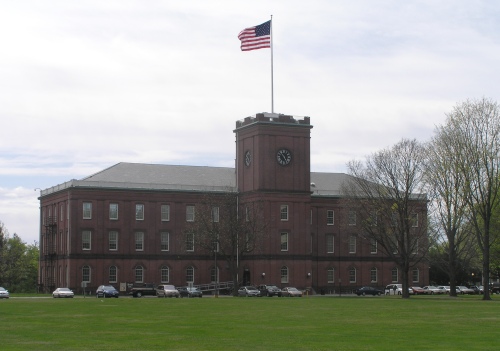
Administrative Building, Springfield Armory (1862)

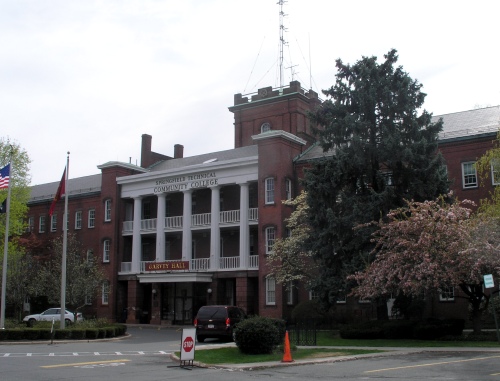
We end Springfield Armory Week at Historic Buildings of Massachusetts with three posts today. Our first post is about the building which is today known as Garvey Hall. In 1862, three buildings at the east end of Armory Square at the Springfield Armory were joined together and connected by a new third story. One of the buildings was built around 1817-1819 and the others two, the North and South Shops, in 1824. A tower was built on the newly combined structure to match the tower of the Main Arsenal, located at the opposite end of armory square. The building was used for administration, as well as for storage and occasionally research and light manufacturing. In 1984, it became the administrative offices of Springfield Technical Community College and was renamed in honor of STCC’s founding president, Dr. Edmond P. Garvey (more…)
East Arsenal, Springfield Armory (1836)

Another of the early arsenal buildings at Springfield Armory is the East Arsenal, constructed in 1836. Originally a storehouse for arms, the East Arsenal, like the neighboring West and Middle Arsenals, was converted to other uses after the completion of the Main Arsenal in 1851. The former East Arsenal was later enlarged and attached to the Armory’s administration building, thus enclosing the southeast corner of Armory Square. The building is now known as Garvey Hall South and is part of the campus of Springfield Technical Community College.
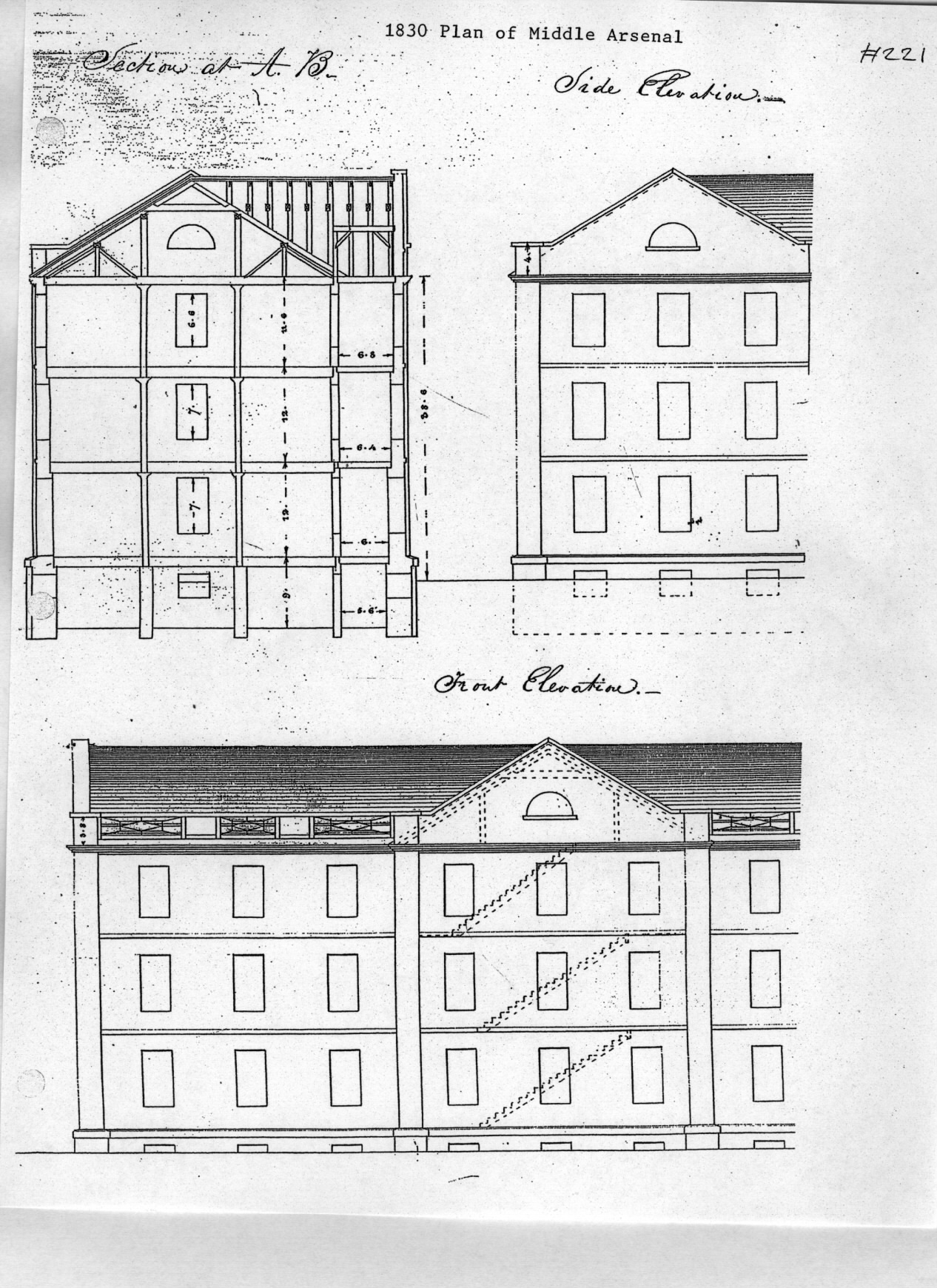
Middle Arsenal, Springfield Armory (1830)

The Middle Arsenal at the Springfield Armory was constructed in 1830 and was the first three-story building on the Armory grounds. Used to store arms, it was here that Henry Wadsworth Longfellow visited during his second honeymoon in 1843 and that his wife, Fanny, compared the stored arms in their racks to a pipe organ. Encouraged to write an anti-war poem by his wife, Longfellow was inspired to use her imagery and write the poem, “The Arsenal at Springfield” (1845). After the completion of the Main Arsenal, in 1851, the Middle Arsenal was converted to other purposes, including being used during the Civil War, along with other earlier arsenal buildings, as part of an assembly line, leading to the Main Arsenal, where finished weapons were stored. The building is now part of the campus of Springfield Technical Community College.
West Arsenal, Springfield Armory (1808)

The oldest surviving building at the Springfield Armory is the West Arsenal, the first two floors of which were constructed in 1808 as a storehouse for completed weapons. The third floor was added in 1863. After the completion of the Main Arsenal, in 1851, the West Arsenal served other purposes over the years, becoming a barrel house, storehouse, recreation building, barracks and, during World War Two, an officer’s club. Today it is part of the campus of Springfield Technical Community College.