Historic Buildings of Massachusetts

  • About
  • Index by Town
  • CT
  • About
  • Index by Town
  • CT

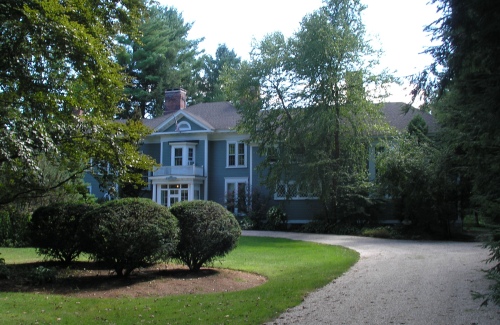
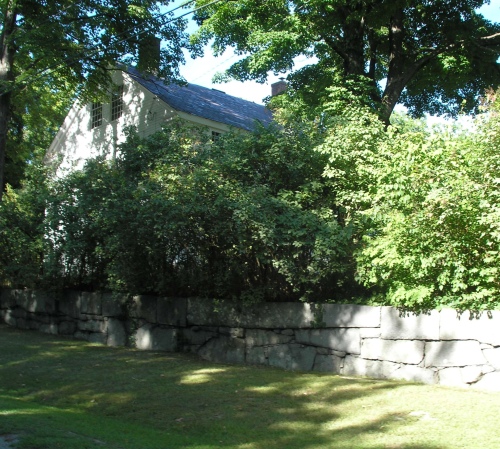
Harvard Shaker Square House (1769)
by Dan/September 3, 2013September 3, 2013/Churches, Colonial, Harvard, Houses, Organizations

Square House

The town of Harvard was once home to the second Shaker community in the United States and the first in Massachusetts. Religious dissenters in the town had built the structure known as the “Square House” in 1769. They were followers of Shadrach Ireland, a “New Light” Baptist preacher who died in 1778 (an event that astounded his followers, who believed him to be immortal!). Mother Ann Lee, founder of the Shakers, visited this dissenting community in 1781-1782 and brought them into the United Society of Believers (Shakers). The Square House then became her base for two years as she went on missionary trips to establish other Shaker communities in New England. The house was used for various purposes by the Shakers until the community closed in 1917. The building‘s original hipped roof was replaced by a gable roof in 1845, at which time the Shakers also added a porch, a third floor and an addition. The house (94 Shaker Road) is now a private residence. The picture above is not a good view, but I have used it due to the building’s great historical and religious importance.
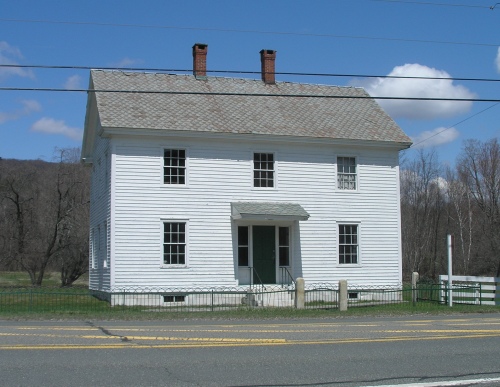
Ministry Shop, Hancock Shaker Village (1873)

by Dan/August 22, 2013/Hancock, Industrial, Organizations, Vernacular

Ministry Shop

Shaker communities were guided by two Elders and two Eldresses who together were known as the Ministry. Hancock Shaker Village was overseen by a Ministry that also had responsibility for the Shaker communities in Tyringham, Massachusetts and Enfield, Connecticut. Like the Shaker brethren and sisters, the Elders and Eldresses were also required to perform hand-labor. The Ministry had an early workshop at Hancock Shaker Village that was moved to north side of Route 20 in 1829 when the Brick Dwelling was constructed. By 1848 there were two Ministry shops, one for Elders and one for Eldresses. A new Ministry Shop was built in 1873 on the foundation of one of these earlier shops. The Ministry Shop was later used as a home for Shakers who had been displaced by the closure of the Enfield, Connecticut community in 1917. Continue reading “Ministry Shop, Hancock Shaker Village (1873)”

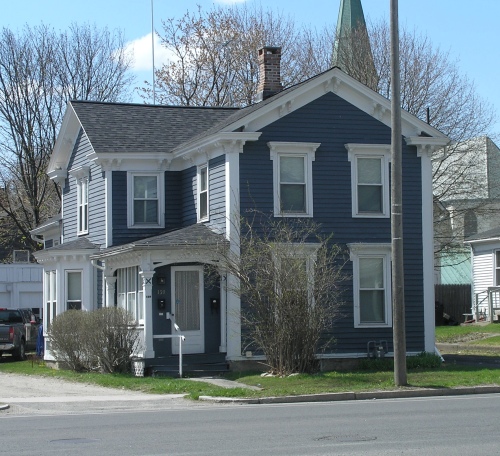
159 First Street, Pittsfield (1876)

by Dan/August 20, 2013/Houses, Italianate, Pittsfield

159 First St., Pittsfield

The house at 159 First Street in Pittsfield is an example of houses were expanded in the nineteenth century as their owners became more affluent. The rear of the house dates to c. 1850, but the more substantial front section, along the street, was added in 1876.

Sedgwick Little House (1898)

by Dan/August 19, 2013/Colonial Revival, Houses, Stockbridge

Sedgwick Little House

At 18 Main Street in Stockbridge is a house known as the “Sedgwick Little House” or the Erik Erikson House. Its earliest section was originally a large cottage built c. 1855 (other dates claimed for the house are 1850 and the 1870s). In 1896, the property was acquired by Henry Dwight Sedgwick III, prominent Stockbridge resident and one of the well-known Sedgwick family. The Sedgwick Pie in Stockbridge Cemetery is the famous burial place of the Sedgwick family. In 1898, Henry D. Sedgwick built “the Sedgwick Little House” (the central section of the current Colonial Revival mansion) for his son Alexander (1867-1929). This seems to have replaced the original cottage (?). The house was later expanded through additions made between 1898 and 1908. The east and west wings were added by Edward L. Morse, who bought the house in 1908. Later, the house was purchased by the well-known writer and psychoanalyst Erik Erikson, who was working at the Austin Riggs Center at the time. The house is now a bed & breakfast called the Taggart House.

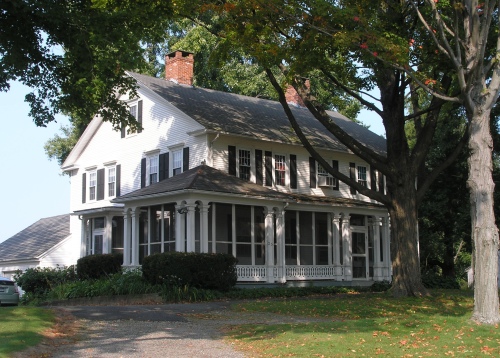
Daniel Dickinson House (1780)

by Dan/August 12, 2013/Federal, Hadley, Houses

Daniel Dickinson House

The first occupant of the house at 25 West Street in Hadley was Daniel Dickinson. He had married in 1779 and the house was built soon after. He also started a tannery that was continued by his son and grandson. Eliakim Smith, a local builder, worked on a shop & addition. The house remained in the Dickinson family until 1905.

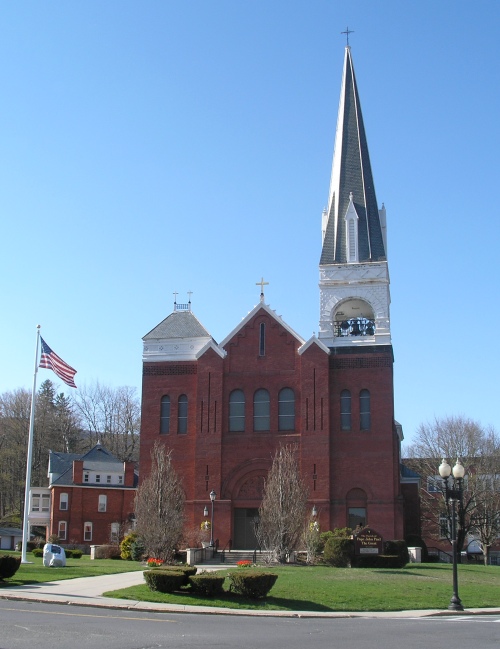
Notre Dame des Sept Douleurs Roman Catholic Church, Adams (1887)

by Dan/August 11, 2013/Adams, Churches, Romanesque Revival

Notre Dame des Sept Douleurs Roman Catholic Church

In vol. II of The History of the Catholic Church in the New England States (1899), Rev. John J. McCoy relates the origins of Notre Dame des Sept Douleurs parish:

Just one year beyond a quarter of a century need we go to find the French-Canadian people of Adams assisting for the first time at Mass in a body by themselves. Then, January 4, 1872, Father Charles Crevier, the pastor of the Sacred Heart church at North Adams, gathered them into a hall on the third story of a building in the town, and said Mass for them and preached to them in their native tongue. Five years later, on Park street, upon land which he had already purchased for $2500, he built a frame chapel at a cost of $5000. The original yet serves the people as a school for the parish children. In September, 1882, Bishop O’Reilly made the Rev. John Baptist Charbonneau, then a curate of Father Crevier, the first resident pastor of the Canadians of Adams.

The parish acquired additional property at 21 Maple Street for $15,000 and

Father Charbonneau, in 1887, hardly five years from the time of his appointment, laid the foundation of the spacious and beautiful church which is the pride of the Canadian people today. Bishop O’Reilly is reported as having called the church of the Sept. Douleurs one of the most beautiful in his diocese. It is of Romanesque architecture, 150 feet long by 70 feet wide, and has seating capacity for 1500 people.

In 1998, Notre Dame des Sept Douleurs Roman Catholic Church and St. Thomas Aquinas Roman Catholic Church in Adams formed a joint parish. In 2008, the two parishes merged to form Pope John Paul the Great Parish, now called Blessed John Paul Parish.

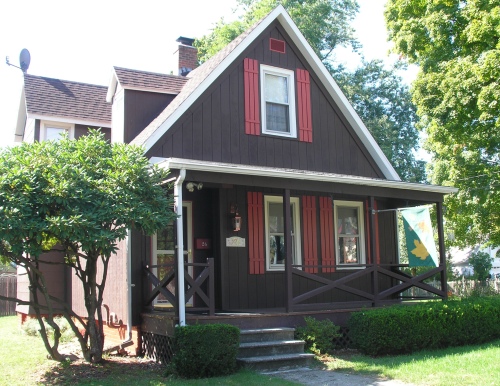
Elisha Hammond House (1845)

by Dan/August 8, 2013/Houses, Northampton, Vernacular

26 Maple Street, Florence

Elisha Hammond was an artist and craftsman in Northampton who joined the Northampton Association of Education and Industry, a utopian society, in 1844. The NAEI opposed slavery and supported fugitive slaves–Hammond’s obituary stated that “fugitives were never turned from his door.” In 1844 he painted a well-known portrait of Frederick Douglass. In 1845 Hammond built the house at 26 Maple Street in the Northampton village of Florence.

Posts navigation

Older posts
Newer posts
Privacy Policy

Categories

  • Architectural Style (943)
    • Art Deco (9)
    • Byzantine (3)
    • Colonial (177)
    • Colonial Revival (85)
    • Craftsman (6)
    • Egyptian Revival (1)
    • Federal (190)
    • Foursquare (6)
    • Gothic (67)
    • Greek Revival (100)
    • Italianate (82)
    • Mission Revival (2)
    • Mission/Spanish Colonial (1)
    • Modern (2)
    • Neoclassical (56)
    • Octagon (3)
    • Postmodern (1)
    • Queen Anne (46)
    • Renaissance Revival (26)
    • Romanesque Revival (53)
    • Second Empire (26)
    • Shingle Style (12)
    • Stick Style (13)
    • Tudor Revival (8)
    • Vernacular (49)
    • Victorian Eclectic (15)
  • Building Type (943)
    • Apartment Buildings (8)
    • Banks (18)
    • Churches (119)
    • Collegiate (32)
    • Commercial (102)
    • Hotels (16)
    • Houses (508)
    • Industrial (23)
    • Libraries (22)
    • Lighthouses (1)
    • Military (15)
    • Monuments (1)
    • Museums (12)
    • Organizations (39)
    • Outbuildings (17)
    • Public Buildings (50)
    • Schools (23)
    • Stations (5)
    • Synagogues (1)
    • Taverns (21)
    • Theaters (9)
  • Town (943)
    • Adams (11)
    • Agawam (4)
    • Amherst (50)
    • Boston (64)
    • Boylston (6)
    • Cambridge (30)
    • Clinton (21)
    • Concord (15)
    • Cummington (1)
    • Danvers (14)
    • Deerfield (31)
    • Gloucester (18)
    • Granville (10)
    • Great Barrington (2)
    • Hadley (9)
    • Hancock (15)
    • Harvard (32)
    • Holyoke (47)
    • Lenox (5)
    • Lexington (8)
    • Longmeadow (32)
    • Marblehead (40)
    • Marlborough (4)
    • Natick (22)
    • Newton (2)
    • Northampton (68)
    • Peabody (4)
    • Pittsfield (20)
    • Salem (110)
    • Saugus (4)
    • Sheffield (4)
    • South Hadley (8)
    • Southborough (8)
    • Southwick (4)
    • Springfield (67)
    • Stockbridge (19)
    • Stow (1)
    • Sturbridge (18)
    • Sudbury (7)
    • Waltham (11)
    • Watertown (1)
    • Wayland (8)
    • West Springfield (14)
    • Westfield (46)
    • Weston (2)
    • Worcester (26)
  • Uncategorized (1)

Recent Comments

  • Wilber Blackson on South Hadley
  • Tami Speiden on Stockbridge
  • DexGuru on Stockbridge

Tags

Alcott Amherst College Asher Benjamin Back Bay Baptist Beacon Hill Big E Black Heritage Trail bowfront Bulfinch Catholic Congregational Episcopal Freedom Trail Gambrel H.H. Richardson Harvard Hawthorne Historic Deerfield Isaac Damon lit Longfellow mansard Methodist Mount Holyoke Museum Museums NPS Old Sturbridge Village PEM Revolutionary War row houses saltbox Samuel McIntire Shakers Smith College SPNEA Springfield Armory Stephen C. Earle Storrowton Underground Railroad UU Washington William Fenno Pratt Witch Trials

Meta

  • Log in
  • Entries feed
  • Comments feed
  • WordPress.org
Proudly powered by WordPress | Theme: ShowMe by NEThemes.