Historic Buildings of Massachusetts

  • About
  • Index by Town
  • CT
  • About
  • Index by Town
  • CT

Tag: Congregational

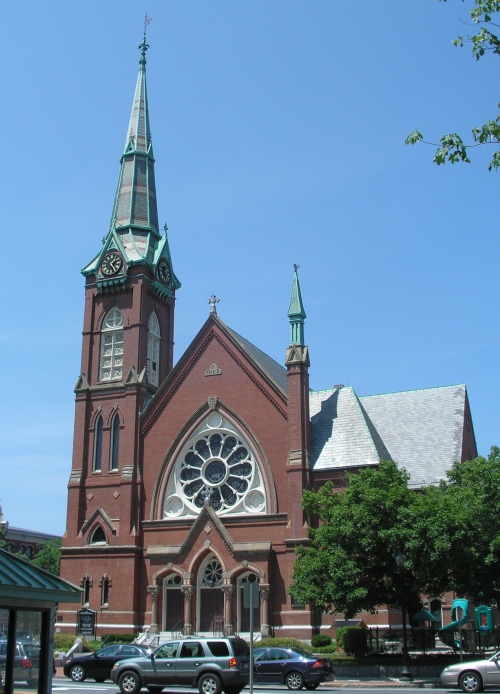
First Congregational Church of Natick (1876)
by Dan/September 5, 2010/Churches, Gothic, Natick

The earliest Congregational Church in Natick was founded in 1651 by John Eliot and served the Natick Praying Indians, who were settled in what is now South Natick. After the retirement in 1799 of Rev. Stephen Badger, last pastor to the Praying Indians, a new First Congregational Church was organized to the north in 1802, with construction of a meeting house having already been started in 1799, in what is now the center of Natick. As described in the History of Middlesex County, Vol. I (1890):

The congregation having again outgrown the meeting-house, this was sold to a Universalist Society, which later, becoming extinct, sold the house to the Roman Catholic denomination. This, enlarged, is the Catholic Church of the present day in the centre of Natick. The Congregational Society then erected a third meeting-house upon the site of the one removed, during the years 1853-54, which was dedicated Nov. 15th of the latter year.

Disaster struck on January 13,1874 when, again quoting from the History,

nearly all the business portion of Natick was laid in ashes, including every hall in the place and the Congregational Church, just enlarged and improved at the cost of about $13,000. This loss of the sanctuary rendered necessary the building of a temporary tabernacle, which, in a rough way, was made ready for religious and other purposes as soon as possible, at the cost of about $1700. Additional land was purchased upon the east side of the old church lot, and the erection of the present beautiful brick church edifice commenced, and so far completed that the vestries could be used for public worship April 30, 1876.

The church, built in 1875-1880 and attributed to J.B. Goodall, is an an example of High Victorian Gothic, with a distinctive polychromatic steeple.
Pilgrim Church, Southborough (1806)

by Dan/July 25, 2010August 19, 2010/Churches, Federal, Italianate, Southborough

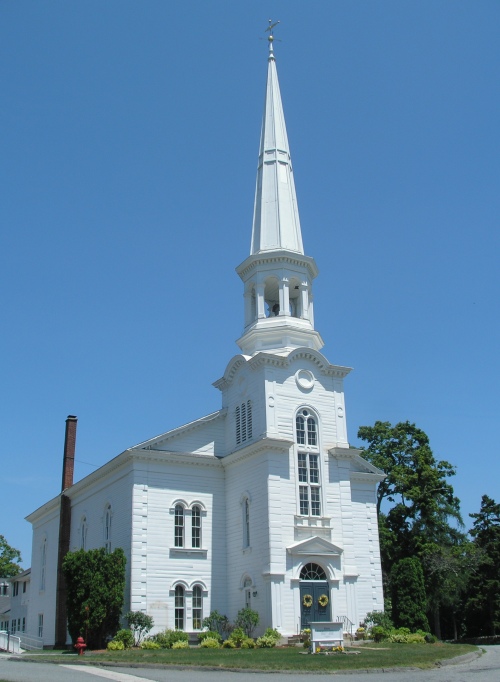
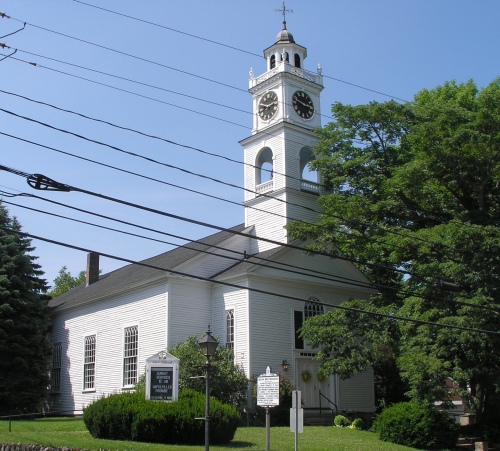
In 1727, the residents of Southborough established a new town and separated from Marlborough. A meeting house was constructed on the area known as “holy hill,” on three acres set aside for a meeting house, burying ground and training field. The original meeting house was replaced by the current church in 1806, built under the supervision of Moses Newton. When the state disestablished parish churches, Unitarians soon came to own the church. In 1831, Trinitarian members of the congregation broke away from the town church. Forming the Pilgrim Congregational Church, they built their own meeting house in 1834, but in 1857 purchased the old meeting house building from the Unitarians. The original church was then renovated and expanded, including the addition of a new and higher steeple with a new bell. That steeple was tipped (but not toppled) by the 1938 hurricane. It was repaired in 1953, so that the bell could again be rung. There is a history of the church (a pdf document) available at http://www.pilgrimchurch.us/Documents/The%20Pilgrim%20Church%20of%20Christ%20in%20Southborough%2018311.pdf.

Eliot Church, South Natick (1828)

by Dan/July 5, 2010/Churches, Federal, Natick

This week we will be looking at buildings in South Natick. The Puritan missionary John Eliot first settled Natick in 1651. It was the first of the towns he established for settlement by the Praying Indians, who had converted to Christianity. Eliot, working with Praying Indian translators, produced an Indian grammar and the Natick Bible. The Praying Indian village was in South Natick, along the banks of the Charles River. The Indian church that Eliot established in Natick in 1651 continued under his successor, the first Native American minister, Rev. Daniel Takawambpait. The church suffered through the breakup of the Praying Indian villages during King Philip’s War. By 1699, the original meeting house had fallen into disrepair, and the remaining Christian Indians of Natick petitioned the General Court to allow them to sell a portion of their plantation to John Coller, Jr., a carpenter, in exchange for his building them a new church. This was accomplished by 1702 and Daniel Takawambpait preached in the new church until his death in 1716.

Another new meeting house was built on the same site in 1721 and in 1729 a new church society was established, consisting of both Indians and English settlers, the latter of whom were rapidly migrating into the area. But the experiment of a communal church did not last: Indian membership continued to decline and the church experienced internal conflict over theological issues and the location of the new meeting house. It was begun, on the site of its predecessors, in 1749, but not finished until until 1767. This occurred during the tenure of Rev. Stephen Badger, last missionary to the Natick Praying Indians, whom many English-descended residents refused to accept as their minister. After Rev. Badger’s retirement in 1799 and death in 1803, the South Natick church was abandoned and in 1802, a new First Congregational Church was organized to the north, in what is now the center of Natick. In 1828, the South Parish Congregational Church was organized and built a church on the site of the four earlier Praying Indian meeting houses. The church became Unitarian in 1870, under the ministry of Rev. Horatio Alger, Sr. The building’s clock was installed in 1872 and the vestry was added in 1880. In 1944, the Unitarian church joined with the John Eliot Congregational Church, both of which had been experiencing financial difficulties, and the two churches used the Unitarian meeting house for worship. The congregations merged in 1990, becoming the united Eliot Church of South Natick.

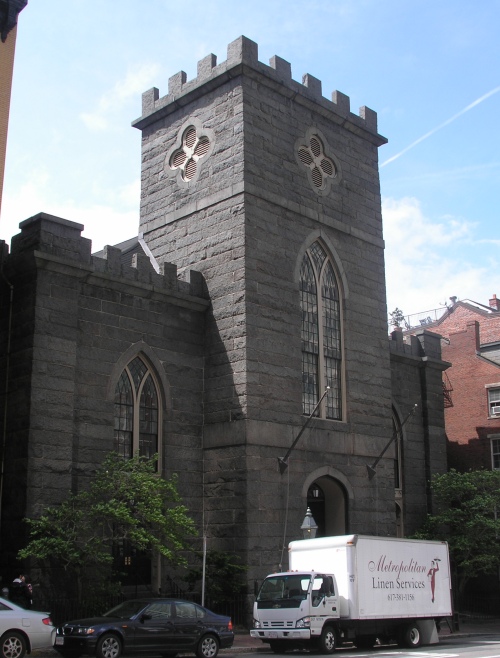
Church of St. John the Evangelist (1831)

by Dan/May 9, 2010/Boston, Churches, Gothic

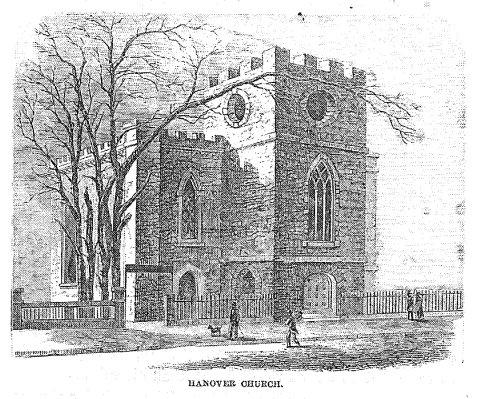
The Church of St. John the Evangelist, on Bowdoin Street in Boston, was built in 1831 for the congregation of Rev. Lyman Beecher, father of Harriet Beecher Stowe. The congregation began at a church on Hanover Street, called the Hanover Church, built in 1826. After the church burned in 1830, the congregation built and consecrated the Bowdoin Street Church. Typical of early New England Gothic Revival churches, the design of the building has been attributed to Solomon Willard, architect of the Bunker Hill Monument. In 1831, Lowell Mason, famous composer of hymns, became choirmaster at the church. Rev. Beecher left his church in Boston in 1832, to become the first president of Lane Theological Seminary in Cincinnati. The church became the Church of the Advent (from 1863 to 1883) and then the Mission Church of St. John the Evangelist under the auspices of the Society of St. John the Evangelist, an Anglican monastic order. The church has been a Parish Church in the Episcopal Diocese of Massachusetts since 1985.

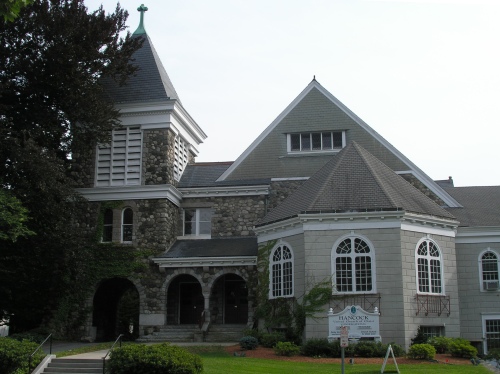
Hancock United Church of Christ (1893)

by Dan/August 17, 2009January 18, 2020/Churches, Craftsman, Lexington, Queen Anne, Shingle Style

Hancock Church

In 1819, the First Congregational Society of Lexington became Unitarian. The minority of Trinitarian Congregationalists attended the local Baptist church for a time, but in 1868 formed the Hancock Congregational Society. The Congregation occupied the old Lexington Academy building until 1893, when the current Hancock Congregational Church was built. The church, designed by Paine and Lewis, features both Shingle Style siding and fieldstone walls. Many additions have been made over the years, including a new stuccoed wing in 1951.

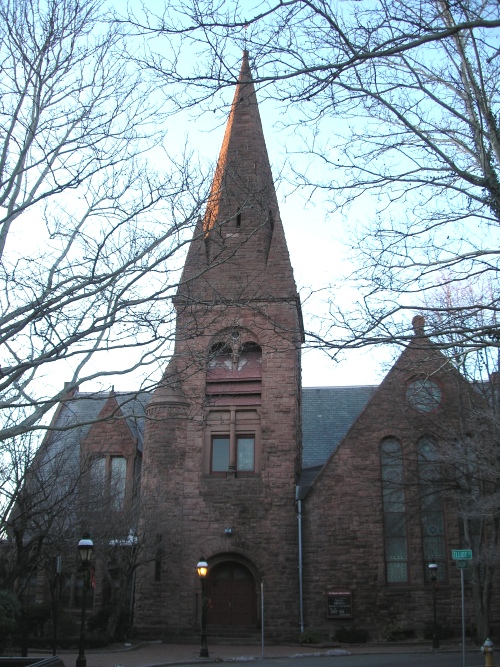
North Congregational Church, Springfield (1873)

by Dan/July 27, 2009January 22, 2020/Churches, Romanesque Revival, Springfield

Hispanic Baptist Church

In 1868, H.H. Richardson won a commission to design the North Congregational Church in Springfield. Originally intended to be built where the congregation’s preceding church building was located, the plans for construction did not go through until a new site had been purchased, on the corner of Salem and Mattoon Streets in 1871, and the initial plan had been revised. Built in 1872 to 1873, the church was constructed of red Longmeadow sandstone and was one of Richardson‘s first works in the Romanesque style. The North Congregational Society disbanded in 1935 and the church was sold and renamed Grace Baptist Church. It is now called the Hispanic Baptist Church. UPDATE: The church was later called the Cristian Biblical Church and then Iglesia Apostolica Renovacion. The building was for sale in 2019.

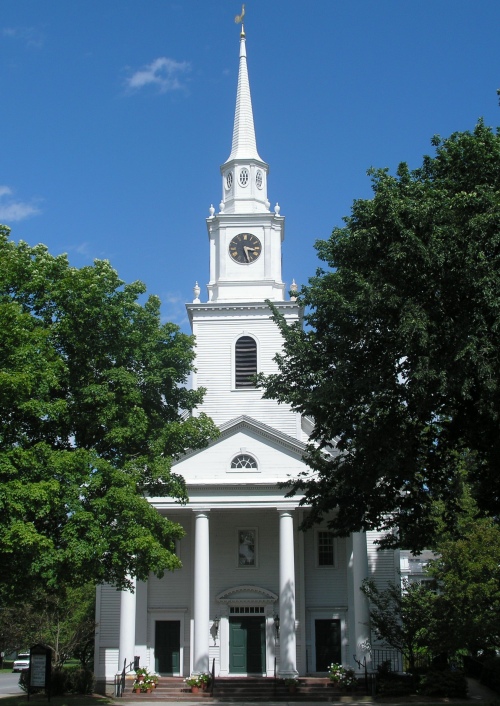
First Church of Christ in Longmeadow (1768)

by Dan/July 26, 2009/Churches, Colonial Revival, Longmeadow

First Church Longmeadow

Where today there is a flagpole on Longmeadow Green, the town’s first church, built in 1716, once stood. By 1764 it was decided that, owing to the great number of repairs the building needed, a new church should be constructed. It was built on the Green in 1767-1768 and in 1769, the old meeting house was torn down. The new church was remodeled in 1828 and in 1874 it went through even more drastic changes, being moved from the Green to its present site and again being remodeled. The First Church of Christ‘s white pillared front portico was added in 1932, modeled on Boston’s Arlington Street Church.

Posts navigation

Older posts
Newer posts
Privacy Policy

Categories

  • Architectural Style (943)
    • Art Deco (9)
    • Byzantine (3)
    • Colonial (177)
    • Colonial Revival (85)
    • Craftsman (6)
    • Egyptian Revival (1)
    • Federal (190)
    • Foursquare (6)
    • Gothic (67)
    • Greek Revival (100)
    • Italianate (82)
    • Mission Revival (2)
    • Mission/Spanish Colonial (1)
    • Modern (2)
    • Neoclassical (56)
    • Octagon (3)
    • Postmodern (1)
    • Queen Anne (46)
    • Renaissance Revival (26)
    • Romanesque Revival (53)
    • Second Empire (26)
    • Shingle Style (12)
    • Stick Style (13)
    • Tudor Revival (8)
    • Vernacular (49)
    • Victorian Eclectic (15)
  • Building Type (943)
    • Apartment Buildings (8)
    • Banks (18)
    • Churches (119)
    • Collegiate (32)
    • Commercial (102)
    • Hotels (16)
    • Houses (508)
    • Industrial (23)
    • Libraries (22)
    • Lighthouses (1)
    • Military (15)
    • Monuments (1)
    • Museums (12)
    • Organizations (39)
    • Outbuildings (17)
    • Public Buildings (50)
    • Schools (23)
    • Stations (5)
    • Synagogues (1)
    • Taverns (21)
    • Theaters (9)
  • Town (943)
    • Adams (11)
    • Agawam (4)
    • Amherst (50)
    • Boston (64)
    • Boylston (6)
    • Cambridge (30)
    • Clinton (21)
    • Concord (15)
    • Cummington (1)
    • Danvers (14)
    • Deerfield (31)
    • Gloucester (18)
    • Granville (10)
    • Great Barrington (2)
    • Hadley (9)
    • Hancock (15)
    • Harvard (32)
    • Holyoke (47)
    • Lenox (5)
    • Lexington (8)
    • Longmeadow (32)
    • Marblehead (40)
    • Marlborough (4)
    • Natick (22)
    • Newton (2)
    • Northampton (68)
    • Peabody (4)
    • Pittsfield (20)
    • Salem (110)
    • Saugus (4)
    • Sheffield (4)
    • South Hadley (8)
    • Southborough (8)
    • Southwick (4)
    • Springfield (67)
    • Stockbridge (19)
    • Stow (1)
    • Sturbridge (18)
    • Sudbury (7)
    • Waltham (11)
    • Watertown (1)
    • Wayland (8)
    • West Springfield (14)
    • Westfield (46)
    • Weston (2)
    • Worcester (26)
  • Uncategorized (1)

Recent Comments

  • Wilber Blackson on South Hadley
  • Tami Speiden on Stockbridge
  • DexGuru on Stockbridge

Tags

Alcott Amherst College Asher Benjamin Back Bay Baptist Beacon Hill Big E Black Heritage Trail bowfront Bulfinch Catholic Congregational Episcopal Freedom Trail Gambrel H.H. Richardson Harvard Hawthorne Historic Deerfield Isaac Damon lit Longfellow mansard Methodist Mount Holyoke Museum Museums NPS Old Sturbridge Village PEM Revolutionary War row houses saltbox Samuel McIntire Shakers Smith College SPNEA Springfield Armory Stephen C. Earle Storrowton Underground Railroad UU Washington William Fenno Pratt Witch Trials

Meta

  • Log in
  • Entries feed
  • Comments feed
  • WordPress.org
Proudly powered by WordPress | Theme: ShowMe by NEThemes.