Historic Buildings of Massachusetts

  • About
  • Index by Town
  • CT
  • About
  • Index by Town
  • CT

Tag: Museum

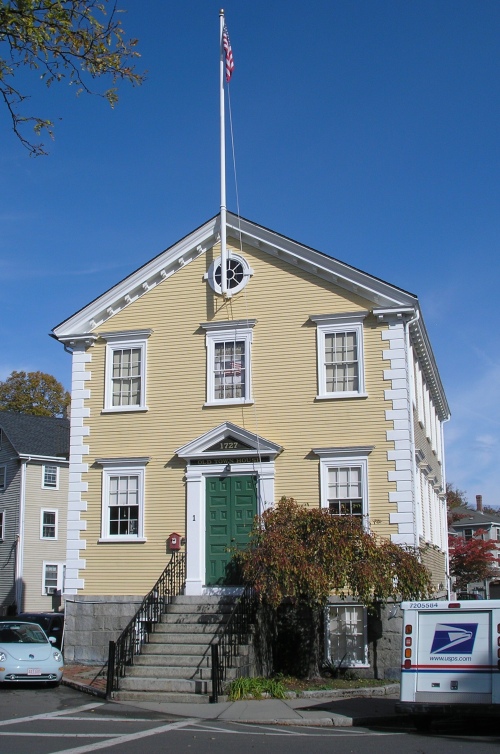
Old Town House, Marblehead (1727)
by Dan/January 18, 2012/Colonial, Marblehead, Public Buildings

This is the 500th Post for Historic Buildings of Massachusetts!!! The Old Town House in Marblehead was built in 1727. The upper level contained the town hall and the lower level was originally used as a market. The building is sometimes called “Marblehead’s Cradle of Liberty” because of meetings held there before the Revolution where such leaders as Elbridge Gerry and General John Glover debated independence. The building‘s lower level, originally at ground level before the addition of a granite foundation to the structure in 1830, served as the town’s Police Station from 1853 to 1961 and is now home to the Marblehead Police Museum. The second floor also has a Grand Army of the Republic meeting hall maintained as a museum.
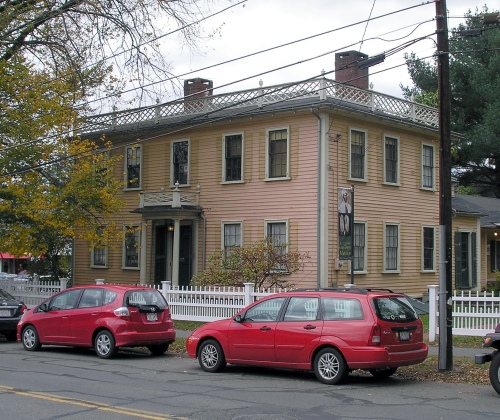
Isaac Damon House (1813)

by Dan/January 17, 2012/Federal, Houses, Northampton

Isaac Damon, a prominent builder based in Northampton in the early nineteenth century, built his own house on Bridge Street in 1813. Today the house contains the administrative offices of Historic Northampton, with a modern addition housing a museum and gift shop.

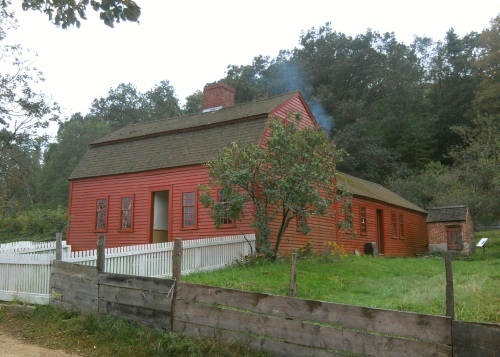
Pliny Freeman House (1815)

by Dan/January 2, 2012/Houses, Sturbridge, Vernacular

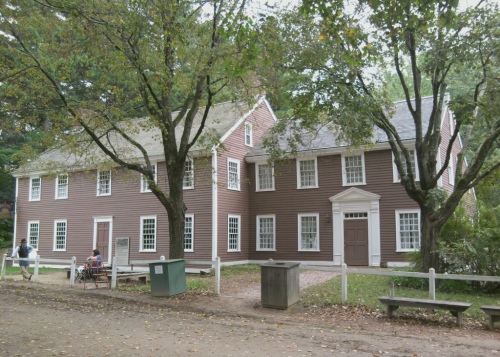
The Pliny Freeman Farmhouse at Old Sturbridge Village was built elsewhere in Sturbridge by Chester Belknap between 1812 and 1815. It is named for Pliny Freeman, who bought the property in 1828 (his third in town) and spent 23 years there. He and his wife Delia Marsh had seven children, most of whom were grown by 1828 and most of whom eventually migrated westward. He sold the farm in 1851 and went to live with his daughter Delia until his death in 1855. The Freeman House was condemned by the Massachusetts highway department and moved to Old Sturbridge Village in 1950 (and relocated again in the Village in 1956). Today, it is surrounded by farm fields and historic outbuildings which collectively depict the life and work on an early-nineteenth century New England farm.

Abbot Hall (1876)

by Dan/January 1, 2012January 1, 2012/Marblehead, Museums, Public Buildings, Romanesque Revival

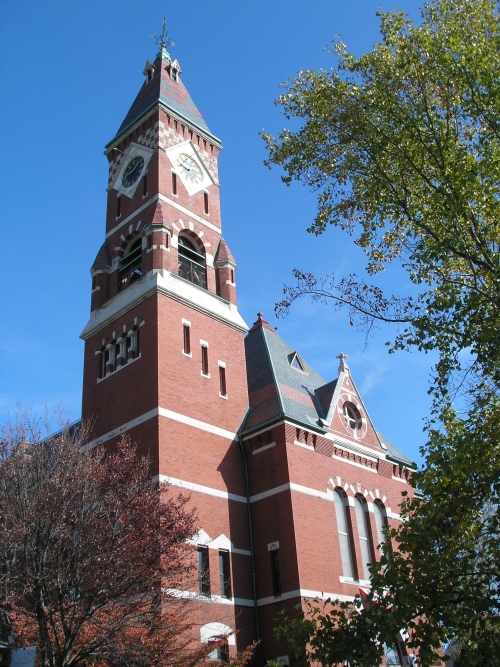
Happy New Year from Historic Buildings of Massachusetts!!! Rising up over Marblehead is one of the town’s most notable landmarks, Abbot Hall, which serves as town hall and also as a museum. Abbot Hall was built through a bequest of Benjamin Abbot (1795-1872), who was born in Marblehead and became wealthy through his cooper business in Boston. In 1875, the town voted to accept his $100,000 bequest and to follow his wishes that part of the legacy be devoted to building Abbot Hall. As related in The History and Traditions of Marblehead (1881), by Samuel Roads, Jr.:

The selection of a site for the new building had for some time occupied the attention of the people, and various localities were strongly advocated through the columns of the local paper. On Saturday, May 22, a town meeting was held for the choice of a site, and a majority of the citizens voted in favor of the Common. Several meetings were held for the election of a building committee, and Messrs. James J. H. Gregory, Simeon Dodge, Moses Gilbert, Henry F. Pitman, and Thomas Appleton were chosen by a majority vote.

In December, the town voted to appropriate $75,000 of the Abbot fund for the erection of the building, and the, committee were instructed to proceed with the work. The opponents of the site chosen by the town, though in the minority, were active and determined in their antagonism; and when, in the spring of 1876, ground was broken on the Common for the erection of the building, a bill in equity was filed in the supreme judicial court to restrain the committee from further proceedings. The bill was based principally on the claim that the town had no legal right to erect the hall on the Common, as the land was the property of the commoners of Marblehead.

The case was tried on Monday, April 17, before Associate Justice Ames, of the supreme judicial court. Hon. Ebenezer R. Hoar appeared as counsel for the town, and Mr. S. B. Ives, Jr., for the petitioners. A decision was rendered in favor of the town, the petitioners being unable to prove an adverse title.

The cornerstone was laid July 25, 1876 and the building, designed by Lord & Fuller of Boston (who also designed the Saugus Town Hall), was dedicated December 12, 1877. Abbot Hall, located at 188 Washington Street, has a historical collection in the Selectmen’s Meeting Room which includes the original version of the painting “The Spirit of ’76” by Archibald M. Willard and the 1684 deed to Marblehead from the tribe of Nanepashemet. The building has a clock tower with a Bell, installed in 1876 and cast by Meneely & Kimberly in Troy, New York.

Bolton Friends Meetinghouse (1796)

by Dan/December 22, 2011January 1, 2012/Churches, Sturbridge, Vernacular

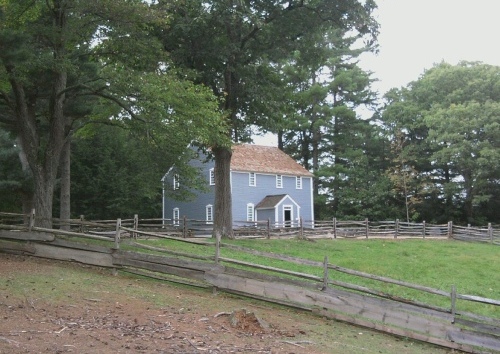
Quakers in Bolton formed the Friends Meeting in 1779 and constructed the Bolton Friends Meetinghouse in 1795. By 1930, membership had dwindled and the Friends joined the Unitarians and Baptists and formed the Bolton Federated Church, known as the First Parish of Bolton. In 1952, the Friends deeded their former meetinghouse to Old Sturbridge Village. It was moved to Sturbridge in 1953 and restored to its original 1796 appearance, necessitating the removal of an 1818 addition.

District School, Old Sturbridge Village (1810)

by Dan/December 21, 2011January 1, 2012/Schools, Sturbridge, Vernacular

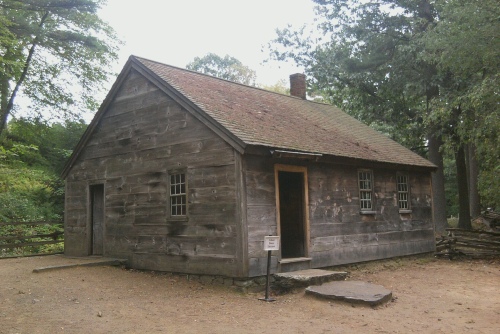
The District School at Old Sturbridge Village is a one-room Schoolhouse, originally built in Candia, New Hampshire, c. 1800-1810. It was moved to Sturbridge in 1955.

Bullard Tavern, Old Sturbridge Village (1946)

by Dan/December 15, 2011January 1, 2012/Colonial Revival, Museums, Sturbridge

Although surrounded by eighteenth and nineteenth century period buildings, Bullard Tavern at Old Sturbridge Village was built in 1946-1947. Although resembling an early New England house or tavern, it was not designed as a strictly accurate historical reproduction. Bullard Tavern was built as a service building, originally intended to provide visitor amenities and exhibit space, but it soon became a restaurant. The woodwork in the Tavern’s Tap Room was salvaged from an eighteenth-century house in Brooklyn, Connecticut.

Posts navigation

Older posts
Newer posts
Privacy Policy

Categories

  • Architectural Style (943)
    • Art Deco (9)
    • Byzantine (3)
    • Colonial (177)
    • Colonial Revival (85)
    • Craftsman (6)
    • Egyptian Revival (1)
    • Federal (190)
    • Foursquare (6)
    • Gothic (67)
    • Greek Revival (100)
    • Italianate (82)
    • Mission Revival (2)
    • Mission/Spanish Colonial (1)
    • Modern (2)
    • Neoclassical (56)
    • Octagon (3)
    • Postmodern (1)
    • Queen Anne (46)
    • Renaissance Revival (26)
    • Romanesque Revival (53)
    • Second Empire (26)
    • Shingle Style (12)
    • Stick Style (13)
    • Tudor Revival (8)
    • Vernacular (49)
    • Victorian Eclectic (15)
  • Building Type (943)
    • Apartment Buildings (8)
    • Banks (18)
    • Churches (119)
    • Collegiate (32)
    • Commercial (102)
    • Hotels (16)
    • Houses (508)
    • Industrial (23)
    • Libraries (22)
    • Lighthouses (1)
    • Military (15)
    • Monuments (1)
    • Museums (12)
    • Organizations (39)
    • Outbuildings (17)
    • Public Buildings (50)
    • Schools (23)
    • Stations (5)
    • Synagogues (1)
    • Taverns (21)
    • Theaters (9)
  • Town (943)
    • Adams (11)
    • Agawam (4)
    • Amherst (50)
    • Boston (64)
    • Boylston (6)
    • Cambridge (30)
    • Clinton (21)
    • Concord (15)
    • Cummington (1)
    • Danvers (14)
    • Deerfield (31)
    • Gloucester (18)
    • Granville (10)
    • Great Barrington (2)
    • Hadley (9)
    • Hancock (15)
    • Harvard (32)
    • Holyoke (47)
    • Lenox (5)
    • Lexington (8)
    • Longmeadow (32)
    • Marblehead (40)
    • Marlborough (4)
    • Natick (22)
    • Newton (2)
    • Northampton (68)
    • Peabody (4)
    • Pittsfield (20)
    • Salem (110)
    • Saugus (4)
    • Sheffield (4)
    • South Hadley (8)
    • Southborough (8)
    • Southwick (4)
    • Springfield (67)
    • Stockbridge (19)
    • Stow (1)
    • Sturbridge (18)
    • Sudbury (7)
    • Waltham (11)
    • Watertown (1)
    • Wayland (8)
    • West Springfield (14)
    • Westfield (46)
    • Weston (2)
    • Worcester (26)
  • Uncategorized (1)

Recent Comments

  • Wilber Blackson on South Hadley
  • Tami Speiden on Stockbridge
  • DexGuru on Stockbridge

Tags

Alcott Amherst College Asher Benjamin Back Bay Baptist Beacon Hill Big E Black Heritage Trail bowfront Bulfinch Catholic Congregational Episcopal Freedom Trail Gambrel H.H. Richardson Harvard Hawthorne Historic Deerfield Isaac Damon lit Longfellow mansard Methodist Mount Holyoke Museum Museums NPS Old Sturbridge Village PEM Revolutionary War row houses saltbox Samuel McIntire Shakers Smith College SPNEA Springfield Armory Stephen C. Earle Storrowton Underground Railroad UU Washington William Fenno Pratt Witch Trials

Meta

  • Log in
  • Entries feed
  • Comments feed
  • WordPress.org
Proudly powered by WordPress | Theme: ShowMe by NEThemes.