Historic Buildings of Massachusetts

  • About
  • Index by Town
  • CT
  • About
  • Index by Town
  • CT

Tag: row houses

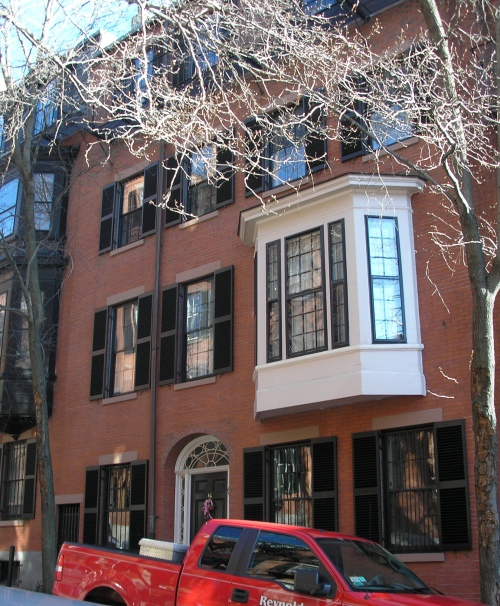
86 Pinckney Street, Boston (1840)
by Dan/March 26, 2009March 26, 2009/Boston, Federal, Houses

86-pinckney.jpg

John J. Smith was born a free black in Richmond, VA and later moved to Boston, where he became a barber. His shop, on the corner of Howard and Bulfinch Streets, was a center of abolitionist activity and abolitionist Senator Charles Sumner could frequently be found there. Smith’s wife, Georgiana, was active in the effort to integrate Boston’s public schools. During the Civil War, Smith recruited for the Fifth Cavalry, an all black unit. After the War, Smith served in the Massachusetts House of Representatives. Smith, who died in 1906, lived at 86 Pinckney Street in Boston (built in 1840) from 1878 to 1893. The house is a stop on the Black Heritage Trail.
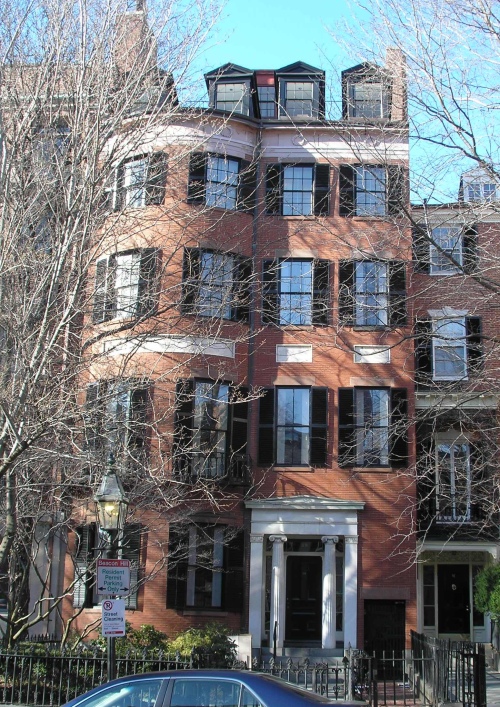
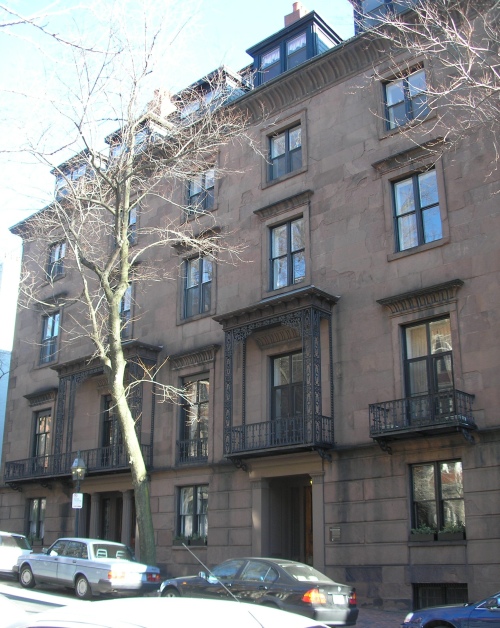
59 Mount Vernon Street (1837)

by Dan/March 25, 2009March 27, 2009/Boston, Greek Revival, Houses

59-mt-vernon.jpg

An earlier entry on this blog featured no. 59 Mt. Vernon Street in Boston together with nos. 55-57, but this house is architecturally and historically significant and deserves it’s own seperate entry. Considered to be the great example of Greek Revival architecture on Beacon Hill, the 1837 house was designed by Edward Shaw, an architect and author of such works as Civil Architecture (1831), Operative Masonry (1832), and The Modern Architect (1854). The house was home to Thomas Bailey Aldrich, who replaced William Dean Howells as editor of the Atlantic Monthly in 1881. Aldrich was also an author and poet. Images of the house’s great Greek Revival doorway appear in two books about Aldrich: The Life of Thomas Bailey Aldrich (1908) by Ferris Greenslet and Crowding Memories (1920) by Lilian Woodman Aldrich.

40-42 Mount Vernon Street, Boston (1850)

by Dan/March 23, 2009March 23, 2009/Boston, Houses, Italianate

40-42-mt-vernon.jpg

The pair of brownstone houses at nos. 40-42 Mount Vernon Street on Beacon Hill were built by the Boston merchant Augustus Hemenway on the site of an earlier 1822 mansion he had demolished. By that time, advances in structural technology allowed the construction of these large and very fashionable buildings. The World Peace Foundation owned the buildings for many years in twentieth century, but they have since been converted into condominiums.

13 Chestnut Street, Boston (1806)

by Dan/March 23, 2009March 23, 2009/Boston, Federal, Houses

13-chestnut-street.jpg

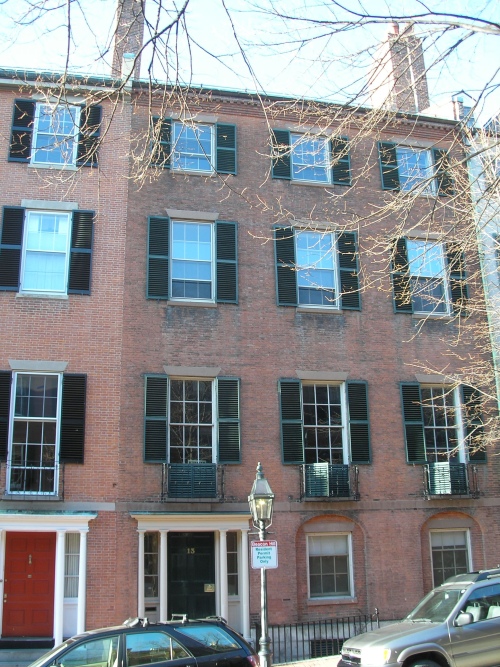
The three houses at nos. 13, 15 & 17 Chestnut Street, on Beacon Hill in Boston, were built in 1806 and designed by Charles Bulfinch. These three adjoining houses are known as the Swan Houses, after the heiress, Hepzibah Swan, who had them built as wedding gifts for her three daughters, who were married in 1806, 1807 and 1817. The houses are regarded as among the most architecturally significant on Chestnut Street. They feature recessed arches on the ground floor above stone string courses, while above are tall windows featuring wrought-iron balconies, which emphasize the importance of the second floor, which has double living rooms. Stairs lead to the houses’ basements from street level. The house at no. 13 was occupied by Swan’s daughter, Mrs. John Turner Sargent. From 1863 to 1866, the house was rented to the humanitarian and abolitionist couple, Samuel Gridley Howe and his wife, Julia Ward Howe, author of The Battle Hymn of the Republic. Starting in 1867, Julia Ward Howe held meetings of the Radical Club in the house.

48 Mount Vernon Street, Boston (1825)

by Dan/March 21, 2009March 23, 2009/Boston, Federal, Houses

48-mt-vernon.jpg

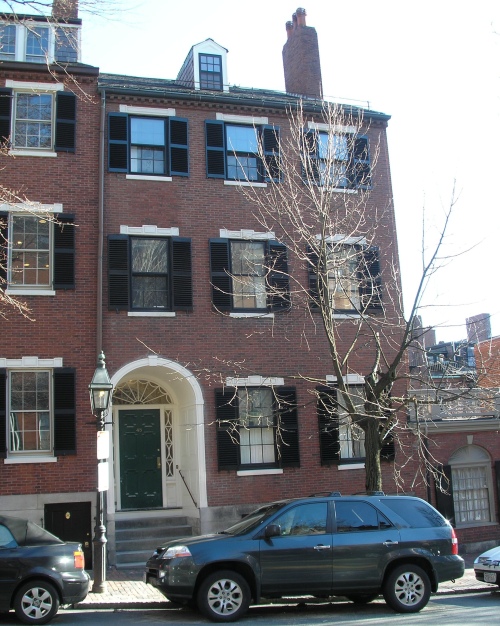
Nos. 44, 46 and 48 Mount Vernon Street in Boston were built in the 1820s and are typical examples of the smaller houses found on the south slope of Beacon Hill. Frances Weston Carruth, in Fictional Rambles in & about Boston (1902) identified No. 48 (c. 1825) as William Dean Howells‘s inspiration for the home of the Coreys in The Rise of Silas Lapham (1885). Victorian Boston Today (2004), on the other hand, notes that Carruth’s photograph and the description in the novel do not fit no. 48 and that therefore no. 45 is the correct address.

66 Mt. Vernon Street, Boston (1809)

by Dan/March 20, 2009/Boston, Federal, Houses

66-mt-vernon.jpg

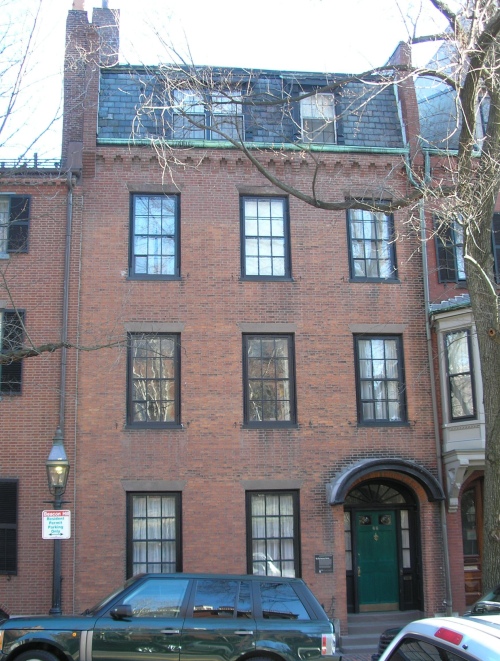
Jeremiah Gardner was a noted house builder in Boston’s Beacon Hill neighborhood. Builders and housewrights would often construct a row of houses, taking one of them as their fee. Gardner built the 1809 house at 66 Mt. Vernon Street for himself. In the early twentieth century, the house was the residence of Arthur A. Shurtleff, a landscape architect. Shurtleff (who later changed his name to Shurcliff) designed such gardens as the Japanese Garden at Bellarmine Hall at Fairfield University and was also involved in urban planning.

50-52 Mattoon Street, Springfield (1872)

by Dan/January 14, 2009/Houses, Second Empire, Springfield

03.jpg

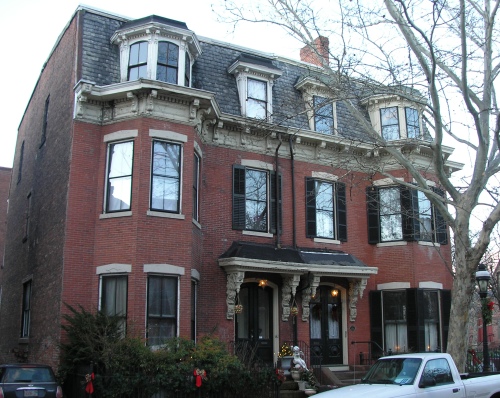
Another example of the Second Empire-style row house, built during the initial 1870s development of Mattoon Street in Springfield, is the building at nos. 50-52. The section of the structure to the right is the Eldredge House.

Posts navigation

Older posts
Newer posts
Privacy Policy

Categories

  • Architectural Style (943)
    • Art Deco (9)
    • Byzantine (3)
    • Colonial (177)
    • Colonial Revival (85)
    • Craftsman (6)
    • Egyptian Revival (1)
    • Federal (190)
    • Foursquare (6)
    • Gothic (67)
    • Greek Revival (100)
    • Italianate (82)
    • Mission Revival (2)
    • Mission/Spanish Colonial (1)
    • Modern (2)
    • Neoclassical (56)
    • Octagon (3)
    • Postmodern (1)
    • Queen Anne (46)
    • Renaissance Revival (26)
    • Romanesque Revival (53)
    • Second Empire (26)
    • Shingle Style (12)
    • Stick Style (13)
    • Tudor Revival (8)
    • Vernacular (49)
    • Victorian Eclectic (15)
  • Building Type (943)
    • Apartment Buildings (8)
    • Banks (18)
    • Churches (119)
    • Collegiate (32)
    • Commercial (102)
    • Hotels (16)
    • Houses (508)
    • Industrial (23)
    • Libraries (22)
    • Lighthouses (1)
    • Military (15)
    • Monuments (1)
    • Museums (12)
    • Organizations (39)
    • Outbuildings (17)
    • Public Buildings (50)
    • Schools (23)
    • Stations (5)
    • Synagogues (1)
    • Taverns (21)
    • Theaters (9)
  • Town (943)
    • Adams (11)
    • Agawam (4)
    • Amherst (50)
    • Boston (64)
    • Boylston (6)
    • Cambridge (30)
    • Clinton (21)
    • Concord (15)
    • Cummington (1)
    • Danvers (14)
    • Deerfield (31)
    • Gloucester (18)
    • Granville (10)
    • Great Barrington (2)
    • Hadley (9)
    • Hancock (15)
    • Harvard (32)
    • Holyoke (47)
    • Lenox (5)
    • Lexington (8)
    • Longmeadow (32)
    • Marblehead (40)
    • Marlborough (4)
    • Natick (22)
    • Newton (2)
    • Northampton (68)
    • Peabody (4)
    • Pittsfield (20)
    • Salem (110)
    • Saugus (4)
    • Sheffield (4)
    • South Hadley (8)
    • Southborough (8)
    • Southwick (4)
    • Springfield (67)
    • Stockbridge (19)
    • Stow (1)
    • Sturbridge (18)
    • Sudbury (7)
    • Waltham (11)
    • Watertown (1)
    • Wayland (8)
    • West Springfield (14)
    • Westfield (46)
    • Weston (2)
    • Worcester (26)
  • Uncategorized (1)

Recent Comments

  • Wilber Blackson on South Hadley
  • Tami Speiden on Stockbridge
  • DexGuru on Stockbridge

Tags

Alcott Amherst College Asher Benjamin Back Bay Baptist Beacon Hill Big E Black Heritage Trail bowfront Bulfinch Catholic Congregational Episcopal Freedom Trail Gambrel H.H. Richardson Harvard Hawthorne Historic Deerfield Isaac Damon lit Longfellow mansard Methodist Mount Holyoke Museum Museums NPS Old Sturbridge Village PEM Revolutionary War row houses saltbox Samuel McIntire Shakers Smith College SPNEA Springfield Armory Stephen C. Earle Storrowton Underground Railroad UU Washington William Fenno Pratt Witch Trials

Meta

  • Log in
  • Entries feed
  • Comments feed
  • WordPress.org
Proudly powered by WordPress | Theme: ShowMe by NEThemes.