Historic Buildings of Massachusetts

  • About
  • Index by Town
  • CT
  • About
  • Index by Town
  • CT

Tag: Episcopal

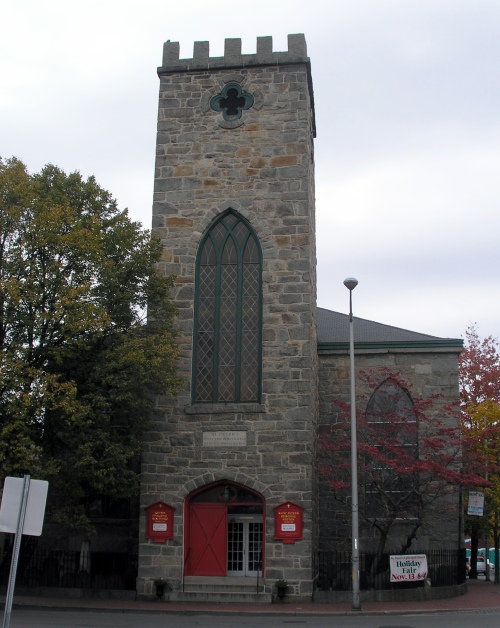
St. Peter’s Episcopal Church, Salem (1833)
by Dan/November 14, 2010November 15, 2010/Churches, Gothic, Salem

St. Peter’s Episcopal Church in Salem was established in 1733 and a wooden church was built the following year on land donated by Philip English, a wealthy merchant. English and his wife, Mary, had been accused of witchcraft during the Salem Witchcraft Trials of 1692. The original church was taken down in 1833 and replaced by the present stone church, constructed from plans by Isaiah Rogers of Boston. Like Salem’s First Church, it is a highly regarded example of a Gothic Revival stone masonry church of the early nineteenth century. It was enlarged in 1845 and a new chapel was added in 1871, built directly over the parish’s old graveyard. Some of the tombstones were incorporated into the chapel’s walls.
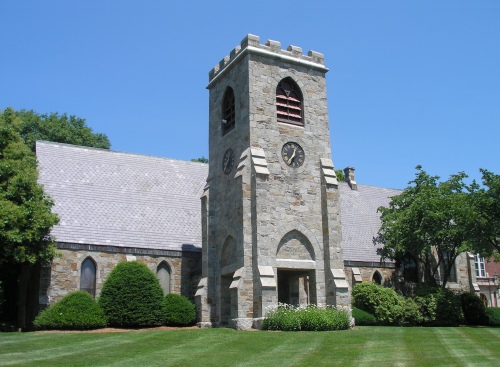
St. Mark’s Episcopal Church, Southborough (1862)

by Dan/July 23, 2010/Churches, Gothic, Southborough

The first Episcopal service in Southborough, the baptism of a daughter of Joseph Burnett in 1850, was held inside the Pilgrim Congregational Church. Burnett, a prominent businessman and Episcopalian, sought to establish the first Episcopal church in town. With services being held, for the time being, in private homes and, after 1860, on the upper floor of a stone mill on Deerfoot Road, Burnett and his colleagues acquired land west of the Southborough Town House for the construction of a church. Built in 1862-1863, the Gothic stone St. Mark’s Episcopal Church was designed by Alexander Esty. The church was expanded several times, with the bell tower being added in 1890 and the sanctuary being renovated and expanded eastward in 1905, in memory of Joseph Burnett. Behind the church is the Burnett family cemetery. Burnett also founded St. Mark’s School, an Episcopal preparatory school in Southborough.

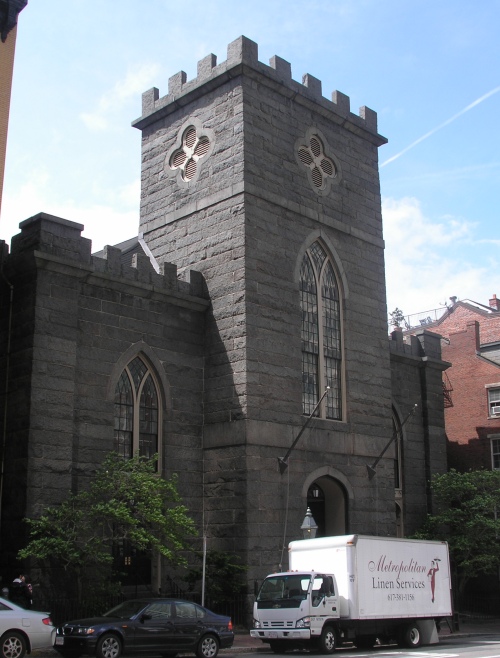
Church of St. John the Evangelist (1831)

by Dan/May 9, 2010/Boston, Churches, Gothic

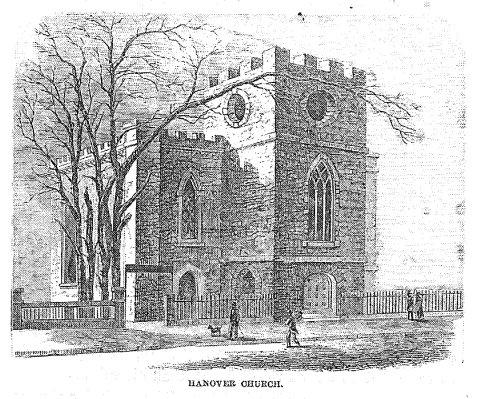
The Church of St. John the Evangelist, on Bowdoin Street in Boston, was built in 1831 for the congregation of Rev. Lyman Beecher, father of Harriet Beecher Stowe. The congregation began at a church on Hanover Street, called the Hanover Church, built in 1826. After the church burned in 1830, the congregation built and consecrated the Bowdoin Street Church. Typical of early New England Gothic Revival churches, the design of the building has been attributed to Solomon Willard, architect of the Bunker Hill Monument. In 1831, Lowell Mason, famous composer of hymns, became choirmaster at the church. Rev. Beecher left his church in Boston in 1832, to become the first president of Lane Theological Seminary in Cincinnati. The church became the Church of the Advent (from 1863 to 1883) and then the Mission Church of St. John the Evangelist under the auspices of the Society of St. John the Evangelist, an Anglican monastic order. The church has been a Parish Church in the Episcopal Diocese of Massachusetts since 1985.

St. John’s Chapel, Cambridge (1868)

by Dan/July 5, 2009July 5, 2009/Cambridge, Churches, Gothic

st-johns-chapel.jpg

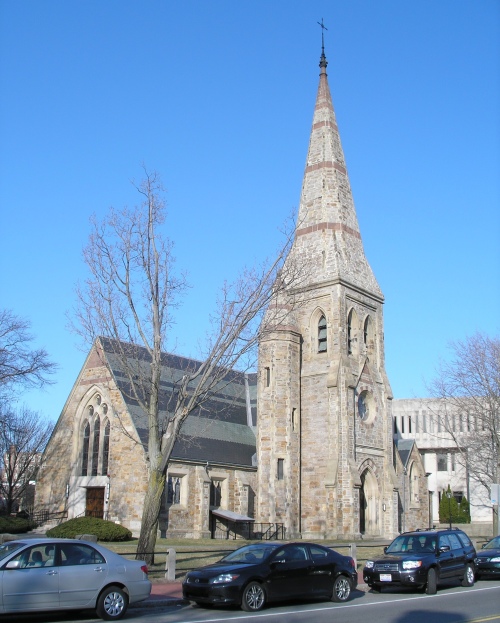
Founded in 1867, the Episcopal Theological School (now the Episcopal Divinity School) hired the architectural firm of Ware and Van Brunt to design their campus on Brattle Street in Cambridge. The first building to be constructed was St. John’s Chapel. Modeled on an English parish church, it was built in 1868-1869. The chapel’s tower is constructed of Roxbury puddingstone. The original side entrance was joined by a new main entrance on the end, added in the 1960s.

King’s Chapel, Boston (1749)

by Dan/January 24, 2009March 24, 2009/Boston, Churches, Colonial

kings-chapel.jpg

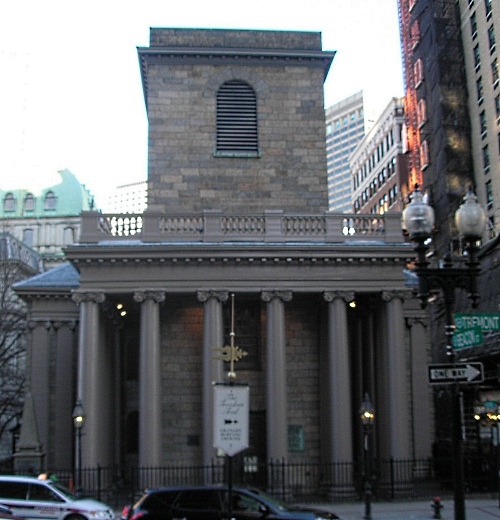
King’s Chapel, originally founded to serve British officers, was the first Anglican church in Puritan Boston. The Chapel‘s first building was a wood structure, built in 1686 on land that had been part of the town’s oldest burying ground. The current Chapel, built of Quincy granite, was constructed around the old one in 1749-1754 (the dismantled remains of the old church were then removed through the windows). The architect was Peter Harrison, of Newport, RI, considered to be America’s “first architect,” who modeled the Georgian-style building on those designed by James Gibbs in England, like St. Martin in the Fields in London, except the steeple of King’s Chapel was never built due to a lack of funds. When the British evacuated Boston during the Revolutionary War, there were few Anglican families remaining in town. James Freeman, a lay reader, became minister in 1783 and led Stone Chapel (as King’s Chapel had come to be called) to become America’s first Unitarian church in 1789 (although the congregation continued to follow a liturgy based on the Book of Common Prayer). That same year, George Washington attended an oratorio at the Chapel intended to raise funds for the construction of a portico of wood Ionic columns, painted to resemble stone. When the Chapel’s bell cracked in 1814, it was recast by Paul Revere. Both the Chapel and the adjacent King’s Chapel Burying Ground are on the Boston Freedom Trail.

Trinity Church, Boston (1877)

by Dan/October 6, 2008December 30, 2012/Boston, Churches, Romanesque Revival

trinity-church.jpg

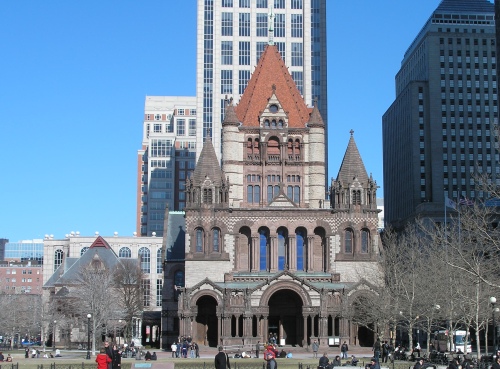
Boston’s Trinity Parish (established in 1734) lost its church on Summer Street in an 1872 fire. They held a design competition for the building of a new church on Copley Square. The winner was H. H. Richardson, whose Romanesque design contrasted with his competitors’ preference for the Victorian Gothic. Richardson, who would produce in Trinity Church one of America’s great buildings, planned the building as a compact Greek Cross with a very prominent central tower. This centralized plan contrasted with the more typical narrow Latin Cross, in which clergy and congregation were separated. In the course of construction (1872-1877), the plan for the tower was eventually altered to a more complex design, inspired by the Cathedral of Salamanca and possibly influenced by Stanford White, who was apprenticing under Richardson at the time. Granite and Longmeadow sandstone were used in the construction. The interiors were realized by the artist, John La Farge, assisted by Augustus Saint-Gaudens. Richardson wished to rebuilt the two front towers, lowering them. Alterations were eventually made after his death when the portico and new towers were added between 1894 and 1897 under the successor of his practice, Hugh Shapley (of Shapley, Rutan, and Coolidge). More recently, geothermal wells have been drilled for heating and cooling. The adjoining Parish House (1874) has features which link it stylistically to the church.

Posts navigation

Newer posts
Privacy Policy

Categories

  • Architectural Style (943)
    • Art Deco (9)
    • Byzantine (3)
    • Colonial (177)
    • Colonial Revival (85)
    • Craftsman (6)
    • Egyptian Revival (1)
    • Federal (190)
    • Foursquare (6)
    • Gothic (67)
    • Greek Revival (100)
    • Italianate (82)
    • Mission Revival (2)
    • Mission/Spanish Colonial (1)
    • Modern (2)
    • Neoclassical (56)
    • Octagon (3)
    • Postmodern (1)
    • Queen Anne (46)
    • Renaissance Revival (26)
    • Romanesque Revival (53)
    • Second Empire (26)
    • Shingle Style (12)
    • Stick Style (13)
    • Tudor Revival (8)
    • Vernacular (49)
    • Victorian Eclectic (15)
  • Building Type (943)
    • Apartment Buildings (8)
    • Banks (18)
    • Churches (119)
    • Collegiate (32)
    • Commercial (102)
    • Hotels (16)
    • Houses (508)
    • Industrial (23)
    • Libraries (22)
    • Lighthouses (1)
    • Military (15)
    • Monuments (1)
    • Museums (12)
    • Organizations (39)
    • Outbuildings (17)
    • Public Buildings (50)
    • Schools (23)
    • Stations (5)
    • Synagogues (1)
    • Taverns (21)
    • Theaters (9)
  • Town (943)
    • Adams (11)
    • Agawam (4)
    • Amherst (50)
    • Boston (64)
    • Boylston (6)
    • Cambridge (30)
    • Clinton (21)
    • Concord (15)
    • Cummington (1)
    • Danvers (14)
    • Deerfield (31)
    • Gloucester (18)
    • Granville (10)
    • Great Barrington (2)
    • Hadley (9)
    • Hancock (15)
    • Harvard (32)
    • Holyoke (47)
    • Lenox (5)
    • Lexington (8)
    • Longmeadow (32)
    • Marblehead (40)
    • Marlborough (4)
    • Natick (22)
    • Newton (2)
    • Northampton (68)
    • Peabody (4)
    • Pittsfield (20)
    • Salem (110)
    • Saugus (4)
    • Sheffield (4)
    • South Hadley (8)
    • Southborough (8)
    • Southwick (4)
    • Springfield (67)
    • Stockbridge (19)
    • Stow (1)
    • Sturbridge (18)
    • Sudbury (7)
    • Waltham (11)
    • Watertown (1)
    • Wayland (8)
    • West Springfield (14)
    • Westfield (46)
    • Weston (2)
    • Worcester (26)
  • Uncategorized (1)

Recent Comments

  • Wilber Blackson on South Hadley
  • Tami Speiden on Stockbridge
  • DexGuru on Stockbridge

Tags

Alcott Amherst College Asher Benjamin Back Bay Baptist Beacon Hill Big E Black Heritage Trail bowfront Bulfinch Catholic Congregational Episcopal Freedom Trail Gambrel H.H. Richardson Harvard Hawthorne Historic Deerfield Isaac Damon lit Longfellow mansard Methodist Mount Holyoke Museum Museums NPS Old Sturbridge Village PEM Revolutionary War row houses saltbox Samuel McIntire Shakers Smith College SPNEA Springfield Armory Stephen C. Earle Storrowton Underground Railroad UU Washington William Fenno Pratt Witch Trials

Meta

  • Log in
  • Entries feed
  • Comments feed
  • WordPress.org
Proudly powered by WordPress | Theme: ShowMe by NEThemes.