Historic Buildings of Massachusetts

  • About
  • Index by Town
  • CT
  • About
  • Index by Town
  • CT

Tag: Museum

Museum of Fine Arts (1909)
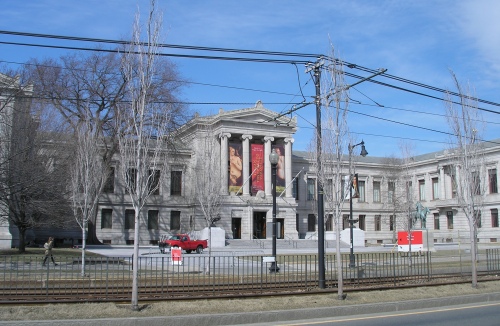
by Dan/April 9, 2009April 9, 2009/Boston, Museums, Neoclassical

mfa-01.jpg

Boston’s Museum of Fine Arts began in 1870 with space in the Boston Athenaeum. In 1876, the museum moved to a Gothic building on Copley Square. In 1907, the museum began planning its next move to a new location on the Fenway, where an interconnected building complex would be constructed over several years. Designed by Guy Lowell, the first section of the Classical Revival structure to be completed was the one on Huntington Avenue (above), finished in 1909, which features a central Greek temple portico with two symmetrical wings on either side. The next section was the Robert Dawson Evans Wing on the Fenway (below), completed in 1915, which features a long Ionic colonnade. Between 1916 and 1925, the John Singer Sargent created the art for the central Rotunda and Colonnade. Various additions have been made to the museum over the years, including the Decorative Arts Wing in 1928, the Forsyth Wickes Addition in 1968, the George Robert White Wing in 1970, and the I. M. Pei-designed West Wing in 1981. Currently, the museum is undergoing a new renovation and expansion. Continue reading “Museum of Fine Arts (1909)”
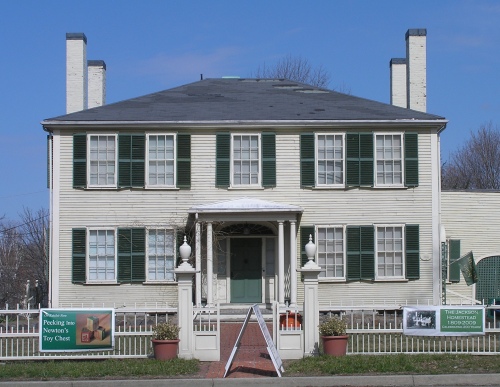
Jackson Homestead (1809)

by Dan/March 22, 2009September 17, 2016/Federal, Houses, Newton

jackson-homestead.jpg

In about 1670, Edward Jackson built a saltbox house on his farmland in a section of Cambridge south of the Charles River in what is today the City of Newton. Edward was involved in the movement to seperate Newton from Cambridge. His son, Sebas Jackson also lived in the house, followed by his son Joseph and then his son, Lt. Timothy Jackson, who died in 1774. Over these years, the original property was subdivided. Lt. Timothy Jackson’s widow, Sarah Smith Jackson, was left to look after the farm, while her son, Maj. Timothy Jackson, fought in the Revolutionary War. In 1809, Timothy replaced the old homestead with a new mansion house in the Federal style. After his death in 1814, with his sons having moved to Boston, the house was rented to a farmer, but eventually Timothy’s son, William Jackson, who, like his father had a notable public career, moved into and the house in 1820 and enlarged it. William started a soap and candle factory and a was a general agent for the Boston and Worcester Railroad and ensured that the line would be routed through Newton.

William Jackson’s house is well documented to have been a station on the Underground Railroad. William’s brother, Francis Jackson, was also an abolitionist and a colleague of William Lloyd Garrison. Francis was the author of A History of the Early Settlement of Newton (1854). After William’s death in 1855, his widow, Mary Bennett Jackson, and three unmarried daughters occupied the house. One of these daughters. Ellen Jackson, wrote a memoir of growing up in the home called Annals from the Old Homestead (1895). William’s decedents lived in the homestead until 1932, when it was rented. The Jackson Homestead was later owned by Frances Middendorf, who left it to the City in 1949. It became the Netwon History Museum in 1950. There is a pdf document with further details about the Homestead and the Jackson family.

Joseph Clesson House (1814)

by Dan/February 28, 2009September 17, 2016/Colonial, Deerfield, Houses

flynt-silver-and-metalware-collection.jpg

Today part of Historic Deerfield, the Joseph Clesson House was built in 1814, probably planned to be the ell of a larger house Clesson, who died two years later, had intended to build on the site. The house was moved moved around the corner in 1872 and replaced with a Victorian-style home. Eventually, the Clesson House was moved to Greenfield. In 1960, the later Victorian house was torn down and the Clesson House returned to its original lot in Deerfield. The following year, the house opened to the public as the home of the Henry Needham Flynt Silver and Metalware Collection. The house’s kitchen was set up as an example of a silversmith’s workshop. To accommodate the collection, a fireproof wing, made of cinder blocks, was added to the house, with its exterior disguised to resemble the original section.

Hall Tavern (1760)

by Dan/February 27, 2009February 28, 2009/Colonial, Deerfield, Taverns

hall-tavern.jpg

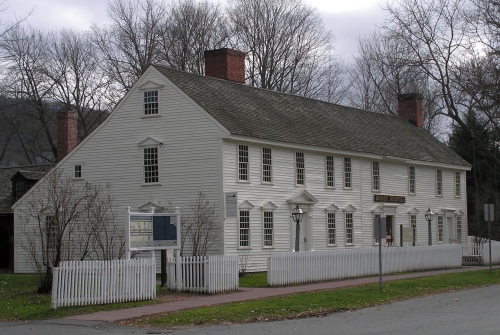
The Hall Tavern Visitor Center at Historic Deerfield was originally built around 1760 on the Mohawk Trail in East Charlemont, not far from Deerfield. It became a tavern in the 1780s and a ballroom was added around 1800. In the early nineteenth century, the tavern was operated by Joel Hall and his wife, Lucretia Street Hall, whose embroidered blanket is in the collection of Historic Deerfield. Joel Hall, who purchased the building in 1807, also manufactured axes. In 1935, the Hall Tavern was the site of an exhibition by the Deerfield Valley Art Association. In the 1950s, the Tavern was moved to a site in Deerfield where a similar tavern, which burned down in 1799, had once stood. It is now the Visitor Center for tours of Historic Deerfield and the restored tavern kitchen is used for open hearth cooking classes. Behind the Tavern is the Cook’s Garden.

Frary House (1760) and Barnard Tavern (1795)

by Dan/February 26, 2009September 17, 2016/Colonial, Deerfield, Houses, Taverns

frary-house-barnard-tavern.jpg

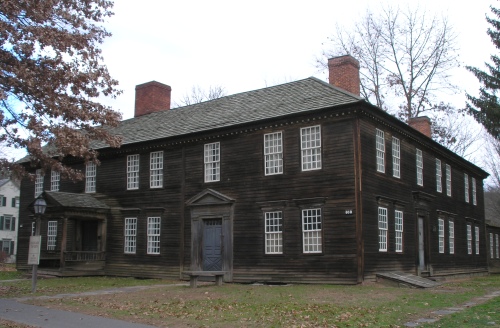
In 1890, Miss Charlotte Alice Baker purchased a colonial home in Deerfield and, assisted by the architectural firm of Shepley, Rutan & Coolidge, restored it in 1892 in one of the earliest efforts at historic preservation in Western Massachusetts. Baker also furnished the home in line with the ideas of the Colonial Revival and Arts and Crafts movements. At the time, the house was believed to have been built by the original Deerfield settler, Samson Frary, who owned the lot and built a house on it sometime after 1683. Frary was killed during the famous 1704 French and Indian Raid on Deerfield. C. Alice Baker, who was a descendant of Samson Frary, did research on the Deerfield captives and wrote a book called True Stories of New England Captives Carried to Canada During the Old French and Indian Wars (1897). She also wrote A Summer in the Azores (1882). Baker’s lifelong companion, Miss Susan Lane, died in 1893 and Miss Baker died in 1909.

The Frary House, now believed to have been built sometime in the late 1750s, is currently owned by Historic Deerfield. The Barnard Tavern is an addition to the Frary House, constructed in 1795. The home had been sold from the Frary to the Barnard families in 1752. With a large second-floor meeting room, the tavern was one of the centers of village life. At the Tavern’s bar, in 1775, Col. Benedict Arnold closed a contract to supply the expedition against Fort Ticonderoga. Recent research, though, suggests that the building may not have served the full functions of a tavern. Archeological work is also planned for the site.

Narbonne House (1675)

by Dan/February 19, 2009September 17, 2016/Colonial, Houses, Salem

narbonne-house.jpg

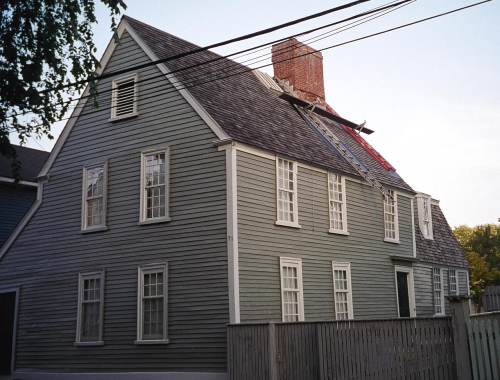
The Narbonne House, on Essex Street in Salem, is part of the Salem Maritime National Historic Site. It was built in 1675 by Thomas Ives, a butcher (or “slaughterer”). The oldest section of the house has a prominent peaked roof. Later owners added to the building, with part of the lean-to and the gambrel-roofed ell probably being constructed when Capt. John Hodges owned the house in the third quarter of the eighteenth century. In 1780, the house was purchased by Jonathan Andrew. His granddaughter, Sarah Narbonne, was born inside and lived there until her death, at age 101, in 1895. Her daughter Mary lived there until her death in 1905. The Park Service acquired the historic structure in 1963. Instead of being restored to a particular period, the Narbonne House is kept unfurnished as an architectural study house. There is a video of a talk outsidethe Narbonne House: Continue reading “Narbonne House (1675)”

Stebbins-Wright House (1824)

by Dan/February 4, 2009September 17, 2016/Deerfield, Federal, Houses

wright-house.jpg

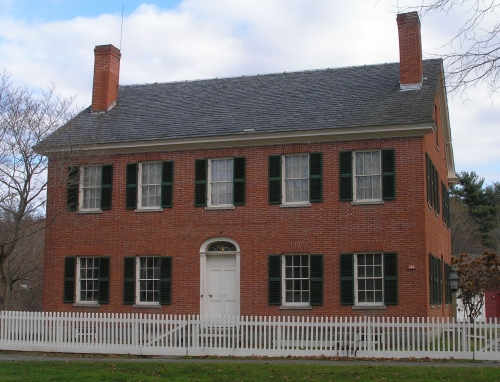
The Stebbins-Wright House is a brick Federal-style house in Old Deerfield. It was built in 1824 by Asa Stebbins, for his son, Asa Stebbins, Jr.. Asa, Sr. had earlier built his own house of brick in 1799. The house was owned by Stebbins’ heirs until 1908, when it was acquired by George and Jane Wright. In 1948, it was acquired by Henry and Helen Flynt for Historic Deerfield. They continued to use the name “Wright House” and restored the house to display a collection of high-style furniture. The house is no longer open to the public.

Posts navigation

Older posts
Newer posts
Privacy Policy

Categories

  • Architectural Style (943)
    • Art Deco (9)
    • Byzantine (3)
    • Colonial (177)
    • Colonial Revival (85)
    • Craftsman (6)
    • Egyptian Revival (1)
    • Federal (190)
    • Foursquare (6)
    • Gothic (67)
    • Greek Revival (100)
    • Italianate (82)
    • Mission Revival (2)
    • Mission/Spanish Colonial (1)
    • Modern (2)
    • Neoclassical (56)
    • Octagon (3)
    • Postmodern (1)
    • Queen Anne (46)
    • Renaissance Revival (26)
    • Romanesque Revival (53)
    • Second Empire (26)
    • Shingle Style (12)
    • Stick Style (13)
    • Tudor Revival (8)
    • Vernacular (49)
    • Victorian Eclectic (15)
  • Building Type (943)
    • Apartment Buildings (8)
    • Banks (18)
    • Churches (119)
    • Collegiate (32)
    • Commercial (102)
    • Hotels (16)
    • Houses (508)
    • Industrial (23)
    • Libraries (22)
    • Lighthouses (1)
    • Military (15)
    • Monuments (1)
    • Museums (12)
    • Organizations (39)
    • Outbuildings (17)
    • Public Buildings (50)
    • Schools (23)
    • Stations (5)
    • Synagogues (1)
    • Taverns (21)
    • Theaters (9)
  • Town (943)
    • Adams (11)
    • Agawam (4)
    • Amherst (50)
    • Boston (64)
    • Boylston (6)
    • Cambridge (30)
    • Clinton (21)
    • Concord (15)
    • Cummington (1)
    • Danvers (14)
    • Deerfield (31)
    • Gloucester (18)
    • Granville (10)
    • Great Barrington (2)
    • Hadley (9)
    • Hancock (15)
    • Harvard (32)
    • Holyoke (47)
    • Lenox (5)
    • Lexington (8)
    • Longmeadow (32)
    • Marblehead (40)
    • Marlborough (4)
    • Natick (22)
    • Newton (2)
    • Northampton (68)
    • Peabody (4)
    • Pittsfield (20)
    • Salem (110)
    • Saugus (4)
    • Sheffield (4)
    • South Hadley (8)
    • Southborough (8)
    • Southwick (4)
    • Springfield (67)
    • Stockbridge (19)
    • Stow (1)
    • Sturbridge (18)
    • Sudbury (7)
    • Waltham (11)
    • Watertown (1)
    • Wayland (8)
    • West Springfield (14)
    • Westfield (46)
    • Weston (2)
    • Worcester (26)
  • Uncategorized (1)

Recent Comments

  • Wilber Blackson on South Hadley
  • Tami Speiden on Stockbridge
  • DexGuru on Stockbridge

Tags

Alcott Amherst College Asher Benjamin Back Bay Baptist Beacon Hill Big E Black Heritage Trail bowfront Bulfinch Catholic Congregational Episcopal Freedom Trail Gambrel H.H. Richardson Harvard Hawthorne Historic Deerfield Isaac Damon lit Longfellow mansard Methodist Mount Holyoke Museum Museums NPS Old Sturbridge Village PEM Revolutionary War row houses saltbox Samuel McIntire Shakers Smith College SPNEA Springfield Armory Stephen C. Earle Storrowton Underground Railroad UU Washington William Fenno Pratt Witch Trials

Meta

  • Log in
  • Entries feed
  • Comments feed
  • WordPress.org
Proudly powered by WordPress | Theme: ShowMe by NEThemes.