Historic Buildings of Massachusetts

  • About
  • Index by Town
  • CT
  • About
  • Index by Town
  • CT

Category: Colonial

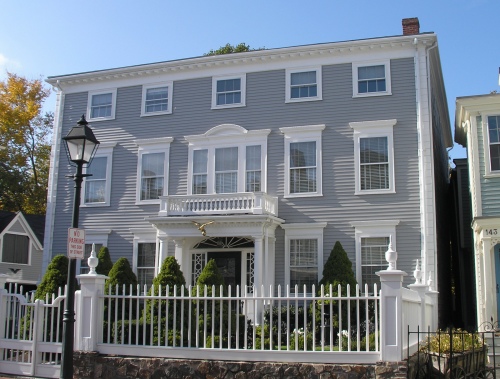
Nathaniel Hooper Mansion (1754)
by Dan/January 28, 2011January 22, 2020/Colonial, Federal, Houses, Marblehead

In 1801, Nathaniel Hooper, son of Robert Hooper and brother of Capt. John Hooper, purchased a parcel of land at the foot of Washington Street in Marblehead. A c. 1754 house was already on the property, which Hooper expanded into a Federal-style mansion. According to the Hooper Genealogy (1908), Nathaniel Hooper (1770-1825), “made public profession of his faith in Christ, his Saviour, in 1811, uniting with the Congregational church of Marblehead [the Hoopers had traditionally been Episcopalians]; became a deacon of the church, a man of large generosity and of much public spirit. He was known among the fishermen as ‘The Oracle,’ being very helpful in settling controversies. He represented the town at the General Court 1813-15 and 1822; was a member of the [Massachusetts Constitutional] Convention of 1820.” The Nathaniel Hooper Mansion, at 147 Washington Street, was later owned by the members of Fabens family of Salem. It was acquired by its current owners in 1983 and has been restored.
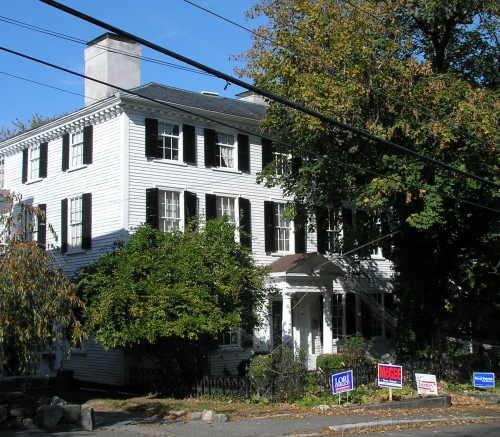
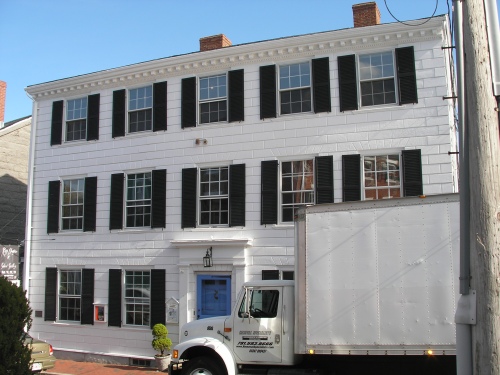
Hooper-Parker House (1761)

by Dan/January 26, 2011January 22, 2020/Colonial, Houses, Marblehead

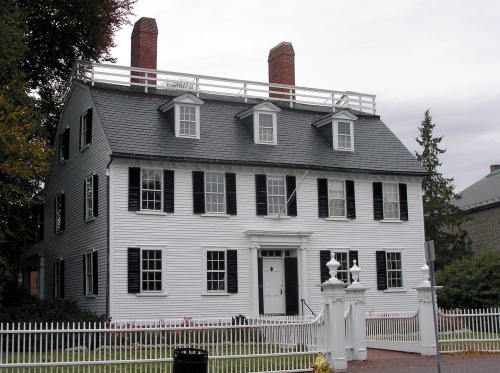
Nathaniel Hooper, successful Marblehead merchant, built a house that was later inherited, at his death in 1760, by his eldest son Robert. In 1761, Robert married Mary (Polly) Ingalls, his next door neighbor. Purchasing the adjacent plot of land from his father-in-law, Robert Hooper expanded his father’s small home into a much larger Georgian-style mansion, known today as the Hooper-Parker House and located at 181 Washington Street. After Robert’s death in 1815, his oldest son, also named Robert, inherited the house and lived there with his wife, Mary Glover, daughter of Capt. John Glover. Mary Glover Hooper was famed as a hostess, entertaining such guests as George Washington and General Lafayette. After Robert’s death in 1843, the house passed to his brother Henry and was later sold to merchant Robert Bridge, who sold it to Rev. Robert B. Parker, Rector of St. Michael’s Episcopal Church from 1922 to 1925. Rev. Parker’s wife Sarah left the house to the SPNEA, which eventually sold the house to a private owner in 1960.

King Hooper Mansion (1745)

by Dan/January 25, 2011January 22, 2020/Colonial, Houses, Marblehead

This week, we’ll be looking at some mansions in Marblehead built by members of the wealthy Hooper family. The oldest section of the King Hooper Mansion, at 8 Hooper Street, dates to 1728 and was built by Greenfield Hooper, a candle maker. The front section, with its elegant Georgian facade, was erected in 1745 by his son, Robert Hooper. As described in The Loyalists of Massachusetts and the Other Side of the American Revolution (1910), by James H. Stark:

Robert Hooper, known as “King Hooper,” was born at Marblehead, June 26, 1709, son of the aforesaid Greenfield Hooper. He was married four times. Was a merchant who rose from poverty to apparently inexhaustible wealth, engrossing for years a large part of the foreign fishing business of Marblehead, which was very extensive about the year 1760. For awhile he purchased all the fish brought into that port, sent it to Bilboa and other parts of Spain and received gold and silver in return, with which he purchased goods in England. He owned lands in Marblehead, Salem, Danvers, and an extensive tract at Lyndeborough, N. H.. and elsewhere. He had a large and elegant house at Marblehead, and also a mansion at Danvers, where he did “royal” entertaining, rode in a chariot like a prince, and was ever after known as “King Hooper.” He was one of the wealthiest and most benevolent men in the colony.

Robert Hooper was also called “King” by the local sailors for his fairness and integrity. In 1819, the mansion was traded to Jason Chamberlain for the schooner Economy. Chamberlain’s heirs owned the house until 1888, using the front room as a dry goods store. It was next owned by the YMCA and then used as a tea room and an antique shop. Since 1938, the house has been owned by the Marblehead Arts Association. The King Hooper Mansion now hosts art exhibitions and can be rented for events.

Ropes Mansion (1727)

by Dan/January 24, 2011January 24, 2020/Colonial, Houses, Salem

Built on Essex Street in Salem around 1727, the Ropes Mansion has been open to the public since 1912. It was built by merchant Samuel Barnard of Deerfield and sold by Barnard’s heirs to Judge Nathaniel Ropes II in 1768. He was a loyalist and died of smallpox as his house was being attacked by a mob of Patriots in 1774. His family went into exile, but reclaimed the house after the Revolutionary War. It remained in the Ropes family until 1907, when sisters Mary and Eliza Ropes bequeathed it as the Ropes Memorial. Various alterations have been made to the interior of the house over the years, most dramatically in 1894, when Colonial Revival modifications were made and the structure was moved back from the street. The building‘s current entryway dates to the 1830s and was inspired by Asher Benjamin‘s American Builder’s Companion (1827). The house also has formal gardens dating to 1912. The house has had several fires: Abigail Ropes burned to death after her dress caught fire in 1839; a disgruntled worker is believed to have started a fire which gutted an addition in 1894; and the third floor attic was damaged in a fire in 2009. Today, the Ropes Mansion is owned by the Peabody Essex Museum.

Thomas Haines House (1681)

by Dan/January 21, 2011December 14, 2017/Colonial, Danvers, Houses

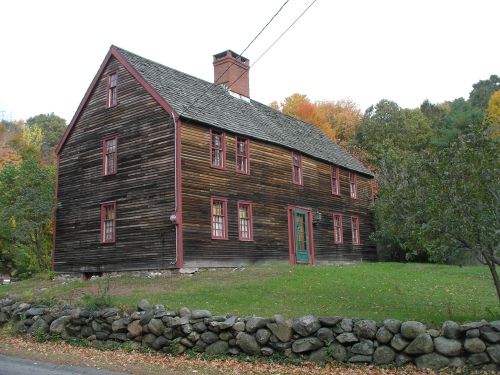
The Thomas Haines House, on Centre Street in Danvers, was built in 1681 by Hains, an innkeeper. During the Salem Witch Trials of 1692, Haines gave testimony in the trial of Elizabeth How of Topsfield which resulted in her being hanged as a witch on July 19, 1692, the same day as Rebecca Nurse, her sister-in-law. Haines moved to New Jersey in 1704 and sold his house to John Allen of Salem, a gunsmith.

Hutchinson-Kimball House (1700)

by Dan/January 20, 2011January 18, 2020/Colonial, Danvers, Houses

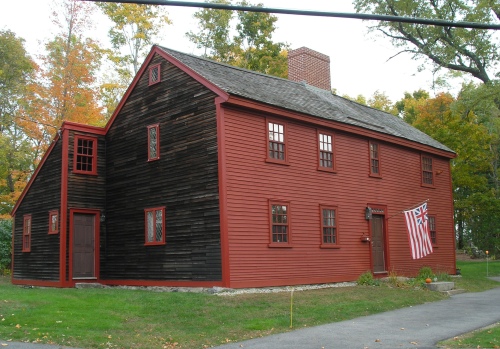
The c. 1700 Hutchinson-Kimball House, on Forest Street in Danvers, is considered to be a fine example of First Period architecture. According to Chronicles of Danvers (Old Salem Village) Massachusetts, 1632-1923 (1923), by Harriet Silvester Tapley, the house was “Built by Ambrose Hutchinson, grandson of Richard Hutchinson, the Emigrant, early in the 18th century.”

General John Glover House (1762)

by Dan/January 19, 2011January 22, 2020/Colonial, Houses, Marblehead

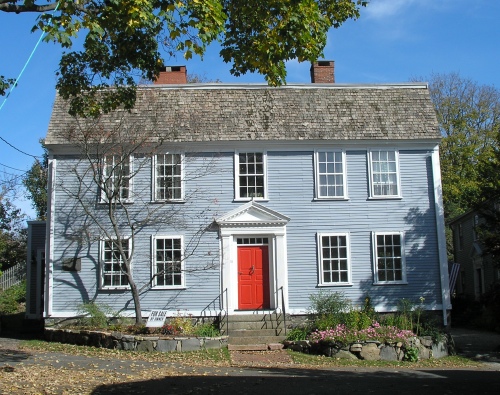
John Glover was a Marblehead fisherman and merchant who rose to the rank of general in the Revolutionary War. His schooner Hannah was the first of many privateers authorized by George Washington to raid British shipping. Glover‘s Marblehead militia became the 14th Continental Regiment, known as the “Amphibious Regiment,” which evacuated Washington’s Continental Army after it lost the Battle of Long Island. His seafaring men would again man the boats for Washington’s Crossing of the Delaware in 1776. John Glover’s gambrel-roofed house at 11 Glover Street in Marblehead was built in 1762.

Posts navigation

Older posts
Newer posts
Privacy Policy

Categories

  • Architectural Style (943)
    • Art Deco (9)
    • Byzantine (3)
    • Colonial (177)
    • Colonial Revival (85)
    • Craftsman (6)
    • Egyptian Revival (1)
    • Federal (190)
    • Foursquare (6)
    • Gothic (67)
    • Greek Revival (100)
    • Italianate (82)
    • Mission Revival (2)
    • Mission/Spanish Colonial (1)
    • Modern (2)
    • Neoclassical (56)
    • Octagon (3)
    • Postmodern (1)
    • Queen Anne (46)
    • Renaissance Revival (26)
    • Romanesque Revival (53)
    • Second Empire (26)
    • Shingle Style (12)
    • Stick Style (13)
    • Tudor Revival (8)
    • Vernacular (49)
    • Victorian Eclectic (15)
  • Building Type (943)
    • Apartment Buildings (8)
    • Banks (18)
    • Churches (119)
    • Collegiate (32)
    • Commercial (102)
    • Hotels (16)
    • Houses (508)
    • Industrial (23)
    • Libraries (22)
    • Lighthouses (1)
    • Military (15)
    • Monuments (1)
    • Museums (12)
    • Organizations (39)
    • Outbuildings (17)
    • Public Buildings (50)
    • Schools (23)
    • Stations (5)
    • Synagogues (1)
    • Taverns (21)
    • Theaters (9)
  • Town (943)
    • Adams (11)
    • Agawam (4)
    • Amherst (50)
    • Boston (64)
    • Boylston (6)
    • Cambridge (30)
    • Clinton (21)
    • Concord (15)
    • Cummington (1)
    • Danvers (14)
    • Deerfield (31)
    • Gloucester (18)
    • Granville (10)
    • Great Barrington (2)
    • Hadley (9)
    • Hancock (15)
    • Harvard (32)
    • Holyoke (47)
    • Lenox (5)
    • Lexington (8)
    • Longmeadow (32)
    • Marblehead (40)
    • Marlborough (4)
    • Natick (22)
    • Newton (2)
    • Northampton (68)
    • Peabody (4)
    • Pittsfield (20)
    • Salem (110)
    • Saugus (4)
    • Sheffield (4)
    • South Hadley (8)
    • Southborough (8)
    • Southwick (4)
    • Springfield (67)
    • Stockbridge (19)
    • Stow (1)
    • Sturbridge (18)
    • Sudbury (7)
    • Waltham (11)
    • Watertown (1)
    • Wayland (8)
    • West Springfield (14)
    • Westfield (46)
    • Weston (2)
    • Worcester (26)
  • Uncategorized (1)

Recent Comments

  • Wilber Blackson on South Hadley
  • Tami Speiden on Stockbridge
  • DexGuru on Stockbridge

Tags

Alcott Amherst College Asher Benjamin Back Bay Baptist Beacon Hill Big E Black Heritage Trail bowfront Bulfinch Catholic Congregational Episcopal Freedom Trail Gambrel H.H. Richardson Harvard Hawthorne Historic Deerfield Isaac Damon lit Longfellow mansard Methodist Mount Holyoke Museum Museums NPS Old Sturbridge Village PEM Revolutionary War row houses saltbox Samuel McIntire Shakers Smith College SPNEA Springfield Armory Stephen C. Earle Storrowton Underground Railroad UU Washington William Fenno Pratt Witch Trials

Meta

  • Log in
  • Entries feed
  • Comments feed
  • WordPress.org
Proudly powered by WordPress | Theme: ShowMe by NEThemes.