Historic Buildings of Massachusetts

  • About
  • Index by Town
  • CT
  • About
  • Index by Town
  • CT

Category: Gothic

Masonic Block, Natick (1874)
by Dan/August 30, 2010/Commercial, Gothic, Natick, Organizations

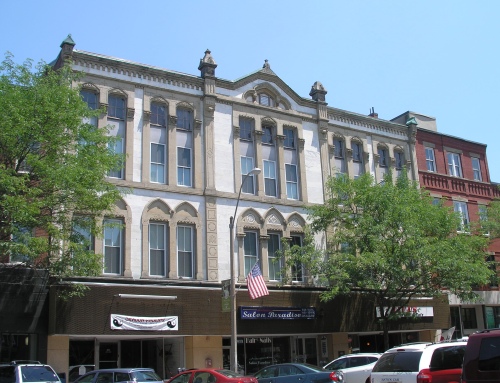
A while back, I had a week on this blog featuring buildings in South Natick. Now I’ll be featuring some buildings in downtown Natick. In 1874, a massive fire destroyed 35 buildings in the downtown. New brick and stone structures were soon built to replace the lost ones. One of the these is the Masonic Block on Main Street, constructed of Vermont marble and completed in 1874. The polychromatic High Victorian Gothic building was designed by S.S. Woodcock and has commercial space on the lower floors and rooms on the upper floors used by the Meridian Lodge, originally established in 1797 by Paul Revere. A glimpse of the building’s occupants in the late nineteenth century can be found in the History of Middlesex County, Vol. I (1890):

Masonic Brick and Marble Block.—This was erected in 1874, and belongs to the estate of the late Leonard Morse. The front is of marble, the other walls are brick. It is occupied on the lower floor by the Atlantic Tea Stores Company, Messrs. Wilde & Soule, who deal in teas, coffees and crockery; by James F. Gray, manufacturer of confectionery and keeper of fruit for sale; by Leonard P. Stone, dealer in meats and vegetables, and by Beals’ Clothing and Furnishing establishment. In the second story are Mulligan’s billiard-room, Finn’s barber-shop, Dr. Abbott’s rooms for dentistry, and Miss Mabel Morse’s musicroom. The third and fourth stories are wholly occupied for Masonic purposes.
St. Mark’s Episcopal Church, Southborough (1862)

by Dan/July 23, 2010/Churches, Gothic, Southborough

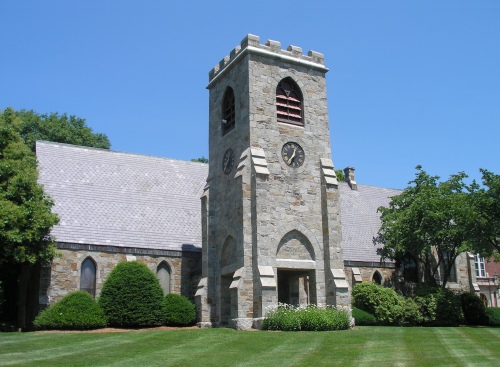
The first Episcopal service in Southborough, the baptism of a daughter of Joseph Burnett in 1850, was held inside the Pilgrim Congregational Church. Burnett, a prominent businessman and Episcopalian, sought to establish the first Episcopal church in town. With services being held, for the time being, in private homes and, after 1860, on the upper floor of a stone mill on Deerfoot Road, Burnett and his colleagues acquired land west of the Southborough Town House for the construction of a church. Built in 1862-1863, the Gothic stone St. Mark’s Episcopal Church was designed by Alexander Esty. The church was expanded several times, with the bell tower being added in 1890 and the sanctuary being renovated and expanded eastward in 1905, in memory of Joseph Burnett. Behind the church is the Burnett family cemetery. Burnett also founded St. Mark’s School, an Episcopal preparatory school in Southborough.

Sacred Heart Church, Natick (1889)

by Dan/July 11, 2010/Churches, Gothic, Natick

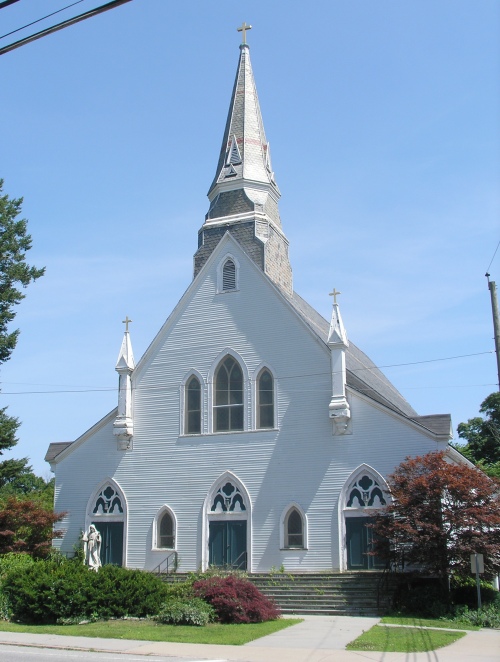
While Harriet Beecher Stowe’s novel Oldtown Folks depicts life in South Natick at a time in the late eighteenth century, when Congregationalists still dominated New England towns, other denominations would be established in the course of the nineteenth century. The first Catholic Church in Natick was Sacred Heart, constructed between 1873 and 1889 on Eliot Street. Services were held in the church before it was finally completed, with members meeting in the basement, sitting on plank and barrel benches, on Easter Sunday 1874. Sacred Heart Parish continued for 130 years, but was closed at Christmas 2004. The Archdiocese of Boston announced the closing of several parishes due to a shortage of priests and dwindling attendance and, perhaps, the financial impact of the priest sex abuse scandal. Most members of Sacred Heart soon joined other parishes, but others protested the decision. The appeals of Sacred Heart and nine other Boston-area parishes were denied by the Vatican earlier this year, although vigils continue at many closed parishes.

Church of St. John the Evangelist (1831)

by Dan/May 9, 2010/Boston, Churches, Gothic

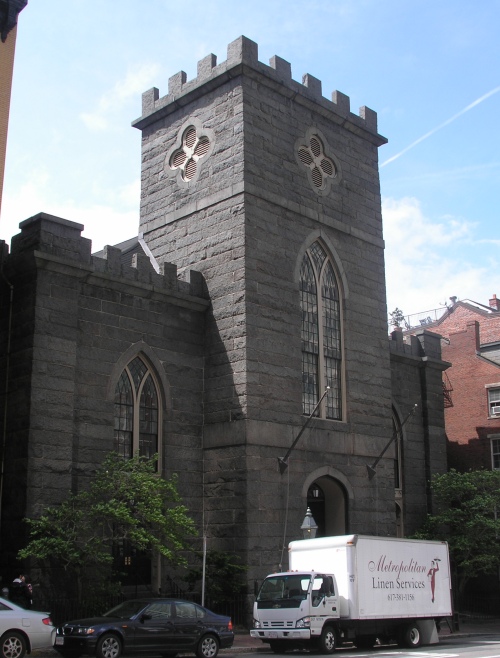
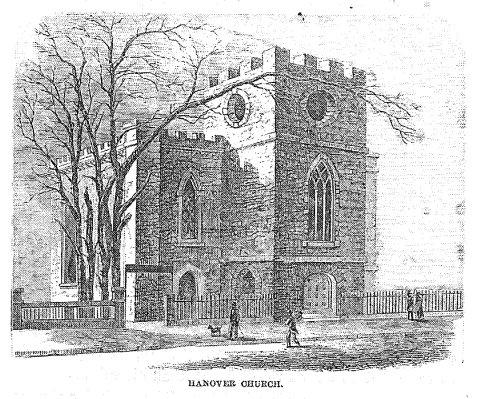
The Church of St. John the Evangelist, on Bowdoin Street in Boston, was built in 1831 for the congregation of Rev. Lyman Beecher, father of Harriet Beecher Stowe. The congregation began at a church on Hanover Street, called the Hanover Church, built in 1826. After the church burned in 1830, the congregation built and consecrated the Bowdoin Street Church. Typical of early New England Gothic Revival churches, the design of the building has been attributed to Solomon Willard, architect of the Bunker Hill Monument. In 1831, Lowell Mason, famous composer of hymns, became choirmaster at the church. Rev. Beecher left his church in Boston in 1832, to become the first president of Lane Theological Seminary in Cincinnati. The church became the Church of the Advent (from 1863 to 1883) and then the Mission Church of St. John the Evangelist under the auspices of the Society of St. John the Evangelist, an Anglican monastic order. The church has been a Parish Church in the Episcopal Diocese of Massachusetts since 1985.

Matthews Hall, Harvard (1872)

by Dan/March 21, 2010March 21, 2010/Cambridge, Collegiate, Gothic

According to the Official guide to Harvard University of 1907:

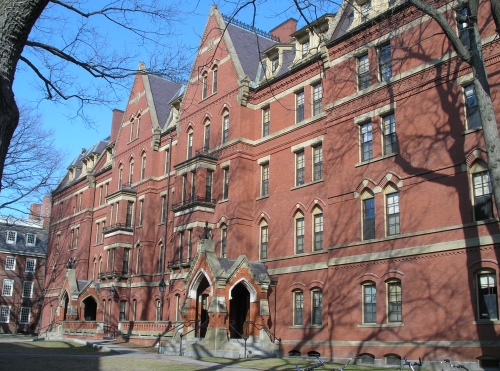
Matthews Hall, completed in 1872, at a cost of about $113,000, was the gift of Nathan Matthews, of Boston, who stipulated that half the net income from the dormitory should be used to aid needy and deserving scholars; students for the ministry of the Protestant Episcopal Church and sons of ministers of that church to be preferred. The fifteen Matthews Scholarships were thus established. This dormitory, containing 60 suites of rooms, is thought to stand on the site of the old Indian College, built in 1654.

When Matthews Hall was built, an earlier brick building, Dane Hall, had to be moved seventy feet to the south to make room. The new building, designed by Peabody and Stearns, has Ruskin-inspired Gothic ornamentation, but is symmetrical in its plan, maintaining a balance consistent with earlier buildings in Harvard Yard. Matthews Hall has had a number of interesting past residents, including Matt Damon, Chuck Schumer, Barney Frank, William Randolph Hearst, John Dos Passos and Ernest Thayer.

St. Michael’s Cathedral, Springfield (1860)

by Dan/January 31, 2010January 31, 2010/Churches, Gothic, Springfield

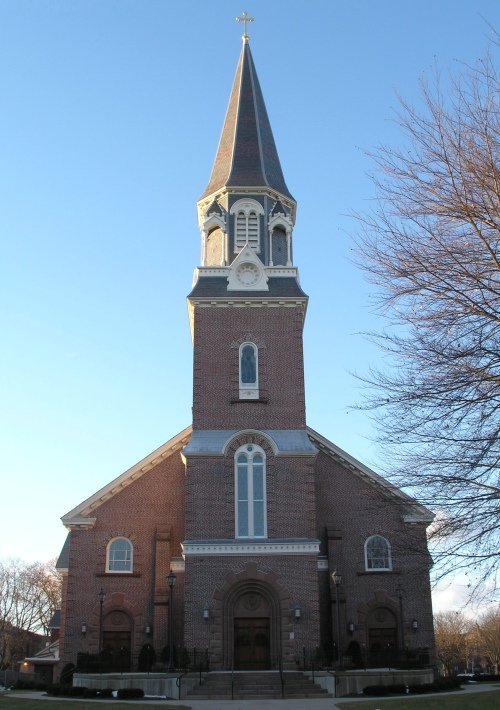
Built in 1860, Saint Michael’s Cathedral, on State Street in Springfield, is the mother church of the Roman Catholic Diocese of Springfield. The Cathedral was designed by the prominent church architect, Patrick Keely. The interior has many examples of Keely’s ornate plasterwork. The Cathedral was expanded in 1996 with the addition of a new wing called the Bishop Marshall Center.

Stephen Colton House (1850)

by Dan/July 18, 2009September 17, 2016/Gothic, Houses, Longmeadow

Stephen Colton House

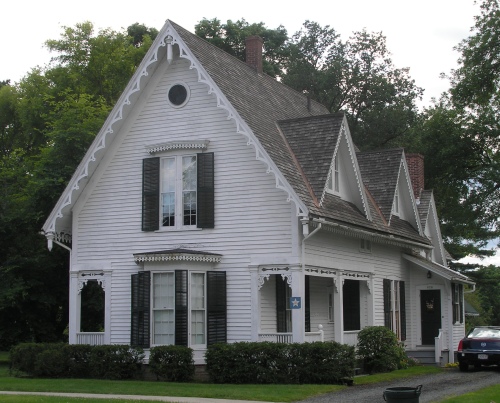
Built off Longmeadow Green in the 1850s, the home of Stephen Colton is an excellent example of a Gothic Revival cottage. It was based on the ideas of Andrew Jackson Downing, specifically the plan for a “symmetrical cottage,” from his book, The Architecture of Country Houses (1850). A Stephen T. Colton is listed as having served as selectman in Longmeadow in the 1850s and during the Civil War.

Posts navigation

Older posts
Newer posts
Privacy Policy

Categories

  • Architectural Style (943)
    • Art Deco (9)
    • Byzantine (3)
    • Colonial (177)
    • Colonial Revival (85)
    • Craftsman (6)
    • Egyptian Revival (1)
    • Federal (190)
    • Foursquare (6)
    • Gothic (67)
    • Greek Revival (100)
    • Italianate (82)
    • Mission Revival (2)
    • Mission/Spanish Colonial (1)
    • Modern (2)
    • Neoclassical (56)
    • Octagon (3)
    • Postmodern (1)
    • Queen Anne (46)
    • Renaissance Revival (26)
    • Romanesque Revival (53)
    • Second Empire (26)
    • Shingle Style (12)
    • Stick Style (13)
    • Tudor Revival (8)
    • Vernacular (49)
    • Victorian Eclectic (15)
  • Building Type (943)
    • Apartment Buildings (8)
    • Banks (18)
    • Churches (119)
    • Collegiate (32)
    • Commercial (102)
    • Hotels (16)
    • Houses (508)
    • Industrial (23)
    • Libraries (22)
    • Lighthouses (1)
    • Military (15)
    • Monuments (1)
    • Museums (12)
    • Organizations (39)
    • Outbuildings (17)
    • Public Buildings (50)
    • Schools (23)
    • Stations (5)
    • Synagogues (1)
    • Taverns (21)
    • Theaters (9)
  • Town (943)
    • Adams (11)
    • Agawam (4)
    • Amherst (50)
    • Boston (64)
    • Boylston (6)
    • Cambridge (30)
    • Clinton (21)
    • Concord (15)
    • Cummington (1)
    • Danvers (14)
    • Deerfield (31)
    • Gloucester (18)
    • Granville (10)
    • Great Barrington (2)
    • Hadley (9)
    • Hancock (15)
    • Harvard (32)
    • Holyoke (47)
    • Lenox (5)
    • Lexington (8)
    • Longmeadow (32)
    • Marblehead (40)
    • Marlborough (4)
    • Natick (22)
    • Newton (2)
    • Northampton (68)
    • Peabody (4)
    • Pittsfield (20)
    • Salem (110)
    • Saugus (4)
    • Sheffield (4)
    • South Hadley (8)
    • Southborough (8)
    • Southwick (4)
    • Springfield (67)
    • Stockbridge (19)
    • Stow (1)
    • Sturbridge (18)
    • Sudbury (7)
    • Waltham (11)
    • Watertown (1)
    • Wayland (8)
    • West Springfield (14)
    • Westfield (46)
    • Weston (2)
    • Worcester (26)
  • Uncategorized (1)

Recent Comments

  • Wilber Blackson on South Hadley
  • Tami Speiden on Stockbridge
  • DexGuru on Stockbridge

Tags

Alcott Amherst College Asher Benjamin Back Bay Baptist Beacon Hill Big E Black Heritage Trail bowfront Bulfinch Catholic Congregational Episcopal Freedom Trail Gambrel H.H. Richardson Harvard Hawthorne Historic Deerfield Isaac Damon lit Longfellow mansard Methodist Mount Holyoke Museum Museums NPS Old Sturbridge Village PEM Revolutionary War row houses saltbox Samuel McIntire Shakers Smith College SPNEA Springfield Armory Stephen C. Earle Storrowton Underground Railroad UU Washington William Fenno Pratt Witch Trials

Meta

  • Log in
  • Entries feed
  • Comments feed
  • WordPress.org
Proudly powered by WordPress | Theme: ShowMe by NEThemes.