Historic Buildings of Massachusetts

  • About
  • Index by Town
  • CT
  • About
  • Index by Town
  • CT

Category: Churches

St. Peter and St. Paul Orthodox Church (1944)
by Dan/September 16, 2012/Byzantine, Churches, Romanesque Revival, Springfield

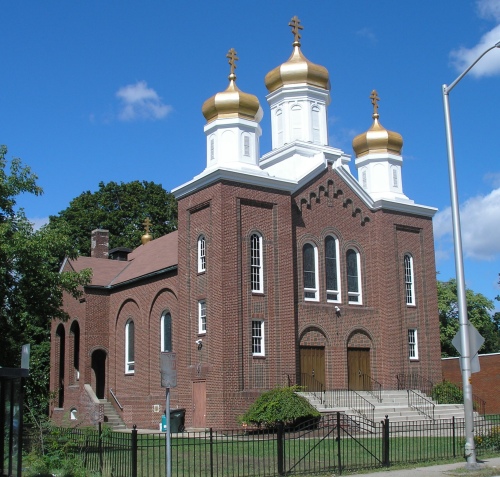
St. Peter & St. Paul Orthodox Church in Springfield was founded as St. Nicholas Russian Orthodox Church in 1916. The congregation’s first church was a brick house on Carew Street in the city’s North End, which was purchased in 1917. The church was reorganized in 1928, when it took the name of St. Peter and St. Paul Russian Orthodox Church. The original church building was later replaced by the current church, built in 1944 and designed by Arthur A. Smith. The church, which is located at 118 Carew Street, won a Preservation Award from the Springfield Preservation Trust in 2008 for the re-gilding of its onion domes in gold leaf.
Holy Trinity Greek Orthodox Church, Holyoke (1917)

by Dan/September 9, 2012/Byzantine, Churches, Holyoke

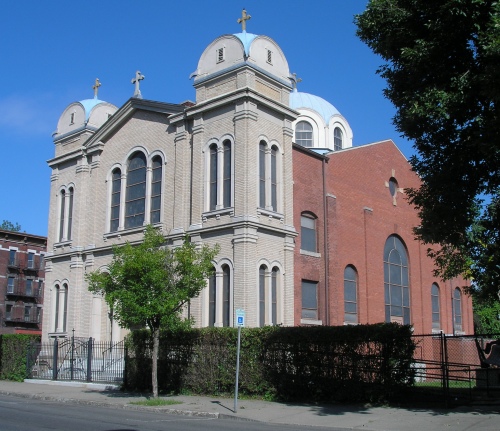
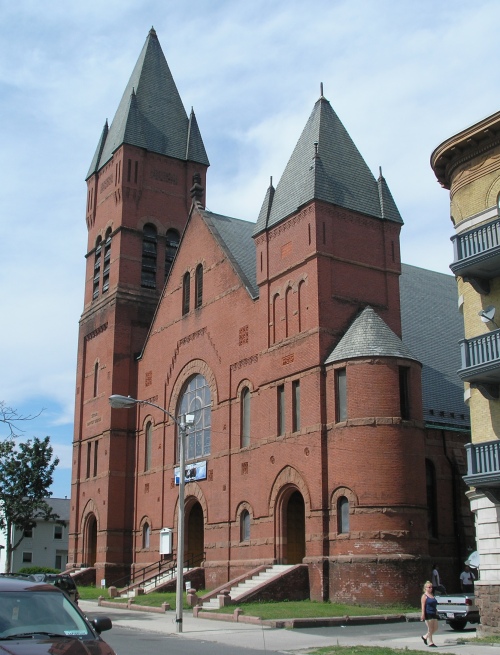
The Divine Liturgy of St. John Chrysostom was celebrated for the first time in Holyoke in 1911 and Greek Orthodox services began to be regularly held in the city by 1914. Holy Trinity Greek Orthodox Church was built in 1916-1917. Two decades later, the mortgage for the church was retired. The Consecration of the edifice, located at 410 Main Street, took place on November 30, 1938. The church was designed by the well known Greek architect, Kyriakos Kalfas of New York City. He modeled its Byzantine design on that of the Church of the Pantocrator in Patras, Greece. A fire on January 31, 1977 extensively damaged the church, but rebuilding process soon began. Services resumed in the church by July 1978 and the building was consecrated again on October 7, 1979.

Second Baptist Church, Holyoke (1885)

by Dan/September 2, 2012January 23, 2020/Churches, Holyoke, Romanesque Revival

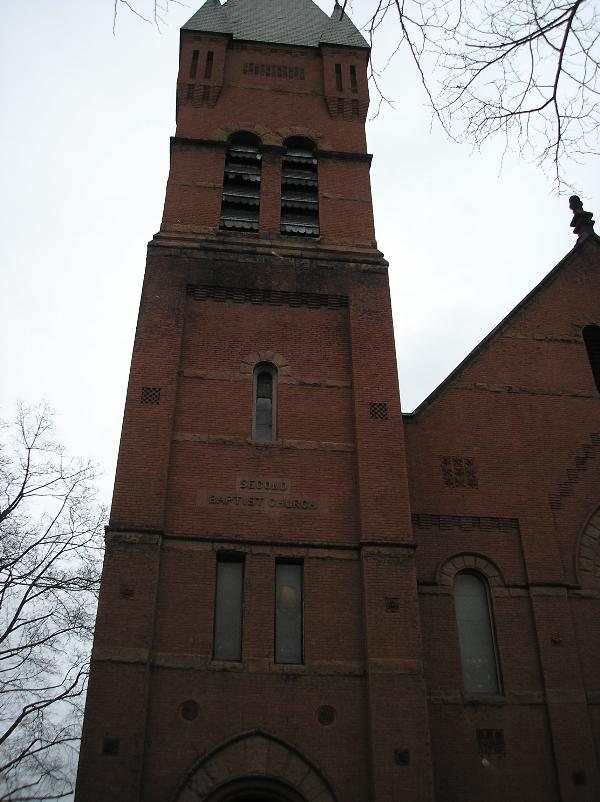
The Second Baptist Church of Holyoke was organized in 1849 and the new society’s first place of worship was Gallaudet and Terry’s Hall, at the corner of High and Lyman streets. They soon moved to Chapin Hall, where services were held until 1855, when the vestry of their new brick church was built on Main Street. The church was completed in 1859, but was destroyed in a fire in 1863. The church was rebuilt and rededicated in 1865. Their next church, at the corner of Appleton and Walnut streets, was built in 1885. In 1986, the church moved across the Connecticut River to become the Second Baptist Church of South Hadley. Their former church building in Holyoke is now the Iglesia de Dios Incomparable. UPDATE: The church was ordered temporarily closed by the city building inspector in 2018 after a partial collapse of the steeple.

St. Michael’s Episcopal Church, Marblehead (1714)

by Dan/July 17, 2012/Churches, Colonial, Marblehead

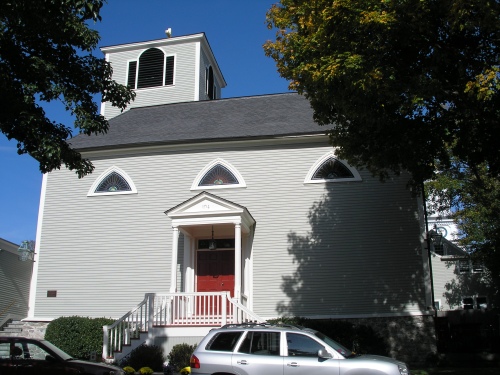
Located at 26 Pleasant Street in Marblehead, St. Michael’s Episcopal Church is the oldest Episcopal church building on its original site in New England. Founded by a group of donors consisting primarily of sea captains, the church was built in 1714, with many of its original materials being shipped from Great Britain. The original square church was expanded by one third in 1728 with a new roof. During the Revolutionary War in 1776, patriots raided the church and removed the British royal coat of arms. Many of St. Michael’s members at the time were Loyalists who fled to Canada. As related in Historic churches of America (1907), by Nellie Urner Wallington:

In the course of time, as one by one the families of the communicants died or removed to distant localities, the parish was so depleted that in 1818 funds were no longer forthcoming for the support of the church. The church building was closed, and the glebe sold to pay off the debt of the parish. In 1833, however, vigorous attempts on the part of the Congregationalists to secure possession of the church edifice roused the whole Episcopal church of the United States, until parish after parish contributed aid and old St. Michael’s was once more set upon its feet.

The church‘s current stained glass windows were installed in 1888.

South Congregational Church, Springfield (1875)

by Dan/April 8, 2012/Churches, Gothic, Springfield

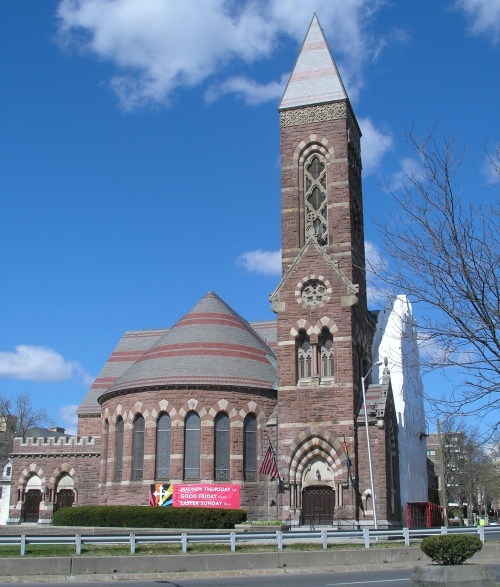
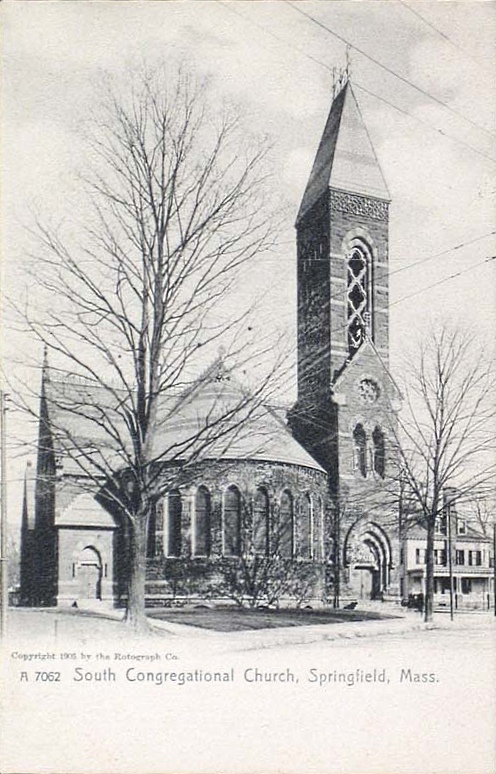
Happy Easter!!! South Congregational Church in Springfield was organized in 1842. According to the “Historical Discourse” by Rev. S.G. Buckingham, published in The Fortieth Anniversary of the South Congregational Church of Springfield, Sunday, March 26, 1882:

The society proceeded at once to “purchase land for a Meeting House, and take all necessary measures for building said House;” also to “employ a minister and provide for public worship.” This was no trifling undertaking, for the number engaged in it was small, and they had none of the wealth now found here, and little of the means which any such enterprise could command now. There were only twenty persons organized into the parish, and forty made up the whole number of the original church. […] And when a lot was to be selected, it was taken upon a side street, and not upon Main street, rather than incur an additional indebtedness of $650—so careful were they about incurring a debt that might be burdensome, and yet so resolute in carrying forward their enterprise. That house of worship was located on Bliss street, a white wooden structure with a spire, and a chapel a little one side, with a study attached. It was a pleasant, comfortable church with galleries, seating about six hundred, and cost $9,463. […] The church was completed and dedicated January 12, 1843 […]

The time came, at length, when one more important step must be taken, before the church could be permanently established, and prosecute its work to best advantage. A new house of worship must be erected, and the location must be changed. Our people were moving away from the neighborhood of the old church, and the Protestant population in the vicinity was diminishing. Besides, we needed ampler and better accommodations. […] The site for the New Church, on the corner of Maple and High streets, was decided upon, and the work of building commenced, in the spring of 1873. The corner-stone was laid, with appropriate religious services, Saturday afternoon, July 19. […] This church was completed and dedicated, February 24, 1875[.]

The architect of the new church was William Appleton Potter. He had received his professional training in the office half-brother, the architect Edward Tuckerman Potter, who designed the Mark Twain House in Hartford, Connecticut. William’s High Victorian Gothic-style South Congregational Church shares many similarities with Edward’s Church of the Good Shepherd in Hartford.

Christ Church Cathedral, Springfield (1876)

by Dan/April 7, 2012April 8, 2012/Churches, Gothic, Springfield

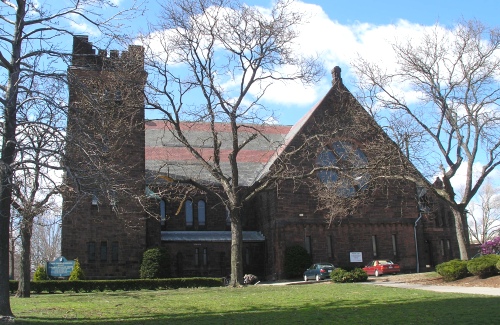
Christ Church in Springfield began in 1817, when the Episcopalian commander of the Springfield Armory, Col. Roswell Lee, established a chapel on the second floor of a small building on the armory grounds. When a fire destroyed the main arsenal in 1824, Springfield Episcopalians worshiped at several different temporary locations until construction began in 1839 on a church at State and Dwight Streets. The church was enlarged in 1851, but further growth necessitated the building of a new church. A Norman Gothic structure of Longmeadow brownstone, it was designed by architect Stephen C. Earle of Worcester and was built on Chestnut Street in 1874-1876. Within a year, the church’s tower cracked and was dismantled for safety reasons. It was not rebuilt until 1927. In 1929, Christ Church became the Cathedral of the Episcopal Diocese of Western Massachusetts.

Feeding Hills Congregational Church (1834)

by Dan/April 5, 2012/Agawam, Churches, Greek Revival

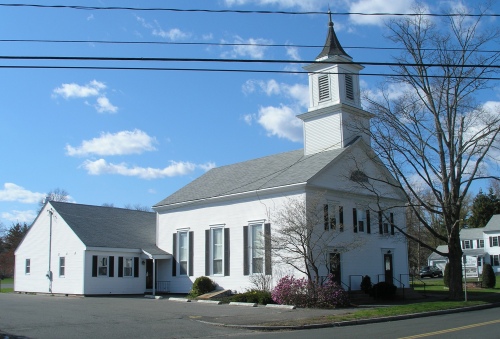
The origins of the Congregational church in the Feeding Hills section of Agawam (pdf) go back to 1757, when Agawam became the sixth parish of Springfield. A church was then organized in 1762. West Springfield was incorporated as a town in 1774, with Agawam as its second parish. Agawam and Feeding Hills were divided into two distinct parishes within the town in 1800. The previously shared meeting house, located between the two villages, was moved to Feeding Hills in 1799 and the Agawam parish built its own new meetinghouse in 1803. Agawam, including Feeding Hills, became a separate town in 1855. The current Greek Revival-style meetinghouse of the Feeding Hills Congregational Church was built in 1834.

Posts navigation

Older posts
Newer posts
Privacy Policy

Categories

  • Architectural Style (943)
    • Art Deco (9)
    • Byzantine (3)
    • Colonial (177)
    • Colonial Revival (85)
    • Craftsman (6)
    • Egyptian Revival (1)
    • Federal (190)
    • Foursquare (6)
    • Gothic (67)
    • Greek Revival (100)
    • Italianate (82)
    • Mission Revival (2)
    • Mission/Spanish Colonial (1)
    • Modern (2)
    • Neoclassical (56)
    • Octagon (3)
    • Postmodern (1)
    • Queen Anne (46)
    • Renaissance Revival (26)
    • Romanesque Revival (53)
    • Second Empire (26)
    • Shingle Style (12)
    • Stick Style (13)
    • Tudor Revival (8)
    • Vernacular (49)
    • Victorian Eclectic (15)
  • Building Type (943)
    • Apartment Buildings (8)
    • Banks (18)
    • Churches (119)
    • Collegiate (32)
    • Commercial (102)
    • Hotels (16)
    • Houses (508)
    • Industrial (23)
    • Libraries (22)
    • Lighthouses (1)
    • Military (15)
    • Monuments (1)
    • Museums (12)
    • Organizations (39)
    • Outbuildings (17)
    • Public Buildings (50)
    • Schools (23)
    • Stations (5)
    • Synagogues (1)
    • Taverns (21)
    • Theaters (9)
  • Town (943)
    • Adams (11)
    • Agawam (4)
    • Amherst (50)
    • Boston (64)
    • Boylston (6)
    • Cambridge (30)
    • Clinton (21)
    • Concord (15)
    • Cummington (1)
    • Danvers (14)
    • Deerfield (31)
    • Gloucester (18)
    • Granville (10)
    • Great Barrington (2)
    • Hadley (9)
    • Hancock (15)
    • Harvard (32)
    • Holyoke (47)
    • Lenox (5)
    • Lexington (8)
    • Longmeadow (32)
    • Marblehead (40)
    • Marlborough (4)
    • Natick (22)
    • Newton (2)
    • Northampton (68)
    • Peabody (4)
    • Pittsfield (20)
    • Salem (110)
    • Saugus (4)
    • Sheffield (4)
    • South Hadley (8)
    • Southborough (8)
    • Southwick (4)
    • Springfield (67)
    • Stockbridge (19)
    • Stow (1)
    • Sturbridge (18)
    • Sudbury (7)
    • Waltham (11)
    • Watertown (1)
    • Wayland (8)
    • West Springfield (14)
    • Westfield (46)
    • Weston (2)
    • Worcester (26)
  • Uncategorized (1)

Recent Comments

  • Wilber Blackson on South Hadley
  • Tami Speiden on Stockbridge
  • DexGuru on Stockbridge

Tags

Alcott Amherst College Asher Benjamin Back Bay Baptist Beacon Hill Big E Black Heritage Trail bowfront Bulfinch Catholic Congregational Episcopal Freedom Trail Gambrel H.H. Richardson Harvard Hawthorne Historic Deerfield Isaac Damon lit Longfellow mansard Methodist Mount Holyoke Museum Museums NPS Old Sturbridge Village PEM Revolutionary War row houses saltbox Samuel McIntire Shakers Smith College SPNEA Springfield Armory Stephen C. Earle Storrowton Underground Railroad UU Washington William Fenno Pratt Witch Trials

Meta

  • Log in
  • Entries feed
  • Comments feed
  • WordPress.org
Proudly powered by WordPress | Theme: ShowMe by NEThemes.