Historic Buildings of Massachusetts

  • About
  • Index by Town
  • CT
  • About
  • Index by Town
  • CT

Category: Churches

Old First Church, Springfield (1819)
by Dan/January 1, 2009September 9, 2012/Churches, Federal, Springfield

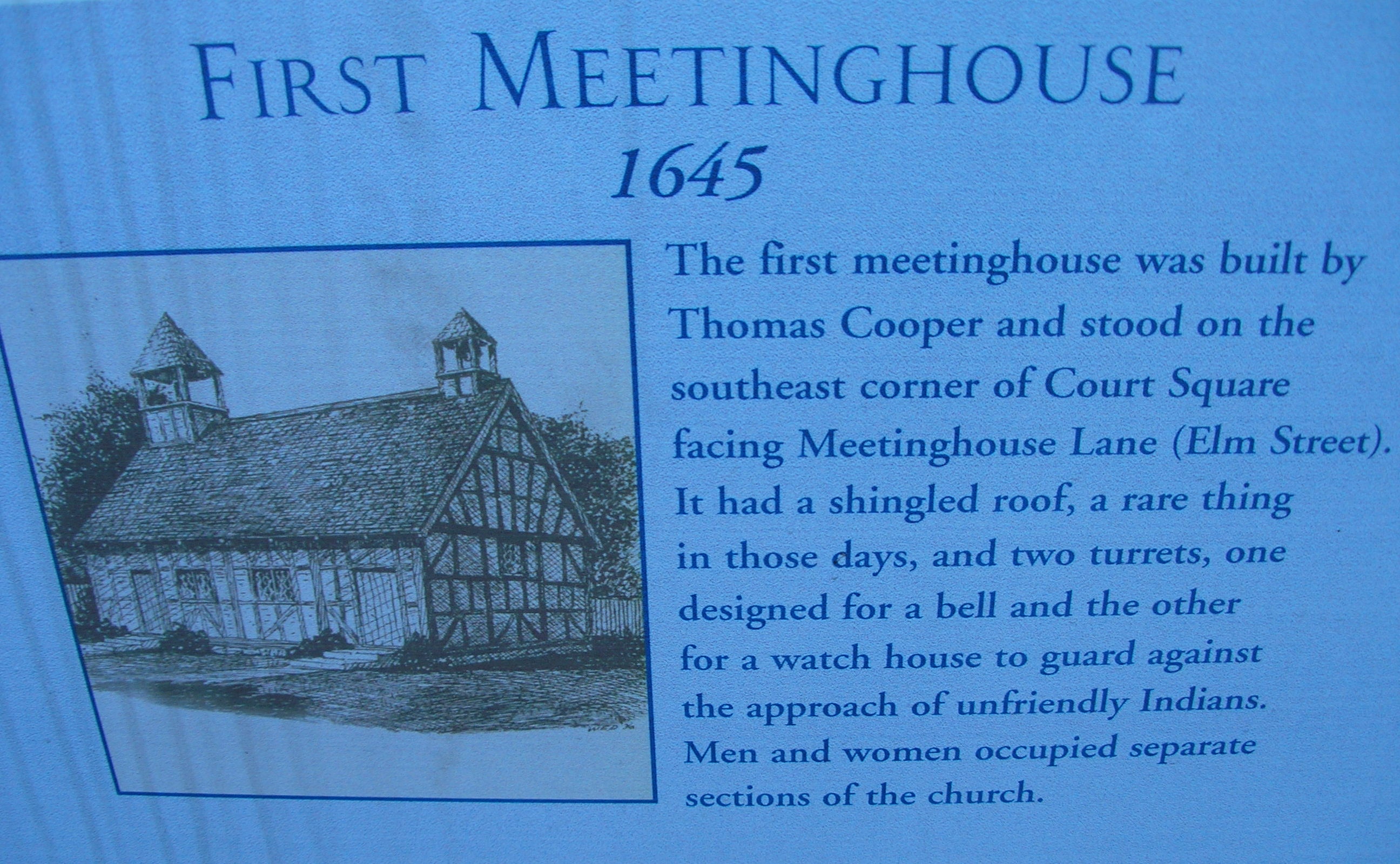
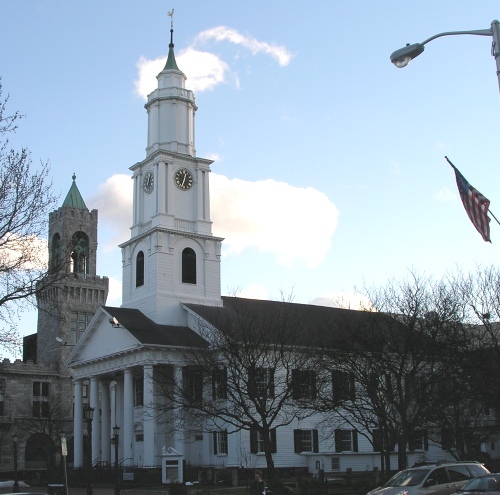
The first Puritan settlers arrived in Springfield from Roxbury in 1636 and organized their church congregation in 1637, with George Moxon as their first minister. The first meetinghouse was built on the southeast corner of Court Square in 1645. It had a shingled roof and two turrets, one used for a bell and the other to guard against attacks by Indians. The second meeting house replaced the first in 1677. The third church building, built in 1752, had a steeple with a clock and a Rooster weathervane, one of three shipped to the colonies in 1750 (the other two went to First Church in Newburyport and South Church in Boston). The weathervane continued to be used on the fourth church building, built in 1819. The church’s most recent organ, built in 1958, was restored in 1997. The First Congregational Church continued to be used for services until the end of 2007, when declining membership led to the closure of the church and the disbanding of the congregation. In March, the city purchased the church, weathervane and organ, but many were concerned when the congregation auctioned off a number of historic items in April. The congregation eventually repurchased the valuable items and donated them to the Springfield Museums Association.
First Congregational Church of Hadley (1808)

by Dan/December 27, 2008February 20, 2009/Churches, Federal, Hadley

hadley-congregational-church.jpg

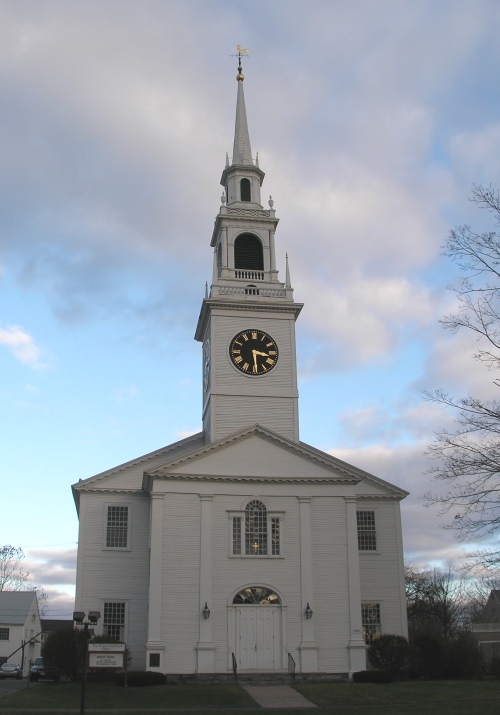
The current meeting house of the First Congregational Church of Hadley, on Middle Street, was built in 1808. The congregation dates back to 1659. The original meeting house was not built right away: although the town had planned to construct it in 1661, work did not begin until 1663 and it took seven years to complete. “Probably during this time meetings were held in the home of some leading church member.” By 1713, “The little old first edifice was falling in pieces,” and the Town decided to build a new church, completed in 1714. This was later replaced by the current building at the same location.

Old South Meeting House (1729)

by Dan/December 19, 2008March 29, 2013/Boston, Churches, Colonial

old-south-church.jpg

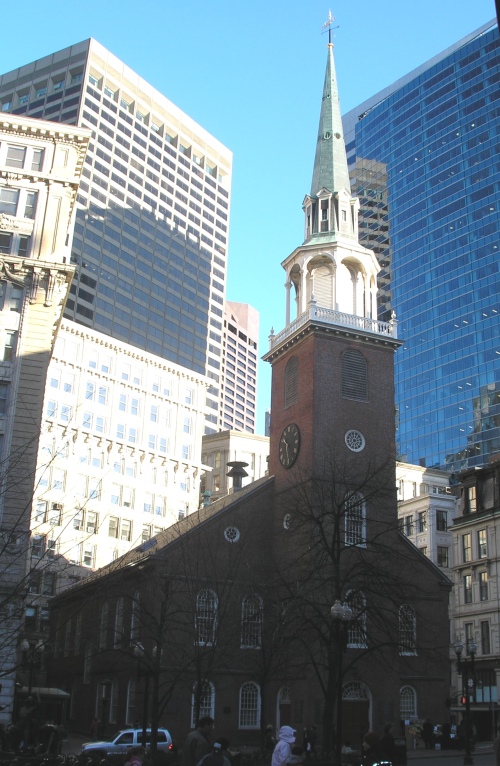
Built in 1729, Boston’s Old South Meeting House was the largest building in the colonial town. The congregation began in 1669, when it separated from Boston’s First Church (becoming the Third Church of Boston). In the years immediately preceding the outbreak of the American Revolution, citizens would gather in the Old South Meeting House to debate and argue in the aftermath of events like the Boston Massacre. On the night of December 16, 1773, over 5,000 colonists, angered over the tax on tea, met at Old South and after hours of debate, Samuel Adams gave a secret signal which began the famous Boston Tea Party. During the war, occupying British troops took revenge for the Tea Party by ripping out the church‘s pews and using the building as a riding stable. They also set up a bar on the first balcony. The church continued to be used as a house of worship, but after it was nearly destroyed in the Great Boston Fire of 1872, the congregation built the New Old South Church at Copley Square. In danger of being torn down, pioneering preservation efforts led to the restoration of the building, which has been a museum and historic site since 1877. It is also a stop on the Boston Freedom Trail. The steeple has been replaced twice, after storms in 1804 and 1954.

New Old South Church (1875)

by Dan/October 6, 2008March 21, 2009/Boston, Churches, Gothic

new-old-south-church.jpg

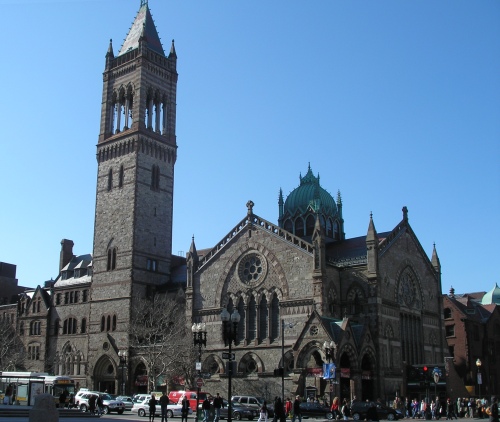
Boston’s New Old South Church, on Boylston Street, is located off Copley Square, not far from Trinity Church, and was built in 1874-5. At that time, the congregation moved from its famous eighteenth century meetinghouse. Designed in a Venetian or Northern Italian Gothic style by Charles Cummings, based on the High Victorian Gothic ideas of John Ruskin, the church makes a strong architectural statement on its prominent corner location, contrasting with the neoclassical Boston Public Library across the street. John Evans, a sculptor from Scotland, carved the exterior sculpture of both New Old South and Trinity churches. The original tower began to lean and was removed in 1931, eventually being replaced by a newer and shorter tower in 1941.

Trinity Church, Boston (1877)

by Dan/October 6, 2008December 30, 2012/Boston, Churches, Romanesque Revival

trinity-church.jpg

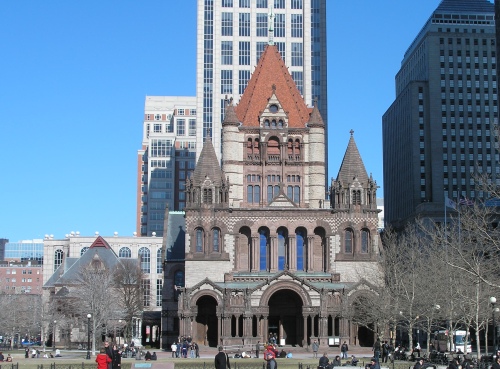
Boston’s Trinity Parish (established in 1734) lost its church on Summer Street in an 1872 fire. They held a design competition for the building of a new church on Copley Square. The winner was H. H. Richardson, whose Romanesque design contrasted with his competitors’ preference for the Victorian Gothic. Richardson, who would produce in Trinity Church one of America’s great buildings, planned the building as a compact Greek Cross with a very prominent central tower. This centralized plan contrasted with the more typical narrow Latin Cross, in which clergy and congregation were separated. In the course of construction (1872-1877), the plan for the tower was eventually altered to a more complex design, inspired by the Cathedral of Salamanca and possibly influenced by Stanford White, who was apprenticing under Richardson at the time. Granite and Longmeadow sandstone were used in the construction. The interiors were realized by the artist, John La Farge, assisted by Augustus Saint-Gaudens. Richardson wished to rebuilt the two front towers, lowering them. Alterations were eventually made after his death when the portico and new towers were added between 1894 and 1897 under the successor of his practice, Hugh Shapley (of Shapley, Rutan, and Coolidge). More recently, geothermal wells have been drilled for heating and cooling. The adjoining Parish House (1874) has features which link it stylistically to the church.

Memorial Church, Harvard (1931)

by Dan/July 29, 2008/Cambridge, Churches, Collegiate, Colonial Revival

memorial-church.jpg

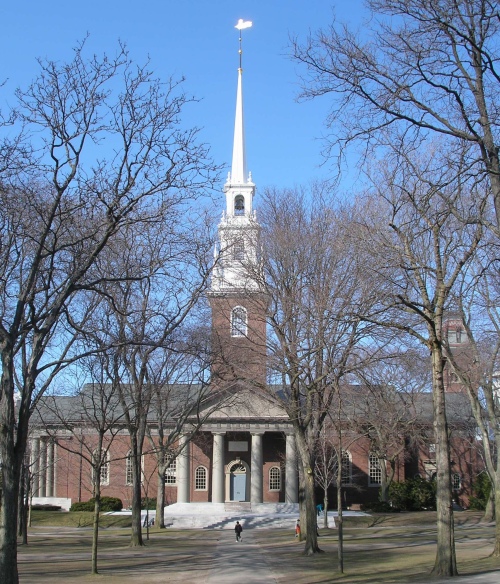
Built to face the massive Widener Library across Harvard Yard, Memorial Church was built in 1931-2 and dedicated on Armistice Day 1932 in honor of those who died in World War I. Memorials to Harvard students who died in later wars have since been added inside the church. Memorial Church was designed in the Georgian Revival style by the architectural firm of Coolidge Shepley Bulfinch and Abbot.

Charles Street Meeting House (1804)

by Dan/July 29, 2008/Boston, Churches, Federal

charles-street-meeting-house.jpg

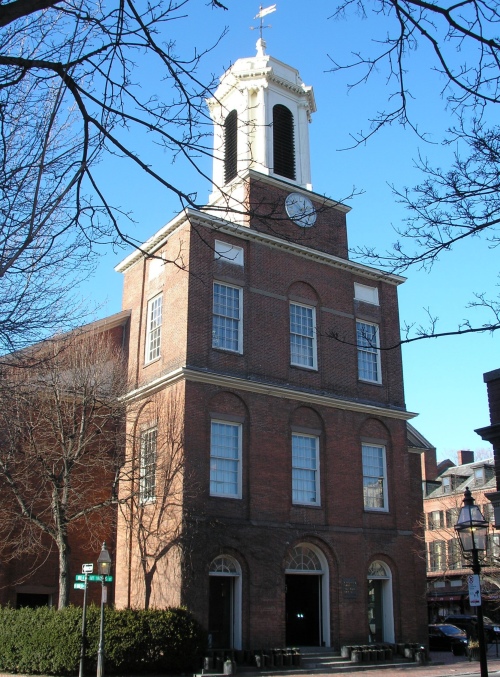
Designed by Asher Benjamin in 1804, the Charles Street Meeting House in Boston’s Beacon Hill neighborhood began as the Third Baptist Church of Boston (it was built on reclaimed land near the Charles River where baptisms could be performed). In the 1830s, abolitionist members, led by Timothy Gilbert, challenged the church’s segregationist seating arrangements and went on to found the integrated Tremont Temple Baptist Church. In the years before the Civil War, the church became a center of abolitionism, with many notable speakers addressing audiences there, including William Lloyd Garrison, Wendell Phillips, Frederick Douglass, Harriet Tubman and Sojourner Truth. From 1876 to 1939, the building was the African Methodist Episcopal Church. In 1920, the church was moved ten feet west to accommodate the widening of Charles Street. With the departure of the African-American community from the north slope of Beacon Hill, it served as an Albanian Orthodox Church and lastly a Unitarian Universalist Church to 1979. In the 1980s, the Charles Street Meeting House was converted to secular use as offices. The building is on the Black Heritage Trail.

Posts navigation

Newer posts
Privacy Policy

Categories

  • Architectural Style (943)
    • Art Deco (9)
    • Byzantine (3)
    • Colonial (177)
    • Colonial Revival (85)
    • Craftsman (6)
    • Egyptian Revival (1)
    • Federal (190)
    • Foursquare (6)
    • Gothic (67)
    • Greek Revival (100)
    • Italianate (82)
    • Mission Revival (2)
    • Mission/Spanish Colonial (1)
    • Modern (2)
    • Neoclassical (56)
    • Octagon (3)
    • Postmodern (1)
    • Queen Anne (46)
    • Renaissance Revival (26)
    • Romanesque Revival (53)
    • Second Empire (26)
    • Shingle Style (12)
    • Stick Style (13)
    • Tudor Revival (8)
    • Vernacular (49)
    • Victorian Eclectic (15)
  • Building Type (943)
    • Apartment Buildings (8)
    • Banks (18)
    • Churches (119)
    • Collegiate (32)
    • Commercial (102)
    • Hotels (16)
    • Houses (508)
    • Industrial (23)
    • Libraries (22)
    • Lighthouses (1)
    • Military (15)
    • Monuments (1)
    • Museums (12)
    • Organizations (39)
    • Outbuildings (17)
    • Public Buildings (50)
    • Schools (23)
    • Stations (5)
    • Synagogues (1)
    • Taverns (21)
    • Theaters (9)
  • Town (943)
    • Adams (11)
    • Agawam (4)
    • Amherst (50)
    • Boston (64)
    • Boylston (6)
    • Cambridge (30)
    • Clinton (21)
    • Concord (15)
    • Cummington (1)
    • Danvers (14)
    • Deerfield (31)
    • Gloucester (18)
    • Granville (10)
    • Great Barrington (2)
    • Hadley (9)
    • Hancock (15)
    • Harvard (32)
    • Holyoke (47)
    • Lenox (5)
    • Lexington (8)
    • Longmeadow (32)
    • Marblehead (40)
    • Marlborough (4)
    • Natick (22)
    • Newton (2)
    • Northampton (68)
    • Peabody (4)
    • Pittsfield (20)
    • Salem (110)
    • Saugus (4)
    • Sheffield (4)
    • South Hadley (8)
    • Southborough (8)
    • Southwick (4)
    • Springfield (67)
    • Stockbridge (19)
    • Stow (1)
    • Sturbridge (18)
    • Sudbury (7)
    • Waltham (11)
    • Watertown (1)
    • Wayland (8)
    • West Springfield (14)
    • Westfield (46)
    • Weston (2)
    • Worcester (26)
  • Uncategorized (1)

Recent Comments

  • Wilber Blackson on South Hadley
  • Tami Speiden on Stockbridge
  • DexGuru on Stockbridge

Tags

Alcott Amherst College Asher Benjamin Back Bay Baptist Beacon Hill Big E Black Heritage Trail bowfront Bulfinch Catholic Congregational Episcopal Freedom Trail Gambrel H.H. Richardson Harvard Hawthorne Historic Deerfield Isaac Damon lit Longfellow mansard Methodist Mount Holyoke Museum Museums NPS Old Sturbridge Village PEM Revolutionary War row houses saltbox Samuel McIntire Shakers Smith College SPNEA Springfield Armory Stephen C. Earle Storrowton Underground Railroad UU Washington William Fenno Pratt Witch Trials

Meta

  • Log in
  • Entries feed
  • Comments feed
  • WordPress.org
Proudly powered by WordPress | Theme: ShowMe by NEThemes.