Historic Buildings of Massachusetts

  • About
  • Index by Town
  • CT
  • About
  • Index by Town
  • CT

Category: Churches

Eliot Church, South Natick (1828)
by Dan/July 5, 2010/Churches, Federal, Natick

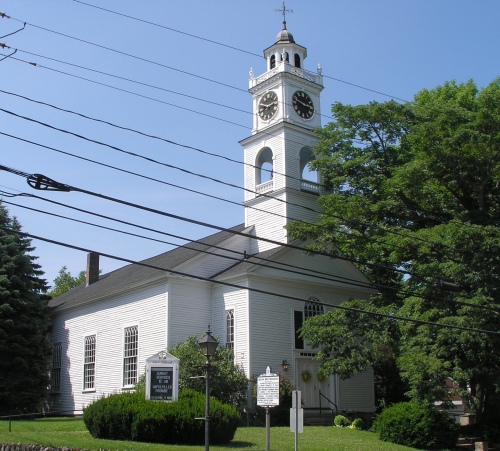
This week we will be looking at buildings in South Natick. The Puritan missionary John Eliot first settled Natick in 1651. It was the first of the towns he established for settlement by the Praying Indians, who had converted to Christianity. Eliot, working with Praying Indian translators, produced an Indian grammar and the Natick Bible. The Praying Indian village was in South Natick, along the banks of the Charles River. The Indian church that Eliot established in Natick in 1651 continued under his successor, the first Native American minister, Rev. Daniel Takawambpait. The church suffered through the breakup of the Praying Indian villages during King Philip’s War. By 1699, the original meeting house had fallen into disrepair, and the remaining Christian Indians of Natick petitioned the General Court to allow them to sell a portion of their plantation to John Coller, Jr., a carpenter, in exchange for his building them a new church. This was accomplished by 1702 and Daniel Takawambpait preached in the new church until his death in 1716.

Another new meeting house was built on the same site in 1721 and in 1729 a new church society was established, consisting of both Indians and English settlers, the latter of whom were rapidly migrating into the area. But the experiment of a communal church did not last: Indian membership continued to decline and the church experienced internal conflict over theological issues and the location of the new meeting house. It was begun, on the site of its predecessors, in 1749, but not finished until until 1767. This occurred during the tenure of Rev. Stephen Badger, last missionary to the Natick Praying Indians, whom many English-descended residents refused to accept as their minister. After Rev. Badger’s retirement in 1799 and death in 1803, the South Natick church was abandoned and in 1802, a new First Congregational Church was organized to the north, in what is now the center of Natick. In 1828, the South Parish Congregational Church was organized and built a church on the site of the four earlier Praying Indian meeting houses. The church became Unitarian in 1870, under the ministry of Rev. Horatio Alger, Sr. The building’s clock was installed in 1872 and the vestry was added in 1880. In 1944, the Unitarian church joined with the John Eliot Congregational Church, both of which had been experiencing financial difficulties, and the two churches used the Unitarian meeting house for worship. The congregations merged in 1990, becoming the united Eliot Church of South Natick.
Church of St. John the Evangelist (1831)

by Dan/May 9, 2010/Boston, Churches, Gothic

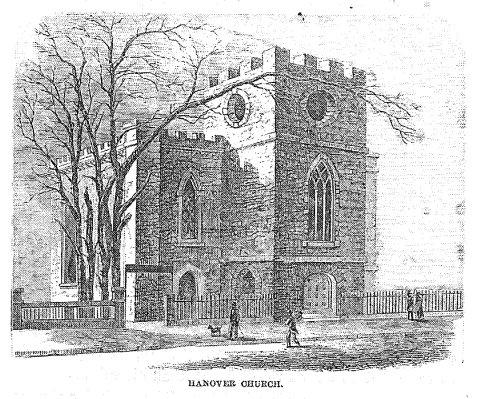
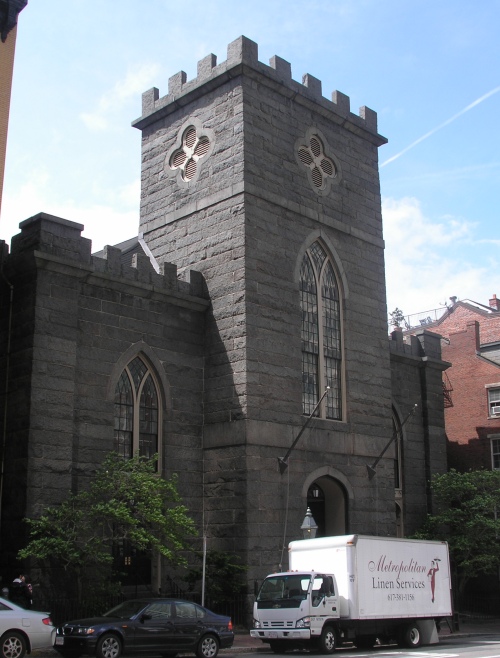
The Church of St. John the Evangelist, on Bowdoin Street in Boston, was built in 1831 for the congregation of Rev. Lyman Beecher, father of Harriet Beecher Stowe. The congregation began at a church on Hanover Street, called the Hanover Church, built in 1826. After the church burned in 1830, the congregation built and consecrated the Bowdoin Street Church. Typical of early New England Gothic Revival churches, the design of the building has been attributed to Solomon Willard, architect of the Bunker Hill Monument. In 1831, Lowell Mason, famous composer of hymns, became choirmaster at the church. Rev. Beecher left his church in Boston in 1832, to become the first president of Lane Theological Seminary in Cincinnati. The church became the Church of the Advent (from 1863 to 1883) and then the Mission Church of St. John the Evangelist under the auspices of the Society of St. John the Evangelist, an Anglican monastic order. The church has been a Parish Church in the Episcopal Diocese of Massachusetts since 1985.

African Meeting House, Boston (1806)

by Dan/May 6, 2010/Boston, Churches, Federal

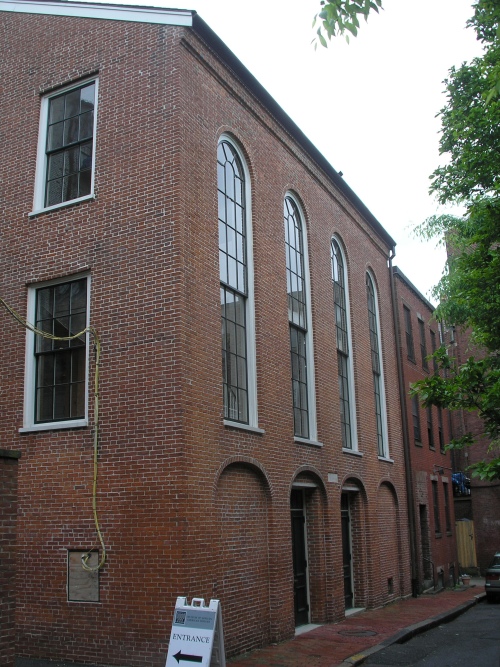
The African Meeting House on Beacon Hill in Boston was built in 1806 to house the first African Baptist Church of Boston, known as the First Independent Baptist Church. A commemorative inscription above the front door reads, “Cato Gardner, first Promoter of this Building 1806.” Cato Gardner, born in Africa, raised more than $1,500 toward the total $7,700 needed to construct the Meeting House. The building, which was constructed almost entirely with black labor, served as the cultural, educational and political center of Boston’s black community for many decades. In 1808, Primus Hall‘s school relocated from the adjacent carpenter’s shop to the Meeting House, using a schoolroom funded by Abiel Smith. It later moved to the Abiel Smith School next door. William Lloyd Garrison held the founding meeting of the New England Anti-Slavery Society in the Meeting House on January 6, 1832. The building, which has a facade adapted from the design for a townhouse published by Boston architect Asher Benjamin, was remodeled in the 1850s, with the windows being elongated and converted to having arched tops.

The Baptist congregation moved to Boston’s South End in 1898 and the Meeting House became the African Methodist Episcopal Church. By the late nineteenth century, many African Americans had moved to other neighborhoods and new immigrants occupied the neighborhood around the African Meeting House, which was sold in 1904 to the Hassidic Jewish Congregation Anshe Lebawitz. In 1972, the building was acquired by the Museum of African American History. The first phase of restoration work on the Meeting House was completed in 1987 and the building was opened to the public as a museum. The African Meeting House, the oldest surviving black church building in America, is also the last stop on the Black Heritage Trail.

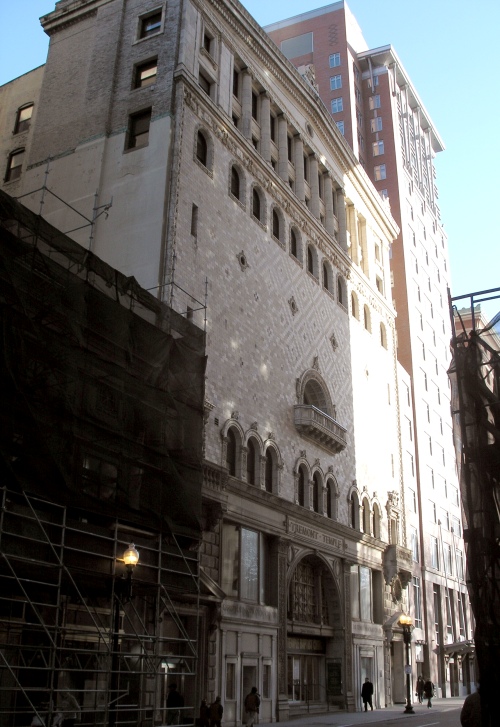
Tremont Temple (1896)

by Dan/March 7, 2010March 7, 2010/Boston, Churches, Renaissance Revival, Theaters

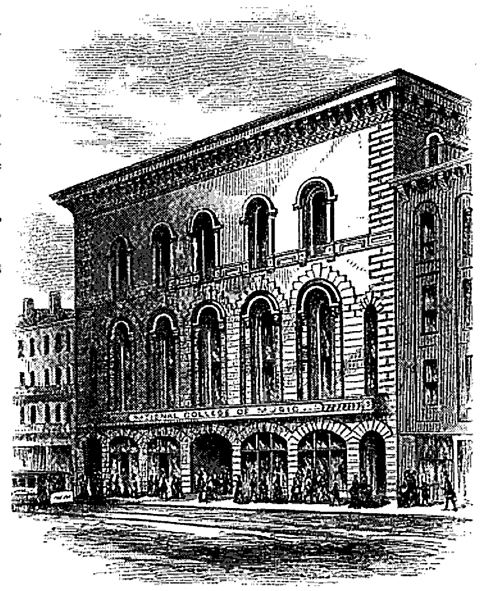
The original Tremont Theatre, on Tremont Street in Boston, was designed in the Greek Revival style by architect Isaiah Rogers and opened in 1827. Many famous actors, orators and singers appeared there over the years. In 1843, the building was purchased by the Free Church Baptists, Boston’s first integrated church, who renamed it the Tremont Temple Baptist Church. Thereafter, it was used as a church, although public events were often held there as well. The church burned and was rebuilt several times. The current building on the site was built in 1896, designed by Clarence Blackall. The church has a large sanctuary on the second floor, which was also used for a time as an auditorium. Originally, there were shops on the ground floor and commercial offices on the upper floors. Revenue from rents and auditorium rentals allowed the Church to provide free seats to all worshipers.

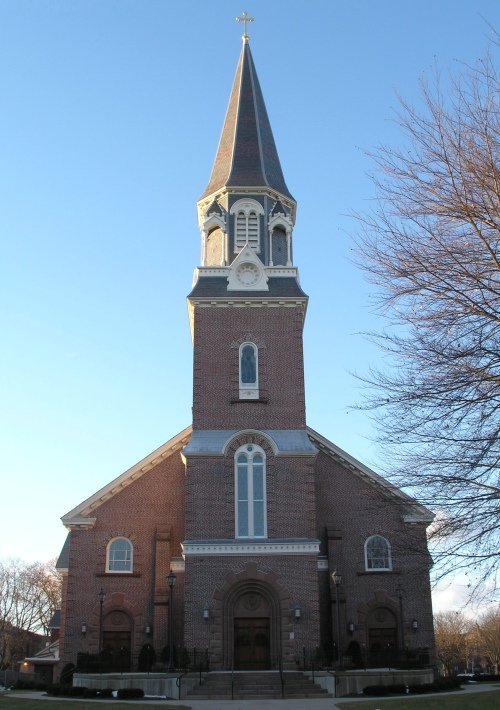
St. Michael’s Cathedral, Springfield (1860)

by Dan/January 31, 2010January 31, 2010/Churches, Gothic, Springfield

Built in 1860, Saint Michael’s Cathedral, on State Street in Springfield, is the mother church of the Roman Catholic Diocese of Springfield. The Cathedral was designed by the prominent church architect, Patrick Keely. The interior has many examples of Keely’s ornate plasterwork. The Cathedral was expanded in 1996 with the addition of a new wing called the Bishop Marshall Center.

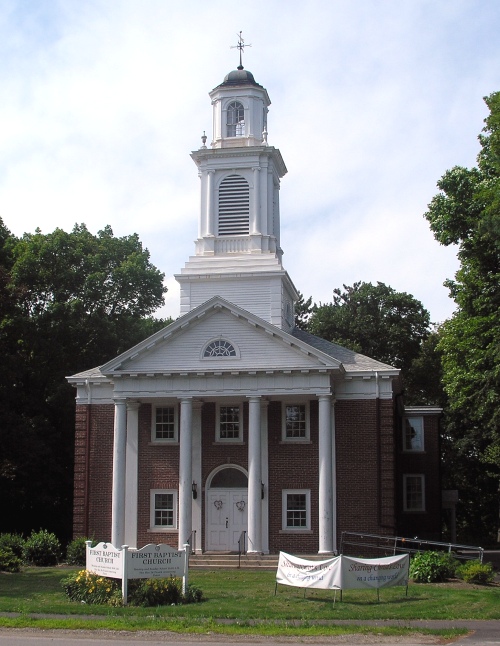
First Baptist Church of Weston (1924)

by Dan/January 17, 2010January 31, 2010/Churches, Colonial Revival, Weston

The Baptist Society in Weston was formed in 1784 and the first church building constructed on the north side of South Avenue in 1788. Until 1825, the Baptists were required to pay taxes to support the First Parish Church, although they frequently protested this at town meetings. The original church was replaced by a larger church on Boston Post Road in 1828. This wooden building remained in use until it was replaced by the current First Baptist Church of Weston, constructed on the same site and completed in 1924.

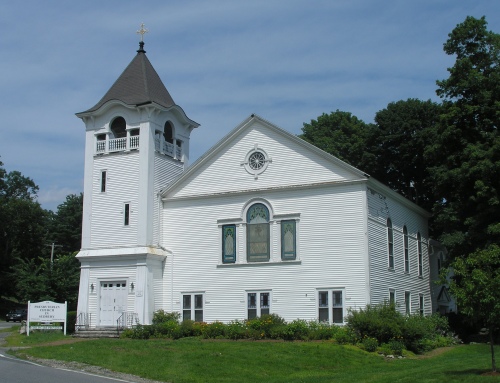
Presbyterian Church in Sudbury (1835)

by Dan/August 27, 2009October 20, 2012/Churches, Italianate, Sudbury

Presbyterian Church in Sudbury

The earliest Methodist meetings in Sudbury were held in the schoolhouse of the town’s north-west district until 1835, when the town decided to no longer allow the use of school buildings for religious meetings. That year, a Methodist meeting house was constructed between Sudbury Green and the Old Revolutionary Cemetery. The church was expanded in 1896, but it now serves as the Presbyterian Church in Sudbury.

Posts navigation

Older posts
Newer posts
Privacy Policy

Categories

  • Architectural Style (943)
    • Art Deco (9)
    • Byzantine (3)
    • Colonial (177)
    • Colonial Revival (85)
    • Craftsman (6)
    • Egyptian Revival (1)
    • Federal (190)
    • Foursquare (6)
    • Gothic (67)
    • Greek Revival (100)
    • Italianate (82)
    • Mission Revival (2)
    • Mission/Spanish Colonial (1)
    • Modern (2)
    • Neoclassical (56)
    • Octagon (3)
    • Postmodern (1)
    • Queen Anne (46)
    • Renaissance Revival (26)
    • Romanesque Revival (53)
    • Second Empire (26)
    • Shingle Style (12)
    • Stick Style (13)
    • Tudor Revival (8)
    • Vernacular (49)
    • Victorian Eclectic (15)
  • Building Type (943)
    • Apartment Buildings (8)
    • Banks (18)
    • Churches (119)
    • Collegiate (32)
    • Commercial (102)
    • Hotels (16)
    • Houses (508)
    • Industrial (23)
    • Libraries (22)
    • Lighthouses (1)
    • Military (15)
    • Monuments (1)
    • Museums (12)
    • Organizations (39)
    • Outbuildings (17)
    • Public Buildings (50)
    • Schools (23)
    • Stations (5)
    • Synagogues (1)
    • Taverns (21)
    • Theaters (9)
  • Town (943)
    • Adams (11)
    • Agawam (4)
    • Amherst (50)
    • Boston (64)
    • Boylston (6)
    • Cambridge (30)
    • Clinton (21)
    • Concord (15)
    • Cummington (1)
    • Danvers (14)
    • Deerfield (31)
    • Gloucester (18)
    • Granville (10)
    • Great Barrington (2)
    • Hadley (9)
    • Hancock (15)
    • Harvard (32)
    • Holyoke (47)
    • Lenox (5)
    • Lexington (8)
    • Longmeadow (32)
    • Marblehead (40)
    • Marlborough (4)
    • Natick (22)
    • Newton (2)
    • Northampton (68)
    • Peabody (4)
    • Pittsfield (20)
    • Salem (110)
    • Saugus (4)
    • Sheffield (4)
    • South Hadley (8)
    • Southborough (8)
    • Southwick (4)
    • Springfield (67)
    • Stockbridge (19)
    • Stow (1)
    • Sturbridge (18)
    • Sudbury (7)
    • Waltham (11)
    • Watertown (1)
    • Wayland (8)
    • West Springfield (14)
    • Westfield (46)
    • Weston (2)
    • Worcester (26)
  • Uncategorized (1)

Recent Comments

  • Wilber Blackson on South Hadley
  • Tami Speiden on Stockbridge
  • DexGuru on Stockbridge

Tags

Alcott Amherst College Asher Benjamin Back Bay Baptist Beacon Hill Big E Black Heritage Trail bowfront Bulfinch Catholic Congregational Episcopal Freedom Trail Gambrel H.H. Richardson Harvard Hawthorne Historic Deerfield Isaac Damon lit Longfellow mansard Methodist Mount Holyoke Museum Museums NPS Old Sturbridge Village PEM Revolutionary War row houses saltbox Samuel McIntire Shakers Smith College SPNEA Springfield Armory Stephen C. Earle Storrowton Underground Railroad UU Washington William Fenno Pratt Witch Trials

Meta

  • Log in
  • Entries feed
  • Comments feed
  • WordPress.org
Proudly powered by WordPress | Theme: ShowMe by NEThemes.