Historic Buildings of Massachusetts

  • About
  • Index by Town
  • CT
  • About
  • Index by Town
  • CT

Category: Public Buildings

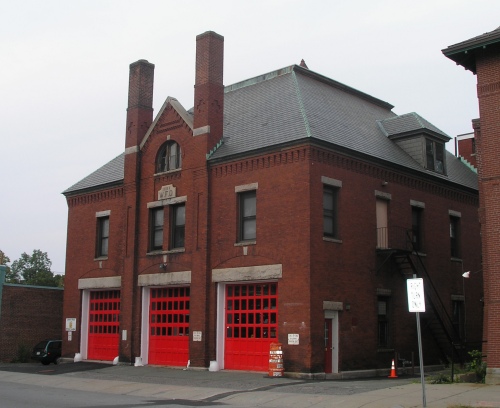
Old Central Fire Station, Waltham (1887)
by Dan/March 24, 2012July 4, 2012/Public Buildings, Romanesque Revival, Waltham

The old Waltham Central Fire Station was built in 1887 at 27 Lexington Street, and is next to the old Police Station. In 1964, Central Station Department Headquarters were moved to the new Municipal Center at 175 Lexington Street and the old Central Station became the Auxiliary Fire Department Quarters. The building is architecturally similar to (although not as elaborate as) the Moody Street Fire Station (built 1890-1892), also located in Waltham.
Old Town House, Marblehead (1727)

by Dan/January 18, 2012/Colonial, Marblehead, Public Buildings

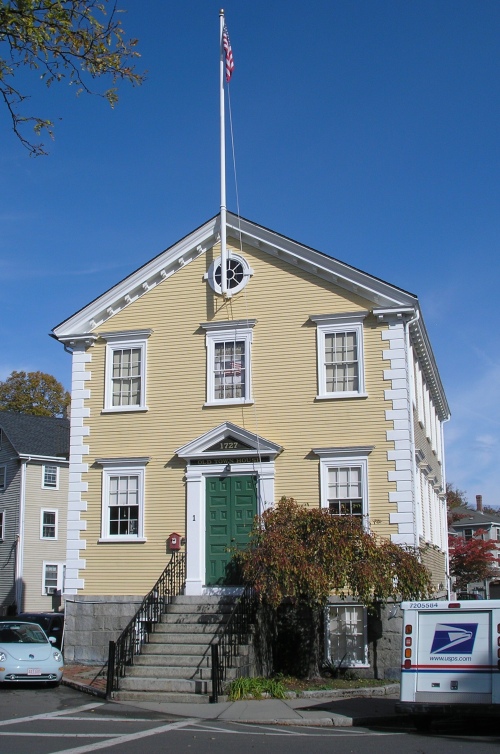
This is the 500th Post for Historic Buildings of Massachusetts!!! The Old Town House in Marblehead was built in 1727. The upper level contained the town hall and the lower level was originally used as a market. The building is sometimes called “Marblehead’s Cradle of Liberty” because of meetings held there before the Revolution where such leaders as Elbridge Gerry and General John Glover debated independence. The building‘s lower level, originally at ground level before the addition of a granite foundation to the structure in 1830, served as the town’s Police Station from 1853 to 1961 and is now home to the Marblehead Police Museum. The second floor also has a Grand Army of the Republic meeting hall maintained as a museum.

Abbot Hall (1876)

by Dan/January 1, 2012January 1, 2012/Marblehead, Museums, Public Buildings, Romanesque Revival

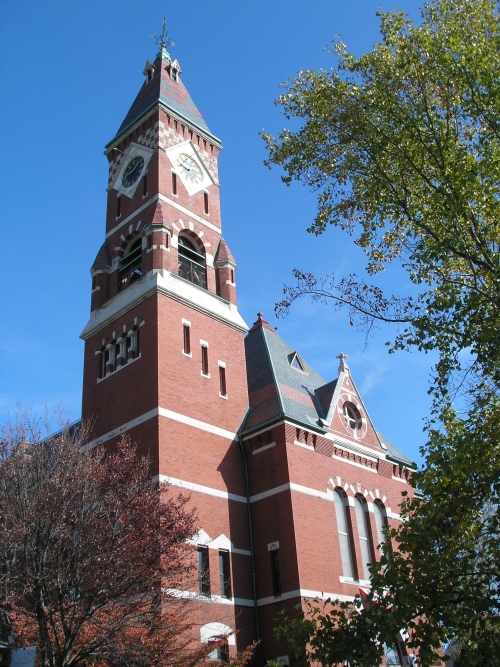
Happy New Year from Historic Buildings of Massachusetts!!! Rising up over Marblehead is one of the town’s most notable landmarks, Abbot Hall, which serves as town hall and also as a museum. Abbot Hall was built through a bequest of Benjamin Abbot (1795-1872), who was born in Marblehead and became wealthy through his cooper business in Boston. In 1875, the town voted to accept his $100,000 bequest and to follow his wishes that part of the legacy be devoted to building Abbot Hall. As related in The History and Traditions of Marblehead (1881), by Samuel Roads, Jr.:

The selection of a site for the new building had for some time occupied the attention of the people, and various localities were strongly advocated through the columns of the local paper. On Saturday, May 22, a town meeting was held for the choice of a site, and a majority of the citizens voted in favor of the Common. Several meetings were held for the election of a building committee, and Messrs. James J. H. Gregory, Simeon Dodge, Moses Gilbert, Henry F. Pitman, and Thomas Appleton were chosen by a majority vote.

In December, the town voted to appropriate $75,000 of the Abbot fund for the erection of the building, and the, committee were instructed to proceed with the work. The opponents of the site chosen by the town, though in the minority, were active and determined in their antagonism; and when, in the spring of 1876, ground was broken on the Common for the erection of the building, a bill in equity was filed in the supreme judicial court to restrain the committee from further proceedings. The bill was based principally on the claim that the town had no legal right to erect the hall on the Common, as the land was the property of the commoners of Marblehead.

The case was tried on Monday, April 17, before Associate Justice Ames, of the supreme judicial court. Hon. Ebenezer R. Hoar appeared as counsel for the town, and Mr. S. B. Ives, Jr., for the petitioners. A decision was rendered in favor of the town, the petitioners being unable to prove an adverse title.

The cornerstone was laid July 25, 1876 and the building, designed by Lord & Fuller of Boston (who also designed the Saugus Town Hall), was dedicated December 12, 1877. Abbot Hall, located at 188 Washington Street, has a historical collection in the Selectmen’s Meeting Room which includes the original version of the painting “The Spirit of ’76” by Archibald M. Willard and the 1684 deed to Marblehead from the tribe of Nanepashemet. The building has a clock tower with a Bell, installed in 1876 and cast by Meneely & Kimberly in Troy, New York.

74 Joy Street, Boston (1862)

by Dan/December 17, 2011/Boston, Organizations, Public Buildings, Second Empire

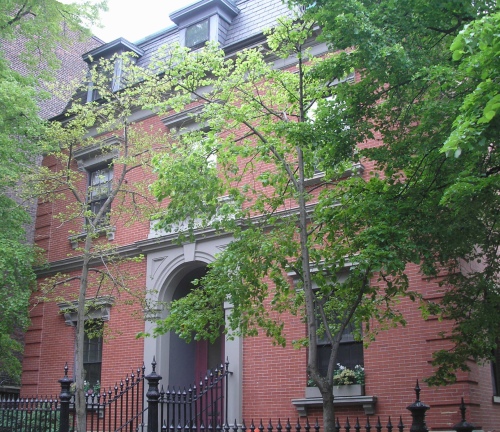
At 74 Joy Street in Boston’s Beacon Hill is a mansard-roofed building, built in 1861-1862. Designed by Gridley J.F. Bryant, it was built as Boston’s Police Station Number 3. In 1962, it ceased being used as a police station and in 1966 it was bought by the Beacon Hill Civic Association (it also houses the Beacon Hill Business Association and Beacon Hill Village).

Northampton City Hall (1850)

by Dan/November 10, 2011November 9, 2011/Gothic, Northampton, Public Buildings

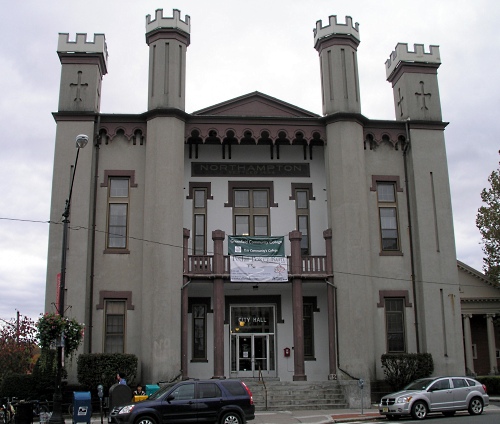
Northampton‘s distinctively Gothic City Hall was designed by William Fenno Pratt and was built in 1849-1850. Conceived as a novelty, the building was in danger of being torn down in 1923, but was saved when voters decided to remodel rather than completely replace it. One result of that remodeling was the loss of the building‘s second floor auditorium, which had hosted many famous speakers and entertainers over the years. Further restorations of City Hall occurred in 1985 and 1993.

Hampshire County Courthouse (1887)

by Dan/October 24, 2011September 19, 2012/Northampton, Public Buildings, Romanesque Revival

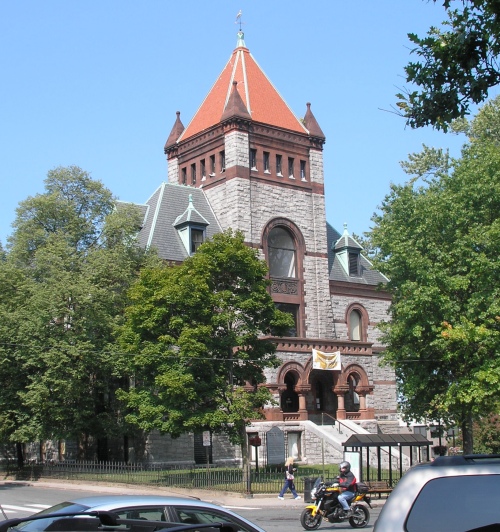
The Hampshire County Courthouse in downtown Northampton was built in 1886-1887. Designed by architect Henry F. Kilbourn in the Richardson Romanesque style (with similarities to the Richardson-designed Hampden County Courthouse in Springfield), the building is the fourth courthouse on the site. The first was built in 1739 and the second in 1767. Isaac Damon designed the third building, built in 1812, which burned in 1886. The current building’s courtroom is seldom used for court business today, although there is office and storage space and a law library used by the judges and staff at the neighboring court building. Much of the the structure‘s space is used as offices by the Hampshire Council of Governments, which owns the building. An architectural assessment of the Courthouse was recently completed and there are plans to completely renovate it. This project will involve replacing the slate roof, the tiles on the building‘s tower and the 1973 plate glass windows. There will also be major structural reinforcement.

Amherst Town Hall (1889)

by Dan/August 15, 2011/Amherst, Public Buildings, Romanesque Revival

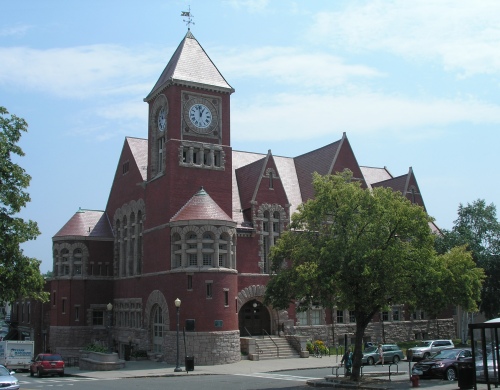
On March 11, 1888, the Palmer Block, in downtown Amherst, burned down in the middle of a blizzard. Because town meetings had been held in the building, the town acquired the land and built a new Town Hall in 1889-1890. The building was designed by H.S. McKay of Boston in the Richardsonian Romanesque style. As described by Frederick H. Hitchcock in his Handbook of Amherst (1891):

The town hall is a picturesque building of brick, red sandstone, and granite. It was erected by the town in 1889 at a cost of $58,000, H. S. McKay of Boston being the designer. In addition to a handsome hall, seating eight hundred and fifty persons, there are rooms for the town officers, the district court, the town library, and several business men.

Posts navigation

Older posts
Newer posts
Privacy Policy

Categories

  • Architectural Style (943)
    • Art Deco (9)
    • Byzantine (3)
    • Colonial (177)
    • Colonial Revival (85)
    • Craftsman (6)
    • Egyptian Revival (1)
    • Federal (190)
    • Foursquare (6)
    • Gothic (67)
    • Greek Revival (100)
    • Italianate (82)
    • Mission Revival (2)
    • Mission/Spanish Colonial (1)
    • Modern (2)
    • Neoclassical (56)
    • Octagon (3)
    • Postmodern (1)
    • Queen Anne (46)
    • Renaissance Revival (26)
    • Romanesque Revival (53)
    • Second Empire (26)
    • Shingle Style (12)
    • Stick Style (13)
    • Tudor Revival (8)
    • Vernacular (49)
    • Victorian Eclectic (15)
  • Building Type (943)
    • Apartment Buildings (8)
    • Banks (18)
    • Churches (119)
    • Collegiate (32)
    • Commercial (102)
    • Hotels (16)
    • Houses (508)
    • Industrial (23)
    • Libraries (22)
    • Lighthouses (1)
    • Military (15)
    • Monuments (1)
    • Museums (12)
    • Organizations (39)
    • Outbuildings (17)
    • Public Buildings (50)
    • Schools (23)
    • Stations (5)
    • Synagogues (1)
    • Taverns (21)
    • Theaters (9)
  • Town (943)
    • Adams (11)
    • Agawam (4)
    • Amherst (50)
    • Boston (64)
    • Boylston (6)
    • Cambridge (30)
    • Clinton (21)
    • Concord (15)
    • Cummington (1)
    • Danvers (14)
    • Deerfield (31)
    • Gloucester (18)
    • Granville (10)
    • Great Barrington (2)
    • Hadley (9)
    • Hancock (15)
    • Harvard (32)
    • Holyoke (47)
    • Lenox (5)
    • Lexington (8)
    • Longmeadow (32)
    • Marblehead (40)
    • Marlborough (4)
    • Natick (22)
    • Newton (2)
    • Northampton (68)
    • Peabody (4)
    • Pittsfield (20)
    • Salem (110)
    • Saugus (4)
    • Sheffield (4)
    • South Hadley (8)
    • Southborough (8)
    • Southwick (4)
    • Springfield (67)
    • Stockbridge (19)
    • Stow (1)
    • Sturbridge (18)
    • Sudbury (7)
    • Waltham (11)
    • Watertown (1)
    • Wayland (8)
    • West Springfield (14)
    • Westfield (46)
    • Weston (2)
    • Worcester (26)
  • Uncategorized (1)

Recent Comments

  • Wilber Blackson on South Hadley
  • Tami Speiden on Stockbridge
  • DexGuru on Stockbridge

Tags

Alcott Amherst College Asher Benjamin Back Bay Baptist Beacon Hill Big E Black Heritage Trail bowfront Bulfinch Catholic Congregational Episcopal Freedom Trail Gambrel H.H. Richardson Harvard Hawthorne Historic Deerfield Isaac Damon lit Longfellow mansard Methodist Mount Holyoke Museum Museums NPS Old Sturbridge Village PEM Revolutionary War row houses saltbox Samuel McIntire Shakers Smith College SPNEA Springfield Armory Stephen C. Earle Storrowton Underground Railroad UU Washington William Fenno Pratt Witch Trials

Meta

  • Log in
  • Entries feed
  • Comments feed
  • WordPress.org
Proudly powered by WordPress | Theme: ShowMe by NEThemes.