Historic Buildings of Massachusetts

  • About
  • Index by Town
  • CT
  • About
  • Index by Town
  • CT

Category: Italianate

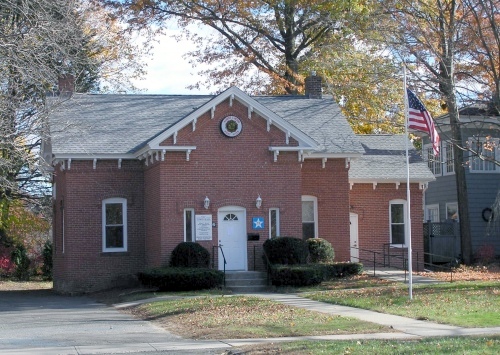
Old Town Hall, Longmeadow (1900)
by Dan/July 24, 2011July 24, 2011/Italianate, Longmeadow, Public Buildings

Longmeadow has had a number of town halls over the years. The building known as the Old Town Hall (pdf), at 417 Longmeadow Street, was built in 1900 and served as the town’s Second District school, then as the Town Office, and then as an American Legion Hall. Today, it is a general multi-purpose use building owned by the town.
Osborne-Salata House (1860)

by Dan/March 14, 2011January 17, 2020/Houses, Italianate, Peabody

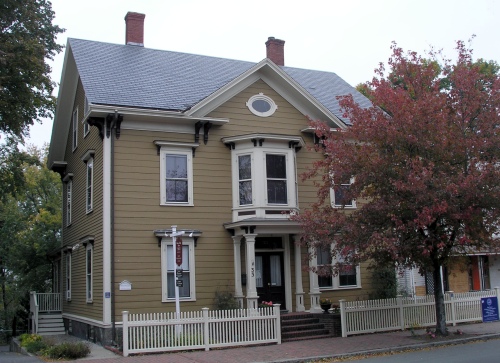
The Osborne-Salata House, at 33 Washington Street in Peabody, was constructed around 1860. This Italianate house was built for Thorndike and Sarah Daniels. It was later owned by Dennison Osborne and next served as a boarding house. The house’s last residents, from 1945-1997, were Dr. Benjamin Salata, a dentist, and wife, Celia, a music teacher. She donated the house to the Peabody Historical Society, which already owned the adjacent General Gideon Foster House. Today the Osborne-Salata House contains the Historical Society’s Elizabeth Cassidy Folk Art Museum, the Peabody Art Association Gallery and the Ruth Hill Library & Archives.

Curwen/Gillis House (1854)

by Dan/November 27, 2010January 25, 2020/Houses, Italianate, Salem

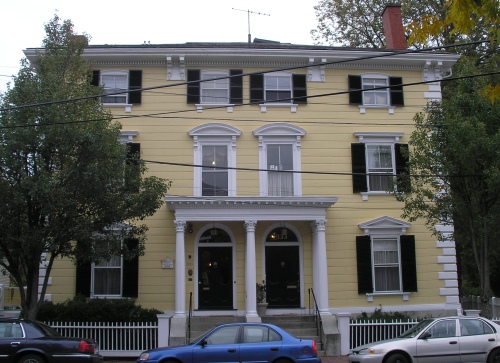
At 331-333 Essex Street in Salem is the Italianate-style Curwen/Gillis Double House, built by the Curwen family around 1854. Today, the Curwen House has eleven guest rooms and is one of three buildings operated by the Salem Inn.

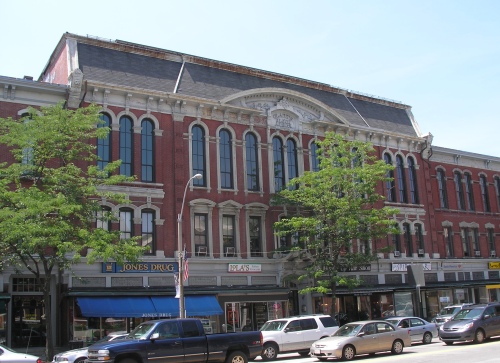
Clark’s Block, Natick (1874)

by Dan/August 31, 2010/Commercial, Italianate, Natick, Public Buildings

Another building constructed in the immediate aftermath of the Natick fire of 1874 is Clark’s Block on Main Street. As described in the History of Middlesex County, Vol. I (1890):

This, which is the largest business block in Natick, or in this part of the Commonwealth, stands partly upon the site of a similar but smaller structure, which was erected in 1872, only to be burned in the great fire of 1874. That block was about 100 feet in length and three stories high, while the present structure is of the same height, but 260 feet long. The latter, as was true of its predecessor, was built and is owned by Mr. Nathaniel Clark, who, after a long and useful business life, is passing the time of old age with the respect and affection of the entire community.

The chief frontage of this block is on Main Street. The lower story, which is devoted to stores, is occupied as follows: Edward Clark, grocer; E.M.Marshall, watch-maker and jeweler; W. L. Doane, boots and shoes; Qardella & Cuneo, fruits; barber; W. F. Cleland & Co., dry-goods; C. H. Whitcomb, hats and furnishing goods; Arthur W. Palmer, readymade clothing and tailor; James H. Frost, apothecary; Charles W. Ambrose, watch-maker and jeweler; W. F. Demeritt, tailor; W. H. Jones, boots and shoes; George L. Bartlett, dry-goods; Miss C. H. Travis, milliner; Daniels & Twitchell, druggists; Harrison L. Whipple, art-store, dealer in pictures and picture-frames—sixteen stores.

In the second story are the rooms of the Natick National Bank and of the Five-Cents Savings Bank (elsewhere described), of O. J. Washburn, dentist, Judge Null’s law-office and Dislrict Court-room; the offices of tax-collector, of the selectmen, of the overseers of the poor, of the assessors, of the town clerk, of the School Committee and of the chief of police ; the law-offices of James McManus, I. W. Parker, C. Q. Tirrell, G. D. Tower and L. H. Wakefield; office of Dr. William Richards; rooms of John F. Dowsley, dentist; of Miss L. M. Hart, dress-maker, Palmer’s sewing-room and four large rooms occupied by the Natick Citizen Printing and Editing Company. In the third story are four halls, the largest of which—Concert Hall—is more than 100 feet long and well furnished for an audience of 1200 or 1400. This the town uses for all town-hall purposes.

The Italianate building has been restored and rehabilitated over the years and continues to have retail space on the ground floor, with offices above.

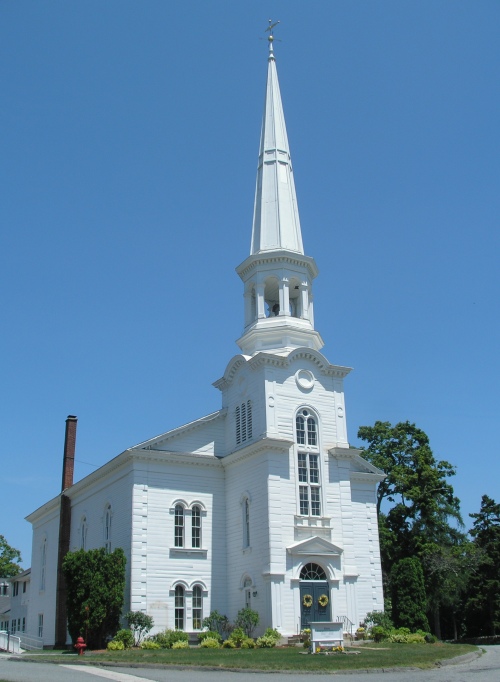
Pilgrim Church, Southborough (1806)

by Dan/July 25, 2010August 19, 2010/Churches, Federal, Italianate, Southborough

In 1727, the residents of Southborough established a new town and separated from Marlborough. A meeting house was constructed on the area known as “holy hill,” on three acres set aside for a meeting house, burying ground and training field. The original meeting house was replaced by the current church in 1806, built under the supervision of Moses Newton. When the state disestablished parish churches, Unitarians soon came to own the church. In 1831, Trinitarian members of the congregation broke away from the town church. Forming the Pilgrim Congregational Church, they built their own meeting house in 1834, but in 1857 purchased the old meeting house building from the Unitarians. The original church was then renovated and expanded, including the addition of a new and higher steeple with a new bell. That steeple was tipped (but not toppled) by the 1938 hurricane. It was repaired in 1953, so that the bell could again be rung. There is a history of the church (a pdf document) available at http://www.pilgrimchurch.us/Documents/The%20Pilgrim%20Church%20of%20Christ%20in%20Southborough%2018311.pdf.

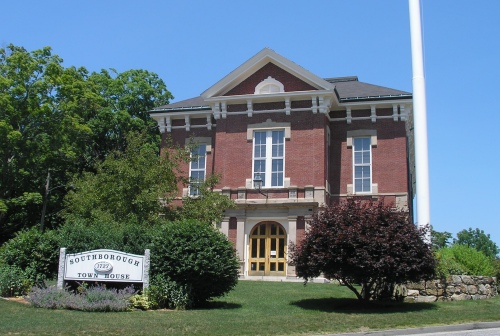
Southborough Town House (1870)

by Dan/July 19, 2010/Italianate, Public Buildings, Southborough

This week, we’ll look at some buildings in Southborough. The current Southborough Town House was dedicated in 1870 and replaced its predecessor, built in 1840. That wood Greek Revival structure burned in 1869 and there were insinuations at the time that local residents had had a hand in its destruction so it that it could be replaced by a grander building, although no evidence to that effect was ever found. The new brick structure had an upstairs hall that was used for town meetings until 1969. Joseph Burnett, Southborough businessman and philanthropist, made a large donation for the building’s construction and chose Framingham architect Alexander Rice Esty to design it. The town hall building‘s interior was eventually subdivided and is currently used for town offices.

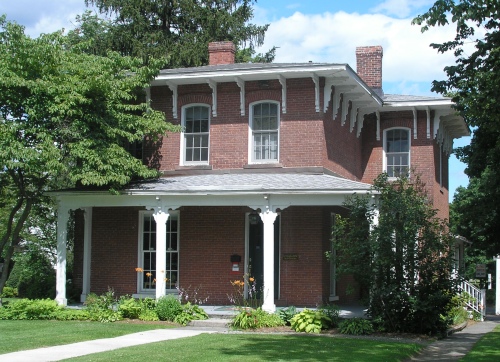
Old Longmeadow Congregational Church Parsonage (1857)

by Dan/February 27, 2010/Houses, Italianate, Longmeadow

The Italianate-style former parsonage of Longmeadow’s Congregational Church was built in 1857 on the site where the home of the town’s first minister, Rev. Stephen Williams, once stood. Ministers resided in the house until 1917 and it was then used for church school classes and as housing for church caretakers. The building was moved to its current site on Longmeadow Street in 1921 to make way for the construction of Longmeadow’s Community House.

Posts navigation

Older posts
Newer posts
Privacy Policy

Categories

  • Architectural Style (943)
    • Art Deco (9)
    • Byzantine (3)
    • Colonial (177)
    • Colonial Revival (85)
    • Craftsman (6)
    • Egyptian Revival (1)
    • Federal (190)
    • Foursquare (6)
    • Gothic (67)
    • Greek Revival (100)
    • Italianate (82)
    • Mission Revival (2)
    • Mission/Spanish Colonial (1)
    • Modern (2)
    • Neoclassical (56)
    • Octagon (3)
    • Postmodern (1)
    • Queen Anne (46)
    • Renaissance Revival (26)
    • Romanesque Revival (53)
    • Second Empire (26)
    • Shingle Style (12)
    • Stick Style (13)
    • Tudor Revival (8)
    • Vernacular (49)
    • Victorian Eclectic (15)
  • Building Type (943)
    • Apartment Buildings (8)
    • Banks (18)
    • Churches (119)
    • Collegiate (32)
    • Commercial (102)
    • Hotels (16)
    • Houses (508)
    • Industrial (23)
    • Libraries (22)
    • Lighthouses (1)
    • Military (15)
    • Monuments (1)
    • Museums (12)
    • Organizations (39)
    • Outbuildings (17)
    • Public Buildings (50)
    • Schools (23)
    • Stations (5)
    • Synagogues (1)
    • Taverns (21)
    • Theaters (9)
  • Town (943)
    • Adams (11)
    • Agawam (4)
    • Amherst (50)
    • Boston (64)
    • Boylston (6)
    • Cambridge (30)
    • Clinton (21)
    • Concord (15)
    • Cummington (1)
    • Danvers (14)
    • Deerfield (31)
    • Gloucester (18)
    • Granville (10)
    • Great Barrington (2)
    • Hadley (9)
    • Hancock (15)
    • Harvard (32)
    • Holyoke (47)
    • Lenox (5)
    • Lexington (8)
    • Longmeadow (32)
    • Marblehead (40)
    • Marlborough (4)
    • Natick (22)
    • Newton (2)
    • Northampton (68)
    • Peabody (4)
    • Pittsfield (20)
    • Salem (110)
    • Saugus (4)
    • Sheffield (4)
    • South Hadley (8)
    • Southborough (8)
    • Southwick (4)
    • Springfield (67)
    • Stockbridge (19)
    • Stow (1)
    • Sturbridge (18)
    • Sudbury (7)
    • Waltham (11)
    • Watertown (1)
    • Wayland (8)
    • West Springfield (14)
    • Westfield (46)
    • Weston (2)
    • Worcester (26)
  • Uncategorized (1)

Recent Comments

  • Wilber Blackson on South Hadley
  • Tami Speiden on Stockbridge
  • DexGuru on Stockbridge

Tags

Alcott Amherst College Asher Benjamin Back Bay Baptist Beacon Hill Big E Black Heritage Trail bowfront Bulfinch Catholic Congregational Episcopal Freedom Trail Gambrel H.H. Richardson Harvard Hawthorne Historic Deerfield Isaac Damon lit Longfellow mansard Methodist Mount Holyoke Museum Museums NPS Old Sturbridge Village PEM Revolutionary War row houses saltbox Samuel McIntire Shakers Smith College SPNEA Springfield Armory Stephen C. Earle Storrowton Underground Railroad UU Washington William Fenno Pratt Witch Trials

Meta

  • Log in
  • Entries feed
  • Comments feed
  • WordPress.org
Proudly powered by WordPress | Theme: ShowMe by NEThemes.