Historic Buildings of Massachusetts

  • About
  • Index by Town
  • CT
  • About
  • Index by Town
  • CT

Category: Second Empire

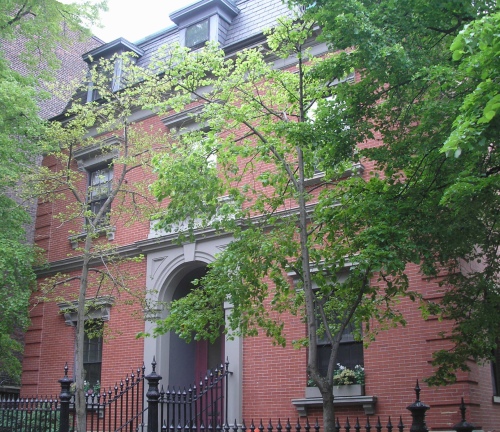
74 Joy Street, Boston (1862)
by Dan/December 17, 2011/Boston, Organizations, Public Buildings, Second Empire

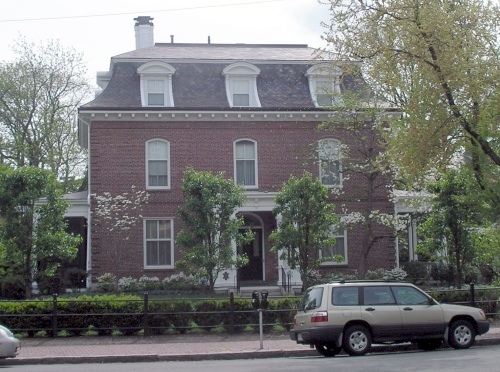
At 74 Joy Street in Boston’s Beacon Hill is a mansard-roofed building, built in 1861-1862. Designed by Gridley J.F. Bryant, it was built as Boston’s Police Station Number 3. In 1962, it ceased being used as a police station and in 1966 it was bought by the Beacon Hill Civic Association (it also houses the Beacon Hill Business Association and Beacon Hill Village).
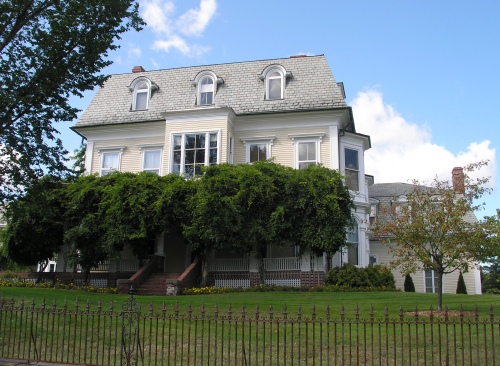
Wistariahurst (1868)

by Dan/October 10, 2011/Holyoke, Houses, Second Empire

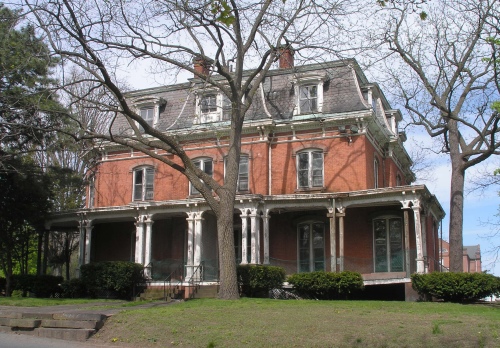
William Skinner, who left England for America at the age of nineteen in 1843, became a successful silk and saten manufacturer. The mills of Skinner’s company, the Unquomonk Silk Company in Williamsburg (where his employees lived in a community called Skinnerville), were destroyed when the Mill River Dam gave way on May 16, 1874. The Holyoke Water Power Company then offered Skinner a prime canal site, where he could rebuild his mill in Holyoke. They also offered him land to build a house and it was to there that he moved his home, called Wistariahurst, which he had built in 1868 and which had survived the flood. The house still stands at 238 Cabot Street in Holyoke. His company, called William Skinner and Sons after 1883, was continued by his sons after his death in 1902. It became the largest producer of satin linings in the world. The Skinner family were also great philantrophists: William Skinner supported various institutions in Holyoke and donated to Mount Holyoke and Vassar Colleges. His daughters, Belle and Katherine, founded the Skinner Coffee House to serve the needs of immigrants who worked in the mills and factories. The Skinner family sold the company in 1961. The house remained in the family until 1959, when Katharine Skinner Kilborne gave it to the city of Holyoke for cultural and educational purposes. It is open to the public for tours as the Wistariahurst Museum.

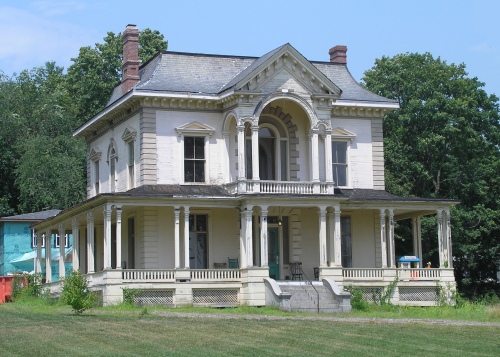
Henry F. Hills House (1863)

by Dan/July 26, 2011October 20, 2012/Amherst, Houses, Italianate, Second Empire

The Henry F. Hills House (pdf) is a striking mansion at 360 Main Street, recently renumbered as 38 Gray Street, in Amherst. It was designed by William Fenno Pratt of Northampton and was built in 1862-1863 for Henry Francis Hills, next to the lot where his father, Leonard M. Hills would soon also build a house by the same architect. Father and son owned a factory complex near the railroad depot that made palm leaf hats. Henry Hills succeeded his father as president of the company in 1877. After Hills’ death in 1924, the house, which had been built as a wedding gift for his bride Adelaide Spenser of South Manchester, Connecticut, was next occupied by his daughter, Susan C. Hills Skillings, who lived there until her death 1968. From 1976 to 2007, the property was owned by the Amherst Boys and Girls Club. It was then sold to a developer, who has restored (pdf) the house and three other historic houses that had been moved to new lots on the former Hills property: the Chapin-Ward House, the Potwine House and the Tuttle Farmhouse.

Greenleaf House (1859)

by Dan/March 30, 2011March 30, 2011/Cambridge, Houses, Second Empire

A Federal-style house, built in 1823, once stood at 76 Brattle Street, but was moved in 1858 to 19 Ash Street to make way for a new mansard-roofed mansion, completed in 1859. The new house was home to Mary Longfellow Greenleaf, sister of Henry Wadsworth Longfellow, and was purchased by Radcliffe College in 1905. At first used for music classes, after 1913 it became the residence of the president of Radcliffe College, and more recently of the dean of the Radcliffe Institute for Advanced Study.

Joseph Burnett House (1850)

by Dan/July 22, 2010January 21, 2020/Houses, Second Empire, Southborough

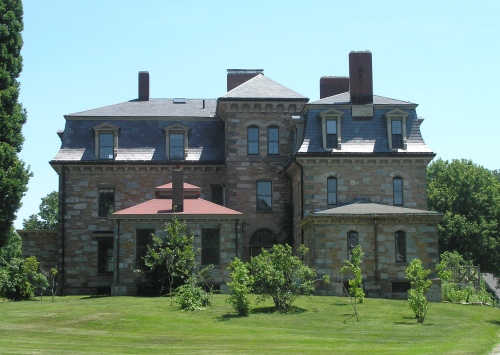
Joseph Burnett (1820-1894) was born in Southborough and studied chemistry in Worcester. In 1837, he moved to Boston, working for, and eventually partnering (in 1845) with, Theodore Metcalf. They had a chemist shop on Tremont Row (now Tremont Street). A woman’s request for vanilla in 1847 led him to develop a premium vanilla extract, which previously had to be imported from France. He eventually established his own business as a manufacturing chemist, Joseph Burnett and Company. Back in Southborough, Burnett purchased land and established the Deerfoot Farms Company, originally a dairy farm, which later also became known for its sausages. Burnett also established an estate, off Main Street in Southborough, where he built a stone mansion. Here he lived with his wife, Josephine Cutter Burnett, and twelve children. Constructed in 1849-1850, the house was updated in 1860. The house was sold out of the family in 1947.

Junior Officers’ Quarters, Springfield Armory (1870)

by Dan/May 2, 2010May 3, 2010/Houses, Military, Second Empire, Springfield

Both civilians and military personnel worked at the Springfield Armory, with the military presence increasing during the Civil War and in the following years. Requiring more housing for junior officers, a duplex house was built for the purpose on Armory Square in 1870. The house is unlike other Armory buildings, having been designed in the Second Empire style with a Mansard roof.

Stonehurst, the Robert Treat Paine Estate (1886)

by Dan/July 16, 2009December 30, 2012/Houses, Romanesque Revival, Second Empire, Shingle Style, Victorian Eclectic, Waltham

Stonehurst

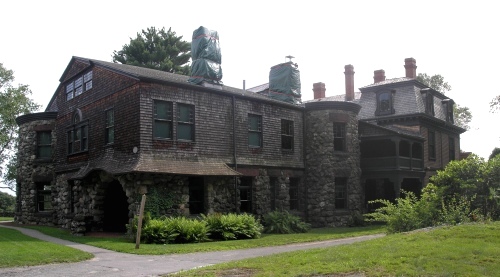
Stonehurst was the country house of Robert Treat Paine, Jr., a lawyer, housing reformer and great grandson of a signer of the Declaration of Independence. Located in Waltham, the earliest part of the house was a Second Empire building, designed by Gridley James Fox Bryant and constructed in 1866 for Paine and his wife, Lydia Lyman Paine. This house was moved to a new site atop a ridge and a large addition in the Shingle style was designed by the architect H.H. Richardson. Begun in 1884, the project was almost complete when Richardson died in 1886. In collaboration with Richardson was the great landscape architect, Frederick Law Olmsted. The organic relationship of the completed house and the landscape is a notable feature of what is considered to be an architectural masterpiece. The estate was given to the City of Waltham and is open to the public.

Posts navigation

Older posts
Newer posts
Privacy Policy

Categories

  • Architectural Style (943)
    • Art Deco (9)
    • Byzantine (3)
    • Colonial (177)
    • Colonial Revival (85)
    • Craftsman (6)
    • Egyptian Revival (1)
    • Federal (190)
    • Foursquare (6)
    • Gothic (67)
    • Greek Revival (100)
    • Italianate (82)
    • Mission Revival (2)
    • Mission/Spanish Colonial (1)
    • Modern (2)
    • Neoclassical (56)
    • Octagon (3)
    • Postmodern (1)
    • Queen Anne (46)
    • Renaissance Revival (26)
    • Romanesque Revival (53)
    • Second Empire (26)
    • Shingle Style (12)
    • Stick Style (13)
    • Tudor Revival (8)
    • Vernacular (49)
    • Victorian Eclectic (15)
  • Building Type (943)
    • Apartment Buildings (8)
    • Banks (18)
    • Churches (119)
    • Collegiate (32)
    • Commercial (102)
    • Hotels (16)
    • Houses (508)
    • Industrial (23)
    • Libraries (22)
    • Lighthouses (1)
    • Military (15)
    • Monuments (1)
    • Museums (12)
    • Organizations (39)
    • Outbuildings (17)
    • Public Buildings (50)
    • Schools (23)
    • Stations (5)
    • Synagogues (1)
    • Taverns (21)
    • Theaters (9)
  • Town (943)
    • Adams (11)
    • Agawam (4)
    • Amherst (50)
    • Boston (64)
    • Boylston (6)
    • Cambridge (30)
    • Clinton (21)
    • Concord (15)
    • Cummington (1)
    • Danvers (14)
    • Deerfield (31)
    • Gloucester (18)
    • Granville (10)
    • Great Barrington (2)
    • Hadley (9)
    • Hancock (15)
    • Harvard (32)
    • Holyoke (47)
    • Lenox (5)
    • Lexington (8)
    • Longmeadow (32)
    • Marblehead (40)
    • Marlborough (4)
    • Natick (22)
    • Newton (2)
    • Northampton (68)
    • Peabody (4)
    • Pittsfield (20)
    • Salem (110)
    • Saugus (4)
    • Sheffield (4)
    • South Hadley (8)
    • Southborough (8)
    • Southwick (4)
    • Springfield (67)
    • Stockbridge (19)
    • Stow (1)
    • Sturbridge (18)
    • Sudbury (7)
    • Waltham (11)
    • Watertown (1)
    • Wayland (8)
    • West Springfield (14)
    • Westfield (46)
    • Weston (2)
    • Worcester (26)
  • Uncategorized (1)

Recent Comments

  • Wilber Blackson on South Hadley
  • Tami Speiden on Stockbridge
  • DexGuru on Stockbridge

Tags

Alcott Amherst College Asher Benjamin Back Bay Baptist Beacon Hill Big E Black Heritage Trail bowfront Bulfinch Catholic Congregational Episcopal Freedom Trail Gambrel H.H. Richardson Harvard Hawthorne Historic Deerfield Isaac Damon lit Longfellow mansard Methodist Mount Holyoke Museum Museums NPS Old Sturbridge Village PEM Revolutionary War row houses saltbox Samuel McIntire Shakers Smith College SPNEA Springfield Armory Stephen C. Earle Storrowton Underground Railroad UU Washington William Fenno Pratt Witch Trials

Meta

  • Log in
  • Entries feed
  • Comments feed
  • WordPress.org
Proudly powered by WordPress | Theme: ShowMe by NEThemes.