Historic Buildings of Massachusetts

  • About
  • Index by Town
  • CT
  • About
  • Index by Town
  • CT

Category: Romanesque Revival

183-191 Main Street, Northampton (1871)
by Dan/September 25, 2012September 25, 2012/Commercial, Northampton, Romanesque Revival

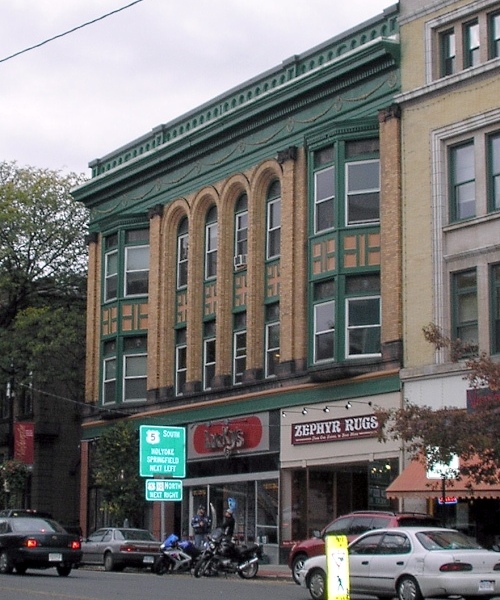
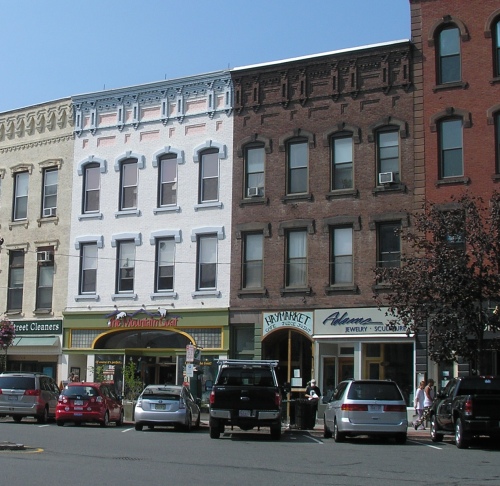
On Main Street in Northampton are two nearly identical commercial blocks located side-by-side. The Fleming Block, on the left, was built in 1868 at 189-191 Main Street. It replaced the earlier Lyman Block. The Astman or Williams Block, on the right, was built in 1871 at 183-187 Main Street to replace a building destroyed in the fire of 1870.
St. Peter and St. Paul Orthodox Church (1944)

by Dan/September 16, 2012/Byzantine, Churches, Romanesque Revival, Springfield

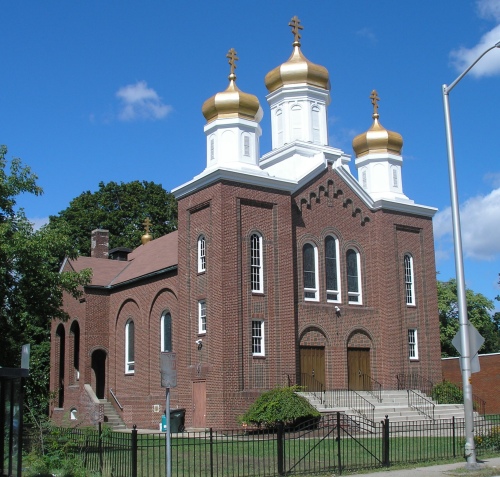
St. Peter & St. Paul Orthodox Church in Springfield was founded as St. Nicholas Russian Orthodox Church in 1916. The congregation’s first church was a brick house on Carew Street in the city’s North End, which was purchased in 1917. The church was reorganized in 1928, when it took the name of St. Peter and St. Paul Russian Orthodox Church. The original church building was later replaced by the current church, built in 1944 and designed by Arthur A. Smith. The church, which is located at 118 Carew Street, won a Preservation Award from the Springfield Preservation Trust in 2008 for the re-gilding of its onion domes in gold leaf.

State Normal Training School (1899)

by Dan/September 6, 2012/Romanesque Revival, Schools, Westfield

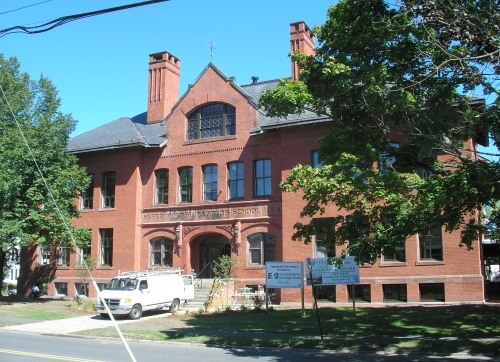
At 27 Washington Street in Westfield is a building constructed in 1899-1900 as the State Normal Training School, where student teachers gained experience from 1900 to 1956. Designed by the architectural firm of Gardner, Pyne & Gardner of Springfield, the building is one of only two nineteenth-century structures which survive from the State Normal School at Westfield, later called Westfield State Teachers College, which is today Westfield State University. This school was first established by Horace Mann in 1838 in Barre and became the first coeducational public training school in the nation. The school closed in 1841, but reopened in Westfield in 1844. In 1956, the training school building became a regular elementary school called the Washington Street School. It later was used by the Westfield District Court until 2002. The vacant building was reacquired by Westfield State University in 2006 and then sold to a developer in 2011 to become market-rate student housing.

Second Baptist Church, Holyoke (1885)

by Dan/September 2, 2012January 23, 2020/Churches, Holyoke, Romanesque Revival

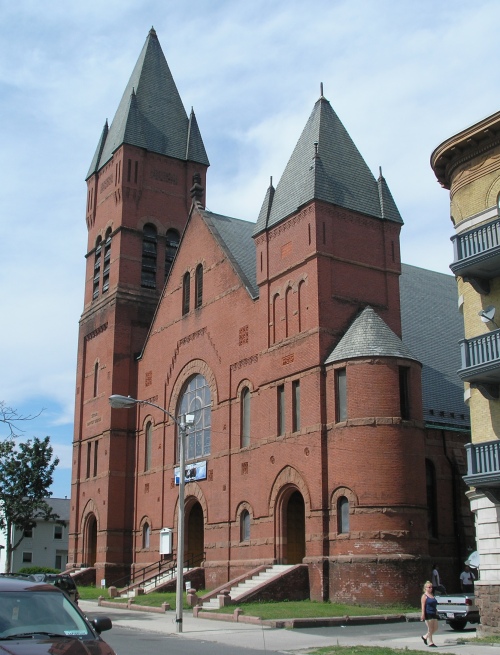
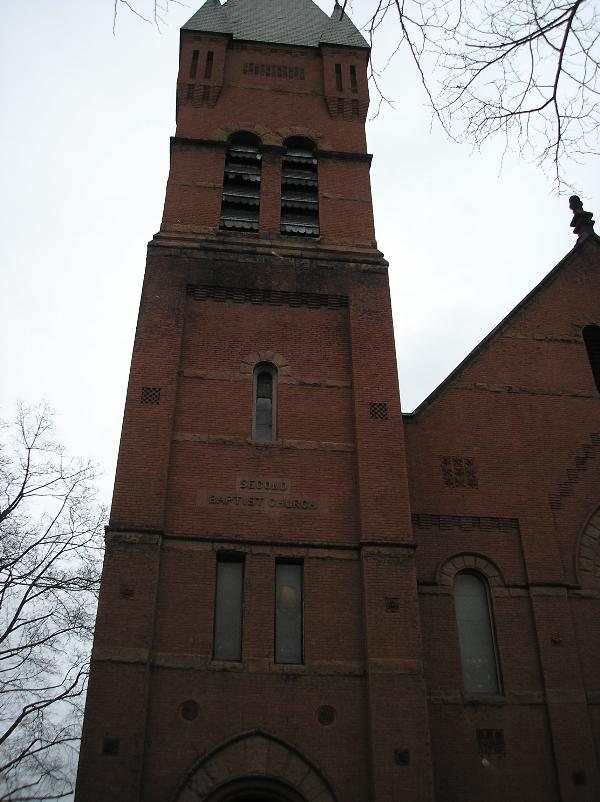
The Second Baptist Church of Holyoke was organized in 1849 and the new society’s first place of worship was Gallaudet and Terry’s Hall, at the corner of High and Lyman streets. They soon moved to Chapin Hall, where services were held until 1855, when the vestry of their new brick church was built on Main Street. The church was completed in 1859, but was destroyed in a fire in 1863. The church was rebuilt and rededicated in 1865. Their next church, at the corner of Appleton and Walnut streets, was built in 1885. In 1986, the church moved across the Connecticut River to become the Second Baptist Church of South Hadley. Their former church building in Holyoke is now the Iglesia de Dios Incomparable. UPDATE: The church was ordered temporarily closed by the city building inspector in 2018 after a partial collapse of the steeple.

Old Central Fire Station, Waltham (1887)

by Dan/March 24, 2012July 4, 2012/Public Buildings, Romanesque Revival, Waltham

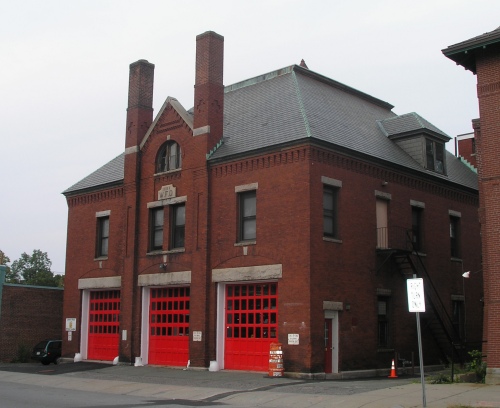
The old Waltham Central Fire Station was built in 1887 at 27 Lexington Street, and is next to the old Police Station. In 1964, Central Station Department Headquarters were moved to the new Municipal Center at 175 Lexington Street and the old Central Station became the Auxiliary Fire Department Quarters. The building is architecturally similar to (although not as elaborate as) the Moody Street Fire Station (built 1890-1892), also located in Waltham.

Hammond Block, Northampton (1896)

by Dan/January 7, 2012January 7, 2012/Commercial, Northampton, Romanesque Revival

At 39 Main Street in Northampton is a commercial building called the Hammond Block (located next to the Masonic Block), built around 1896. The building is constructed of Roman Brick and its architecture was inspired by that of ancient Rome.

Abbot Hall (1876)

by Dan/January 1, 2012January 1, 2012/Marblehead, Museums, Public Buildings, Romanesque Revival

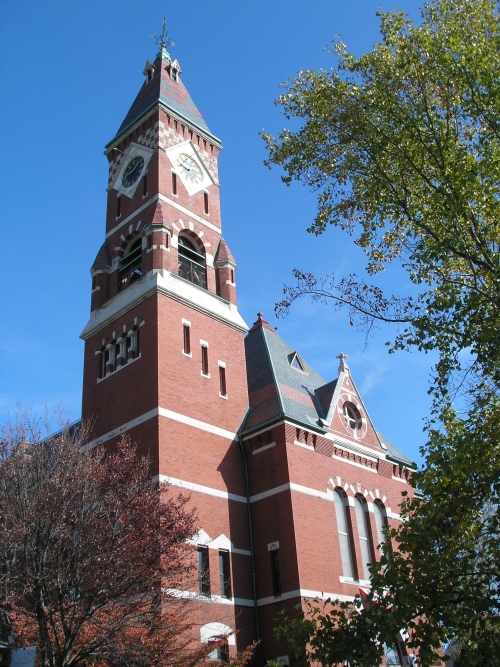
Happy New Year from Historic Buildings of Massachusetts!!! Rising up over Marblehead is one of the town’s most notable landmarks, Abbot Hall, which serves as town hall and also as a museum. Abbot Hall was built through a bequest of Benjamin Abbot (1795-1872), who was born in Marblehead and became wealthy through his cooper business in Boston. In 1875, the town voted to accept his $100,000 bequest and to follow his wishes that part of the legacy be devoted to building Abbot Hall. As related in The History and Traditions of Marblehead (1881), by Samuel Roads, Jr.:

The selection of a site for the new building had for some time occupied the attention of the people, and various localities were strongly advocated through the columns of the local paper. On Saturday, May 22, a town meeting was held for the choice of a site, and a majority of the citizens voted in favor of the Common. Several meetings were held for the election of a building committee, and Messrs. James J. H. Gregory, Simeon Dodge, Moses Gilbert, Henry F. Pitman, and Thomas Appleton were chosen by a majority vote.

In December, the town voted to appropriate $75,000 of the Abbot fund for the erection of the building, and the, committee were instructed to proceed with the work. The opponents of the site chosen by the town, though in the minority, were active and determined in their antagonism; and when, in the spring of 1876, ground was broken on the Common for the erection of the building, a bill in equity was filed in the supreme judicial court to restrain the committee from further proceedings. The bill was based principally on the claim that the town had no legal right to erect the hall on the Common, as the land was the property of the commoners of Marblehead.

The case was tried on Monday, April 17, before Associate Justice Ames, of the supreme judicial court. Hon. Ebenezer R. Hoar appeared as counsel for the town, and Mr. S. B. Ives, Jr., for the petitioners. A decision was rendered in favor of the town, the petitioners being unable to prove an adverse title.

The cornerstone was laid July 25, 1876 and the building, designed by Lord & Fuller of Boston (who also designed the Saugus Town Hall), was dedicated December 12, 1877. Abbot Hall, located at 188 Washington Street, has a historical collection in the Selectmen’s Meeting Room which includes the original version of the painting “The Spirit of ’76” by Archibald M. Willard and the 1684 deed to Marblehead from the tribe of Nanepashemet. The building has a clock tower with a Bell, installed in 1876 and cast by Meneely & Kimberly in Troy, New York.

Posts navigation

Older posts
Newer posts
Privacy Policy

Categories

  • Architectural Style (943)
    • Art Deco (9)
    • Byzantine (3)
    • Colonial (177)
    • Colonial Revival (85)
    • Craftsman (6)
    • Egyptian Revival (1)
    • Federal (190)
    • Foursquare (6)
    • Gothic (67)
    • Greek Revival (100)
    • Italianate (82)
    • Mission Revival (2)
    • Mission/Spanish Colonial (1)
    • Modern (2)
    • Neoclassical (56)
    • Octagon (3)
    • Postmodern (1)
    • Queen Anne (46)
    • Renaissance Revival (26)
    • Romanesque Revival (53)
    • Second Empire (26)
    • Shingle Style (12)
    • Stick Style (13)
    • Tudor Revival (8)
    • Vernacular (49)
    • Victorian Eclectic (15)
  • Building Type (943)
    • Apartment Buildings (8)
    • Banks (18)
    • Churches (119)
    • Collegiate (32)
    • Commercial (102)
    • Hotels (16)
    • Houses (508)
    • Industrial (23)
    • Libraries (22)
    • Lighthouses (1)
    • Military (15)
    • Monuments (1)
    • Museums (12)
    • Organizations (39)
    • Outbuildings (17)
    • Public Buildings (50)
    • Schools (23)
    • Stations (5)
    • Synagogues (1)
    • Taverns (21)
    • Theaters (9)
  • Town (943)
    • Adams (11)
    • Agawam (4)
    • Amherst (50)
    • Boston (64)
    • Boylston (6)
    • Cambridge (30)
    • Clinton (21)
    • Concord (15)
    • Cummington (1)
    • Danvers (14)
    • Deerfield (31)
    • Gloucester (18)
    • Granville (10)
    • Great Barrington (2)
    • Hadley (9)
    • Hancock (15)
    • Harvard (32)
    • Holyoke (47)
    • Lenox (5)
    • Lexington (8)
    • Longmeadow (32)
    • Marblehead (40)
    • Marlborough (4)
    • Natick (22)
    • Newton (2)
    • Northampton (68)
    • Peabody (4)
    • Pittsfield (20)
    • Salem (110)
    • Saugus (4)
    • Sheffield (4)
    • South Hadley (8)
    • Southborough (8)
    • Southwick (4)
    • Springfield (67)
    • Stockbridge (19)
    • Stow (1)
    • Sturbridge (18)
    • Sudbury (7)
    • Waltham (11)
    • Watertown (1)
    • Wayland (8)
    • West Springfield (14)
    • Westfield (46)
    • Weston (2)
    • Worcester (26)
  • Uncategorized (1)

Recent Comments

  • Wilber Blackson on South Hadley
  • Tami Speiden on Stockbridge
  • DexGuru on Stockbridge

Tags

Alcott Amherst College Asher Benjamin Back Bay Baptist Beacon Hill Big E Black Heritage Trail bowfront Bulfinch Catholic Congregational Episcopal Freedom Trail Gambrel H.H. Richardson Harvard Hawthorne Historic Deerfield Isaac Damon lit Longfellow mansard Methodist Mount Holyoke Museum Museums NPS Old Sturbridge Village PEM Revolutionary War row houses saltbox Samuel McIntire Shakers Smith College SPNEA Springfield Armory Stephen C. Earle Storrowton Underground Railroad UU Washington William Fenno Pratt Witch Trials

Meta

  • Log in
  • Entries feed
  • Comments feed
  • WordPress.org
Proudly powered by WordPress | Theme: ShowMe by NEThemes.