Historic Buildings of Massachusetts

  • About
  • Index by Town
  • CT
  • About
  • Index by Town
  • CT

Category: Federal

First Parish in Wayland (1814)
by Dan/August 2, 2009August 6, 2009/Churches, Federal, Wayland

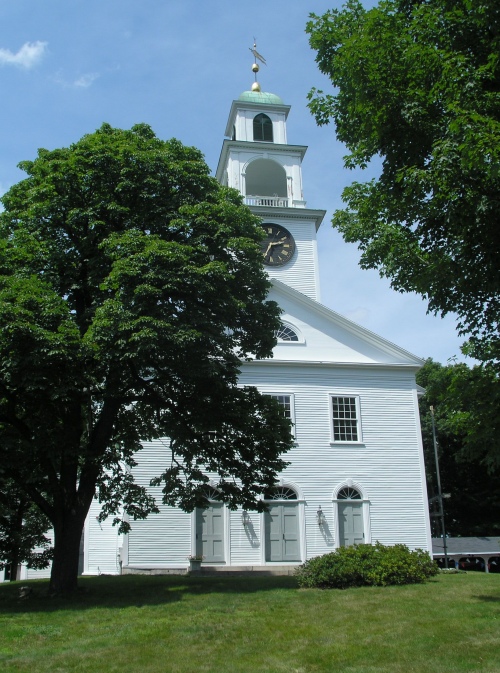
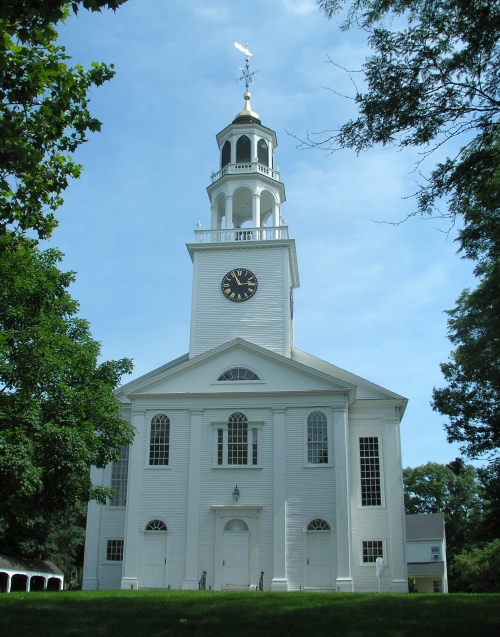
First Parish Church in Wayland

Sudbury was first settled in 1640 and successive meeting houses for the community were built, east of the Sudbury River, in 1642, 1652, 1682 and 1725. In 1780, the section of town west of the river separated from the eastern section, which was at first called East Sudbury and, from 1835, Wayland. The 1725 meeting house was replaced, in 1814-1815, by the current Federal-style church, built by Andrew Palmer of Newburyport to a design by Asher Benjamin. The church bell was cast by the foundry of Paul Revere and Son. The church became Unitarian in 1825, during the ministry of Reverend John Burt Wight. In 1850, the interior of the church was altered to to create a two-story plan, with an auditorium on the second floor. While he was minister at First Parish in Wayland, Reverend Edmund Hamilton Sears composed the Christmas hymn, “It Came Upon the Midnight Clear.”
Gore Place (1806)

by Dan/July 22, 2009/Federal, Houses, Waltham

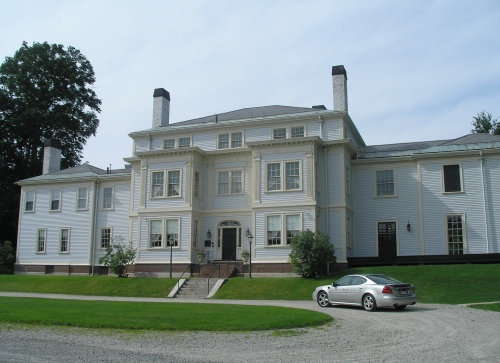
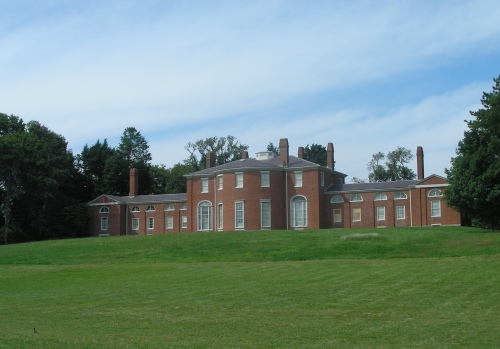
Gore Place

Christopher Gore, born in Boston, was a lawyer and Federalist politician, who served as Governor of Massachusetts (1808-1810) and a United States Senator (1813-1816). Earlier, Gore had spent eight years in Britain, initially as a commissioner to the Jay Treaty in 1796. It was during this time, in 1799, that his country mansion in Waltham, built in 1793, burned down. Gore and his wife, Rebecca Amory Payne, influenced by the estates they had seen in Europe, planed the construction of a new mansion after their return home in 1804. Called Gore Place, it was completed in 1805. Christopher Gore retired to his estate in 1816, but declining health led him to return to Boston in 1822, where he lived until his death in 1827. After Mrs. Gore’s death, the house was sold at auction. Other families lived there in the following years and in 1921 the house and grounds became home to a country club. The house was saved from demolition in 1935 by Gore Place Society and the restored mansion has since been open to the public.

Hosmer House (1793)

by Dan/July 19, 2009September 17, 2016/Federal, Houses, Sudbury

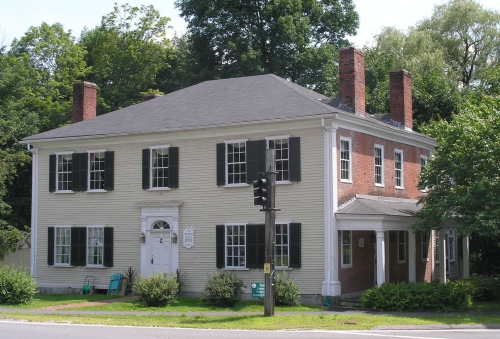
Hosmer House

The Hosmer House, at the intersection of Concord and Old Sudbury Roads in Sudbury Center, is a 1793 Federal-style house with a brick end facing Concord Road. It was built by Elisha Wheeler and Asher Goodnow as a commercial venture and was purchased by Ella and James Willis, who ran a general store and post office out of the building, with a ballroom above and a cobbler’s shop attached on the side. A retired Congregational minister, the Rev. Edwin Barrett Hosmer, bought the house in 1897 and lived there with his wife, Abbie Louisa Ames. Their daughter, Florence Ames Hosmer, was an artist and lived in the house until her death in 1978. The historic building had already been deeded to the town as a memorial to her father, along with nearly 500 of her paintings. The house, which displays many of the paintings, is now the headquarters of the Sudbury Historical Commission and is opened to the public on many holidays and special occasions. There is a pdf brochure for the house.

Lyman Estate (1793)

by Dan/July 17, 2009September 17, 2016/Federal, Houses, Waltham

Lyman Estate

The Lyman Estate, formerly known as “The Vale,” is a country estate in Waltham, originally established in 1793 by Boston merchant Theodore Lyman. The Estate’s grand Federal-style mansion was completed in 1798 and was designed by the Salem architect, Samuel McIntire. The mansion remained in the Lyman family as a summer home for the next century-and-a-half. Lydia Lyman Paine, daughter of nineteenth century owner George Lyman, married Robert Treat Paine, who built Stonehurst on a neighboring estate. The Lyman family added an upper story to their house in 1882. The estate, now owned by Historic New England, is known for its greenhouses (the earliest of which dates to 1800), which are open to the public.

Samuel Colton Booth House (1821)

by Dan/July 15, 2009September 17, 2016/Federal, Houses, Longmeadow

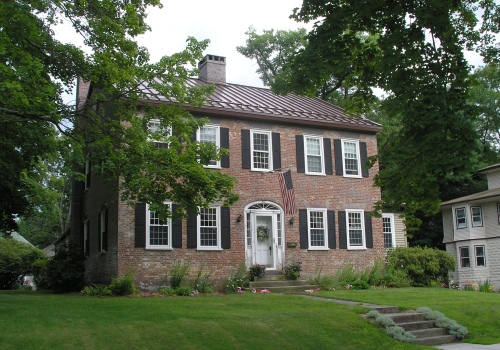
Samuel Colton Booth

The 1821 brick Federal style home of Samuel Colton Booth is at 577 Longmeadow Street in Longmeadow. Booth was married twice, first to Mary Ann Alvord and then to Rhoda Colton. He was a farmer who had a strong interest in mineralogy and archeology, collecting many specimens, which were later donated to the Springfield Science Museum. His daughter, Mary Ann Booth, also pursued an interest in natural science. Samuel Colton Booth was also a member of the Massachusetts Militia in the early nineteenth century.

First Parish Church in Sudbury (1797)

by Dan/July 12, 2009/Churches, Federal, Sudbury

First Parish Church in Sudbury

The first religious services in the Parish of Sudbury took place in 1640, east of the Sudbury River in what is now Wayland. The congregation west of the river completed their own meeting house in 1722 and Rev. Israel Loring became their first minister. The current First Parish Church in Sudbury replaced the original structure on the same location in 1797. In 1837, the rise of the Unitarian movement split the congregation and the First Parish became a Unitarian church. According to the History of Sudbury (1889), by Alfred Sereno Hudson,

For a time the old society had different preachers to supply the pulpit. From March 30 to September 22, according to a record book of Capt. Israel Haynes, no less than twelve different ministers preached there. In the summer of 1841, Rev. Linus Shaw was invited to preach, which he did till fall. Soon after, the meeting-house was remodelled, and in 1844, he was invited to preach there again ; he did so, and the result was his settlement as pastor. He was installed June 5, 1845, and continued in the pastorate till his death.

University Hall, Harvard (1814)

by Dan/July 4, 2009July 4, 2009/Cambridge, Collegiate, Federal

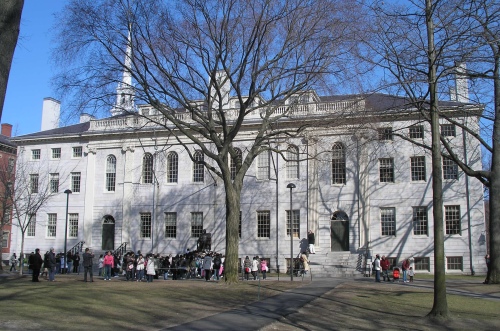
university-hall.jpg

Designed by Charles Bulfinch, Harvard‘s monumental University Hall was built in 1813-1814. Loammi Baldwin, who designed the Middlesex Canal and Harvard’s Holworthy Hall of 1811-1812, supervised the construction of University Hall. Built of Chelmsford granite, it was Harvard’s first stone building. The first floor originally contained four dining halls, one for each class, with kitchens located in the basement. The second floor contained a chapel, marked on the exterior by tall arched windows. These initial interior arrangements have been completely altered over the years and the building‘s original portico was removed in 1842.

Posts navigation

Older posts
Newer posts
Privacy Policy

Categories

  • Architectural Style (943)
    • Art Deco (9)
    • Byzantine (3)
    • Colonial (177)
    • Colonial Revival (85)
    • Craftsman (6)
    • Egyptian Revival (1)
    • Federal (190)
    • Foursquare (6)
    • Gothic (67)
    • Greek Revival (100)
    • Italianate (82)
    • Mission Revival (2)
    • Mission/Spanish Colonial (1)
    • Modern (2)
    • Neoclassical (56)
    • Octagon (3)
    • Postmodern (1)
    • Queen Anne (46)
    • Renaissance Revival (26)
    • Romanesque Revival (53)
    • Second Empire (26)
    • Shingle Style (12)
    • Stick Style (13)
    • Tudor Revival (8)
    • Vernacular (49)
    • Victorian Eclectic (15)
  • Building Type (943)
    • Apartment Buildings (8)
    • Banks (18)
    • Churches (119)
    • Collegiate (32)
    • Commercial (102)
    • Hotels (16)
    • Houses (508)
    • Industrial (23)
    • Libraries (22)
    • Lighthouses (1)
    • Military (15)
    • Monuments (1)
    • Museums (12)
    • Organizations (39)
    • Outbuildings (17)
    • Public Buildings (50)
    • Schools (23)
    • Stations (5)
    • Synagogues (1)
    • Taverns (21)
    • Theaters (9)
  • Town (943)
    • Adams (11)
    • Agawam (4)
    • Amherst (50)
    • Boston (64)
    • Boylston (6)
    • Cambridge (30)
    • Clinton (21)
    • Concord (15)
    • Cummington (1)
    • Danvers (14)
    • Deerfield (31)
    • Gloucester (18)
    • Granville (10)
    • Great Barrington (2)
    • Hadley (9)
    • Hancock (15)
    • Harvard (32)
    • Holyoke (47)
    • Lenox (5)
    • Lexington (8)
    • Longmeadow (32)
    • Marblehead (40)
    • Marlborough (4)
    • Natick (22)
    • Newton (2)
    • Northampton (68)
    • Peabody (4)
    • Pittsfield (20)
    • Salem (110)
    • Saugus (4)
    • Sheffield (4)
    • South Hadley (8)
    • Southborough (8)
    • Southwick (4)
    • Springfield (67)
    • Stockbridge (19)
    • Stow (1)
    • Sturbridge (18)
    • Sudbury (7)
    • Waltham (11)
    • Watertown (1)
    • Wayland (8)
    • West Springfield (14)
    • Westfield (46)
    • Weston (2)
    • Worcester (26)
  • Uncategorized (1)

Recent Comments

  • Wilber Blackson on South Hadley
  • Tami Speiden on Stockbridge
  • DexGuru on Stockbridge

Tags

Alcott Amherst College Asher Benjamin Back Bay Baptist Beacon Hill Big E Black Heritage Trail bowfront Bulfinch Catholic Congregational Episcopal Freedom Trail Gambrel H.H. Richardson Harvard Hawthorne Historic Deerfield Isaac Damon lit Longfellow mansard Methodist Mount Holyoke Museum Museums NPS Old Sturbridge Village PEM Revolutionary War row houses saltbox Samuel McIntire Shakers Smith College SPNEA Springfield Armory Stephen C. Earle Storrowton Underground Railroad UU Washington William Fenno Pratt Witch Trials

Meta

  • Log in
  • Entries feed
  • Comments feed
  • WordPress.org
Proudly powered by WordPress | Theme: ShowMe by NEThemes.