Historic Buildings of Massachusetts

  • About
  • Index by Town
  • CT
  • About
  • Index by Town
  • CT

Category: Federal

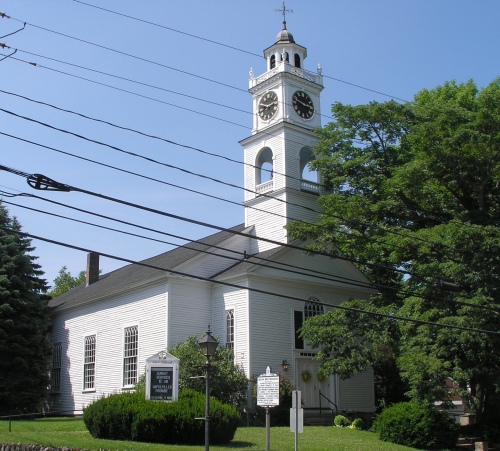
Eliot Church, South Natick (1828)
by Dan/July 5, 2010/Churches, Federal, Natick

This week we will be looking at buildings in South Natick. The Puritan missionary John Eliot first settled Natick in 1651. It was the first of the towns he established for settlement by the Praying Indians, who had converted to Christianity. Eliot, working with Praying Indian translators, produced an Indian grammar and the Natick Bible. The Praying Indian village was in South Natick, along the banks of the Charles River. The Indian church that Eliot established in Natick in 1651 continued under his successor, the first Native American minister, Rev. Daniel Takawambpait. The church suffered through the breakup of the Praying Indian villages during King Philip’s War. By 1699, the original meeting house had fallen into disrepair, and the remaining Christian Indians of Natick petitioned the General Court to allow them to sell a portion of their plantation to John Coller, Jr., a carpenter, in exchange for his building them a new church. This was accomplished by 1702 and Daniel Takawambpait preached in the new church until his death in 1716.

Another new meeting house was built on the same site in 1721 and in 1729 a new church society was established, consisting of both Indians and English settlers, the latter of whom were rapidly migrating into the area. But the experiment of a communal church did not last: Indian membership continued to decline and the church experienced internal conflict over theological issues and the location of the new meeting house. It was begun, on the site of its predecessors, in 1749, but not finished until until 1767. This occurred during the tenure of Rev. Stephen Badger, last missionary to the Natick Praying Indians, whom many English-descended residents refused to accept as their minister. After Rev. Badger’s retirement in 1799 and death in 1803, the South Natick church was abandoned and in 1802, a new First Congregational Church was organized to the north, in what is now the center of Natick. In 1828, the South Parish Congregational Church was organized and built a church on the site of the four earlier Praying Indian meeting houses. The church became Unitarian in 1870, under the ministry of Rev. Horatio Alger, Sr. The building’s clock was installed in 1872 and the vestry was added in 1880. In 1944, the Unitarian church joined with the John Eliot Congregational Church, both of which had been experiencing financial difficulties, and the two churches used the Unitarian meeting house for worship. The congregations merged in 1990, becoming the united Eliot Church of South Natick.
David Ames, Jr. House (1826)

by Dan/May 29, 2010January 21, 2020/Federal, Houses, Springfield

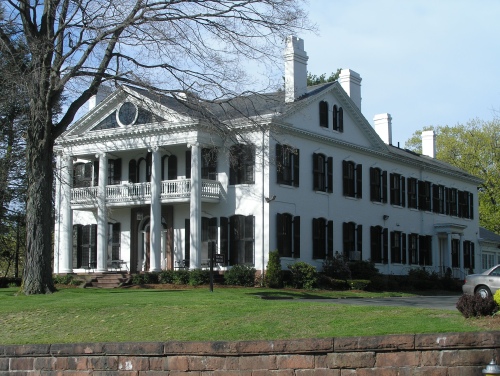
David Ames, Jr., a Springfield paper manufacturer, was the son of Col. David Ames, first superintendent of the Springfield Armory. The David Ames Jr. House, at 241 Maple Street, on Ames Hill in Springfield, was built in 1826-7 and was the work of Chauncey Shepard, a prominent local architect and builder. In 1867, Solomon J. Gordon, a New York City lawyer, purchased the property and Shepard was hired to remodel the house he had built forty-one years earlier. Gordon lived in the house until his death in 1891. Today the house is known as Young House and is part of the campus of the MacDuffie School.

Fay House, Radcliffe (1806)

by Dan/May 13, 2010/Cambridge, Collegiate, Colonial Revival, Federal, Houses

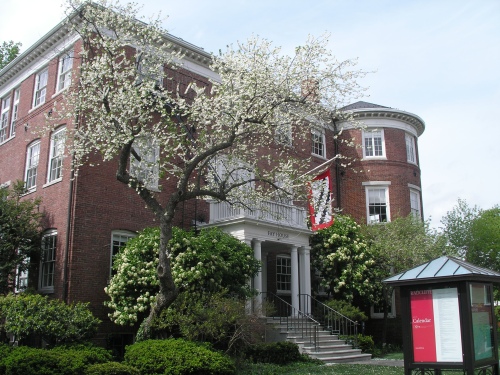
Radcliffe College in Cambridge was founded in 1879 to educate women, who were then not yet allowed at Harvard. The college bought its first building in 1885: Fay House, an 1806 Federal-style mansion. Built by Nathaniel Ireland, who made iron work for ships, the house was later owned by Joseph McKean, professor of rhetoric and oratory at Harvard. After McKean’s death in 1818, the house had several tenants, including Edward Everett in 1820-1821. The house was also home for a time to Francis Dana, Jr. His daughter, Sophia Willard Dana Ripley, kept a girls’ boarding school in the house and among her students was the first wife of Thomas Wentworth Higginson. For fifty years after 1835, the house was occupied by the family of Judge Samuel Phillips Prescott Fay.

After its acquisition by Radcliffe, Alice Longfellow, one of the College’s founders, donated funds for the remodeling of Fay House in the Colonial Revival mode, work completed in 1890 under the direction of her cousin, the architect Alexander W. Longfellow, Jr. He also oversaw the further expansion of the structure in 1892, with the addition of a third story, skylit library, porches, and more classroom and laboratory space. As additional buildings were constructed in the development of Radcliffe Yard, Fay House continued as an administration building for the College and now for its successor, the Radcliffe Institute for Advanced Study. The building has recently been renovated (pdf).

African Meeting House, Boston (1806)

by Dan/May 6, 2010/Boston, Churches, Federal

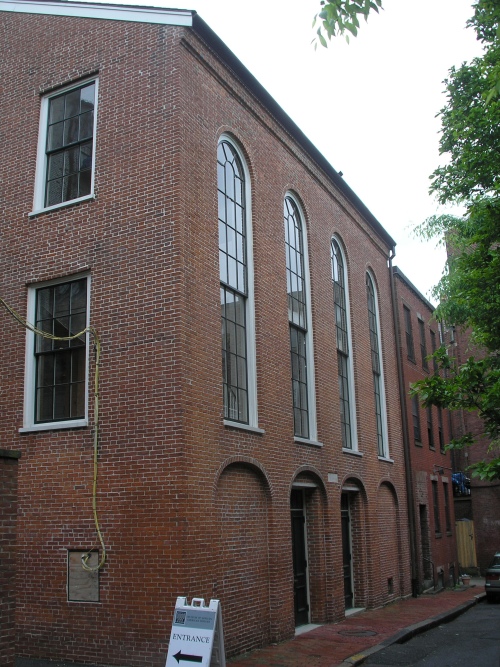
The African Meeting House on Beacon Hill in Boston was built in 1806 to house the first African Baptist Church of Boston, known as the First Independent Baptist Church. A commemorative inscription above the front door reads, “Cato Gardner, first Promoter of this Building 1806.” Cato Gardner, born in Africa, raised more than $1,500 toward the total $7,700 needed to construct the Meeting House. The building, which was constructed almost entirely with black labor, served as the cultural, educational and political center of Boston’s black community for many decades. In 1808, Primus Hall‘s school relocated from the adjacent carpenter’s shop to the Meeting House, using a schoolroom funded by Abiel Smith. It later moved to the Abiel Smith School next door. William Lloyd Garrison held the founding meeting of the New England Anti-Slavery Society in the Meeting House on January 6, 1832. The building, which has a facade adapted from the design for a townhouse published by Boston architect Asher Benjamin, was remodeled in the 1850s, with the windows being elongated and converted to having arched tops.

The Baptist congregation moved to Boston’s South End in 1898 and the Meeting House became the African Methodist Episcopal Church. By the late nineteenth century, many African Americans had moved to other neighborhoods and new immigrants occupied the neighborhood around the African Meeting House, which was sold in 1904 to the Hassidic Jewish Congregation Anshe Lebawitz. In 1972, the building was acquired by the Museum of African American History. The first phase of restoration work on the Meeting House was completed in 1987 and the building was opened to the public as a museum. The African Meeting House, the oldest surviving black church building in America, is also the last stop on the Black Heritage Trail.

First Harrison Gray Otis House (1796)

by Dan/May 5, 2010January 19, 2020/Boston, Federal, Houses

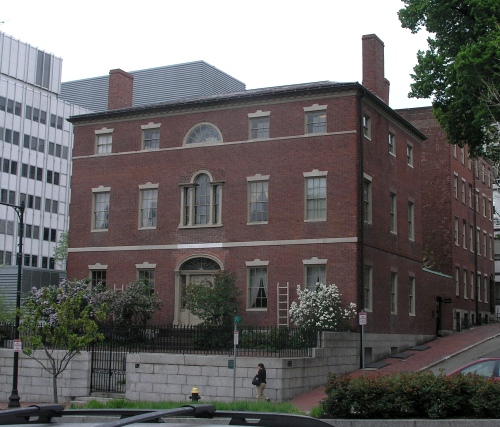
The first of three houses designed by Charles Bulfinch for Harrison Gray Otis is located on Cambridge Street in Boston. Otis was a Federalist lawyer and politician who became one of the wealthiest men in Boston in the early nineteenth century, developing the area of Beacon Hill. His brick house, with brownstone stringcourses, displays distinctive traits of the Federal style, including the semicircular window and side lights of the entryway on the first floor (added after 1801), the Palladian window on the second floor and the semicircular, or lunette, window on the shorter third floor. The Otis House‘s design was based on a house that Bulfinch saw in Philadelphia in 1789, the William Bingham House, which in turn was based on a house in London. By the 1830s, the Otis House had been subdivided and rented out and later became a boarding house. In 1916, restoration of the house was begun by the Society for the Preservation of New England Antiquities (Historic New England), which moved the house about 40 feet from its original location in 1926, to save it from a widening of Cambridge Street. Today the house is attached to additional buildings to the rear and serves as a museum and headquarters of Historic New England. Continue reading “First Harrison Gray Otis House (1796)”

Long Storehouse, Springfield Armory (1863)

by Dan/May 2, 2010May 3, 2010/Federal, Military, Springfield

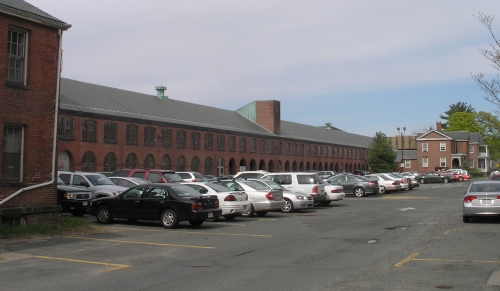
The Long Storehouse at Springfield Armory is a 764-foot structure, built in four stages between 1846 and 1863. It was constructed as part of Maj. James Ripley‘s improvement campaign and was originally a storehouse for the wood used in making gun stocks. The building’s third stage provided stables for the Armory’s horses and the entire structure has also been known as a casern, or cavalry barracks. As described by Albert Harleigh Kirkham in King’s Handbook of Springfield

Whilst digging for the foundations of the long storehouse which stands upon the terrace overlooking Pearl and Worthington Streets, the remains of 12 or more soldiers dressed in regimentals were uncovered. During the 1812 war, the United-States Armory being a Government post, the United-States soldiers were often quartered in the barracks and in the dwelling-houses which were on “public ground.” The houses were commonly occupied by Armorers; but, at a short notice that soldiers were coming, they moved out, and the soldiers moved in, and they remained in these comfortable quarters a longer or shorter time, “according to orders.” A portion of the ground now occupied by the storehouse was then used as a graveyard; and soldiers were often buried there, and buried, too, in their uniforms.

Administrative Building, Springfield Armory (1862)

by Dan/May 2, 2010May 3, 2010/Federal, Military, Springfield

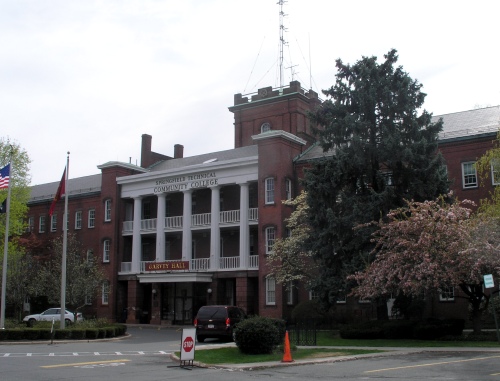
We end Springfield Armory Week at Historic Buildings of Massachusetts with three posts today. Our first post is about the building which is today known as Garvey Hall. In 1862, three buildings at the east end of Armory Square at the Springfield Armory were joined together and connected by a new third story. One of the buildings was built around 1817-1819 and the others two, the North and South Shops, in 1824. A tower was built on the newly combined structure to match the tower of the Main Arsenal, located at the opposite end of armory square. The building was used for administration, as well as for storage and occasionally research and light manufacturing. In 1984, it became the administrative offices of Springfield Technical Community College and was renamed in honor of STCC’s founding president, Dr. Edmond P. Garvey Continue reading “Administrative Building, Springfield Armory (1862)”

Posts navigation

Older posts
Newer posts
Privacy Policy

Categories

  • Architectural Style (943)
    • Art Deco (9)
    • Byzantine (3)
    • Colonial (177)
    • Colonial Revival (85)
    • Craftsman (6)
    • Egyptian Revival (1)
    • Federal (190)
    • Foursquare (6)
    • Gothic (67)
    • Greek Revival (100)
    • Italianate (82)
    • Mission Revival (2)
    • Mission/Spanish Colonial (1)
    • Modern (2)
    • Neoclassical (56)
    • Octagon (3)
    • Postmodern (1)
    • Queen Anne (46)
    • Renaissance Revival (26)
    • Romanesque Revival (53)
    • Second Empire (26)
    • Shingle Style (12)
    • Stick Style (13)
    • Tudor Revival (8)
    • Vernacular (49)
    • Victorian Eclectic (15)
  • Building Type (943)
    • Apartment Buildings (8)
    • Banks (18)
    • Churches (119)
    • Collegiate (32)
    • Commercial (102)
    • Hotels (16)
    • Houses (508)
    • Industrial (23)
    • Libraries (22)
    • Lighthouses (1)
    • Military (15)
    • Monuments (1)
    • Museums (12)
    • Organizations (39)
    • Outbuildings (17)
    • Public Buildings (50)
    • Schools (23)
    • Stations (5)
    • Synagogues (1)
    • Taverns (21)
    • Theaters (9)
  • Town (943)
    • Adams (11)
    • Agawam (4)
    • Amherst (50)
    • Boston (64)
    • Boylston (6)
    • Cambridge (30)
    • Clinton (21)
    • Concord (15)
    • Cummington (1)
    • Danvers (14)
    • Deerfield (31)
    • Gloucester (18)
    • Granville (10)
    • Great Barrington (2)
    • Hadley (9)
    • Hancock (15)
    • Harvard (32)
    • Holyoke (47)
    • Lenox (5)
    • Lexington (8)
    • Longmeadow (32)
    • Marblehead (40)
    • Marlborough (4)
    • Natick (22)
    • Newton (2)
    • Northampton (68)
    • Peabody (4)
    • Pittsfield (20)
    • Salem (110)
    • Saugus (4)
    • Sheffield (4)
    • South Hadley (8)
    • Southborough (8)
    • Southwick (4)
    • Springfield (67)
    • Stockbridge (19)
    • Stow (1)
    • Sturbridge (18)
    • Sudbury (7)
    • Waltham (11)
    • Watertown (1)
    • Wayland (8)
    • West Springfield (14)
    • Westfield (46)
    • Weston (2)
    • Worcester (26)
  • Uncategorized (1)

Recent Comments

  • Wilber Blackson on South Hadley
  • Tami Speiden on Stockbridge
  • DexGuru on Stockbridge

Tags

Alcott Amherst College Asher Benjamin Back Bay Baptist Beacon Hill Big E Black Heritage Trail bowfront Bulfinch Catholic Congregational Episcopal Freedom Trail Gambrel H.H. Richardson Harvard Hawthorne Historic Deerfield Isaac Damon lit Longfellow mansard Methodist Mount Holyoke Museum Museums NPS Old Sturbridge Village PEM Revolutionary War row houses saltbox Samuel McIntire Shakers Smith College SPNEA Springfield Armory Stephen C. Earle Storrowton Underground Railroad UU Washington William Fenno Pratt Witch Trials

Meta

  • Log in
  • Entries feed
  • Comments feed
  • WordPress.org
Proudly powered by WordPress | Theme: ShowMe by NEThemes.