Historic Buildings of Massachusetts

  • About
  • Index by Town
  • CT
  • About
  • Index by Town
  • CT

Category: Federal

Charles Sumner House (1805)
by Dan/October 17, 2010January 19, 2020/Boston, Federal, Houses

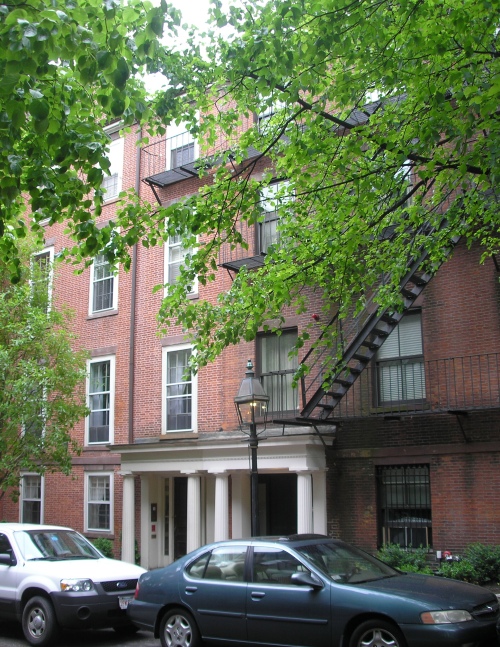
At 20 Hancock Street on Beacon Hill in Boston is the home once occupied by Senator Charles Sumner. It was built in 1805 by Ebenezer Farley and was purchased by Sumner’s father in 1830. Charles Sumner was a fiery opponent of slavery and the victim of a famous caning, delivered by Representative Preston Brooks on the floor of the Senate on May 22, 1856. After the Civil War, Sumner was a leader of the Radical Republicans. He lived in the house until 1867 and was possibly the one who added the Greek Revival portico that links nos. 20 and 22 Beacon Hill.
Dr. Austin Scott House (1810)

by Dan/October 1, 2010January 18, 2020/Federal, Granville, Houses

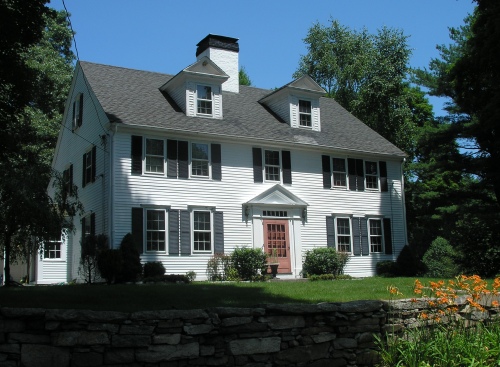
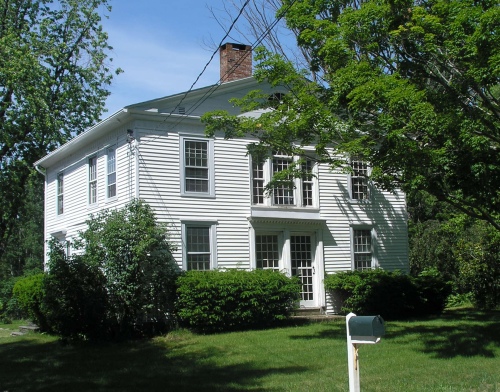
Built around 1810, the home of James Cooley in Granville Center is a Federal-style home with a double leaf front door below a Palladian window. The house was later the summer home of Dr. Austin Scott, president of Rutgers University from 1891 to 1906. He died in Granville in 1922 and according to Rutgers Alumni Monthly (Vol. 2, No. 1):

Dr. Scott’s funeral service was held at Granville Center, Massachusetts. For years he had his summer home there, the home of his grandfather, with whom he spent much of his boyhood. The service was in the village Congregational Church, and the neighbors gathered to pay their tribute of great respect and friendship.

Joel Root House (1816)

by Dan/September 29, 2010January 18, 2020/Federal, Granville, Houses

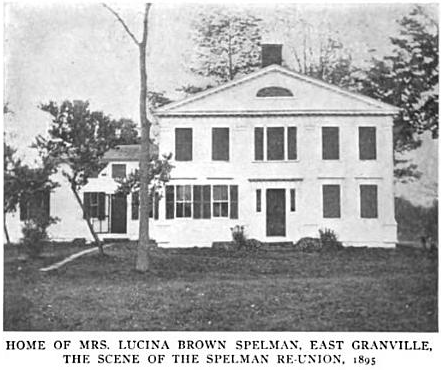
In the Spelman Genealogy (1910), Fannie Cooley Williams Barbour writes of Elizabeth Lucins Spelman Brown:

Mrs. Brown spent much of her girlhood in the “Old Spelman Red House,” and received the names of her two grandmothers, Hayes and Kent. Soon after her marriage, her husband purchased the old Joel Root homestead on the hill at East Granville, near the church. The house is built in the Colonial style, and the door and entrance is much admired. Mrs. Brown has lived in it for fifty years, and still continues to reside there. […] Mrs. Brown was a singer, taking part in the Granville Jubilee of 1845 and later in the Jubilee of 1895, having retained her vocal talent for the intervening years. She was prominent in the affairs of the schools of Granville, and did much to aid them. At the time of the Jubilee of 1895 a reunion of the Spelman family took place at her house, and a large gathering of descendants was present, coming from all parts of the United States.

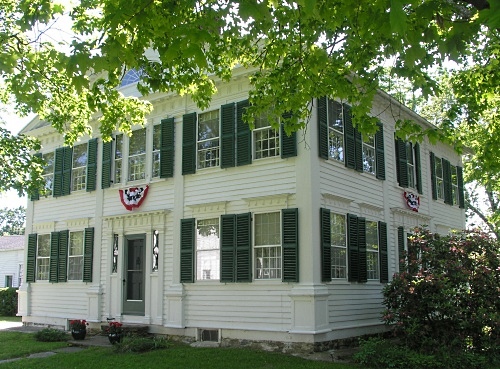
The house, on Main Road in Granville Center, was built around 1816 by Joel Root, who married Sarah Ensign in 1803 and then, after her death, married her sister Clarissa Ensign in 1811. According to James Pierce Root in Root Genealogical Records (1870):

He commenced business in early life, and was a successful merchant for more than forty years in his native town, where, by honesty, integrity, and faithful application to business, he accumulated a property large for those days and the place in which he lived. He was postmaster for a series of years, and during his whole life had the confidence and respect of his fellow townsmen, being frequently honored with the highest offices within their gift. Mrs. C. Root has resided in Springfield, Mass., for the past few years, and though nearly eighty, has never used spectacles, and reads with ease the finest print.

At an 1850 double-wedding in Springfield, Root’s daughter Amorette married Col. Horatio N. Case of Springfield and another daughter, Sarah, married Calvin Spencer of Hartford.

Old Meeting House, Granville (1802)

by Dan/September 28, 2010/Churches, Federal, Granville, Public Buildings

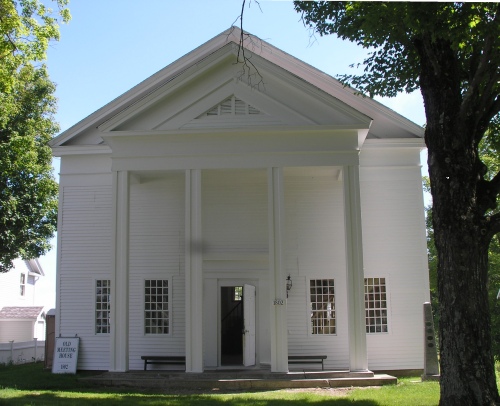
Granville‘s first Congregational meeting house was built in 1747 and replaced by the current Old Meeting House in 1802. The gable-roofed structure, which lost its steeple in a gale in 1840, was remodeled in 1890. The present front columns were most likely added in 1862 or during the 1890 remodeling. The first permanent town hall was built in 1927. In 1937, the First Congregational Church is joined with the Baptist Church to form the Granville Federated Church. Since 1976, the Old Meeting House has been owned by the town and the restored building is rented out for various events. Continue reading “Old Meeting House, Granville (1802)”

Pilgrim Church, Southborough (1806)

by Dan/July 25, 2010August 19, 2010/Churches, Federal, Italianate, Southborough

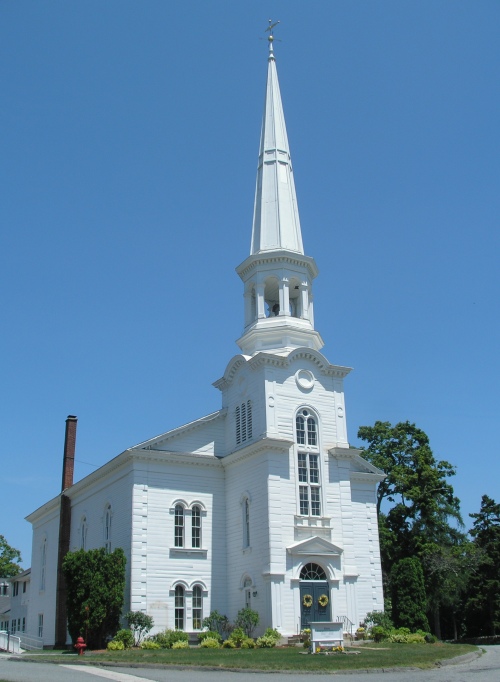
In 1727, the residents of Southborough established a new town and separated from Marlborough. A meeting house was constructed on the area known as “holy hill,” on three acres set aside for a meeting house, burying ground and training field. The original meeting house was replaced by the current church in 1806, built under the supervision of Moses Newton. When the state disestablished parish churches, Unitarians soon came to own the church. In 1831, Trinitarian members of the congregation broke away from the town church. Forming the Pilgrim Congregational Church, they built their own meeting house in 1834, but in 1857 purchased the old meeting house building from the Unitarians. The original church was then renovated and expanded, including the addition of a new and higher steeple with a new bell. That steeple was tipped (but not toppled) by the 1938 hurricane. It was repaired in 1953, so that the bell could again be rung. There is a history of the church (a pdf document) available at http://www.pilgrimchurch.us/Documents/The%20Pilgrim%20Church%20of%20Christ%20in%20Southborough%2018311.pdf.

Charles Burnett-Warner Oland House (1815)

by Dan/July 21, 2010January 21, 2020/Federal, Houses, Southborough

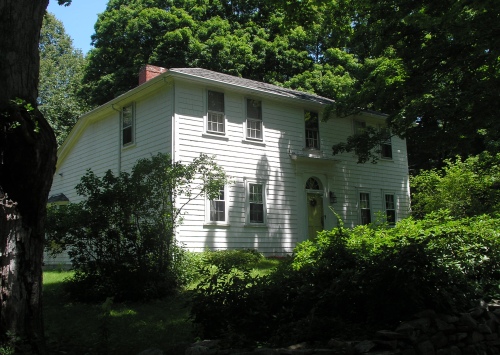
In 1783, Charles Ripley Burnett, farmer and rope maker, married Lovina Mathews, a descendant of the earliest settlers of Southborough. The couple lived in the Matthews Homestead, known as the garrison house, on Gilmore Road, in the Southville section of Southborough. Their son, Charles R. Burnett Jr., married Keziah Pond in 1815 and soon built a house, adjacent to his father’s, on Gilmore Road. It was here that Charles and Keziah‘s son, Joseph Burnett, was born in 1820. He would become a prominent businessman and chemist. In the twentieth century, the Burnett House became the summer home of actor Warner Oland and his wife, artist Edith Gardener Shearn. Born in Sweden, Oland is most remembered for his role as Charlie Chan in the 1930s. He and his wife also translated plays by August Strindberg. Oland died while visiting Sweden in 1938 and his ashes are buried in Southborough. The stone marker is from his Southborough home, called Smoke Tree Farm.

Harriet Beecher Stowe House, Natick (1816)

by Dan/July 6, 2010January 22, 2020/Federal, Houses, Natick

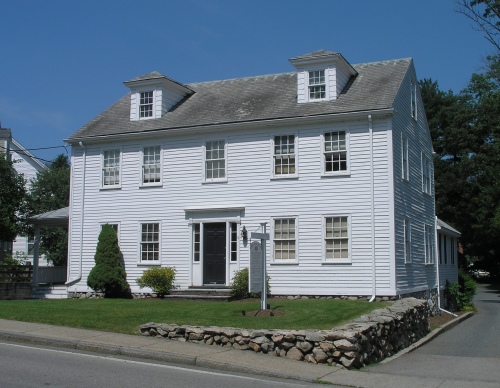
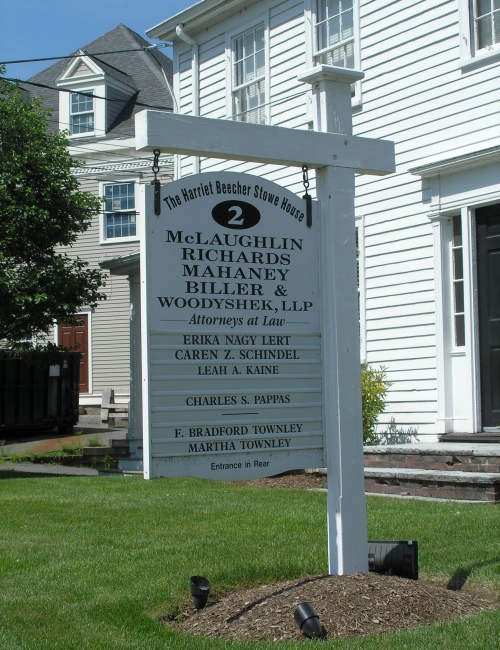
The sign in front says “The Harriet Beecher Stowe House,” but the historic structure at 2 Pleasant Street in South Natick, which now serves as lawyers’ offices, was not a residence of the author of Uncle Tom’s Cabin. Instead, it was built during the childhood of her husband, Calvin Ellis Stowe, who had grown up in the neighborhood. Stowe was born in Natick in 1802, but the death of his father in 1808 left Calvin, his mother and brother in need of financial support. They went to live with the family of Calvin’s grandfather, Col. William Bigelow, in Natick and, with the help of local ministers, Calvin was able to graduate from Bowdoin College with honors in 1824. By the 1830s, Calvin was teaching sacred literature at Lane Theological Seminary in Cincinnati, Ohio. After the death of his first wife, Eliza Tyler, in 1836, he married her best friend in Cincinnati, Harriet Elizabeth Beecher, daughter of the Seminary‘s president, Lyman Beecher. The couple later made visits to the house at Pleasant Street in Natick. It had been built in 1816 by Dr. Alexander Thayer, on land he had acquired from Col. Bigelow. Dr. Thayer, who had married Bigelow’s daughter, built the house for his father-in-law. Thayer’s son, Alexander Wheelock Thayer, later became the author of a famous biography of Beethoven.

Drawing on reminiscences of her husband and in-laws and possibly the written source, “A Brief Account of the Customs and Manner of Living in the Days of our Forefathers” in Oliver N. Bacon’s A history of Natick (1856), Harriet Beecher Stowe wrote the novel, Oldtown Folks, published in 1869, and the story collection, Oldtown Fireside Stories, published in 1872. According to the Genealogy of the Bigelow family of America (1890), Stowe’s grandfather, William Bigelow

was the original character described by Harriet Beecher Stowe in the story of “Old Town Folks” as “Deacon Badger,” his wife Hepsibah is described as “Grandmother Badger,” and those who remember them say that their characters were most accurately depicted. William, the eldest son, is described as “Uncle Bill,” Hepsibah (the mother of Prof. Calvin E. Stowe), was known as “Susy,” while Eunice figured as “Aunt Lois,” and Abigail as “Aunt Keziah.”

Calvin Stowe was also an author. His book, Origin and history of the Books of the Bible was published in 1868. Continue reading “Harriet Beecher Stowe House, Natick (1816)”

Posts navigation

Older posts
Newer posts
Privacy Policy

Categories

  • Architectural Style (943)
    • Art Deco (9)
    • Byzantine (3)
    • Colonial (177)
    • Colonial Revival (85)
    • Craftsman (6)
    • Egyptian Revival (1)
    • Federal (190)
    • Foursquare (6)
    • Gothic (67)
    • Greek Revival (100)
    • Italianate (82)
    • Mission Revival (2)
    • Mission/Spanish Colonial (1)
    • Modern (2)
    • Neoclassical (56)
    • Octagon (3)
    • Postmodern (1)
    • Queen Anne (46)
    • Renaissance Revival (26)
    • Romanesque Revival (53)
    • Second Empire (26)
    • Shingle Style (12)
    • Stick Style (13)
    • Tudor Revival (8)
    • Vernacular (49)
    • Victorian Eclectic (15)
  • Building Type (943)
    • Apartment Buildings (8)
    • Banks (18)
    • Churches (119)
    • Collegiate (32)
    • Commercial (102)
    • Hotels (16)
    • Houses (508)
    • Industrial (23)
    • Libraries (22)
    • Lighthouses (1)
    • Military (15)
    • Monuments (1)
    • Museums (12)
    • Organizations (39)
    • Outbuildings (17)
    • Public Buildings (50)
    • Schools (23)
    • Stations (5)
    • Synagogues (1)
    • Taverns (21)
    • Theaters (9)
  • Town (943)
    • Adams (11)
    • Agawam (4)
    • Amherst (50)
    • Boston (64)
    • Boylston (6)
    • Cambridge (30)
    • Clinton (21)
    • Concord (15)
    • Cummington (1)
    • Danvers (14)
    • Deerfield (31)
    • Gloucester (18)
    • Granville (10)
    • Great Barrington (2)
    • Hadley (9)
    • Hancock (15)
    • Harvard (32)
    • Holyoke (47)
    • Lenox (5)
    • Lexington (8)
    • Longmeadow (32)
    • Marblehead (40)
    • Marlborough (4)
    • Natick (22)
    • Newton (2)
    • Northampton (68)
    • Peabody (4)
    • Pittsfield (20)
    • Salem (110)
    • Saugus (4)
    • Sheffield (4)
    • South Hadley (8)
    • Southborough (8)
    • Southwick (4)
    • Springfield (67)
    • Stockbridge (19)
    • Stow (1)
    • Sturbridge (18)
    • Sudbury (7)
    • Waltham (11)
    • Watertown (1)
    • Wayland (8)
    • West Springfield (14)
    • Westfield (46)
    • Weston (2)
    • Worcester (26)
  • Uncategorized (1)

Recent Comments

  • Wilber Blackson on South Hadley
  • Tami Speiden on Stockbridge
  • DexGuru on Stockbridge

Tags

Alcott Amherst College Asher Benjamin Back Bay Baptist Beacon Hill Big E Black Heritage Trail bowfront Bulfinch Catholic Congregational Episcopal Freedom Trail Gambrel H.H. Richardson Harvard Hawthorne Historic Deerfield Isaac Damon lit Longfellow mansard Methodist Mount Holyoke Museum Museums NPS Old Sturbridge Village PEM Revolutionary War row houses saltbox Samuel McIntire Shakers Smith College SPNEA Springfield Armory Stephen C. Earle Storrowton Underground Railroad UU Washington William Fenno Pratt Witch Trials

Meta

  • Log in
  • Entries feed
  • Comments feed
  • WordPress.org
Proudly powered by WordPress | Theme: ShowMe by NEThemes.