Historic Buildings of Massachusetts

  • About
  • Index by Town
  • CT
  • About
  • Index by Town
  • CT

Category: Town

Round Stone Barn, Hancock Shaker Village (1826)
by Dan/May 6, 2013May 7, 2013/Hancock, Outbuildings, Vernacular

Round Stone Barn

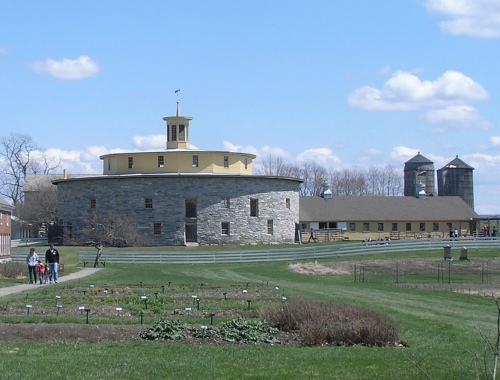
This week we look at buildings at the Hancock Shaker Village, which was active from 1783 to 1960 and is now a museum. The Village‘s most iconic building is the Round Stone Barn, a large dairy barn erected in 1826. It replaced an earlier barn complex which had burned in 1825. A circular shape was used for the barn because of its functionality. As described by “H.C.” in the New York Farmer and reprinted in The Genesee Farmer (Vol. V, No. 49, December, 1835):

The great object of agricultural curiosity at Hancock, is their magnificent stone barn, two stories in height and ninety-six feet in diameter. The great mow is in the centre, and is said to he capable of containing between three and four hundred tons of hay. The floor or driveway is on tho outside of the circle, and the team goes round and comes out at the same door at which it enters. Several teams can stand on the floor and be unloaded at the same time. In the centre of this mow a large post or mast is erected, reaching from tho ground to the roof. At the apex of the roof is a small cupola. Around this post, slats or strips of plank are placed at a small distance from it, to prevent the hay from coming in immediate contact, and the hay at the bottom, being raised by an open frame from the ground, a perfect ventilation is formed, and the steam from the new hay is in this way effectually carried off.

A fire destroyed much of the barn in 1864, but it was rebuilt. Around 1870, the 12-sided upper level loft superstructure, which provides interior ventilation and illumination, was completed. In the twentieth century, cracks began appearing in the masonry. In 1968, the walls were dismantled, the foundations shored up and the walls rebuilt using the original stones. The Round Stone Barn‘s exterior woodwork’s yellow paint color was restored in 2009. Continue reading “Round Stone Barn, Hancock Shaker Village (1826)”
First Baptist Church, Pittsfield (1927)

by Dan/May 5, 2013/Churches, Colonial Revival, Pittsfield

First Baptist Church, Pittsfield

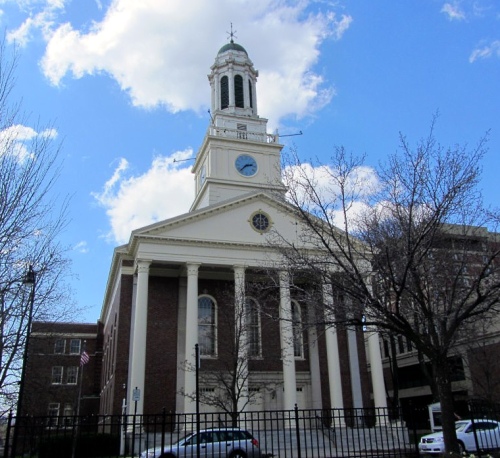
The origins of the Baptist church in Pittsfield go back to the eighteenth century, but its first meeting house was completed in 1827. It was located on North Street, on the northwest corner of the burial ground. The church’s growth led to the construction of a larger building in 1850, which was enlarged and remodeled in 1874-1875. This church was demolished in 1920 to make way for the Onota Building. The First Baptist Church‘s current edifice, at 88 South Street, was built in 1927-1930 (the parish house being completed first in 1926). It was designed by Joseph McArthur Vance.

Old Berkshire Athenaeum (1876)

by Dan/May 1, 2013/Gothic, Libraries, Pittsfield

Berkshire Athenaeum

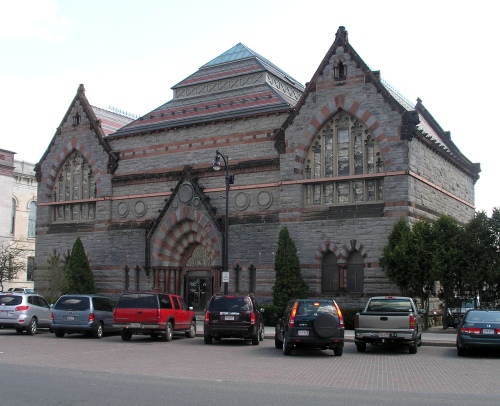
The old Berkshire Athenaeum building, at 44 Bank Row in Pittsfield, was built in 1874-1876. A gift of railway magnate Thomas Allen, it is a High Victorian Gothic building, designed by William Appleton Potter of New York, and displays that style’s distinctive ploychromatic masonry. An addition was made to the rear of the building in 1897. The addition was raised to two stories in 1926, the same year the building’s chimneys were removed. The building served as Pittsfield’s library until 1976, when a new building was constructed across the street on Wendell Avenue. The building was also home to the county museum until the Berkshire Museum was built in 1903. The Athenaeum had responsibility for the museum until it became a separate institution in 1932. The old Athenaeum building stood vacant for three years until it reopened in 1980 as an annex to the Berkshire County Courthouse. It currently houses the Berkshire Probate and Family Court.

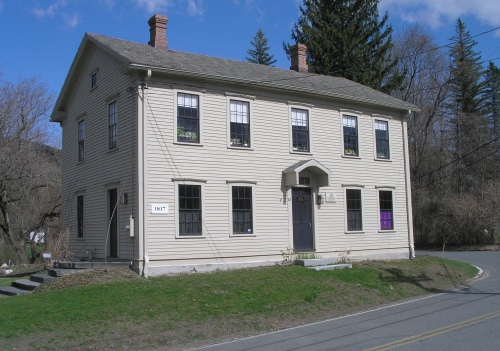
Susan B. Anthony Birthplace (1817)

by Dan/April 30, 2013May 3, 2013/Adams, Federal, Houses

Susan B. Anthony Birthplace

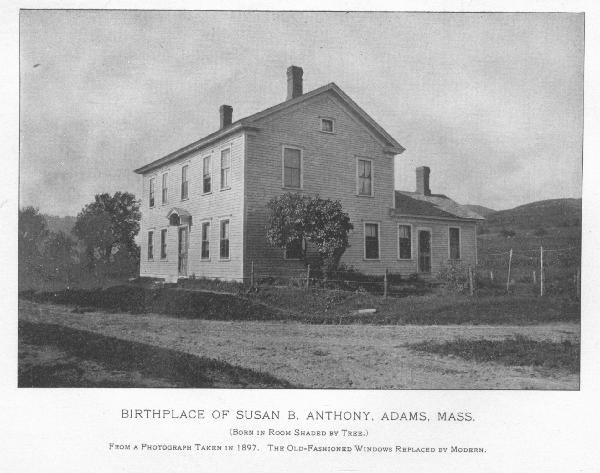
[Note–This is a non-partisan post, but some of the links lead to pages reflecting representing strong opinions on both sides of the abortion issue.] The famous women’s suffrage leader Susan B. Anthony was born in 1820 in a house in Adams. The house had been built by her father, Daniel Anthony, in 1817. He was a cotton manufacturer and abolitionist who raised Susan in the family’s Quaker religion. The family left the house in 1827 and moved to New York State. Their former home, located at 67 East Road in Adams, passed through several owners. From 1926 to 1949, The Society of Friends Descendents owned the house and operated a museum about Susan B. Anthony. After a few unsuccessful attempts by later owners to again make the house a museum, it was purchased at auction in 2006 by Carol Crossed, of the pro-life group Feminists for Life. The restored house opened to the public in 2010 as the Susan B. Anthony Birthplace Museum. It did not open without controversy, however, as there were objections to the museum’s presentation of Anthony’s position on abortion.

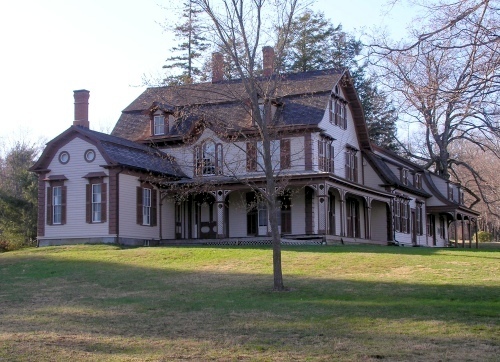
William Cullen Bryant Homestead (1785)

by Dan/April 29, 2013/Colonial, Cummington, Houses, Italianate, Victorian Eclectic

William Cullen Bryant Homestead

William Cullen Bryant (1794-1878) was a major poet and for 50 years was editor and publisher of The New York Evening Post. He was born in a log cabin in Cummington. When he was two, Bryant‘s father, Dr. Peter Bryant, moved the family to a house in Cummington that the doctor’s father-in-law had built in circa 1783-1785. The house became young William Cullen Bryant‘s boyhood home and is now called the William Cullen Bryant Homestead. In 1865, after the old farmhouse had been out of the family for 30 years, Bryant purchased and extensively altered it in to reflect Victorian stylistic tastes. He began by raising the original section of the house, creating a new ground floor. He also added a gambrel-roofed study, a replica of his father’s medical office, which projects from the front facade, and constructed an addition to the house’s original rear ell. The renovated house would serve as his summer home until his death. It is now owned by the Trustees of Reservations and can be toured by the public. Continue reading “William Cullen Bryant Homestead (1785)”

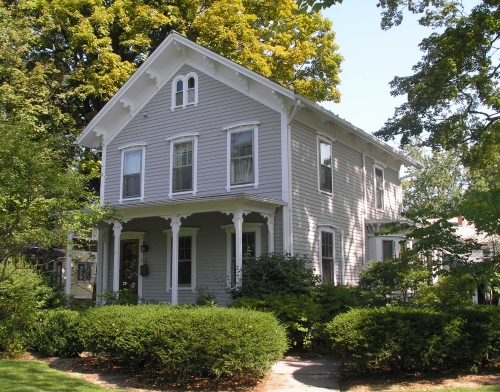
Bray-Hoadley House (1873)

by Dan/April 23, 2013/Houses, Italianate, Northampton

9 Park Street, Florence

The house at 9 Park Street in Florence (Northampton) was built circa 1871-1873 for Eliphalet Bray, a lather (lathe machinist), and his wife Sarah C. Tilton Bray. In the 1880s, the house was home to George Hoadley, principal of Florence High School.

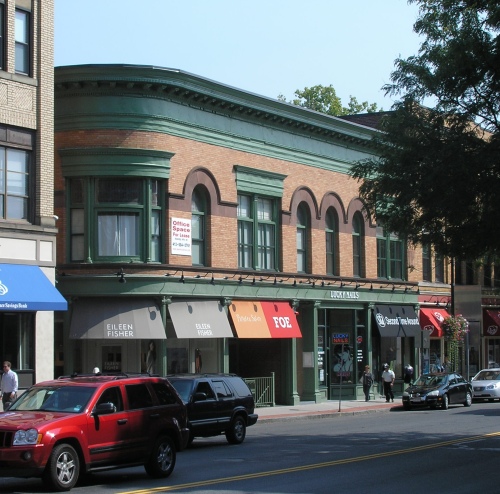
Dewey Block, Northampton (1912)

by Dan/April 22, 2013/Commercial, Northampton, Romanesque Revival

Dewey Block

Born in Ireland and coming to America as a child, John T. Dewey became a businessman in Northampton. He built the commercial block at 24-36 Pleasant Street in about 1912. It is a Romanesque Revival building that features brick, cast iron and stone arches. Taking advantage of an alleyway on the north, the facade of the Dewey Block extends around the northwest corner.

Posts navigation

Older posts
Newer posts
Privacy Policy

Categories

  • Architectural Style (943)
    • Art Deco (9)
    • Byzantine (3)
    • Colonial (177)
    • Colonial Revival (85)
    • Craftsman (6)
    • Egyptian Revival (1)
    • Federal (190)
    • Foursquare (6)
    • Gothic (67)
    • Greek Revival (100)
    • Italianate (82)
    • Mission Revival (2)
    • Mission/Spanish Colonial (1)
    • Modern (2)
    • Neoclassical (56)
    • Octagon (3)
    • Postmodern (1)
    • Queen Anne (46)
    • Renaissance Revival (26)
    • Romanesque Revival (53)
    • Second Empire (26)
    • Shingle Style (12)
    • Stick Style (13)
    • Tudor Revival (8)
    • Vernacular (49)
    • Victorian Eclectic (15)
  • Building Type (943)
    • Apartment Buildings (8)
    • Banks (18)
    • Churches (119)
    • Collegiate (32)
    • Commercial (102)
    • Hotels (16)
    • Houses (508)
    • Industrial (23)
    • Libraries (22)
    • Lighthouses (1)
    • Military (15)
    • Monuments (1)
    • Museums (12)
    • Organizations (39)
    • Outbuildings (17)
    • Public Buildings (50)
    • Schools (23)
    • Stations (5)
    • Synagogues (1)
    • Taverns (21)
    • Theaters (9)
  • Town (943)
    • Adams (11)
    • Agawam (4)
    • Amherst (50)
    • Boston (64)
    • Boylston (6)
    • Cambridge (30)
    • Clinton (21)
    • Concord (15)
    • Cummington (1)
    • Danvers (14)
    • Deerfield (31)
    • Gloucester (18)
    • Granville (10)
    • Great Barrington (2)
    • Hadley (9)
    • Hancock (15)
    • Harvard (32)
    • Holyoke (47)
    • Lenox (5)
    • Lexington (8)
    • Longmeadow (32)
    • Marblehead (40)
    • Marlborough (4)
    • Natick (22)
    • Newton (2)
    • Northampton (68)
    • Peabody (4)
    • Pittsfield (20)
    • Salem (110)
    • Saugus (4)
    • Sheffield (4)
    • South Hadley (8)
    • Southborough (8)
    • Southwick (4)
    • Springfield (67)
    • Stockbridge (19)
    • Stow (1)
    • Sturbridge (18)
    • Sudbury (7)
    • Waltham (11)
    • Watertown (1)
    • Wayland (8)
    • West Springfield (14)
    • Westfield (46)
    • Weston (2)
    • Worcester (26)
  • Uncategorized (1)

Recent Comments

  • Wilber Blackson on South Hadley
  • Tami Speiden on Stockbridge
  • DexGuru on Stockbridge

Tags

Alcott Amherst College Asher Benjamin Back Bay Baptist Beacon Hill Big E Black Heritage Trail bowfront Bulfinch Catholic Congregational Episcopal Freedom Trail Gambrel H.H. Richardson Harvard Hawthorne Historic Deerfield Isaac Damon lit Longfellow mansard Methodist Mount Holyoke Museum Museums NPS Old Sturbridge Village PEM Revolutionary War row houses saltbox Samuel McIntire Shakers Smith College SPNEA Springfield Armory Stephen C. Earle Storrowton Underground Railroad UU Washington William Fenno Pratt Witch Trials

Meta

  • Log in
  • Entries feed
  • Comments feed
  • WordPress.org
Proudly powered by WordPress | Theme: ShowMe by NEThemes.