Historic Buildings of Massachusetts

  • About
  • Index by Town
  • CT
  • About
  • Index by Town
  • CT

Category: Organizations

Plimpton House, Amherst College (1914)
by Dan/January 25, 2012/Amherst, Collegiate, Colonial Revival, Organizations

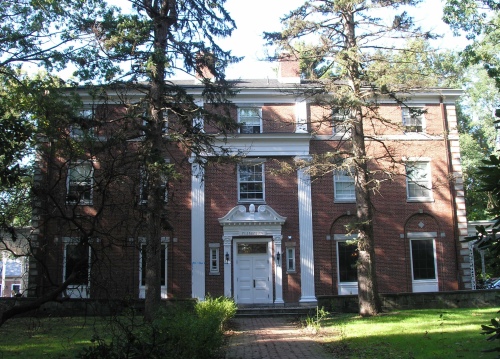
The building at 82 Lessey Street in Amherst was built in 1914 by the Delta Kappa Epsilon Fraternity of Amherst College. It replaced the fraternity’s two earlier connected buildings on the site. One of these had been purchased on land acquired in 1883 from Col. W.S. Clark, President of the Massachusetts Agricultural College (now UMASS Amherst) and the second was built next to it in 1886. The new Georgian Revival fraternity house was designed by Lionel Moses II of the firm of McKim, Meade & White and has a doorway modeled on that of Westover, the eighteenth-century Virginia plantation house of William Byrd II. The fraternity house became an Amherst College dormitory, named Plimpton House, in 1984.
74 Joy Street, Boston (1862)

by Dan/December 17, 2011/Boston, Organizations, Public Buildings, Second Empire

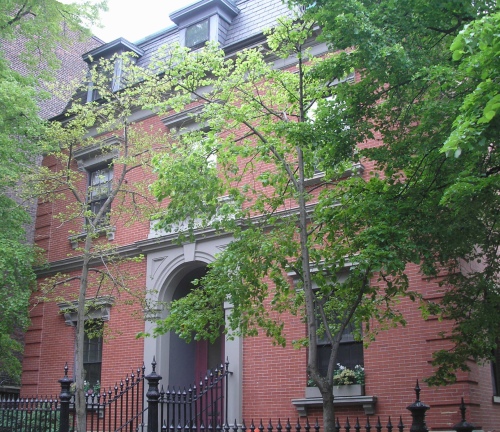
At 74 Joy Street in Boston’s Beacon Hill is a mansard-roofed building, built in 1861-1862. Designed by Gridley J.F. Bryant, it was built as Boston’s Police Station Number 3. In 1962, it ceased being used as a police station and in 1966 it was bought by the Beacon Hill Civic Association (it also houses the Beacon Hill Business Association and Beacon Hill Village).

Smith Charities (1851)

by Dan/December 4, 2011/Italianate, Northampton, Organizations

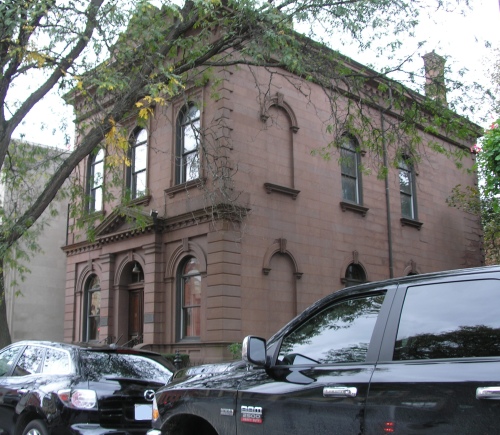
At 51 Main Street in Northampton is an 1851 sandstone Italianate building designed by William Fenno Pratt. The building is home to Smith Charities, an organization which aids indigent children and women. As explained in the American Journal of Education, Vol. 27, No. 7, (July 1877):

This large and comprehensive system or charities was founded by Oliver Smith, Esq., of Hatfield, who died Dec. 22, 1845. His estate was valued, at the time of his death, at $370,000. In his will, he directed that a board of trustees should be constituted in the following manner: The towns of Northampton, Hadley, Hatfield, Amherst, and Williamsburg, in Hampshire County, and Deerfield, Greenfield, and Whately, in Franklin County, shall choose at each annual meeting a person who shall be called an elector. The electors were to choose three persons who should constitute a board of trustees, who were to have the control and management of all the funds.

Some of Smith’s heirs contested his will, resulting in a trial in July 1847. As the above article relates, “Two days were occupied in the trial, Rufus Choate arguing the case for the heirs-at-law, and Daniel Webster for the will. The courthouse was crowded to overflowing, and ladders were put up to the windows, so eager were the people to see and hear the great orators.” As described in Early Northampton (1914):

The heirs—among them Austin Smith (a nephew of Oliver Smith and a brother of Sophia Smith, founder of Smith College)—wished to break the will, claiming that while the law required three competent witnesses to such a document, only two of the witnesses of the Oliver Smith will were in fit condition to sign it. Oliver Smith, another of the heirs, also a nephew of Oliver Smith, Sr., and executor of the will, determined, against his own interests, to uphold it, and engaged Daniel Webster, with Judge Forbes as junior counsel. Charles Delano was also retained—the latter two being Northampton lawyers. Webster, by his remarkable personality and brilliancy, and by his judicious handling of the witnesses, gained the case, in spite of the utmost efforts of his able antagonist, Mr. Choate.

Former Masonic Temple, Springfield (1924)

by Dan/December 3, 2011/Churches, Egyptian Revival, Neoclassical, Organizations, Springfield

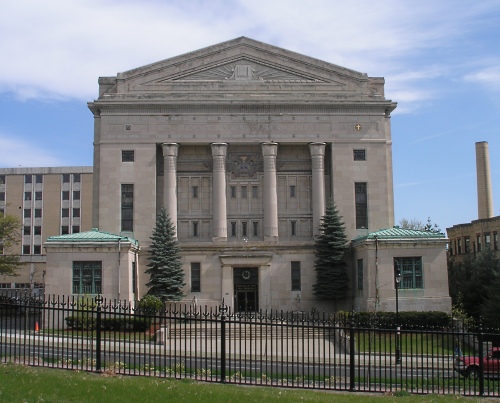
The former Springfield Masonic Temple, located at 339-341 State Street, was built between 1924 and 1926. Before its construction, the Springfield Masons used an earlier Masonic Hall at the corner of Main and State streets. The 1924 Temple is a Springfield landmark, with a monumental neo-classical exterior built of Indiana limestone with terra cotta trim. The facade features Egyptian Revival details, including four columns above the doorway, and symbols characteristic of masonry. Above the colonnade is a frieze with the dates A.L. 5924 and A.D. 1924, and the Latin inscription: “Aedificatum Ut Lux Splendesceret” (“Erected That Light Might Become Brighter”). In 2007, the Masons sold the building to the International Communion of the Holy Christian Orthodox Church, under the leadership of Archbishop Timothy Paul Baymon. The building is now used as a church called the Basilica of the Holy Apostles.

Masonic Block, Northampton (1898)

by Dan/November 19, 2011November 16, 2011/Commercial, Neoclassical, Northampton, Organizations

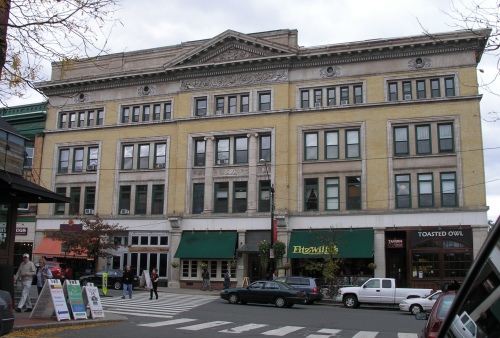
The Masonic Block, at 25 Main Street in Northampton, is a Classical Revival commercial and office structure which, given its name, no doubt also once had a Masonic Hall. Its architect was R. F. Putnam and it was built in 1898. The law office of Calvin Coolidge, who later became president, was located in the central section of the building from 1898 to 1918.

Union Club, Boston (1809)

by Dan/May 22, 2011/Boston, Greek Revival, Organizations

In 1863, some former members of the Somerset Club in Boston who were strong supporters of the Union formed the Union Club. They acquired a house at 8 Park Street in Boston to be their clubhouse. It had been built in 1809 for John Gore and been completely remodeled in Greek Revival style (but with interesting cast iron balconies as well) in 1838 for Abbott Lawrence. The Union Club hired Gridley J. F. Bryant, who had overseen the earlier remodeling, and John Hubbard Sturgis to remodel the interior. Peabody and Stearns were hired in the 1880s to add a fifth floor and the Club was expanded into the adjoining house, at 7 Park Street, in 1896. That house (1809) had been the home, from 1854 to 1856, of Governor Henry Gardener of the “Know Nothing” party. In 1869 the house was sold to John Amory Lowell and the Club acquired the house from his estate.

Solomon B. Griffin House (1904)

by Dan/February 11, 2011January 21, 2020/Houses, Organizations, Springfield, Tudor Revival

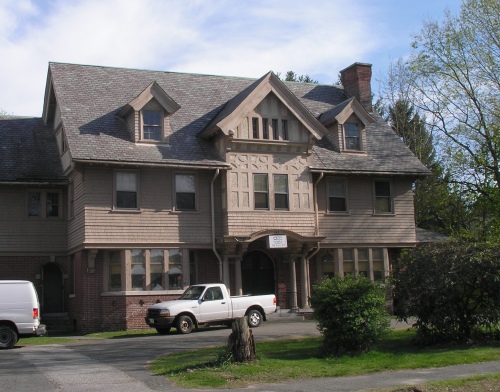
The Solomon B. Griffin House, at 185 Mill Street in Springfield, was built in 1904. It was designed by Charles E. Hamilton in the Tudor or English Revival style. Griffin was an author and managing editor of the Springfield Republican newspaper for many years. Today, the house is Amity Lodge 172 of the Independent Order of Odd Fellows.

Posts navigation

Older posts
Newer posts
Privacy Policy

Categories

  • Architectural Style (943)
    • Art Deco (9)
    • Byzantine (3)
    • Colonial (177)
    • Colonial Revival (85)
    • Craftsman (6)
    • Egyptian Revival (1)
    • Federal (190)
    • Foursquare (6)
    • Gothic (67)
    • Greek Revival (100)
    • Italianate (82)
    • Mission Revival (2)
    • Mission/Spanish Colonial (1)
    • Modern (2)
    • Neoclassical (56)
    • Octagon (3)
    • Postmodern (1)
    • Queen Anne (46)
    • Renaissance Revival (26)
    • Romanesque Revival (53)
    • Second Empire (26)
    • Shingle Style (12)
    • Stick Style (13)
    • Tudor Revival (8)
    • Vernacular (49)
    • Victorian Eclectic (15)
  • Building Type (943)
    • Apartment Buildings (8)
    • Banks (18)
    • Churches (119)
    • Collegiate (32)
    • Commercial (102)
    • Hotels (16)
    • Houses (508)
    • Industrial (23)
    • Libraries (22)
    • Lighthouses (1)
    • Military (15)
    • Monuments (1)
    • Museums (12)
    • Organizations (39)
    • Outbuildings (17)
    • Public Buildings (50)
    • Schools (23)
    • Stations (5)
    • Synagogues (1)
    • Taverns (21)
    • Theaters (9)
  • Town (943)
    • Adams (11)
    • Agawam (4)
    • Amherst (50)
    • Boston (64)
    • Boylston (6)
    • Cambridge (30)
    • Clinton (21)
    • Concord (15)
    • Cummington (1)
    • Danvers (14)
    • Deerfield (31)
    • Gloucester (18)
    • Granville (10)
    • Great Barrington (2)
    • Hadley (9)
    • Hancock (15)
    • Harvard (32)
    • Holyoke (47)
    • Lenox (5)
    • Lexington (8)
    • Longmeadow (32)
    • Marblehead (40)
    • Marlborough (4)
    • Natick (22)
    • Newton (2)
    • Northampton (68)
    • Peabody (4)
    • Pittsfield (20)
    • Salem (110)
    • Saugus (4)
    • Sheffield (4)
    • South Hadley (8)
    • Southborough (8)
    • Southwick (4)
    • Springfield (67)
    • Stockbridge (19)
    • Stow (1)
    • Sturbridge (18)
    • Sudbury (7)
    • Waltham (11)
    • Watertown (1)
    • Wayland (8)
    • West Springfield (14)
    • Westfield (46)
    • Weston (2)
    • Worcester (26)
  • Uncategorized (1)

Recent Comments

  • Wilber Blackson on South Hadley
  • Tami Speiden on Stockbridge
  • DexGuru on Stockbridge

Tags

Alcott Amherst College Asher Benjamin Back Bay Baptist Beacon Hill Big E Black Heritage Trail bowfront Bulfinch Catholic Congregational Episcopal Freedom Trail Gambrel H.H. Richardson Harvard Hawthorne Historic Deerfield Isaac Damon lit Longfellow mansard Methodist Mount Holyoke Museum Museums NPS Old Sturbridge Village PEM Revolutionary War row houses saltbox Samuel McIntire Shakers Smith College SPNEA Springfield Armory Stephen C. Earle Storrowton Underground Railroad UU Washington William Fenno Pratt Witch Trials

Meta

  • Log in
  • Entries feed
  • Comments feed
  • WordPress.org
Proudly powered by WordPress | Theme: ShowMe by NEThemes.