Historic Buildings of Massachusetts

  • About
  • Index by Town
  • CT
  • About
  • Index by Town
  • CT

Category: Vernacular

Sam Lawton House (1798)
by Dan/July 7, 2010January 22, 2020/Houses, Natick, Vernacular

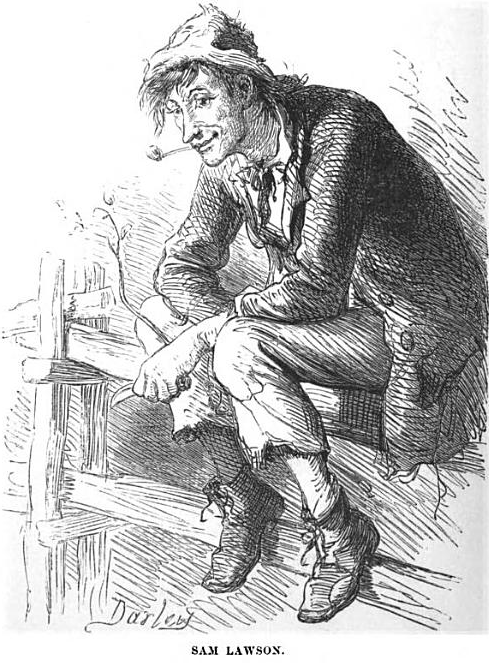
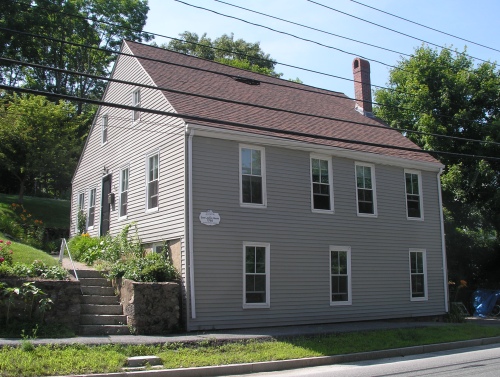
In her 1869 novel, Oldtown Folks (1869), Harriet Beecher Stowe presents the lives of people in a old Massachusetts town, based primarily on reminiscences of real individuals by her husband, Prof. Calvin Ellis Stowe, who grew up in South Natick. One of the prominent characters in Oldtown Folks is Sam Lawson, who also appears as the narrator in another work by Stowe, Sam Lawson’s Oldtown Fireside Stories (1872). Sam Lawson was based on Sam Lawton, an actual resident of South Natick. As written in Proceedings of the reunion of the descendants of John Eliot “The Apostle to the Indians” at Guilford, Conn., Sept. 15, 1875; Second Meeting at South Natick, Mass., July 3, 1901, and the 250th anniversary of the founding of So. Natick, July 4th, 1901 (1901),

Near the tavern, about where Cooper’s drug store now stands, was the store, where was sold everything from hoe handles up to cambric needles, where the post office was kept, and where was a general exchange of news. There Sam Lawton, the village gossip and do-nothing, whose name Mrs. Stowe has changed in her story to Lawson, used to sit on a convenient barrel and swap stories with the farmers whose wagons stood hitched around the door, while their wives and daughters were shopping among the dress goods and ribbons.
“Sam Lawson” is the most unique character in the Oldtown story, and is also one of the most true to life. Those who remember the real Samuel Lawton say the sketch of him is not at all exaggerated.

In an article called “South Natick in Fact and Fiction,” (The New England Magazine, Vol. 23, no. 2. Oct. 1904, Edith A. Sawyer writes that

The “Sam Lawson,” or Lawton, house stands on Eliot street, between the Parson Lothrop house on the one hand and the tavern-site on the other, and not far from the Bacon Free Library. The basement, Sam used for his blacksmith shop. He occupied this place from 1798 to 1812, when he sold it, and leased a small one-story house with basement below, nearly opposite. Here he lived until his removal to Newton Lower Falls, in 1828, where he died.

The Sam Lawton House was purchased in 1812 by Benjamin Bird of Needham, who was also a blacksmith, and was occupied by his family after his death in 1836. In 1867 the house was sold to William Selfe. When Eliot Street was widened in the 1870s, the house was moved back 16 feet from the street to its present location.
Concord School of Philosophy (1880)

by Dan/November 11, 2009November 11, 2009/Concord, Schools, Vernacular

001

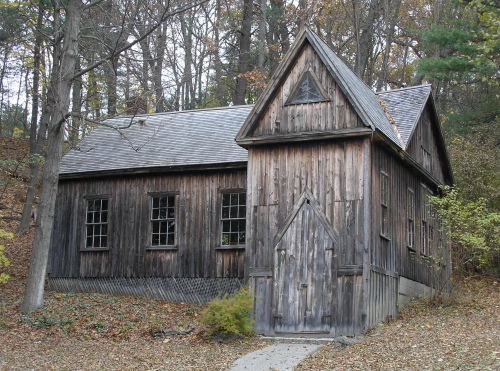
Adjacent to Orchard House (the home of A. Bronson Alcott and his family) is a building, designed and built by Alcott himself in 1880, which was originally called the Hillside Chapel and is known today as the Concord School of Philosophy. This school, which was organized by Alcott and operated from 1879 to 1888, was modeled on Plato’s Academy as series of of summer lectures for adults, with notable speakers and discussions of philosophy. For the first year, the sessions were held in Orchard House, but the following year and thereafter, the school met in Alcott’s Hillside Chapel. The school’s final meeting, in 1888, commemorated Alcott, who had died that year. Today, the building is part of the Orchard House museum. Continue reading “Concord School of Philosophy (1880)”

“New” Nathaniel Ely House (1856)

by Dan/September 19, 2009September 17, 2016/Houses, Longmeadow, Vernacular

New Nathaniel Ely House

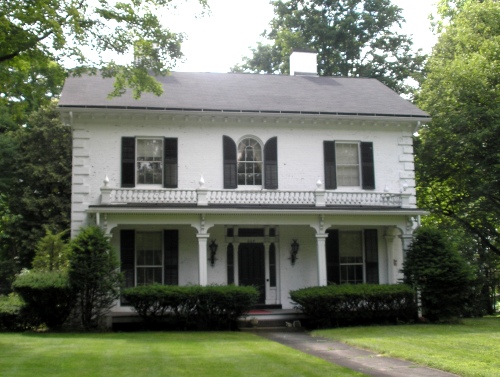
The Nathaniel Ely House (called “New” to distinguish it from the earlier “Old” Nathaniel Ely House nearby) was built in 1856 off Longmeadow Green. The Thomas Bliss House originally stood where the Ely House was later conbstructed, but was moved across the street to make way for the new structure. The Ely House has elements from a variety of architectural styles, including the Federal, Italianate and Gothic styles–truly a Victorian Eclectic building!

Mellen Law Office (1826)

by Dan/August 31, 2009/Commercial, Vernacular, Wayland

Mellen Law Office

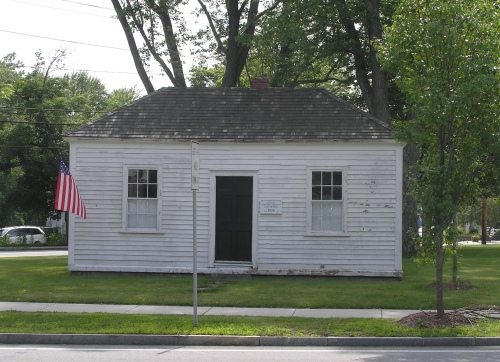
Located on a green in the center of Wayland is the Mellen Law Office. It was built in 1826 by Samuel Hale Mann, who only practiced law there for four years before ill health forced him to sell it (and his house across the street) to Edward Mellen, who eventually became chief justice of the Court of Common Pleas in Worcester. The office housed many other offices and businesses over the years, all the while remaining in the possession of the Mellen family. In 1971, it was donated to the town and is maintained by the Wayland Historical Society.

Sudbury Grange Hall (1846)

by Dan/August 26, 2009August 26, 2009/Organizations, Schools, Sudbury, Vernacular

Sudbury Grange Hall

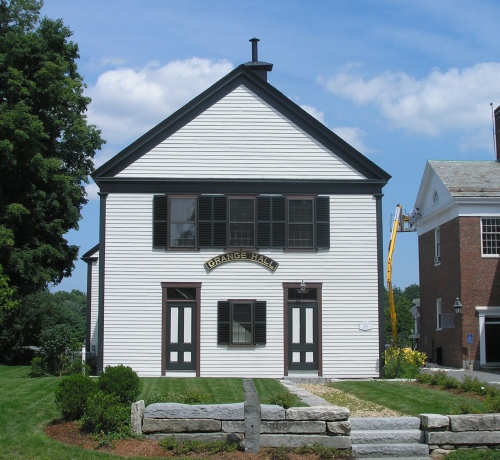
In 1846, the same year Sudbury’s original Town Hall (rebuilt in 1932) was constructed, a schoolhouse was built on the southeast corner of Sudbury Common. The structure was later raised to two-stories. The building, later moved to its current location next to the Town Hall, served as a school until 1890, when it was sold to the Sudbury Grange. In 2006, the building was acquired by the Sudbury Foundation and has been restored and modernized, with a new rear addition. The first floor is now the Foundation’s offices and the second floor is used by the Sudbury Grange and as a public meeting space by the town.

Garrity House (1856)

by Dan/August 17, 2009September 17, 2016/Houses, Lexington, Vernacular

Garrity House

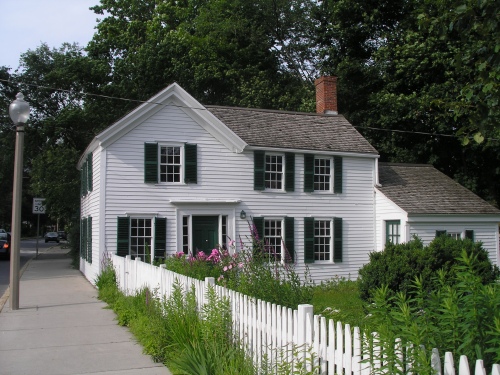
A complex of several farm buildings once surrounded the Buckman Tavern in Lexington. The only ones to survive today are a Federal-style carriage house and the adjacent Garrity House. Built in the first half of the nineteenth century, the Garrity House is privately owned today, although the Town maintains the grounds through a land lease and preservation agreement.

West India Goods Store (1804)

by Dan/June 30, 2009June 30, 2009/Commercial, Salem, Vernacular

west-india-goods-store.jpg

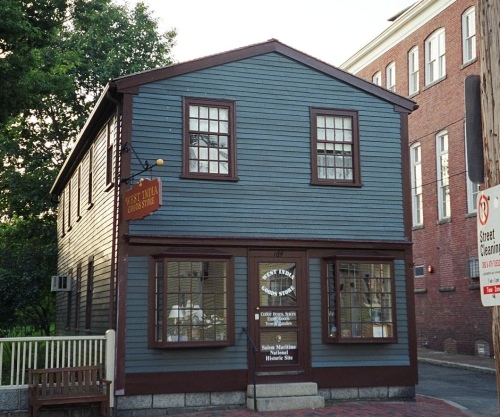
Typical of the waterfront commercial buildings of early nineteenth century Salem is the West India Goods Store on Derby Street. Now a part of the Salem Maritime National Historic Site, the Store was built sometime between 1800 and 1815, probably around 1804, by the merchant, Captain Henry Prince, Sr., when he lived in the Derby House next door. Prince probably used it as a warehouse, its first documented use as a store being in 1836. The store actually sold goods from all over the world, the term “West India Goods Store” being a generic term for a store selling international goods. The building was altered many times over the years, being moved at one point from the left of the house to the right. It was restored by the Society for the Preservation of New England Antiquities in 1928 and was acquired by the Park Service in 1937. Today the Store sells items similar to those it would have sold in the nineteenth century.

Posts navigation

Newer posts
Privacy Policy

Categories

  • Architectural Style (943)
    • Art Deco (9)
    • Byzantine (3)
    • Colonial (177)
    • Colonial Revival (85)
    • Craftsman (6)
    • Egyptian Revival (1)
    • Federal (190)
    • Foursquare (6)
    • Gothic (67)
    • Greek Revival (100)
    • Italianate (82)
    • Mission Revival (2)
    • Mission/Spanish Colonial (1)
    • Modern (2)
    • Neoclassical (56)
    • Octagon (3)
    • Postmodern (1)
    • Queen Anne (46)
    • Renaissance Revival (26)
    • Romanesque Revival (53)
    • Second Empire (26)
    • Shingle Style (12)
    • Stick Style (13)
    • Tudor Revival (8)
    • Vernacular (49)
    • Victorian Eclectic (15)
  • Building Type (943)
    • Apartment Buildings (8)
    • Banks (18)
    • Churches (119)
    • Collegiate (32)
    • Commercial (102)
    • Hotels (16)
    • Houses (508)
    • Industrial (23)
    • Libraries (22)
    • Lighthouses (1)
    • Military (15)
    • Monuments (1)
    • Museums (12)
    • Organizations (39)
    • Outbuildings (17)
    • Public Buildings (50)
    • Schools (23)
    • Stations (5)
    • Synagogues (1)
    • Taverns (21)
    • Theaters (9)
  • Town (943)
    • Adams (11)
    • Agawam (4)
    • Amherst (50)
    • Boston (64)
    • Boylston (6)
    • Cambridge (30)
    • Clinton (21)
    • Concord (15)
    • Cummington (1)
    • Danvers (14)
    • Deerfield (31)
    • Gloucester (18)
    • Granville (10)
    • Great Barrington (2)
    • Hadley (9)
    • Hancock (15)
    • Harvard (32)
    • Holyoke (47)
    • Lenox (5)
    • Lexington (8)
    • Longmeadow (32)
    • Marblehead (40)
    • Marlborough (4)
    • Natick (22)
    • Newton (2)
    • Northampton (68)
    • Peabody (4)
    • Pittsfield (20)
    • Salem (110)
    • Saugus (4)
    • Sheffield (4)
    • South Hadley (8)
    • Southborough (8)
    • Southwick (4)
    • Springfield (67)
    • Stockbridge (19)
    • Stow (1)
    • Sturbridge (18)
    • Sudbury (7)
    • Waltham (11)
    • Watertown (1)
    • Wayland (8)
    • West Springfield (14)
    • Westfield (46)
    • Weston (2)
    • Worcester (26)
  • Uncategorized (1)

Recent Comments

  • Wilber Blackson on South Hadley
  • Tami Speiden on Stockbridge
  • DexGuru on Stockbridge

Tags

Alcott Amherst College Asher Benjamin Back Bay Baptist Beacon Hill Big E Black Heritage Trail bowfront Bulfinch Catholic Congregational Episcopal Freedom Trail Gambrel H.H. Richardson Harvard Hawthorne Historic Deerfield Isaac Damon lit Longfellow mansard Methodist Mount Holyoke Museum Museums NPS Old Sturbridge Village PEM Revolutionary War row houses saltbox Samuel McIntire Shakers Smith College SPNEA Springfield Armory Stephen C. Earle Storrowton Underground Railroad UU Washington William Fenno Pratt Witch Trials

Meta

  • Log in
  • Entries feed
  • Comments feed
  • WordPress.org
Proudly powered by WordPress | Theme: ShowMe by NEThemes.