Search
Advertisement
Become a Fan!
Buy My Book! Click Cover Image to Order!
Categories
- Architectural Style (689)
- Art Deco (2)
- Byzantine (3)
- Colonial (157)
- Colonial Revival (60)
- Craftsman (3)
- Egyptian Revival (1)
- Federal (157)
- Foursquare (3)
- Gothic (45)
- Greek Revival (75)
- Italianate (48)
- Mission Revival (1)
- Modern (1)
- Neoclassical (29)
- Octagon (2)
- Postmodern (1)
- Queen Anne (26)
- Renaissance Revival (18)
- Romanesque Revival (33)
- Second Empire (18)
- Shingle Style (9)
- Stick Style (10)
- Tudor Revival (6)
- Vernacular (30)
- Victorian Eclectic (7)
- Building Type (689)
- Apartment Buildings (5)
- Banks (7)
- Churches (82)
- Collegiate (31)
- Commercial (52)
- Hotels (11)
- Houses (404)
- Industrial (10)
- Libraries (12)
- Lighthouses (1)
- Military (13)
- Monuments (1)
- Museums (9)
- Organizations (27)
- Outbuildings (9)
- Public Buildings (33)
- Schools (16)
- Stations (2)
- Synagogues (1)
- Taverns (17)
- Theaters (6)
- Town (689)
- Adams (2)
- Agawam (4)
- Amherst (50)
- Boston (64)
- Cambridge (30)
- Clinton (8)
- Concord (8)
- Cummington (1)
- Danvers (14)
- Deerfield (31)
- Granville (10)
- Hadley (8)
- Hancock (6)
- Holyoke (19)
- Lenox (5)
- Lexington (8)
- Longmeadow (31)
- Marblehead (40)
- Marlborough (4)
- Natick (22)
- Newton (2)
- Northampton (40)
- Peabody (4)
- Pittsfield (5)
- Salem (98)
- Saugus (4)
- South Hadley (8)
- Southborough (8)
- Southwick (3)
- Springfield (50)
- Stockbridge (10)
- Stow (1)
- Sturbridge (18)
- Sudbury (7)
- Waltham (10)
- Watertown (1)
- Wayland (8)
- West Springfield (14)
- Westfield (19)
- Weston (2)
- Worcester (12)
- Uncategorized (1)
- Architectural Style (689)
Recent Comments
- peter hiller on Boston
- Pat Barnes on Springfield Municipal Group (1913)
- Paul A. Doucette on The Joseph Burnett House (1850)
- Judith on The Joseph Burnett House (1850)
- PCL on Hotel Vendome (1871)
Tags
Alcott Amherst College Asher Benjamin Back Bay Baptist Beacon Hill Big E Black Heritage Trail bowfront Bulfinch Catholic Congregational Episcopal Freedom Trail Gambrel H.H. Richardson Harvard Hawthorne Historic Deerfield Isaac Damon lit Longfellow mansard Methodist Mount Holyoke Museum Museums NPS Old Sturbridge Village PEM Revolutionary War row houses saltbox Samuel McIntire Shakers Shingle SPNEA Springfield Armory Stick Style Storrowton Underground Railroad UU Washington William Fenno Pratt Witch Trials-

Centers And SquaresBlogroll
Links
- Boston Preservation Alliance
- Cape Cod Modern House Trust
- Digital Treasures
- Historic Boston Inc.
- Historic Deerfield
- Historic New England
- Historic Salem Inc.
- Image Museum
- Old Sturbridge Village
- Preservation Massachusetts
- Preservation Worcester
- Salem Preservation, Inc.
- Springfield Preservation Trust
- The Trustees of Reservations
-
Recent Posts
- Saunders-Saltonstall-Tuckerman Double House (1810)
- Hadley Farm Museum (1782)
- Mechanics Hall (1857)
- Hotel Northampton (1927)
- Berkshire Life Insurance Company (1868)
- Friends Meeting House, Adams (1782)
- Meetinghouse, Hancock Shaker Village (1793)
- Trustees’ Office and Store, Hancock Shaker Village (1813)
- Sisters’ Dairy and Weave Shop (1790)
- Brethren’s Shop, Hancock Shaker Village (1813)
- Brick Poultry House, Hancock Shaker Village (1878)
- Brick Dwelling, Hancock Shaker Village (1830)
- Round Stone Barn, Hancock Shaker Village (1826)
- First Baptist Church, Pittsfield (1927)
- Old Berkshire Athenaeum (1876)
Archives
- May 2013
- April 2013
- March 2013
- February 2013
- January 2013
- December 2012
- November 2012
- October 2012
- September 2012
- August 2012
- July 2012
- June 2012
- May 2012
- April 2012
- March 2012
- February 2012
- January 2012
- December 2011
- November 2011
- October 2011
- September 2011
- August 2011
- July 2011
- June 2011
- May 2011
- April 2011
- March 2011
- February 2011
- January 2011
- December 2010
- November 2010
- October 2010
- September 2010
- August 2010
- July 2010
- June 2010
- May 2010
- April 2010
- March 2010
- February 2010
- January 2010
- December 2009
- November 2009
- October 2009
- September 2009
- August 2009
- July 2009
- June 2009
- May 2009
- April 2009
- March 2009
- February 2009
- January 2009
- December 2008
- November 2008
- October 2008
- July 2008
- June 2008
- May 2008
- April 2008
- March 2008
-

Pages
- Towns
- Adams
- Agawam
- Amherst
- Boston
- Burlington
- Cambridge
- Clinton
- Concord
- Cummington
- Danvers
- Deerfield
- Granville
- Hadley
- Hancock
- Hatfield
- Holyoke
- Lenox
- Lexington
- Longmeadow
- Marblehead
- Marlborough
- Natick
- Newton
- Northampton
- Peabody
- Pittsfield
- Salem
- Saugus
- South Hadley
- Southborough
- Southwick
- Springfield
- Stockbridge
- Stow
- Sturbridge
- Sudbury
- Waltham
- Watertown
- Wayland
- West Springfield
- Westfield
- Weston
- Worcester
- Towns
Meta
Tag Archives: Historic Deerfield
The Joseph Clesson House (1814)
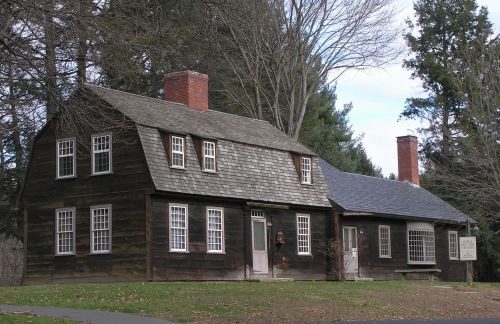
Today part of Historic Deerfield, the Joseph Clesson House was built in 1814, probably planned to be the ell of a larger house Clesson, who died two years later, had intended to build on the site. The house was moved moved around the corner in 1872 and replaced with a Victorian-style home. Eventually, the Clesson House was moved to Greenfield. In 1960, the later Victorian house was torn down and the Clesson House returned to its original lot in Deerfield. The following year, the house opened to the public as the home of the Henry Needham Flynt Silver and Metalware Collection. The house’s kitchen was set up as an example of a silversmith’s workshop. To accommodate the collection, a fireproof wing, made of cinder blocks, was added to the house, with its exterior disguised to resemble the original section.
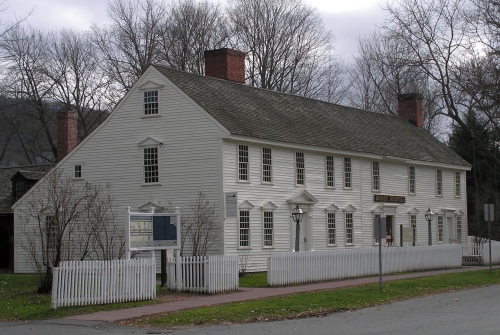
Hall Tavern (1760)

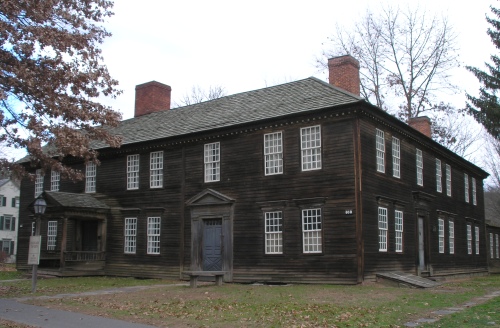
The Hall Tavern Visitor Center at Historic Deerfield was originally built around 1760 on the Mohawk Trail in East Charlemont, not far from Deerfield. It became a tavern in the 1780s and a ballroom was added around 1800. In the early nineteenth century, the tavern was operated by Joel Hall and his wife, Lucretia Street Hall, whose embroidered blanket is in the collection of Historic Deerfield. Joel Hall, who purchased the building in 1807, also manufactured axes. In 1935, the Hall Tavern was the site of an exhibition by the Deerfield Valley Art Association. In the 1950s, the Tavern was moved to a site in Deerfield where a similar tavern, which burned down in 1799, had once stood. It is now the Visitor Center for tours of Historic Deerfield and the restored tavern kitchen is used for open hearth cooking classes. Behind the Tavern is the Cook’s Garden.
The Frary House (1760) and Barnard Tavern (1795)

In 1890, Miss Charlotte Alice Baker purchased a colonial home in Deerfield and, assisted by the architectural firm of Shepley, Rutan & Coolidge, restored it in 1892 in one of the earliest efforts at historic preservation in Western Massachusetts. Baker also furnished the home in line with the ideas of the Colonial Revival and Arts and Crafts movements. At the time, the house was believed to have been built by the original Deerfield settler, Samson Frary, who owned the lot and built a house on it sometime after 1683. Frary was killed during the famous 1704 French and Indian Raid on Deerfield. C. Alice Baker, who was a descendant of Samson Frary, did research on the Deerfield captives and wrote a book called True Stories of New England Captives Carried to Canada During the Old French and Indian Wars (1897). She also wrote A Summer in the Azores (1882). Baker’s lifelong companion, Miss Susan Lane, died in 1893 and Miss Baker died in 1909.
The Frary House, now believed to have been built sometime in the late 1750s, is currently owned by Historic Deerfield. The Barnard Tavern is an addition to the Frary House, constructed in 1795. The home had been sold from the Frary to the Barnard families in 1752. With a large second-floor meeting room, the tavern was one of the centers of village life. At the Tavern’s bar, in 1775, Col. Benedict Arnold closed a contract to supply the expedition against Fort Ticonderoga. Recent research, though, suggests that the building may not have served the full functions of a tavern. Archeological work is also planned for the site.
Posted in Colonial, Deerfield, Houses, Taverns
Tagged Historic Deerfield, Museum, Revolutionary War
Leave a comment
The Stebbins-Wright House (1824)

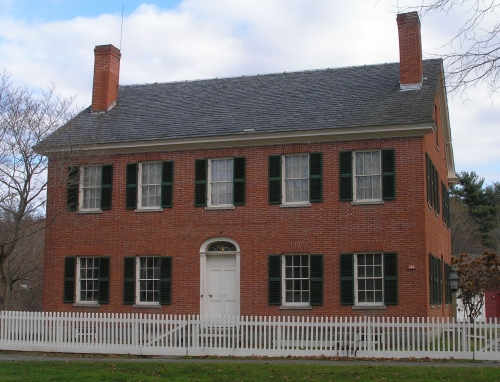
The Stebbins-Wright House is a brick Federal-style house in Old Deerfield. It was built in 1824 by Asa Stebbins, for his son, Asa Stebbins, Jr.. Asa, Sr. had earlier built his own house of brick in 1799. The house was owned by Stebbins’ heirs until 1908, when it was acquired by George and Jane Wright. In 1948, it was acquired by Henry and Helen Flynt for Historic Deerfield. They continued to use the name “Wright House” and restored the house to display a collection of high-style furniture. The house is no longer open to the public.
The Hinsdale and Anna Williams House (1730)

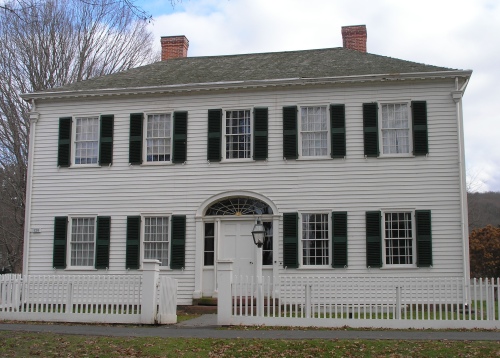
The Hinsdale and Anna Williams House in Deerfield was originally built in 1730 by Ebenezer Hinsdale, who founded Hinsdale , New Hampshire. It later passed through other owners until it came into the possession of Hinsdale’s grandnephew, Ebenezer Hinsdale Williams, whose mother was from Deerfield. In 1816, Williams extensively altered the house in the Federal style, raising the structure in order to install a fanlight above the door, raising the roof and doubling the size of the house with the addition of a two-story ell. Hinsdale Williams lived in the home, with his wife Anna and two children, until his death in 1838. From 1866-1981, the Williams House was occupied by members of the Cowles family. Russell Cowles worked to preserve the house and when the original French scenic wallpaper depicting Venetian scenes, installed by Williams in 1816, was damaged in the Flood of 1936, Cowles went to the Museum of Fine Arts in Boston to learn how to restore it. The building was restored in the 1980s as part of Historic Deerfield.
The Asa Stebbins House (1799)

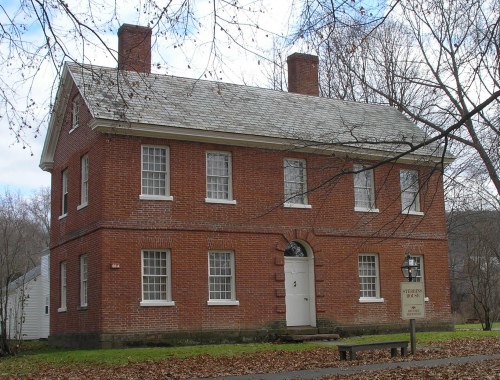
The Federal-style Asa Stebbins House, now one of the museum houses of Historic Deerfield, was built in 1799 and was the first brick house in Franklin county. Stebbins, a wealthy farmer and mill owner, was on the building committees for two other brick structures: the original building of Deerfield Academy (now the Memorial Hall Museum) and the town’s “brick church“. He was also a town selectman and state representative and built and decorated his house in the popular Federal style. Inside, the house has French scenic wallpaper by Joseph Dufour depicting the voyages of Captain Cook.
The Allen House (1734)

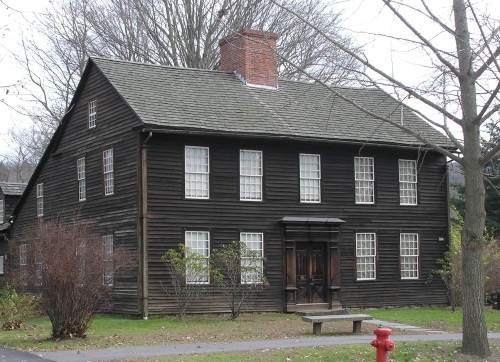
The colonial saltbox known as the Allen House was renovated in 1945 to become the Deerfield home of Henry and Helen Flynt, the founders of Historic Deerfield. They believed the house had been built around 1705, just after the Deerfield Raid of 1704. Current research indicates it was built around 1734. The land was originally owned by Simon and Hannah Beaman, who had been captured during the raid. The house was occupied by the Bardwell family and then by the Allen family, after the 1842 marriage of Catherine Elizabeth Bardwell and Caleb Allen. In 1896, Caleb Bardwell’s nieces, Frances and Mary Allen, with their mother took possession of the house. The Allen sisters were photographers, famous for their Deerfield scenes. They sold their work out of a shop in the house. During the nineteenth century, the interior of the house had been completely changed, leading the Flynts to gut it and recreate an eighteenth century plan. Open to visitors, the antiques-filled interior decoration of the house remains as it was when the Flynts were in residence.