Search
Advertisement
Become a Fan!
Buy My Book! Click Cover Image to Order!
Categories
- Architectural Style (688)
- Art Deco (2)
- Byzantine (3)
- Colonial (157)
- Colonial Revival (60)
- Craftsman (3)
- Egyptian Revival (1)
- Federal (156)
- Foursquare (3)
- Gothic (45)
- Greek Revival (75)
- Italianate (48)
- Mission Revival (1)
- Modern (1)
- Neoclassical (29)
- Octagon (2)
- Postmodern (1)
- Queen Anne (26)
- Renaissance Revival (18)
- Romanesque Revival (33)
- Second Empire (18)
- Shingle Style (9)
- Stick Style (10)
- Tudor Revival (6)
- Vernacular (30)
- Victorian Eclectic (7)
- Building Type (688)
- Apartment Buildings (5)
- Banks (7)
- Churches (82)
- Collegiate (31)
- Commercial (52)
- Hotels (11)
- Houses (403)
- Industrial (10)
- Libraries (12)
- Lighthouses (1)
- Military (13)
- Monuments (1)
- Museums (9)
- Organizations (27)
- Outbuildings (9)
- Public Buildings (33)
- Schools (16)
- Stations (2)
- Synagogues (1)
- Taverns (17)
- Theaters (6)
- Town (688)
- Adams (2)
- Agawam (4)
- Amherst (50)
- Boston (64)
- Cambridge (30)
- Clinton (8)
- Concord (8)
- Cummington (1)
- Danvers (14)
- Deerfield (31)
- Granville (10)
- Hadley (8)
- Hancock (6)
- Holyoke (19)
- Lenox (5)
- Lexington (8)
- Longmeadow (31)
- Marblehead (40)
- Marlborough (4)
- Natick (22)
- Newton (2)
- Northampton (40)
- Peabody (4)
- Pittsfield (5)
- Salem (97)
- Saugus (4)
- South Hadley (8)
- Southborough (8)
- Southwick (3)
- Springfield (50)
- Stockbridge (10)
- Stow (1)
- Sturbridge (18)
- Sudbury (7)
- Waltham (10)
- Watertown (1)
- Wayland (8)
- West Springfield (14)
- Westfield (19)
- Weston (2)
- Worcester (12)
- Uncategorized (1)
- Architectural Style (688)
Recent Comments
- peter hiller on Boston
- Pat Barnes on Springfield Municipal Group (1913)
- Paul A. Doucette on The Joseph Burnett House (1850)
- Judith on The Joseph Burnett House (1850)
- PCL on Hotel Vendome (1871)
Tags
Alcott Amherst College Asher Benjamin Back Bay Baptist Beacon Hill Big E Black Heritage Trail bowfront Bulfinch Catholic Congregational Episcopal Freedom Trail Gambrel H.H. Richardson Harvard Hawthorne Historic Deerfield Isaac Damon lit Longfellow mansard Methodist Mount Holyoke Museum Museums NPS Old Sturbridge Village PEM Revolutionary War row houses saltbox Samuel McIntire Shakers Shingle SPNEA Springfield Armory Stick Style Storrowton Underground Railroad UU Washington William Fenno Pratt Witch Trials-

Centers And SquaresBlogroll
Links
- Boston Preservation Alliance
- Cape Cod Modern House Trust
- Digital Treasures
- Historic Boston Inc.
- Historic Deerfield
- Historic New England
- Historic Salem Inc.
- Image Museum
- Old Sturbridge Village
- Preservation Massachusetts
- Preservation Worcester
- Salem Preservation, Inc.
- Springfield Preservation Trust
- The Trustees of Reservations
-
Recent Posts
- Hadley Farm Museum (1782)
- Mechanics Hall (1857)
- Hotel Northampton (1927)
- Berkshire Life Insurance Company (1868)
- Friends Meeting House, Adams (1782)
- Meetinghouse, Hancock Shaker Village (1793)
- Trustees’ Office and Store, Hancock Shaker Village (1813)
- Sisters’ Dairy and Weave Shop (1790)
- Brethren’s Shop, Hancock Shaker Village (1813)
- Brick Poultry House, Hancock Shaker Village (1878)
- Brick Dwelling, Hancock Shaker Village (1830)
- Round Stone Barn, Hancock Shaker Village (1826)
- First Baptist Church, Pittsfield (1927)
- Old Berkshire Athenaeum (1876)
- Susan B. Anthony Birthplace (1817)
Archives
- May 2013
- April 2013
- March 2013
- February 2013
- January 2013
- December 2012
- November 2012
- October 2012
- September 2012
- August 2012
- July 2012
- June 2012
- May 2012
- April 2012
- March 2012
- February 2012
- January 2012
- December 2011
- November 2011
- October 2011
- September 2011
- August 2011
- July 2011
- June 2011
- May 2011
- April 2011
- March 2011
- February 2011
- January 2011
- December 2010
- November 2010
- October 2010
- September 2010
- August 2010
- July 2010
- June 2010
- May 2010
- April 2010
- March 2010
- February 2010
- January 2010
- December 2009
- November 2009
- October 2009
- September 2009
- August 2009
- July 2009
- June 2009
- May 2009
- April 2009
- March 2009
- February 2009
- January 2009
- December 2008
- November 2008
- October 2008
- July 2008
- June 2008
- May 2008
- April 2008
- March 2008
-

Pages
- Towns
- Adams
- Agawam
- Amherst
- Boston
- Burlington
- Cambridge
- Clinton
- Concord
- Cummington
- Danvers
- Deerfield
- Granville
- Hadley
- Hancock
- Hatfield
- Holyoke
- Lenox
- Lexington
- Longmeadow
- Marblehead
- Marlborough
- Natick
- Newton
- Northampton
- Peabody
- Pittsfield
- Salem
- Saugus
- South Hadley
- Southborough
- Southwick
- Springfield
- Stockbridge
- Stow
- Sturbridge
- Sudbury
- Waltham
- Watertown
- Wayland
- West Springfield
- Westfield
- Weston
- Worcester
- Towns
Meta
Tag Archives: Hawthorne
Hawthorne Hotel (1925)
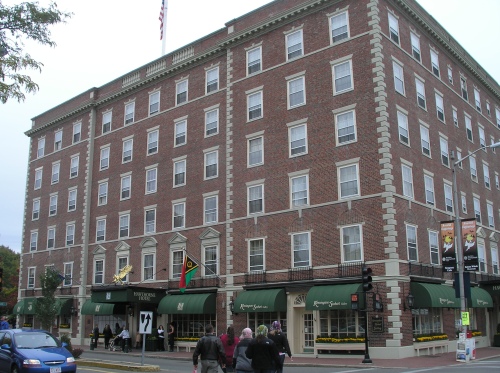
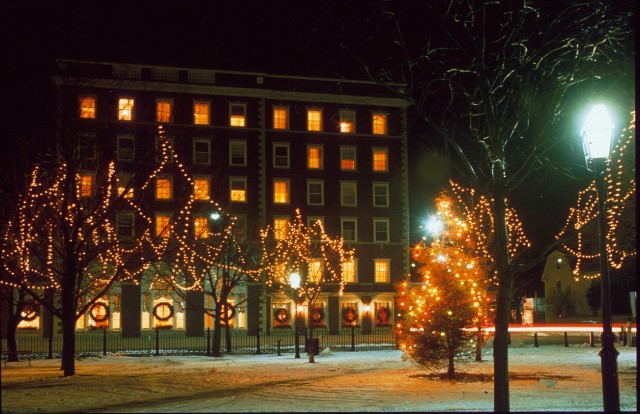
In 1809, the corner of Washington Square and Essex Street, off Salem Common in Salem, became the site of the Archer Block. Later called the Franklin Building, it was a commercial and residential building constructed under the direction of Samuel McIntire. Destroyed by fire in 1860, it was replaced with an Italianate-style successor. From 1833, the property was owned by the Salem Marine Society, which later agreed to raze the building and sell the land for construction of a new hotel. In return, the hotel built a room for the society’s use on the top floor. The hotel, built in 1924-1925, was named the Hawthorne Hotel, in honor of the famous Salem author. It was designed by architect Philip Horton Smith of the firm of Smith & Walker.
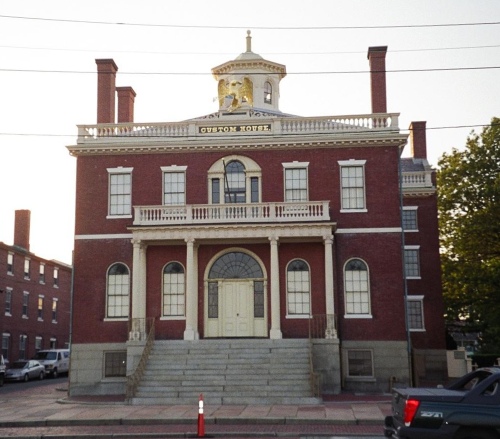
Salem Custom House (1819)

The last in a series of 13 custom houses built in Salem since 1649, the Salem Custom House of 1819 is famous for being featured in the introduction to Nathaniel Hawthorne‘s The Scarlet Letter (1850). Hawthorne worked in the Custom House for the U.S. Custom Service as Surveyor in 1846-1849. The building housed offices and an attached warehouse, the Public Stores, which contained bonded and impounded cargo. The structure was designed in the Federal style by Perley Putnam, a Weigher and Gauger for the U.S. Custom Service. A wooden eagle, carved by Salem craftsman Joseph True, was placed atop the Custom House in 1826. It was was replaced with a fiberglass replica in 2004. The Custom House is now a part of the Salem Maritime National Historic Site.
The Benjamin W. Crowninshield House (1812)

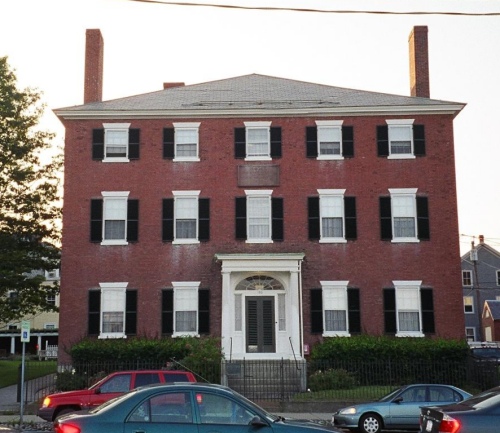
Built 1810-1812 on Derby Street in Salem, the Benjamin W. Crowninshield House may be based on a plan by Samuel McIntire, but completed after his death by his son, Samuel Field McIntire. Benjamin Williams Crowninshield was a congressman and Secretary of the Navy (1815-1818) under presidents Madison and Monroe, the latter of whom once stayed in the house. Brigader General James Miller, a hero of the War of 1812, lived in the house while he was serving as collector at the Custom House next door from 1825 to 1829. The house’s Greek Revival front porch was added after 1820 and the building was expanded in the rear in 1906 and 1916. The house has been used, as noted on a panel on the front facade, as a “Home for Aged Women presented by Robert Brookhouse in 1861″
The Simon Forrester House (1790)

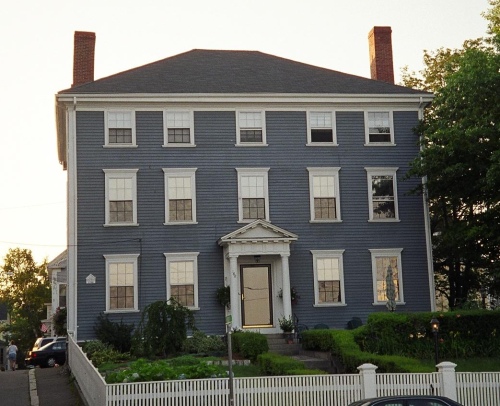
In 1791, Capt. Simon Forrester acquired an unfinished house on Derby Street in Salem. The three-story hipped-roof house has been attributed to Samuel McIntire and the east parlor mantelpiece, carved by McIntire, is now in the Peabody Essex Museum. Forrester was a Irish born ship captain, brought to America by Capt. Daniel Hathorne, the grandfather of Nathaniel Hawthorne (Forrester is mentioned in The Scarlet Letter). Forrester married Capt. Hathorne’s daughter and became wealthy during the Revolutionary War. Many of the house‘s architectural details were removed or altered after the First World War, but more recently the house has been restored to a more original appearance.
Nathaniel Hawthorne Birthplace (1730)

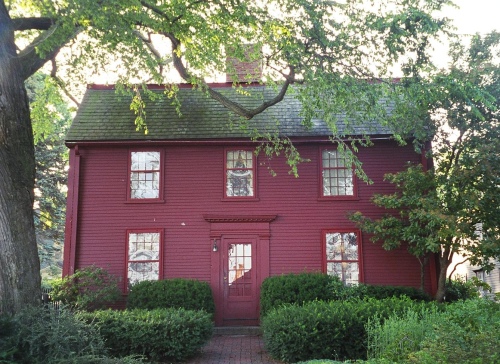
The house in which the author, Nathaniel Hawthorne, was born on July 4, 1804 and lived in until he was age 4 is located in Salem. It was originally on Union Street, but in 1958 it was moved to a site adjacent to the House of the Seven Gables, the building that would inspire Hawthorne to write the novel of the same name. The house was built between 1730 and 1745 for Joshua Pickman, a Boston mariner. It was bought by Hawthorne’s grandfather, the famous shipmaster Captain Daniel Hawthorne, in 1772. As part of the House of the Seven Gables Settlement Association property, the house is now a museum open to visitors.
The Old Manse (1770)
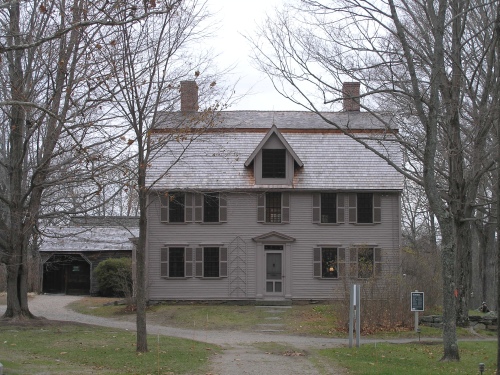
The famous house in Concord known as the “Old Manse,” has associations with the Revolutionary War and with two of America’s greatest literary figures. It was built in 1770 as a “manse”, or parsonage, for the town’s minister, William Emerson. Emerson was there, on April 19, 1775, when the Revolutionary War began at the Old North Bridge, located just behind the Manse property (and now part of Minute Man National Historical Park). Emerson went on to serve as a chaplain with the Continental Army, but died of a fever in October 1776, during the Fort Ticonderoga Expedition. In 1778, Ezra Ripley became Concord’s new minister. He boarded at the Old Manse and in 1780 married William Emerson’s widow, Phebe Bliss Emerson. William Emerson’s son, also named William, became a minister. His son was the famous Transcendentalist, Ralph Waldo Emerson, who lived in the Old Manse, his ancestral home, from 1834-1835, before purchasing his own house in Concord. It was during his residence in the Old Manse that Emerson wrote the first draft of his classic work, Nature.
Ezra Ripley died in 1841 and from 1842 to 1845, the Old Manse was rented by Nathaniel Hawthorne and his new wife, Sophia Peabody. It was during this period that Hawthorne would write many of the stories featured in his collection, Mosses from an Old Manse, including his introductory description of the Old Manse that would help make the building famous. In 1846, the Hawthorne’s left the Manse because Ezra Ripley’s son, Samuel Ripley, returned to live in his childhood home, although he died the following year. His wife, Sarah Alden Bradford Ripley, who had mastered numerous subjects and seven languages, lived on for another two decades, exchanging views with many of the intellectual leaders of the times. She lived through the Civil War, which claimed the life of her younger son, Lt. Ezra Ripley.
When Sarah and Samuel Ripley’s granddaughter, Sarah Ripley Thayer Ames, died in 1939, according to her wishes the house and its contents were sold to The Trustees of Reservations. The Old Manse is now a museum where visitors can tour this National Historic Landmark.
Posted in Colonial, Concord, Houses
Tagged Emerson, Gambrel, Hawthorne, Revolutionary War, Trustees of Reservations
Leave a comment
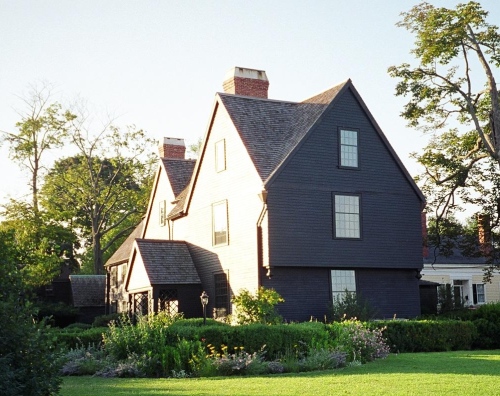
The House of the Seven Gables (1668)

The House of the Seven Gables,
Capt. Ingersoll and his son died at sea in 1804 and the house was later inherited by his only surviving child, Susannah Ingersoll, who was unusual for a woman at the time in being a businesswoman, active in real estate. She was the cousin of Nathaniel Hawthorne and it was during his visits with her that he would have learned of the home’s past. In 1851, Hawthorne published his famous novel, The House of the Seven Gables. Susannah Ingersoll died in 1858 and the house passed through many different owners, remaining vacant during part of this period. In 1908, the house was purchased by the philanthropist, Caroline O. Emmerton, who thus saved it from becoming a tenement. She enlisted the prominent early preservation architect Joseph Everett Chandler to restore it. She founded the House of Seven Gables Settlement Association and opened the house to the public in 1910, using the admission proceeds to support the Settlement. Visitor expectations based on Hawthorne’s novel influenced the restoration at the expense of strict historical accuracy, although this approach was not uncommon for early twentieth century colonial revival preservation efforts.
The house museum is often visited today as a popular tourist attraction and is part of a compound containing other historic buildings, acquired by Emmerton and her successors, and a Colonial Revival Garden. In 2007, the house was designated a National Historic Landmark. A pdf file is available of the National Historic Landmark Nomination form.