Historic Buildings of Massachusetts

  • About
  • Index by Town
  • CT
  • About
  • Index by Town
  • CT

Wistariahurst (1868)
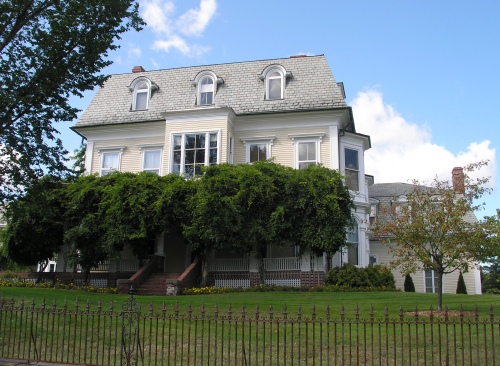
by Dan/October 10, 2011/Holyoke, Houses, Second Empire

William Skinner, who left England for America at the age of nineteen in 1843, became a successful silk and saten manufacturer. The mills of Skinner’s company, the Unquomonk Silk Company in Williamsburg (where his employees lived in a community called Skinnerville), were destroyed when the Mill River Dam gave way on May 16, 1874. The Holyoke Water Power Company then offered Skinner a prime canal site, where he could rebuild his mill in Holyoke. They also offered him land to build a house and it was to there that he moved his home, called Wistariahurst, which he had built in 1868 and which had survived the flood. The house still stands at 238 Cabot Street in Holyoke. His company, called William Skinner and Sons after 1883, was continued by his sons after his death in 1902. It became the largest producer of satin linings in the world. The Skinner family were also great philantrophists: William Skinner supported various institutions in Holyoke and donated to Mount Holyoke and Vassar Colleges. His daughters, Belle and Katherine, founded the Skinner Coffee House to serve the needs of immigrants who worked in the mills and factories. The Skinner family sold the company in 1961. The house remained in the family until 1959, when Katharine Skinner Kilborne gave it to the city of Holyoke for cultural and educational purposes. It is open to the public for tours as the Wistariahurst Museum.
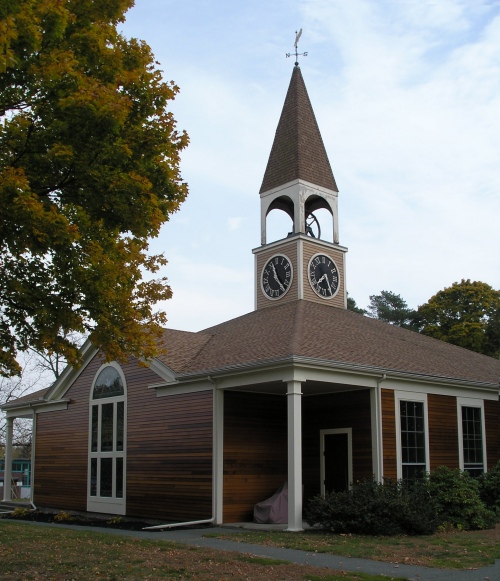
First Church of Danvers (1980)

by Dan/October 9, 2011/Churches, Danvers, Postmodern

The First Church of Danvers was established in 1672, when the area was still a part of Salem and was known as Salem Village. Instead of traveling every Sunday to Salem, the people of Salem Village wanted their own meeting house, which was built over several years at what is now the intersection of Forest and Hobart Streets. This building was the site of most of the examinations at the start of the 1692 Salem withcraft hysteria. The original meeting house was abandoned in 1701 and new one was built on the site of the current First Church of Danvers. This second meeting house stood until 1785, and a new and larger one was then built on the same spot the following year. This building lasted twenty years, until it burned down in 1805. Its replacement, built in 1806, was constructed of brick. Concerns about some cracking and settling of the brick walls led to its being replaced in 1839 by yet another new structure. Remodeled in 1869 and again in 1889, this fifth building burned to the ground in 1890. The next church building was dedicated in 1891 and the seventh and current building opened in 1980.

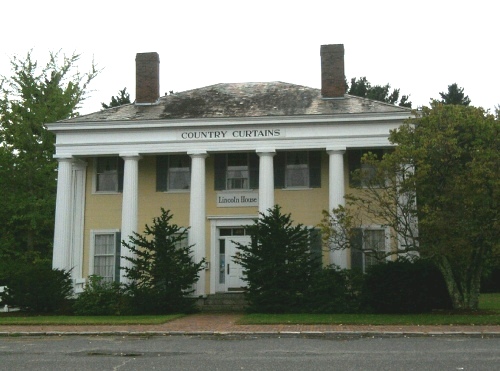
Levi Lincoln, Jr. House (1836)

by Dan/October 8, 2011January 1, 2012/Greek Revival, Houses, Sturbridge

Levi Lincoln, Jr., distantly related to and a supporter of Abraham Lincoln, was a lawyer and politician who served as governor of Massachusetts (1825-1834) and in congress (1834-1841). He later returned to his native Worcester, where he served as mayor. He built a Greek Revival house on Elm Street in Worcester in 1836. When Lincoln’s heirs sold the property for development in 1949, it was rescued by Old Sturbridge Village, where it was moved in 1952. Too much of a urban mansion to be suitable for the Village itself, the Lincoln House was placed instead along Route 20, near the entrance to the museum. It was opened to the public as a restaurant at first, became a fabric shop in 1968 and has housed a branch of Country Curtains since 1982.

Cooley Griffin House (1840)

by Dan/October 4, 2011October 5, 2011/Greek Revival, Houses, Southwick

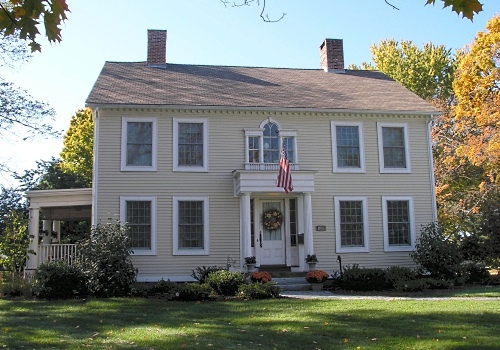
At 476 College Highway, near the intersection with Depot Street in Southwick, is a Greek Revival-style house, built around 1840. In the later nineteenth century it was owned by Cooley Anson Griffin, who married Effie J. Doherty in 1892. In the twentieth century, their son, Raymond George Griffin, lived in the Loomis J. Sackett House, next door, which was torn down after October 1942. Born in 1906, Raymond Griffin attended the Massachusetts Agricultural College (now UMASS), where he made his mark on the 1926 baseball and 1927 basketball teams.

John Fenno House (1704)

by Dan/October 3, 2011/Colonial, Houses, Sturbridge

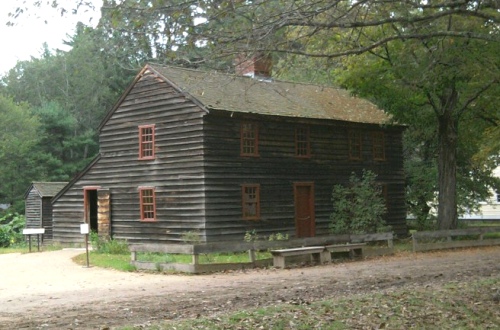
The Fenno House at Old Sturbridge Village was moved there in 1950 from its original site in the town of Canton, where it stood ouside the center village. This property was acquired by John Fenno in 1694 and either he or his son, also named John, is thought to have built the house in 1704 (although recent dendrochronological work suggests it was built later, around 1724. The house remained a Fenno family residence until 1810, when Jesse Fenno built a new home and converted the old house into a barn and storage building. It was purchased from the Fenno family in 1913 by Caroline S. Saltonstall. Later donated by the Saltonstalls to the Canton Historical Society, ownership of the house passed to Old Sturbridge Village in 1949. The house has been reconstructed several times in its history, with much of its original fabric being replaced.

Asa Knight Store (1838)

by Dan/September 30, 2011September 30, 2011/Commercial, Greek Revival, Sturbridge

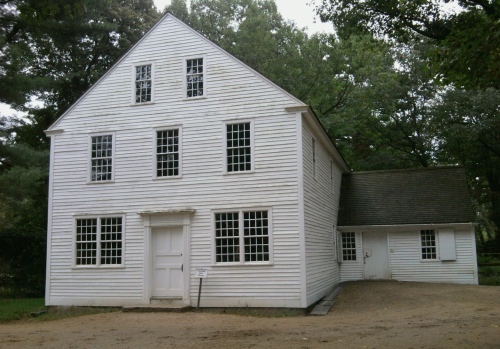
In the early nineteenth century, Asa Knight operated a general store in the village center of Dummerston, Vermont. In 1826, Knight bought the store, the oldest section of which had been built around 1810, and added a storekeeper’s office. He further expanded the building with a new main wing in 1838-1839. The older section became an ell, attached to the new two-and-a-half story building. By the 1870s, the building ended its period as a store and remained mostly vacant and unmodernized for the next century. In 1972, it was moved to Old Sturbridge Village, restored and restocked to represent a village store of the 1830s. The earliest section, built in 1810, had been removed in 1909 and was reconstructed, based on old photographs and archaeological research.

Joseph Button House (1805)

by Dan/September 28, 2011September 28, 2011/Agawam, Federal, Houses

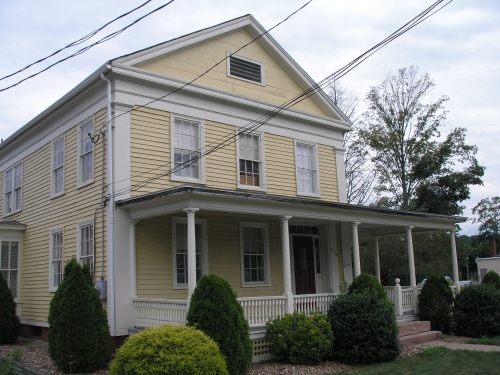
Built around 1805, the Joseph Button House is a Federal-style structure at 588 Main Street in Agawam. In 2005-2006, the house, after being purchased by the Bethany Assembly of God, was moved uphill (to enable the church to widen its driveway) and restored to become a parsonage.

Posts navigation

Older posts
Newer posts
Privacy Policy

Categories

  • Architectural Style (943)
    • Art Deco (9)
    • Byzantine (3)
    • Colonial (177)
    • Colonial Revival (85)
    • Craftsman (6)
    • Egyptian Revival (1)
    • Federal (190)
    • Foursquare (6)
    • Gothic (67)
    • Greek Revival (100)
    • Italianate (82)
    • Mission Revival (2)
    • Mission/Spanish Colonial (1)
    • Modern (2)
    • Neoclassical (56)
    • Octagon (3)
    • Postmodern (1)
    • Queen Anne (46)
    • Renaissance Revival (26)
    • Romanesque Revival (53)
    • Second Empire (26)
    • Shingle Style (12)
    • Stick Style (13)
    • Tudor Revival (8)
    • Vernacular (49)
    • Victorian Eclectic (15)
  • Building Type (943)
    • Apartment Buildings (8)
    • Banks (18)
    • Churches (119)
    • Collegiate (32)
    • Commercial (102)
    • Hotels (16)
    • Houses (508)
    • Industrial (23)
    • Libraries (22)
    • Lighthouses (1)
    • Military (15)
    • Monuments (1)
    • Museums (12)
    • Organizations (39)
    • Outbuildings (17)
    • Public Buildings (50)
    • Schools (23)
    • Stations (5)
    • Synagogues (1)
    • Taverns (21)
    • Theaters (9)
  • Town (943)
    • Adams (11)
    • Agawam (4)
    • Amherst (50)
    • Boston (64)
    • Boylston (6)
    • Cambridge (30)
    • Clinton (21)
    • Concord (15)
    • Cummington (1)
    • Danvers (14)
    • Deerfield (31)
    • Gloucester (18)
    • Granville (10)
    • Great Barrington (2)
    • Hadley (9)
    • Hancock (15)
    • Harvard (32)
    • Holyoke (47)
    • Lenox (5)
    • Lexington (8)
    • Longmeadow (32)
    • Marblehead (40)
    • Marlborough (4)
    • Natick (22)
    • Newton (2)
    • Northampton (68)
    • Peabody (4)
    • Pittsfield (20)
    • Salem (110)
    • Saugus (4)
    • Sheffield (4)
    • South Hadley (8)
    • Southborough (8)
    • Southwick (4)
    • Springfield (67)
    • Stockbridge (19)
    • Stow (1)
    • Sturbridge (18)
    • Sudbury (7)
    • Waltham (11)
    • Watertown (1)
    • Wayland (8)
    • West Springfield (14)
    • Westfield (46)
    • Weston (2)
    • Worcester (26)
  • Uncategorized (1)

Recent Comments

  • Wilber Blackson on South Hadley
  • Tami Speiden on Stockbridge
  • DexGuru on Stockbridge

Tags

Alcott Amherst College Asher Benjamin Back Bay Baptist Beacon Hill Big E Black Heritage Trail bowfront Bulfinch Catholic Congregational Episcopal Freedom Trail Gambrel H.H. Richardson Harvard Hawthorne Historic Deerfield Isaac Damon lit Longfellow mansard Methodist Mount Holyoke Museum Museums NPS Old Sturbridge Village PEM Revolutionary War row houses saltbox Samuel McIntire Shakers Smith College SPNEA Springfield Armory Stephen C. Earle Storrowton Underground Railroad UU Washington William Fenno Pratt Witch Trials

Meta

  • Log in
  • Entries feed
  • Comments feed
  • WordPress.org
Proudly powered by WordPress | Theme: ShowMe by NEThemes.