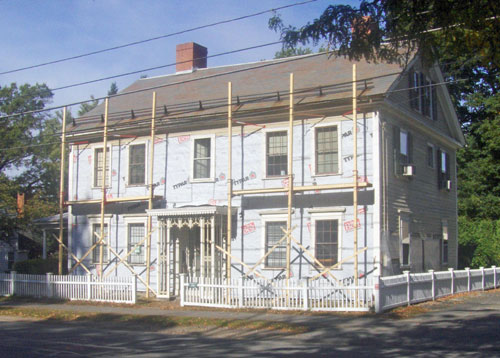
John Prince House (1761)
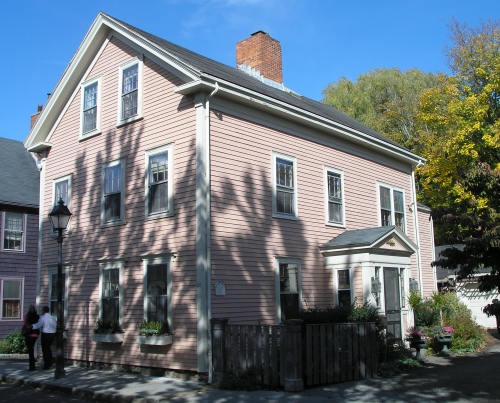
According to the sign on the house at 24 State Street in Marblehead, the house was built in 1761 for Capt. John Prince, a blacksmith. In the twentieth century, it was the home of Charles Gilbert, a carpenter.
According to the sign on the house at 24 State Street in Marblehead, the house was built in 1761 for Capt. John Prince, a blacksmith. In the twentieth century, it was the home of Charles Gilbert, a carpenter.
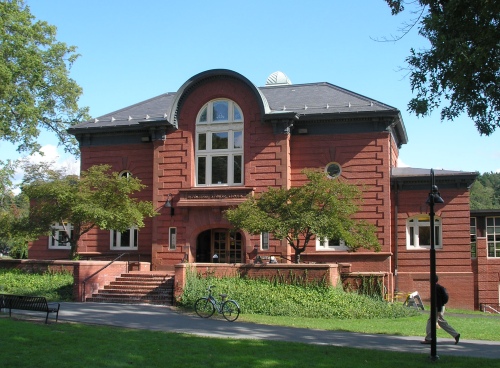
By the late 1890s there was clamoring for a gymnasium to be constructed at Mount Holyoke College in South Hadley. The College Gymnasium, noted at the time for its state-of-the-art ventilation system, was built in 1899-1900 and was designed by William C. Brocklesby. In 1950, the building was converted into offices and housed the campus post office. In 1988, it became the Blanchard Campus Center, named for Elizabeth Blanchard, an 1858 graduate who served as principal (1883-1888) and acting president (1888-189) of the College. The building was much expanded with additional facilities in 2003.
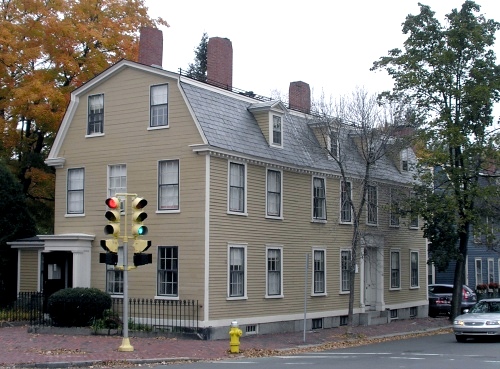
The asymmetrically-laid-out house at 40 Summer Street in Salem was built around 1762 by Capt. Thomas Eden (d. 1768), who lived with his family in one part while running a retail shop in the other. Later owners partitioned the house as a residence between them. In 1889, the entire house was owned by the Browne family and in 1923 it was purchased by the Sanders family. The house has a matched-board gable end.
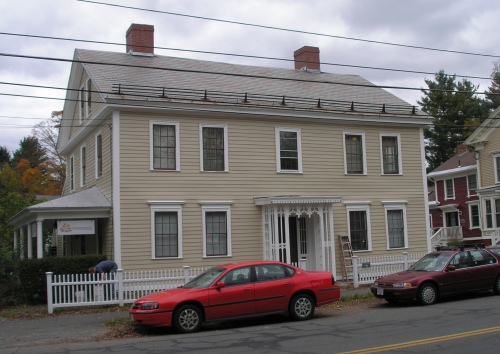
Built by Seth Russell in 1796, the house at 66 Bridge Street in Northampton is part of Historic Northampton’s complex of buildings. It is known as the Shepherd House because Susan Monroe Shepherd purchased it in 1856 and lived there with her husband, Henry Shepherd. Their son, Thomas Monroe Shepherd (1856-1923), left the house to the Historical Society, now called Historic Northampton. The late colonial-style house was much altered over the years by its various owners. The Gothic-style front porch was added in 1840 and the columned porch on the west side was added in 1899. The house is now rented as the headquarters of the Massachusetts Foundation for the Humanities.
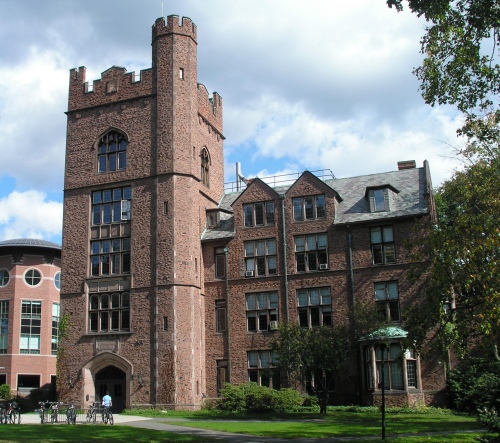
Williston Hall at Mount Holyoke College in South Hadley burned down in 1917 and was replaced by the Cornelia Clapp Laboratory in 1924. The Gothic Revival building was named for Cornelia Clapp, a member of the Mount Holyoke class of 1871 and a professor of zoology at the college from 1872 to 1916.
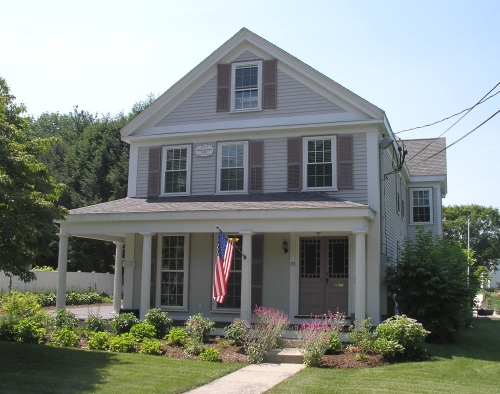
The Atkins-Fair House is a Greek Revival-style dwelling at 39 Eliot Street in South Natick. The house was built in 1839 for the newly-married John Atkins. As written in the entry by Horace Mann on the “David Morse Place and Pelatiah Morse Place” in A Review of the First Fourteen Years of the Historical, Natural History and Library Society of South Natick, Mass. (1884):
In 1794, the old house and a portion of the David Morse estate had passed to the Welles family, and Hon. John Welles sold it to Capt. John Atkins of Truro. Atkins became a leader in society at Natick, and held important town offices. In the adjustment of “Lady Lothrop‘s” estate and the litigation that attended it, he was a conspicuous party; he is also one of the stars of Mrs. Stowe’s “Old Town Folks.” For a number of years he was one of the guardians of the Natick Indians, and during his administration of their affairs the last of their lands, the possessions of Hannah Thomas, passed to white ownership. In 1847 John Atkins sold the Morse estate to Hon. John Welles, and the so-called Eliot acre was deeded to Atkins by Hon. Chester Adams.
In 1883, the 1839 Atkins House was bought by William Fair.
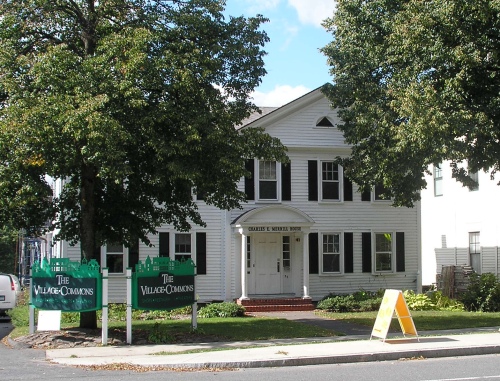
Merrill House in South Hadley has been owned since 1956 by Mount Holyoke College and was purchased, in part, with funds provided by Charles E. Merrill. The house was built in 1840 for Rev. Joseph D. Condit (1804-1847), who was Secretary of the Trustees of the College from 1836 to 1847. According to In Old South Hadley (1912), by Sophie E. Eastman:
Rev. Joseph Condit, who was settled here in 1835, was the first one of our ministers who refused the glass of cider, brandy, or the spiced elderberry wine, which his parishioners delighted to offer him, and when he made his pastoral calls, cake and cheese soon took the place of the former hospitable toddy. […] The faithful sermons of Mr. Condit against the use of ardent spirits had prepared the way for a Temperance Crusade.