Historic Buildings of Massachusetts

  • About
  • Index by Town
  • CT
  • About
  • Index by Town
  • CT

J.D. Bartlett House (1865)
by Dan/November 14, 2012/Houses, Italianate, Westfield

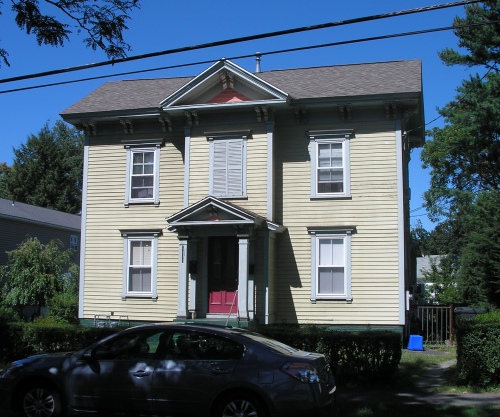
The Italianate residence at 27 King Street in Westfield was built around 1865. In 1870, J.D. Bartlett is listed as the owner. This may be the same J.D. Bartlett who is mentioned in several sources as a local historian. Vol. 2 of “Our County and its People” A History of Hampden County, Massachusetts (1902) mentions “J. D. Bartlett, of Westfield, who has spent much time in gathering facts for a history of the town,” and Rev. John H. Lockwood, in Vol. 1 of his Westfield and Its Historic Influences (1922), mentions “the historical notes of J. D. Bartlett, gathered with such patience and at such personal cost.”
Children’s Chime Tower (1878)

by Dan/November 13, 2012November 15, 2012/Monuments, Romanesque Revival, Stick Style, Stockbridge

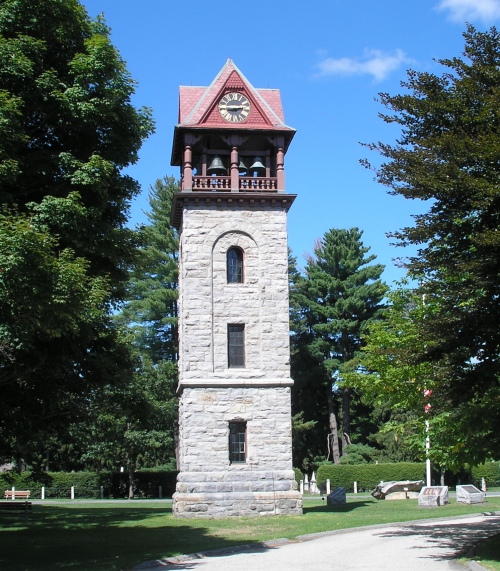
The Children’s Chime Tower (or Chimes Tower) is a memorial tower in Stockbridge. It was built in 1878 and was a gift to the town by David Dudley Field, a wealthy New York lawyer and son of Rev. D.D. Fields of Stockbridge. Field gave the tower in memory of his grandchildren and, in accordance with his instructions, its chimes are rung at 5:30 every evening between “apple blossom time and the first frost on the pumpkin.” The tower is believed to have been built on the site of Stockbridge’s original meeting house of 1739. The wooden portion at the top of the tower represents the Stick style of architecture. Clocks are mounted in the central gables on all four sides of the roof.

Sessions House (1710)

by Dan/November 13, 2012/Colonial, Houses, Northampton

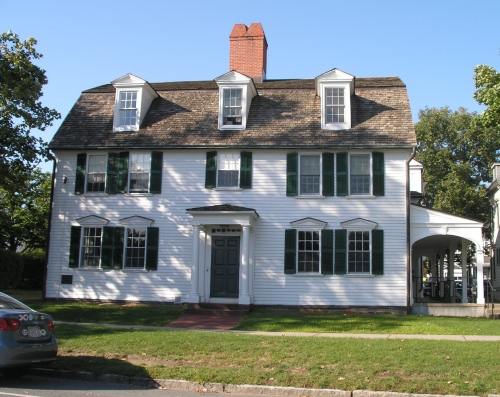
Sessions House is a colonial residence at 109 Elm Street in Northampton that is now used as a Smith College dormitory. It was built around 1710 (or perhaps as early as 1700) by Captain Jonathan Hunt (1665-1738) and was the first house in Northampton to be built outside the early settlement’s protective stockade. The house has a staircase that was originally designed as a secret passageway for the family to hide in during Native American raids. The house passed to the Henshaw family by marriage and was later owned by other families. Eventually, around 1900, it passed to Mrs. Ruth Huntington Sessions, who ran it as off campus housing for Smith College students. Born in Cambridge in 1859, Ruth Huntington moved with her parents to Syracuse, New York when her father, Frederic Dan Huntington, became Episcopal Bishop of Central New York. In 1880, her family sent her to Europe, where she studied piano under Clara Schumann. In 1887 she married Archibald Lowery Sessions and moved with him to New York City. A social activist and writer (her memoir, Sixty Odd: A Personal History, was published in 1936), Sessions (d. 1946) spent her summers at the Porter-Phelps-Huntington House in Hadley, given to her by her father, and her winters in Northampton. She sold the Northampton house to Smith College in 1921. Continue reading “Sessions House (1710)”

Steiger Building (1899)

by Dan/November 13, 2012/Commercial, Holyoke, Neoclassical

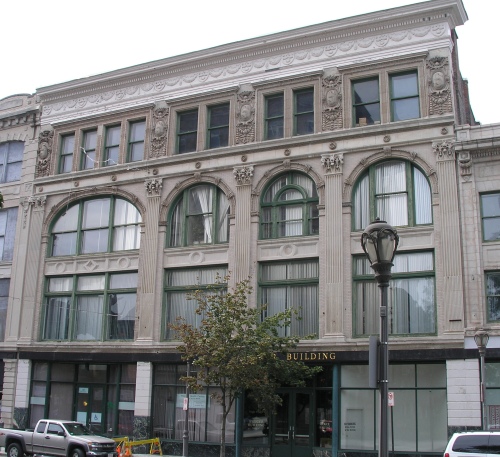
The Steiger Building, at 259-271 High Street in Holyoke, is a Beaux Arts structure built in 1899. The elaborately ornamented building, designed by G.P.B. Alderman, housed Steigers Department Store. It has an asymmetrical facade due to the fact that the southern 25 feet were purchased by Albert Steiger in 1901 and thus that section was built two years after the rest of the building. Continue reading “Steiger Building (1899)”

John R. Foster House (1882)

by Dan/November 12, 2012/Clinton, Houses, Stick Style

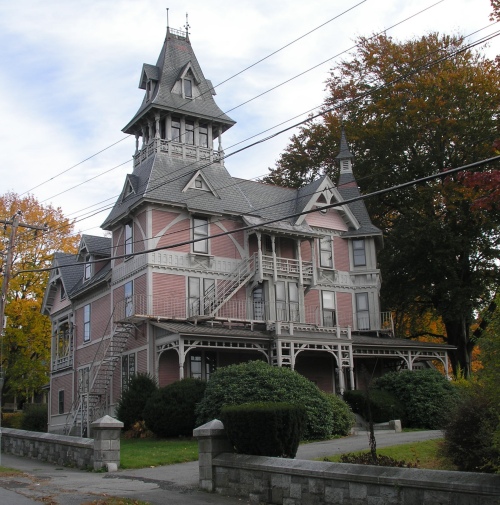
At 271 Church Street in Clinton is the elaborate Stick Style house, designed by Henry M. Francis and built for John R. Foster in 1882. Foster was a wealthy merchant who owned a chain of clothing stores throughout New England. As related by Andrew E. Ford in his History of the Origin of the Town of Clinton, Massachusetts, 1653-1865 (1896):

John R. Foster was born in Moretown, Vt., November 7, 1834. He began to work in a store at the age of twelve. He was for some time a clerk in Waterbury, Vt. In September, 1856, he went into partnership with W. H. Ashley, in the clothing business, in Clinton. Their store was in the A. H. Pierce Block on Church Street; thence they moved to the Clinton House Hall Block. Ashley remained in Clinton but a few months, then Mr. Foster took the business alone and carried it on until 1870, when he started the clothing stores in Danielsonville, Ct., Willimantic, Ct., and other places, which have proved so profitable to him, and have enabled him to add so much to the beauty of the town through his private residence and public benefactions.

Foster donated a fountain for Clinton’s Central Park in 1890 that was destroyed in the Hurricane of 1938 (a replica was rededicated in 2000). His second wife, Catherine Harlow, was a member of the corporation that formed the Clinton Home for Aged People. In 1900 (or 1909?), the house was purchased by Dr. Walter P. Bowers for the Clinton Home for the Aged, now called The Clinton Home Foundation, Inc.

Epworth United Methodist Church, Worcester (1927)

by Dan/November 11, 2012November 12, 2012/Churches, Gothic, Worcester

The First Swedish Methodist Episcopal Church in Quinsigamond Village in Worcester was formally organized in 1880. As recorded in Vol. I of Charles Nutt’s History of Worcester and its People (1919):

A colony from the First Church organized the Second Swedish Methodist Church April 9, 1885, with a membership of 94, including 29 probationers. Rev. Mr. D. S. Sorlin came from the First Church and was the first pastor of the Second. The first place of worship was in the chapel on Thomas street, purchased of the First Church of Christ for $8,000. By two additions in 1887 and 1888 costing $13,400 the seating capacity was increased to more than 500. It was dedicated Sept. 27, 1885.

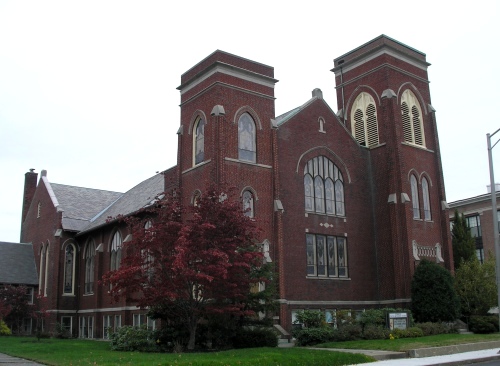
Having grown too large for its first church building, the congregation built the present structure in 1926-1927 at 64 Salisbury Street. At the time of the move to the new building, designed by Henry Eckland of Chicago, the name of the church was changed to Epworth Methodist Church, now Epworth United Methodist Church.

Stow Town Hall (1848)

by Dan/November 10, 2012/Greek Revival, Public Buildings, Stow

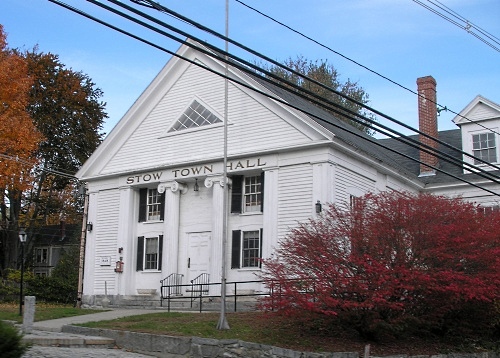
After the fourth Congregational meeting house, or church, in Stow burned down in 1847, a new one was constructed. The church had been used for town meetings, but now religious and government functions were separated, so that in addition to a new church, a town hall was also constructed. Both buildings were built with nearly identical Greek Revival facades. The Town Hall was built by Micah Smith, a carpenter and millwright. According to a plaque on the building, it cost $2,559.73. An addition was built on the south side of the Town Hall in 1895.

Posts navigation

Older posts
Newer posts
Privacy Policy

Categories

  • Architectural Style (943)
    • Art Deco (9)
    • Byzantine (3)
    • Colonial (177)
    • Colonial Revival (85)
    • Craftsman (6)
    • Egyptian Revival (1)
    • Federal (190)
    • Foursquare (6)
    • Gothic (67)
    • Greek Revival (100)
    • Italianate (82)
    • Mission Revival (2)
    • Mission/Spanish Colonial (1)
    • Modern (2)
    • Neoclassical (56)
    • Octagon (3)
    • Postmodern (1)
    • Queen Anne (46)
    • Renaissance Revival (26)
    • Romanesque Revival (53)
    • Second Empire (26)
    • Shingle Style (12)
    • Stick Style (13)
    • Tudor Revival (8)
    • Vernacular (49)
    • Victorian Eclectic (15)
  • Building Type (943)
    • Apartment Buildings (8)
    • Banks (18)
    • Churches (119)
    • Collegiate (32)
    • Commercial (102)
    • Hotels (16)
    • Houses (508)
    • Industrial (23)
    • Libraries (22)
    • Lighthouses (1)
    • Military (15)
    • Monuments (1)
    • Museums (12)
    • Organizations (39)
    • Outbuildings (17)
    • Public Buildings (50)
    • Schools (23)
    • Stations (5)
    • Synagogues (1)
    • Taverns (21)
    • Theaters (9)
  • Town (943)
    • Adams (11)
    • Agawam (4)
    • Amherst (50)
    • Boston (64)
    • Boylston (6)
    • Cambridge (30)
    • Clinton (21)
    • Concord (15)
    • Cummington (1)
    • Danvers (14)
    • Deerfield (31)
    • Gloucester (18)
    • Granville (10)
    • Great Barrington (2)
    • Hadley (9)
    • Hancock (15)
    • Harvard (32)
    • Holyoke (47)
    • Lenox (5)
    • Lexington (8)
    • Longmeadow (32)
    • Marblehead (40)
    • Marlborough (4)
    • Natick (22)
    • Newton (2)
    • Northampton (68)
    • Peabody (4)
    • Pittsfield (20)
    • Salem (110)
    • Saugus (4)
    • Sheffield (4)
    • South Hadley (8)
    • Southborough (8)
    • Southwick (4)
    • Springfield (67)
    • Stockbridge (19)
    • Stow (1)
    • Sturbridge (18)
    • Sudbury (7)
    • Waltham (11)
    • Watertown (1)
    • Wayland (8)
    • West Springfield (14)
    • Westfield (46)
    • Weston (2)
    • Worcester (26)
  • Uncategorized (1)

Recent Comments

  • Wilber Blackson on South Hadley
  • Tami Speiden on Stockbridge
  • DexGuru on Stockbridge

Tags

Alcott Amherst College Asher Benjamin Back Bay Baptist Beacon Hill Big E Black Heritage Trail bowfront Bulfinch Catholic Congregational Episcopal Freedom Trail Gambrel H.H. Richardson Harvard Hawthorne Historic Deerfield Isaac Damon lit Longfellow mansard Methodist Mount Holyoke Museum Museums NPS Old Sturbridge Village PEM Revolutionary War row houses saltbox Samuel McIntire Shakers Smith College SPNEA Springfield Armory Stephen C. Earle Storrowton Underground Railroad UU Washington William Fenno Pratt Witch Trials

Meta

  • Log in
  • Entries feed
  • Comments feed
  • WordPress.org
Proudly powered by WordPress | Theme: ShowMe by NEThemes.