Historic Buildings of Massachusetts

  • About
  • Index by Town
  • CT
  • About
  • Index by Town
  • CT

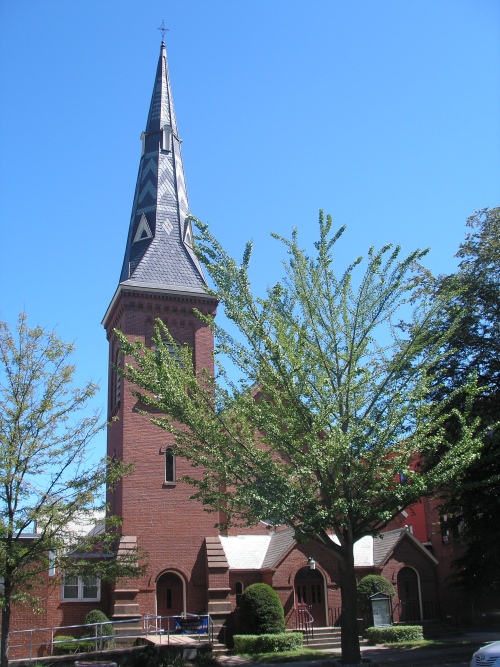
St. John the Evangelist Church, Clinton (1886)
by Dan/June 2, 2013June 2, 2013/Churches, Clinton, Romanesque Revival

St. John the Evangelist Church

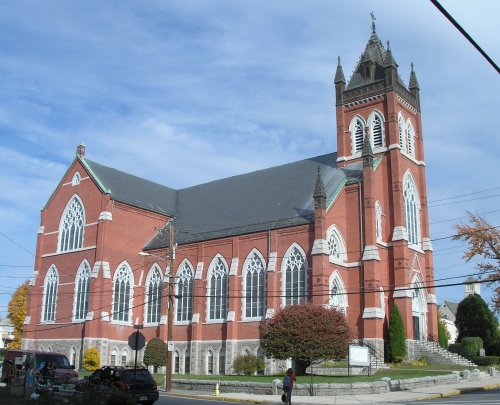
There were two St. John the Evangelist Churches in Clinton before the current one, at 80 Union Street, was built in 1886. Begun as a mission church to the growing community’s Irish immigrants in the 1840s, the the first church was dedicated on October 4, 1850. It was a wood frame church on South Main Street. As described by Andrew Elmer Ford in his History of the Origin of the Town of Clinton, Massachusetts, 1653-1865 (1896):

The inclosure of pine trees which today makes the former location of the church conspicuous, was set out under the direction of Father Boyce. At first, this church was much more simply furnished than in its later days. The galleries, the pews, the organ and the furnace were put in as the means of the people increased.

This building was soon outgrown, as was the second church, a temporary structure also built of wood, which was occupied in 1869. The original church was demolished in 1874. As related in a historical sermon by Rev. Edward J. Fitzgerald that appears in the volume commemorating the Semi-centennial Celebration of the Incorporation of the Town of Clinton, Mar. 14, 1850, which took place on June 17, 18, 19, 1900:

Already the old church was inadequate and the growing numbers and the increasing prosperity of the Catholics made the plan of erecting an enduring church, which would be a glory to the God who dwelt therein and an ornament to the town, no longer a chimera. The year 1875 saw the consummation of this project, when on August 8 the erstwhile curate, now the first Bishop of the Springfield diocese, laid the corner-stone of St. John’s Church in which we are assembled today. The basement finished, the work lagged somewhat for five years, when by the united efforts of the loyal and generous people of the parish, the superstructure was raised and ornamented, and 1886 saw it dedicated to God with the beautiful ceremonial of our church, the Right Reverend Bishop being surrounded by the most dignified members of his clergy, and the lesson of the event being pointed out by eloquent lips.

The parish is called Saint John the Guardian of Our Lady Parish at St. John the Evangelist Church.
Central Baptist Church, Westfield (1867)

by Dan/May 26, 2013/Churches, Romanesque Revival, Westfield

Central Baptist Church

The First Baptist Church of Westfield was formed in 1784. In 1833, the church split over the issue of supporting missions. Those in favor of supporting missions left to form the Central Baptist Church. Soon most of the members of the First Baptist Church were absorbed into Central Baptist. The new church’s first meeting house was built in 1837-1838 at the corner of Elm and Church Streets in Westfield. Plans for erecting the current church (at 115 Elm Street) began in 1863. The Chapel (now Hays Hall) was completed in 1867 and the sanctuary was built the following year.

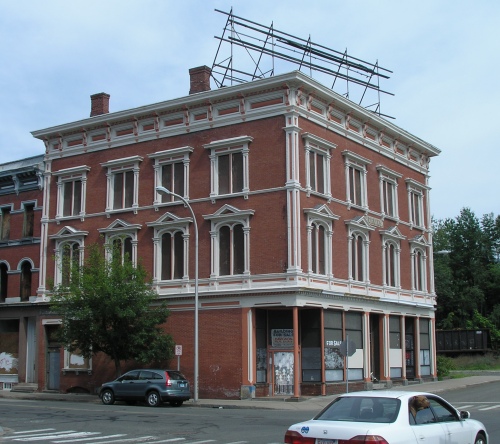
Perkins Block, Holyoke (1875)

by Dan/May 25, 2013/Commercial, Holyoke, Italianate

Perkins Block

The Perkins Block, at 335-337 Dwight Street (corner of Main Street–the old Depot Square) in Holyoke, was built in circa 1872-1875. It features detailed cornice and window surrounds, all done in metal. An early tenant of the building was John Eaton Chase, who ran a mill supply store.

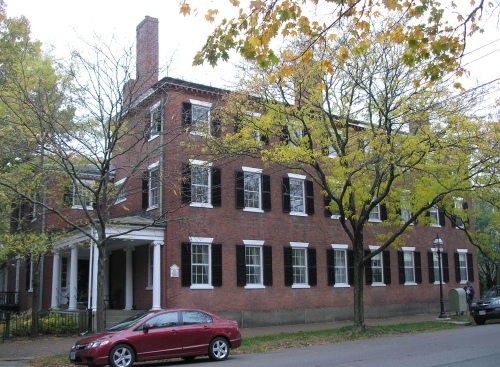
Saunders-Saltonstall-Tuckerman Double House (1810)

by Dan/May 24, 2013/Federal, Houses, Salem

Saunders-Saltonstall-Tuckerman House

Thomas Saunders, who lived at 39 Chestnut Street in Salem, built a double house next door, at 41-43 Chestnut Street, in 1810-1811. It was a gift to his two daughters, Caroline (1793-1882) and Mary Elizabeth (1788-1858), who married two Saltonstall brothers. The western half was the home of Nathaniel (1784-1838) and Caroline’s family until 1880, after which it was owned by Charles Saunders into the twentieth century. Until 1851, the eastern half was home to Mary Elizabeth and her husband, Leverett Saltonstall (1783-1845), who was Salem’s first mayor, serving from 1836 to 1838. It was then home to the Tuckerman family until the end of the century. The porch on the western side is believed to be original, while the two-story wing and the porch on the eastern side date from 1838.

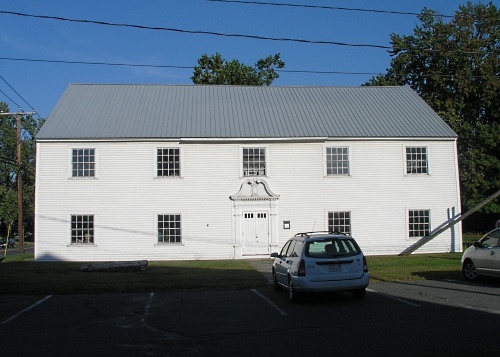
Hadley Farm Museum (1782)

by Dan/May 23, 2013May 23, 2013/Colonial Revival, Hadley, Outbuildings, Vernacular

Hadley Farm Museum

A barn, constructed in 1782 on the Porter-Phelps-Huntington estate, was moved in 1930 to the rear of the Hadley Town Hall. It is now home to the Hadley Farm Museum, which houses a collection of vehicles and equipment used on New England farms from the eighteenth through the early twentieth centuries. When it was moved, the barn‘s exterior was redecorated with white painted clapboards. A doorway was added, which is a copy of the famous Connecticut River Valley doorway of the Samuel Porter House in Hadley.

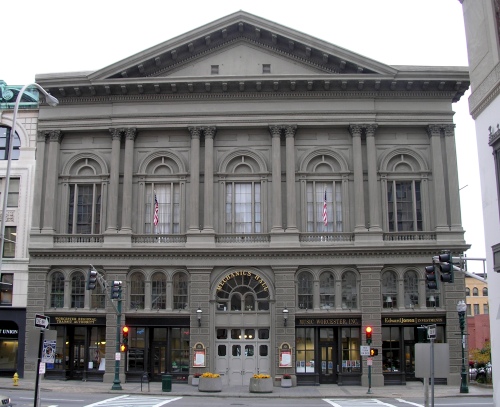
Mechanics Hall (1857)

by Dan/May 22, 2013/Organizations, Renaissance Revival, Theaters, Worcester

Mechanics Hall

One of Worcester’s most iconic buildings is Mechanics Hall. It was built in 1857 to house educational and cultural activities by the Worcester County Mechanics Association. This organization was formed in 1842 to promote the mechanical arts and to provide education and training for industrial workers. Mechanics Hall featured meeting rooms, a library, and two halls. The building was designed by Elbridge Boyden, a Worcester architect. By the mid-twentieth century, other organizations had taken up the role once played by the Mechanics Association and other auditoriums had found favor with the public. To raise revenue, Mechanics Hall was rented out for sporting events and for a time was even a roller skating rink. The old building was no longer the cultural center it had once been and was in danger of demolition. Citizens rallied to save Mechanics Hall, which was restored and reopened in 1977. Today, the Mechanics Association‘s primary mission is to maintain Mechanics Hall, which is considered to be the finest pre-Civil War concert hall in the country and one of the four finest in North America. The Main Hall features the 1864 Hook Organ (aka the Worcester Organ). Built by E. & G.G. Hook, it is the oldest unaltered four-keyboard organ in the Western Hemisphere.

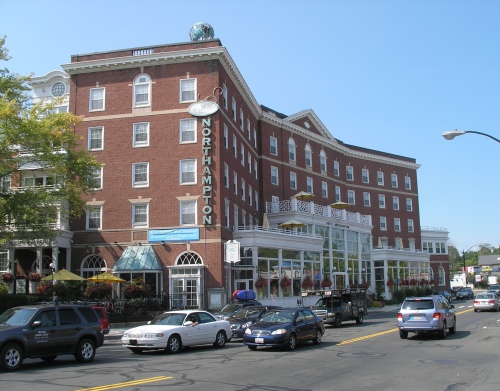
Hotel Northampton (1927)

by Dan/May 21, 2013May 21, 2013/Colonial Revival, Hotels, Northampton

Hotel Northampton

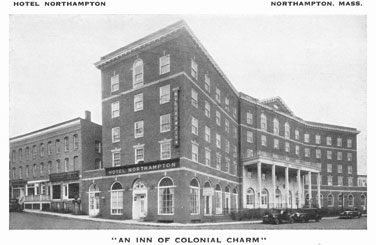
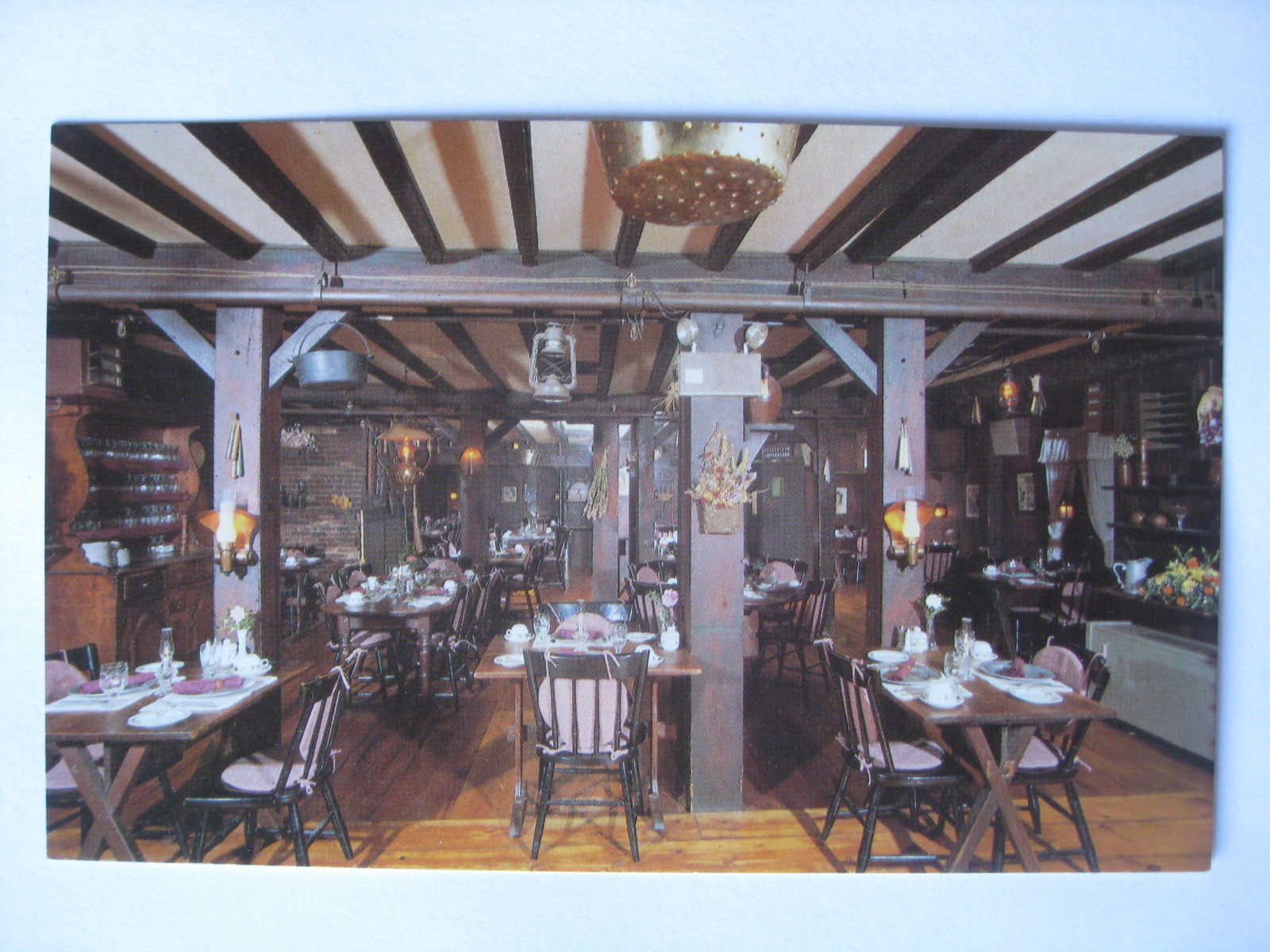
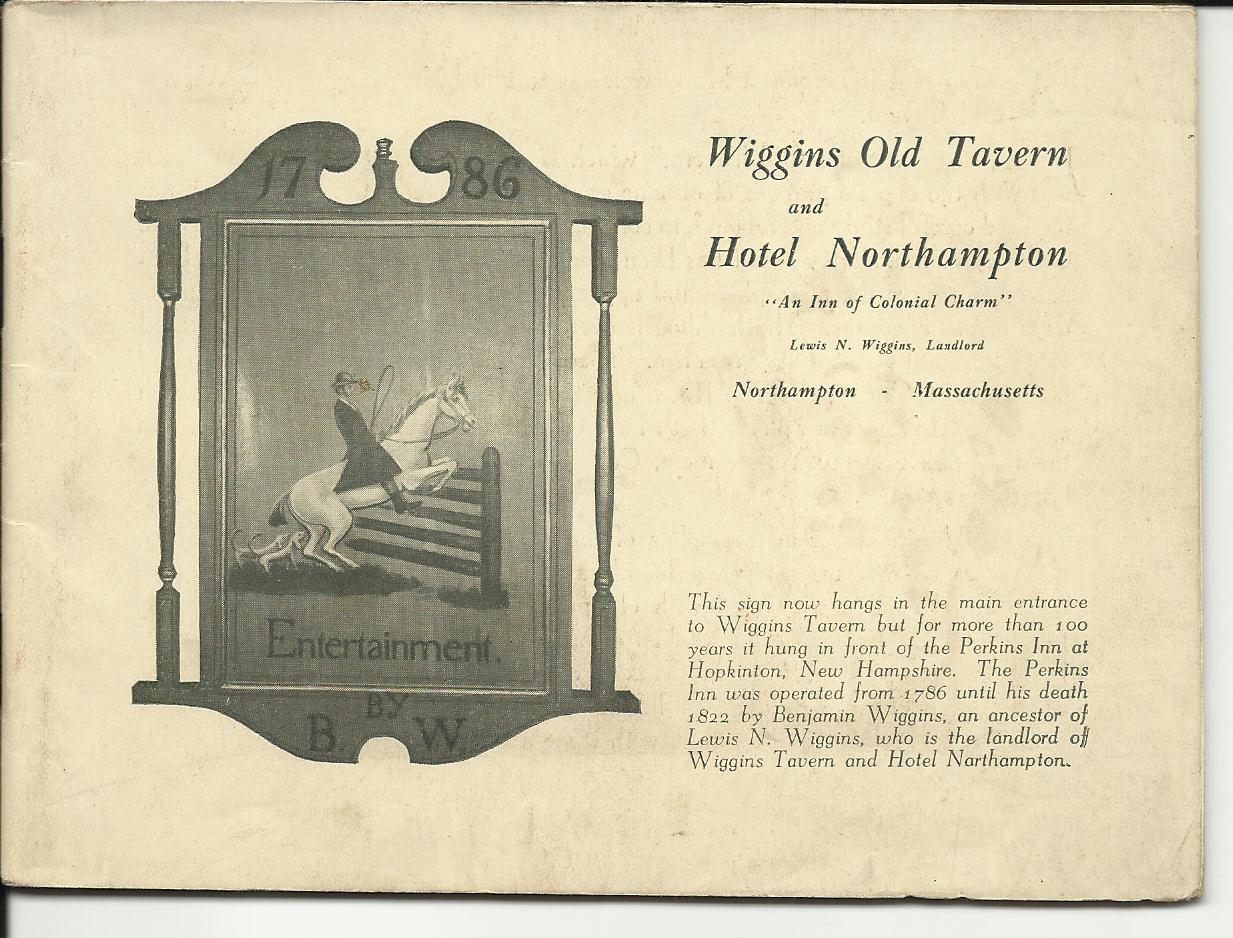
The Hotel Northampton, at 36 King Street in Northampton, was first opened in 1927. The hotel was funded by a five-year subscription drive by the local chamber of commerce to provide Northampton with an appropriately substantial and luxurious hotel. The Colonial Revival-style Hotel Northampton is one of the National Trust for Historic Preservation’s “Historic Hotels of America.” Attached to the hotel is the old Wiggins Tavern, a building which dates back to 1786 and was moved to Northampton from Hopkinton, New Hampshire. The Tavern had been opened by Benjamin Wiggins, an ancestor of Lewis Wiggins, the entrepreneur who had built the Hotel Northampton.

Posts navigation

Older posts
Newer posts
Privacy Policy

Categories

  • Architectural Style (943)
    • Art Deco (9)
    • Byzantine (3)
    • Colonial (177)
    • Colonial Revival (85)
    • Craftsman (6)
    • Egyptian Revival (1)
    • Federal (190)
    • Foursquare (6)
    • Gothic (67)
    • Greek Revival (100)
    • Italianate (82)
    • Mission Revival (2)
    • Mission/Spanish Colonial (1)
    • Modern (2)
    • Neoclassical (56)
    • Octagon (3)
    • Postmodern (1)
    • Queen Anne (46)
    • Renaissance Revival (26)
    • Romanesque Revival (53)
    • Second Empire (26)
    • Shingle Style (12)
    • Stick Style (13)
    • Tudor Revival (8)
    • Vernacular (49)
    • Victorian Eclectic (15)
  • Building Type (943)
    • Apartment Buildings (8)
    • Banks (18)
    • Churches (119)
    • Collegiate (32)
    • Commercial (102)
    • Hotels (16)
    • Houses (508)
    • Industrial (23)
    • Libraries (22)
    • Lighthouses (1)
    • Military (15)
    • Monuments (1)
    • Museums (12)
    • Organizations (39)
    • Outbuildings (17)
    • Public Buildings (50)
    • Schools (23)
    • Stations (5)
    • Synagogues (1)
    • Taverns (21)
    • Theaters (9)
  • Town (943)
    • Adams (11)
    • Agawam (4)
    • Amherst (50)
    • Boston (64)
    • Boylston (6)
    • Cambridge (30)
    • Clinton (21)
    • Concord (15)
    • Cummington (1)
    • Danvers (14)
    • Deerfield (31)
    • Gloucester (18)
    • Granville (10)
    • Great Barrington (2)
    • Hadley (9)
    • Hancock (15)
    • Harvard (32)
    • Holyoke (47)
    • Lenox (5)
    • Lexington (8)
    • Longmeadow (32)
    • Marblehead (40)
    • Marlborough (4)
    • Natick (22)
    • Newton (2)
    • Northampton (68)
    • Peabody (4)
    • Pittsfield (20)
    • Salem (110)
    • Saugus (4)
    • Sheffield (4)
    • South Hadley (8)
    • Southborough (8)
    • Southwick (4)
    • Springfield (67)
    • Stockbridge (19)
    • Stow (1)
    • Sturbridge (18)
    • Sudbury (7)
    • Waltham (11)
    • Watertown (1)
    • Wayland (8)
    • West Springfield (14)
    • Westfield (46)
    • Weston (2)
    • Worcester (26)
  • Uncategorized (1)

Recent Comments

  • Wilber Blackson on South Hadley
  • Tami Speiden on Stockbridge
  • DexGuru on Stockbridge

Tags

Alcott Amherst College Asher Benjamin Back Bay Baptist Beacon Hill Big E Black Heritage Trail bowfront Bulfinch Catholic Congregational Episcopal Freedom Trail Gambrel H.H. Richardson Harvard Hawthorne Historic Deerfield Isaac Damon lit Longfellow mansard Methodist Mount Holyoke Museum Museums NPS Old Sturbridge Village PEM Revolutionary War row houses saltbox Samuel McIntire Shakers Smith College SPNEA Springfield Armory Stephen C. Earle Storrowton Underground Railroad UU Washington William Fenno Pratt Witch Trials

Meta

  • Log in
  • Entries feed
  • Comments feed
  • WordPress.org
Proudly powered by WordPress | Theme: ShowMe by NEThemes.