Historic Buildings of Massachusetts

  • About
  • Index by Town
  • CT
  • About
  • Index by Town
  • CT

Joseph Willard House (1730)
by Dan/February 2, 2015February 2, 2015/Colonial, Harvard, Houses

Joseph Willard House

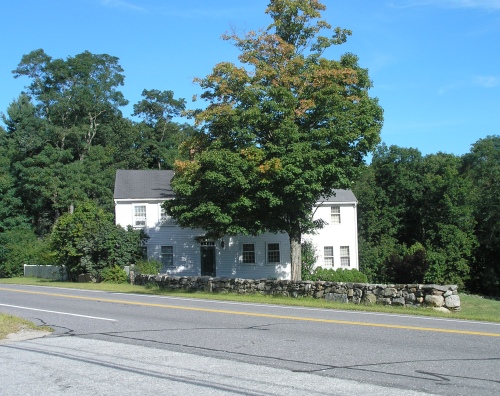
The house at 175 Still River Road in Harvard was built around 1730 with a saltbox form, but was later altered to a full two stories. Standing at the northern edge of Still River Village, the house was built by Joseph Willard (1685-1761) and remained in the family until it was sold to other owners in the early nineteenth century. It was bought back by Luther Willard in 1830 and it passed to Luther’s son, Frederick, in the 1860s. Frederick served as town selectman in 1876, and later operated a brickyard. Following his death, the farm passed to his brother, Rev. John Barstow Willard (1822-1900), and two sisters. Rev. Willard served as minister in Westford from 1848 to 1850 and his background is described in the History of the Town of Westford, in the County of Middlesex, Massachusetts, 1659-1883 (1883), by Rev. Edwin R. Hodgman:

Rev. John B. Willard was born in New York city, April 1, 1822. His parents, Luther and Mary (Davis) Willard, were born in Harvard, Massachusetts. He graduated at Brown University in 1842, and then studied law three years, partly in Syracuse, New York, and partly in Boston, but never entered the legal profession. He studied theology with Rev. Washington Gilbert, then of Harvard.

As related in the History of the Town of Harvard, Massachusetts, 1732-1893 (1894) by Henry S. Nourse:

The guests at the first Harvard ordination in 1733 were entertained at the house of Joseph Willard, son of the first Henry. This dwelling stands in excellent preservation, in North Still River, at the junction of the Groton and Harvard roads, being now the home of Reverend John B. Willard and his sisters. They are direct descendants of the first owner. The roof at the rear originally sloped to a single story, and other alterations have given the house a somewhat modern appearance. In making these changes it was found that the outer walls were lined with brick laid in clay; and upon beams and joist were several memoranda dated between 1730 and 1740, and one or more dates of the previous century. The south-west room was known as the “dower room,” being fitted for the residence of the dowager with a special stairway to cellar, and oven and closet conveniences. This feature was quite usual in old country houses. The mansion, if a new one when Joseph and Elizabeth Willard began housekeeping, was built about 1712; but there is some reason to believe that it dates from about 1730, though very probably in part a reconstruction from the materials, or built upon the site, of an older edifice.

In the early twentieth century the house was acquired by James Murchie, a cattle dealer, and in the early 1920s by H. E. Drury, a retired navy paymaster.
Museum of Russian Icons (1853, 1859, 2006)

by Dan/January 28, 2015/Clinton, Commercial, Industrial, Italianate, Museums, Organizations, Victorian Eclectic

Museum of Russian Icons

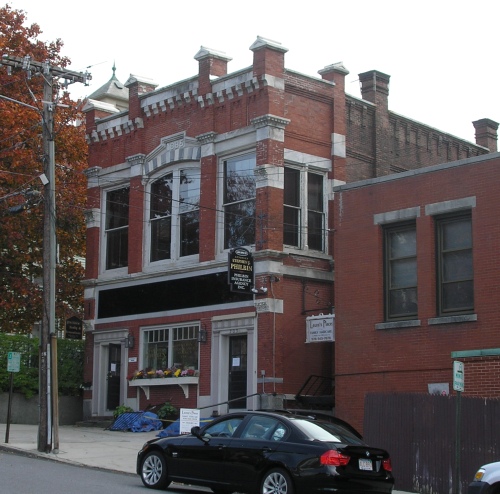
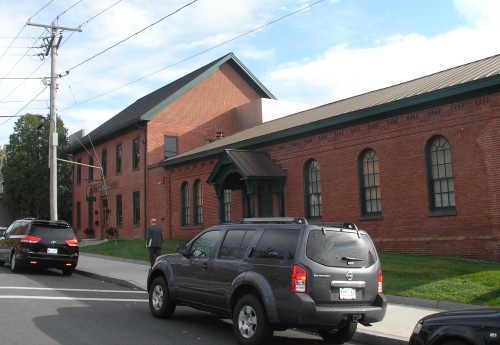
The building at 203 Union Street in Clinton was constructed in 1853 to house the Bigelow Mechanics Institute. This institution was founded in 1846. As described in History of the Origin of the Town of Clinton, Massachusetts, 1653-1865 (1896), by Andrew E. Ford:

April 14, 1846, a petition was made to a justice of peace by H. N. Bigelow, J. R. Stewart, L. F. Bancroft, J. B. Parker, Sanborn Worthen, A. S. Carleton and G. H. Kendall, representing that those gentlemen were “desirous of forming an association for the purpose of mutual improvement and for the further purpose of extending improvement to and throughout the village in which they reside, and the neighborhood with which they are more immediately connected, by sustaining courses of lectures upon the sciences and their connection with the mechanical arts, by sustaining, if their means shall allow it, a school for scientific instruction and education in those branches more immediately connected with their employment, and the collection of a library, a reading room and a repository of ‘models and drawings of useful machines and mechanical inventions.” In answer to this petition, a warrant was issued for a meeting for the purpose of organizing an association with these ends in view.

[. . .] The preamble of the constitution presented and adopted offers a broader basis of organization than was suggested in the petition, namely: “In order to promote our mutual improvement in literature, science and the mechanical arts; —to diffuse a taste for literary, scientific and mechanical pursuits in the community in which we reside;—and to develop the social, moral and intellectual natures with which we arc endowed by one Creator.”

The society took the name “The Bigelow Mechanics’ Institute in Clintonville.” E. B. Bigelow, in whose honor this name had been assumed, in addition to other donations, gave to the society as a recognition of his esteem, the valuable air pump, now used by the Clinton High School, and two hundred dollars to be used for the good of the Institute. A fee of five dollars was charged for membership, and some forty men joined.

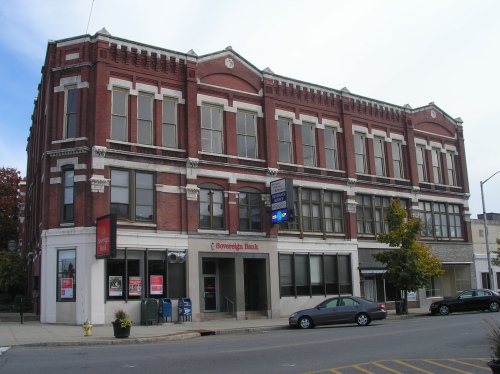
At various times, from 1853 to 1873, the Institute also rented out space in the building to the postal service, to the Town of Clinton for its armory and to local businesses. Next door to the Institute, the building at 195 Union Street was built in 1859 to serve as Horatio N. Bigelow‘s private office. The brothers, Horatio N. and Erastus B. Bigelow developed Clinton as an industrial community.

In 1873, the Bigelow Mechanics Institute disbanded and its library was donated to the town to become the Bigelow Free Public Library. The Institute’s old building became a tenement. The adjacent building, H. N. Bigelow’s former office, served as the the Second District Court of Eastern Worcester County from 1886 to 1972, and its basement was the Clinton Police Station until 1969. Both buildings later served as law offices. In recent years the complex has undergone an extensive transformation to house the Museum of Russian Icons, founded in 2006 by art collector and industrialist Gordon B. Lankton. A contemporary, aluminum-clad addition to the museum was constructed in 2008.

Bank Building, Clinton (1881)

by Dan/January 28, 2015/Banks, Clinton, Victorian Eclectic

Bank Block

The building at 79 High Street in Clinton was built in 1881 to house two banks: the Clinton Savings Bank and the First National Bank of Clinton, which became the Clinton Trust Company in 1919. The Clinton Savings Bank moved to a new building in 1929. The building at 79 High Street housed various successor banks to the Clinton Trust Company. It is currently home to a branch of Santander Bank.

203 Church Street, Clinton (1885)

by Dan/January 28, 2015January 28, 2015/Clinton, Commercial, Victorian Eclectic

Original Post Office, 203 Church Street

The building at 203 Church Street in Clinton was built in 1885 and was the town’s first Post Office. The second floor was once rented to the Prescott Club, a private club for businessmen. In the 1940’s, the Liberty Club, an Italian-American organization, purchased the building. Renovated inside in 1987, the building is now used as retail and office space.

Backus-Park Building (1820)

by Dan/January 22, 2015January 22, 2015/Commercial, Federal, Pittsfield

Backus-Park Building

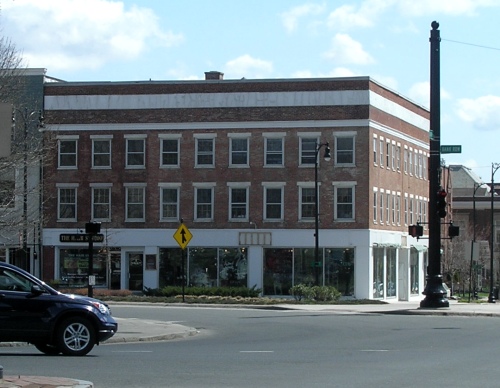
The commercial building at 4-8 Bank Row at the corner of South Street in Pittsfield has been much altered over the years. It was built around 1820 by William G. Backus, who ran a stove and plumber’s supply store for over half-a-century. Originally three separate buildings fronting South Street, it was later altered to have a unified front and a third story. Herman Melville lived in a house on South Street behind the Backus Block in 1862-1863 after moving from Arrowhead.

Pickering-Mack-Stone Double House (1814)

by Dan/January 22, 2015January 22, 2015/Federal, Houses, Salem

Pickering-Mack-Stone Double House

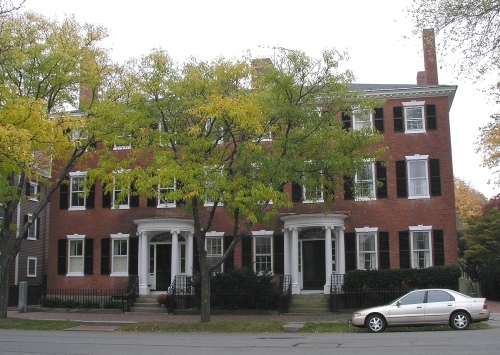
The three-story brick double house at 21-23 Chestnut Street in Salem was built in 1814-1815 by master builder Jabez Smith for the brothers John Pickering VI (1777-1846), the linguist and polymath who lived in the western half of the house, and Henry Pickering VI, who lived in the eastern half of the house. Judge Elisha Mack and his son Dr. William Mack owned the eastern half from 1837 to 1896. Dr. Mack bequeathed his later home, a house built in the 1850s, with a 25 acre property to the City of Salem as a park. Pickering Dodge lived in the western half while his house at 29 Chestnut Street was being constructed, selling it to the Stone family in 1822. President Andrew Jackson was entertained in the house in 1833. Continue reading “Pickering-Mack-Stone Double House (1814)”

Holyoke City Hall (1876)

by Dan/January 13, 2015/Gothic, Holyoke, Public Buildings

Holyoke City Hall

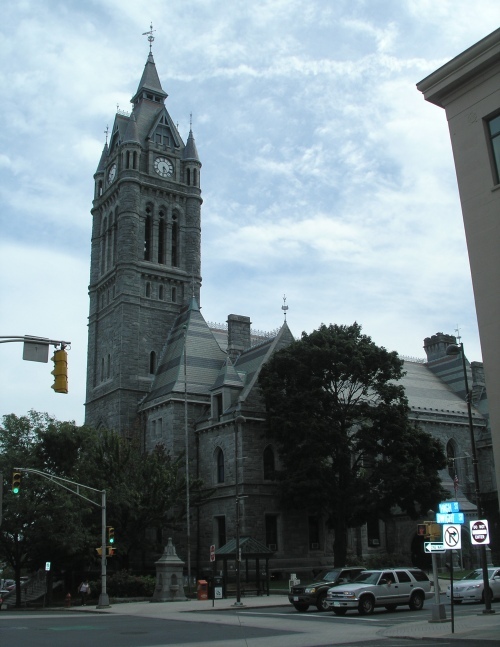
The City Hall of Holyoke, located at the corner of Dwight and High Streets (536 Dwight Street), was built in 1871-1876. It was planned as the Town Hall, but Holyoke had become a city by the time it was completed. It was built with granite quarried in Monson. The building was designed by Charles B. Atwood, who utilized elements of the Gothic and Romanesque Revival styles. During construction, Because Atwood was not delivering updated drawings in a timely manner, the design work was turned over to H.F. Kilburn in 1874. An annex in the same style was completed in 1913. The building has a second-floor auditorium, called the City Hall Ballroom, that features thirteen stained glass windows designed by Samuel West of the Ecclesiastical Stained Glass Works in Boston. In recent years the painted antique glass windows had fallen into disrepair. A campaign was organized that raised funds and the windows were restored last year. Other restoration work has also been done on the building’s exterior and interior. Continue reading “Holyoke City Hall (1876)”

Posts navigation

Older posts
Newer posts
Privacy Policy

Categories

  • Architectural Style (943)
    • Art Deco (9)
    • Byzantine (3)
    • Colonial (177)
    • Colonial Revival (85)
    • Craftsman (6)
    • Egyptian Revival (1)
    • Federal (190)
    • Foursquare (6)
    • Gothic (67)
    • Greek Revival (100)
    • Italianate (82)
    • Mission Revival (2)
    • Mission/Spanish Colonial (1)
    • Modern (2)
    • Neoclassical (56)
    • Octagon (3)
    • Postmodern (1)
    • Queen Anne (46)
    • Renaissance Revival (26)
    • Romanesque Revival (53)
    • Second Empire (26)
    • Shingle Style (12)
    • Stick Style (13)
    • Tudor Revival (8)
    • Vernacular (49)
    • Victorian Eclectic (15)
  • Building Type (943)
    • Apartment Buildings (8)
    • Banks (18)
    • Churches (119)
    • Collegiate (32)
    • Commercial (102)
    • Hotels (16)
    • Houses (508)
    • Industrial (23)
    • Libraries (22)
    • Lighthouses (1)
    • Military (15)
    • Monuments (1)
    • Museums (12)
    • Organizations (39)
    • Outbuildings (17)
    • Public Buildings (50)
    • Schools (23)
    • Stations (5)
    • Synagogues (1)
    • Taverns (21)
    • Theaters (9)
  • Town (943)
    • Adams (11)
    • Agawam (4)
    • Amherst (50)
    • Boston (64)
    • Boylston (6)
    • Cambridge (30)
    • Clinton (21)
    • Concord (15)
    • Cummington (1)
    • Danvers (14)
    • Deerfield (31)
    • Gloucester (18)
    • Granville (10)
    • Great Barrington (2)
    • Hadley (9)
    • Hancock (15)
    • Harvard (32)
    • Holyoke (47)
    • Lenox (5)
    • Lexington (8)
    • Longmeadow (32)
    • Marblehead (40)
    • Marlborough (4)
    • Natick (22)
    • Newton (2)
    • Northampton (68)
    • Peabody (4)
    • Pittsfield (20)
    • Salem (110)
    • Saugus (4)
    • Sheffield (4)
    • South Hadley (8)
    • Southborough (8)
    • Southwick (4)
    • Springfield (67)
    • Stockbridge (19)
    • Stow (1)
    • Sturbridge (18)
    • Sudbury (7)
    • Waltham (11)
    • Watertown (1)
    • Wayland (8)
    • West Springfield (14)
    • Westfield (46)
    • Weston (2)
    • Worcester (26)
  • Uncategorized (1)

Recent Comments

  • Wilber Blackson on South Hadley
  • Tami Speiden on Stockbridge
  • DexGuru on Stockbridge

Tags

Alcott Amherst College Asher Benjamin Back Bay Baptist Beacon Hill Big E Black Heritage Trail bowfront Bulfinch Catholic Congregational Episcopal Freedom Trail Gambrel H.H. Richardson Harvard Hawthorne Historic Deerfield Isaac Damon lit Longfellow mansard Methodist Mount Holyoke Museum Museums NPS Old Sturbridge Village PEM Revolutionary War row houses saltbox Samuel McIntire Shakers Smith College SPNEA Springfield Armory Stephen C. Earle Storrowton Underground Railroad UU Washington William Fenno Pratt Witch Trials

Meta

  • Log in
  • Entries feed
  • Comments feed
  • WordPress.org
Proudly powered by WordPress | Theme: ShowMe by NEThemes.