Historic Buildings of Massachusetts

  • About
  • Index by Town
  • CT
  • About
  • Index by Town
  • CT

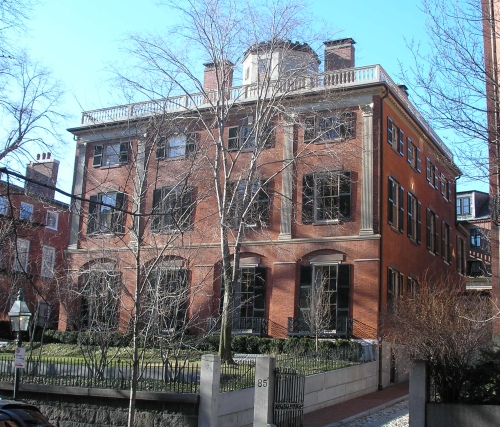
Second Harrison Gray Otis House (1802)
by Dan/June 8, 2008September 17, 2016/Boston, Federal, Houses

second-harrison-gray-otis-house.jpg

The only freestanding mansion on Boston’s Beacon Hill is the second of three houses designed by Charles Bulfinch for Harrison Gray Otis, a prominent businessman, lawyer and Federalist Party leader. Both Otis and Bulfinch were members of the Mount Vernon Proprietors, who purchased land on Beacon Hill for development. Bulfinch created an even more elegant mansion for Otis on Mount Vernon Street than the one he had created earlier, on Cambridge Street in 1796. Constructed between 1800 and 1802, Bulfinch hoped that the freestanding home on a landscaped property with outbuildings in back would be a model for the rest of Beacon Hill, but the neighborhood would end up being much more densely developed. Otis sold the house in 1806, only a few years after it was built: his growing family would require an even larger home, also to be designed by Bulfinch. Many people have owned the Second Harrison Gray Otis House over the years and undertaken various renovations and remodelings.
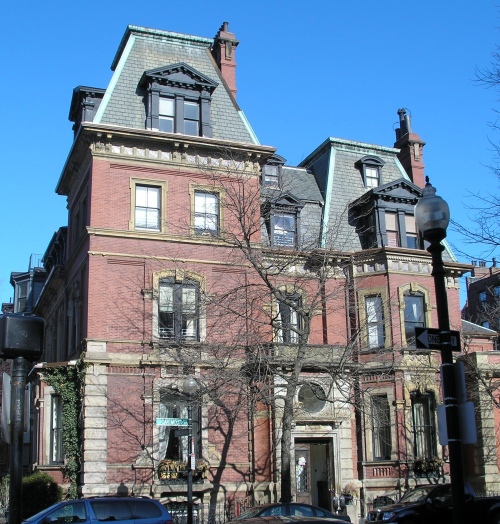
Hollis H. Hunnewell House (1869)

by Dan/June 8, 2008September 17, 2016/Boston, Houses, Second Empire

hunnewell-house.jpg

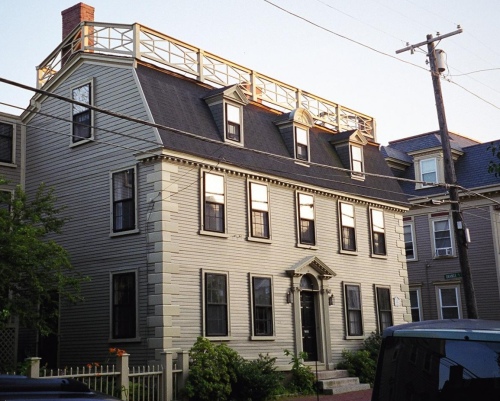
The Hollis H. Hunnewell House, on Dartmouth Street in Boston’s Back Bay, was built in 1869-1870. It was designed by Sturgis and Brigham for Hollis Horatio Hunnewell, son of Horatio Hollis Hunnewell, a wealthy financier, horticulturalist, and great benefactor of the town and college of Wellesley. Sturgis and Brigham designed the house with some of Boston’s earliest ceramic ornamentation on a building’s exterior. The mansard roofs atop the mansion’s irregularly sized towers, as well as a new one-story wing, were added to the building after a fire in 1881. In the early twentieth century, the house was owned by T. Jefferson Coolidge.

Benjamin Wadsworth House (1726)

by Dan/June 8, 2008September 17, 2016/Cambridge, Colonial, Houses

benjamin-wadsworth-house.jpg

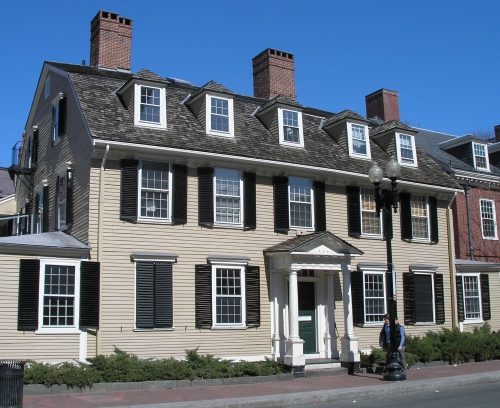
In 1726, a house was constructed on Massachusetts Avenue in Cambridge, on the site where Harvard’s earliest building, the Peyntree House, had stood. It was first occupied by Harvard’s fourth president, Benjamin Wadsworth, his family and two slaves. After Wadsworth, it would serve as the home of eight other presidents, until 1849, when president Jared Sparks chose to reside in his own Cambridge home. During the Revolutionary War, the house was Washington’s first headquarters when he came to command the army during the siege of Boston in 1775. Do to its state of disrepair at the time, Washington soon moved to other quarters. Over the years, the house would serve as lodging for visiting ministers and student boarders (including Ralph Waldo Emerson). The building now houses the Office of the University Marshal and other offices. The Wadsworth House lost its front yard when Massachusetts Avenue was widened. Today it is the second oldest of Harvard’s surviving buildings, after Massachusetts Hall.

John Hodges House (1788)

by Dan/June 8, 2008September 17, 2016/Colonial, Houses, Salem

john-hodges-house.jpg

Built around 1788 on Essex Street in Salem, the John Hodges House is late Georgian-style home with a grand spiral staircase within. Hodges was a merchant and passed the house on to his son, Benjamin Hodges, after it was built.

Sever Hall, Harvard (1880)

by Dan/May 12, 2008December 30, 2012/Cambridge, Collegiate, Romanesque Revival

sever-hall.jpg

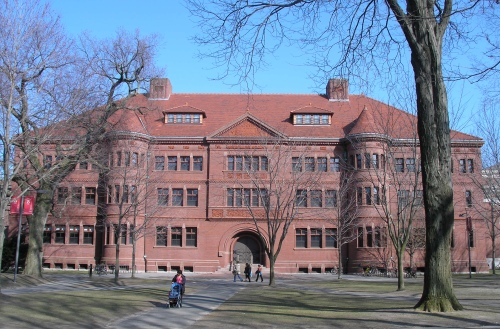
Sever Hall, on the campus of Harvard University in Cambridge, is one of the most important buildings designed by the architect H.H. Richardson. Constructed between 1878 and 1880 in Richardson’s Romanesque style, Sever Hall is notable for its brickwork, which features 100,000 bricks on the exterior elevations and elaborate brick carving. Red mortar was used originally to join the bricks. The facade also has Longmeadow brownstone and a varied placement of windows. The massive structure is linked to the neighboring eighteenth century buildings of Harvard Yard through the use of brick, the greater regularity of the design and the central pediments on the east and west facades. Sever Hall, an academic building consisting of both large and small classrooms, was recently restored and the upper floors contain the film program of Harvard’s Department of Visual and Environmental Studies.

55-57 Mount Vernon Street, Boston (1804)

by Dan/May 6, 2008March 23, 2009/Boston, Federal, Greek Revival, Houses

002.jpg
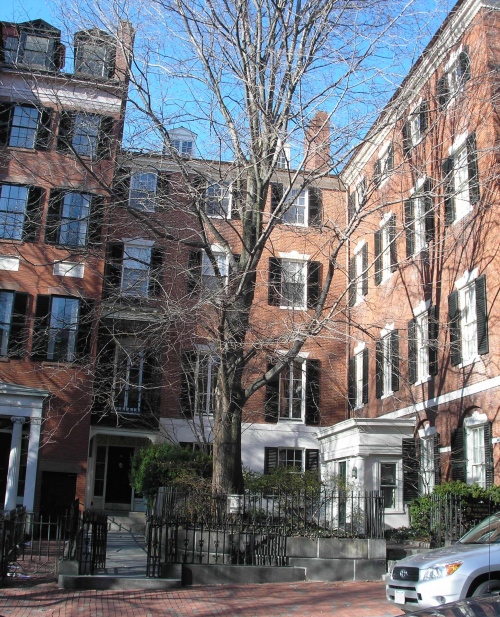
Left: 59 Mt. Vernon St.; Center: 57 Mt. Vernon St.;
Right: Nichols House Museum (55 Mt. Vernon St.);

Jonathan Mason, one of the Mount Vernon Proprietors (the group of real estate speculators who developed Boston’s Beacon Hill), commissioned the architect Charles Bulfinch to design a row of four houses (51-57 Mt. Vernon St.) for his daughters. Originally constructed in 1804, Nos. 55 & 57 both had side entrances on their west elevations, facing Mason’s mansion, which is no longer standing. In 1837, No. 59 (designed by Edward Shaw) was built to the west, blocking the entrance to No. 57, which was consequently moved to its current location on the front facade, facing Mt. Vernon St. Nos. 55-57 have had some notable residents.

Continue reading “55-57 Mount Vernon Street, Boston (1804)”

Josiah Dwight House (1725)

by Dan/April 28, 2008September 17, 2016/Colonial, Deerfield, Houses

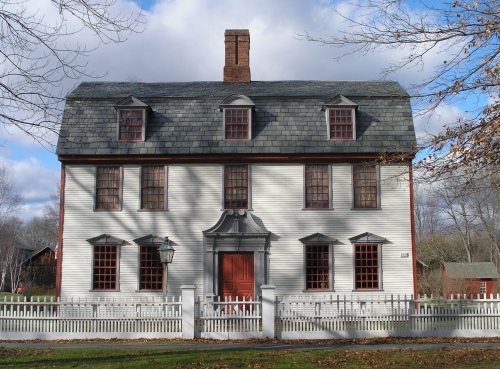
Originally built on Main Street in Springfield between 1722 and 1733 by David Ingersoll, the Dwight House was bought in 1743 by Josiah Dwight, who added a Connecticut River Valley Broken Scroll doorway, window pediments and a gambrel roof in the 1750s. Used as a rooming house in the later nineteenth century, the building was moved to Howard Street in 1884. In the early twentieth century, its original doorway pediment was purchased by Henry du Pont for his Long Island summer house (it was later moved to Winterthur). In 1950, when the house was facing demolition, it was purchased by Henry and Helen Flint for Historic Deerfield and stored until a location on the Street in Deerfield could be found. The Italianate-style Josiah Fogg House of 1868 was then demolished to make room for a restored Dwight House, complete with a reproduction of the original doorway pediment. Opened to the public in 1954, the Dwight House was originally interpreted as a the home of a doctor (complete with doctor’s office). It now presents the two contrasting interior decorative styles of Boston and the Connecticut River Valley on either side of the house. Continue reading “Josiah Dwight House (1725)”

Posts navigation

Older posts
Newer posts
Privacy Policy

Categories

  • Architectural Style (943)
    • Art Deco (9)
    • Byzantine (3)
    • Colonial (177)
    • Colonial Revival (85)
    • Craftsman (6)
    • Egyptian Revival (1)
    • Federal (190)
    • Foursquare (6)
    • Gothic (67)
    • Greek Revival (100)
    • Italianate (82)
    • Mission Revival (2)
    • Mission/Spanish Colonial (1)
    • Modern (2)
    • Neoclassical (56)
    • Octagon (3)
    • Postmodern (1)
    • Queen Anne (46)
    • Renaissance Revival (26)
    • Romanesque Revival (53)
    • Second Empire (26)
    • Shingle Style (12)
    • Stick Style (13)
    • Tudor Revival (8)
    • Vernacular (49)
    • Victorian Eclectic (15)
  • Building Type (943)
    • Apartment Buildings (8)
    • Banks (18)
    • Churches (119)
    • Collegiate (32)
    • Commercial (102)
    • Hotels (16)
    • Houses (508)
    • Industrial (23)
    • Libraries (22)
    • Lighthouses (1)
    • Military (15)
    • Monuments (1)
    • Museums (12)
    • Organizations (39)
    • Outbuildings (17)
    • Public Buildings (50)
    • Schools (23)
    • Stations (5)
    • Synagogues (1)
    • Taverns (21)
    • Theaters (9)
  • Town (943)
    • Adams (11)
    • Agawam (4)
    • Amherst (50)
    • Boston (64)
    • Boylston (6)
    • Cambridge (30)
    • Clinton (21)
    • Concord (15)
    • Cummington (1)
    • Danvers (14)
    • Deerfield (31)
    • Gloucester (18)
    • Granville (10)
    • Great Barrington (2)
    • Hadley (9)
    • Hancock (15)
    • Harvard (32)
    • Holyoke (47)
    • Lenox (5)
    • Lexington (8)
    • Longmeadow (32)
    • Marblehead (40)
    • Marlborough (4)
    • Natick (22)
    • Newton (2)
    • Northampton (68)
    • Peabody (4)
    • Pittsfield (20)
    • Salem (110)
    • Saugus (4)
    • Sheffield (4)
    • South Hadley (8)
    • Southborough (8)
    • Southwick (4)
    • Springfield (67)
    • Stockbridge (19)
    • Stow (1)
    • Sturbridge (18)
    • Sudbury (7)
    • Waltham (11)
    • Watertown (1)
    • Wayland (8)
    • West Springfield (14)
    • Westfield (46)
    • Weston (2)
    • Worcester (26)
  • Uncategorized (1)

Recent Comments

  • Wilber Blackson on South Hadley
  • Tami Speiden on Stockbridge
  • DexGuru on Stockbridge

Tags

Alcott Amherst College Asher Benjamin Back Bay Baptist Beacon Hill Big E Black Heritage Trail bowfront Bulfinch Catholic Congregational Episcopal Freedom Trail Gambrel H.H. Richardson Harvard Hawthorne Historic Deerfield Isaac Damon lit Longfellow mansard Methodist Mount Holyoke Museum Museums NPS Old Sturbridge Village PEM Revolutionary War row houses saltbox Samuel McIntire Shakers Smith College SPNEA Springfield Armory Stephen C. Earle Storrowton Underground Railroad UU Washington William Fenno Pratt Witch Trials

Meta

  • Log in
  • Entries feed
  • Comments feed
  • WordPress.org
Proudly powered by WordPress | Theme: ShowMe by NEThemes.