Historic Buildings of Massachusetts

  • About
  • Index by Town
  • CT
  • About
  • Index by Town
  • CT

North Congregational Church, Springfield (1873)
by Dan/July 27, 2009January 22, 2020/Churches, Romanesque Revival, Springfield

Hispanic Baptist Church

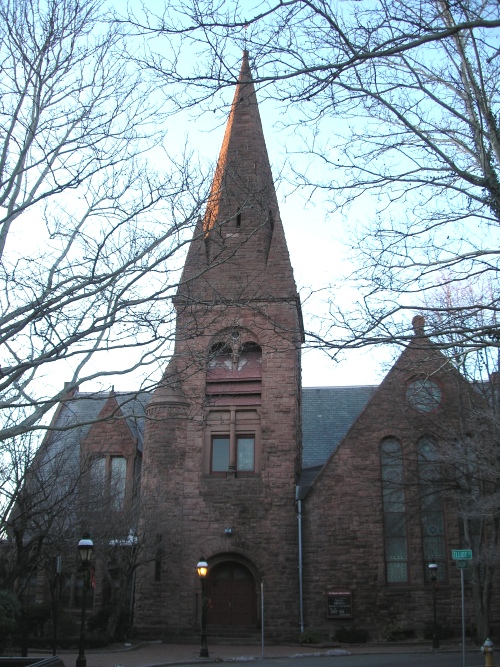
In 1868, H.H. Richardson won a commission to design the North Congregational Church in Springfield. Originally intended to be built where the congregation’s preceding church building was located, the plans for construction did not go through until a new site had been purchased, on the corner of Salem and Mattoon Streets in 1871, and the initial plan had been revised. Built in 1872 to 1873, the church was constructed of red Longmeadow sandstone and was one of Richardson‘s first works in the Romanesque style. The North Congregational Society disbanded in 1935 and the church was sold and renamed Grace Baptist Church. It is now called the Hispanic Baptist Church. UPDATE: The church was later called the Cristian Biblical Church and then Iglesia Apostolica Renovacion. The building was for sale in 2019.
First Church of Christ in Longmeadow (1768)

by Dan/July 26, 2009/Churches, Colonial Revival, Longmeadow

First Church Longmeadow

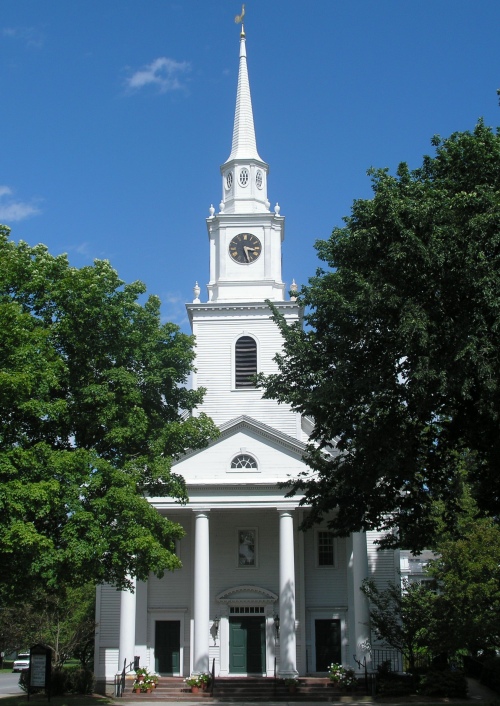
Where today there is a flagpole on Longmeadow Green, the town’s first church, built in 1716, once stood. By 1764 it was decided that, owing to the great number of repairs the building needed, a new church should be constructed. It was built on the Green in 1767-1768 and in 1769, the old meeting house was torn down. The new church was remodeled in 1828 and in 1874 it went through even more drastic changes, being moved from the Green to its present site and again being remodeled. The First Church of Christ‘s white pillared front portico was added in 1932, modeled on Boston’s Arlington Street Church.

Buckman Tavern (1690)

by Dan/July 25, 2009July 25, 2009/Colonial, Lexington, Taverns

Buckman Tavern

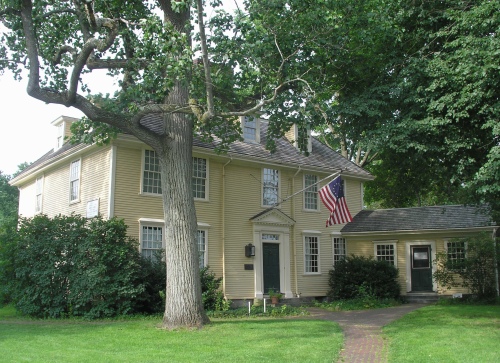
Buckman Tavern, off Lexington Green, was built in 1690 by Benjamin Muzzey and by a license granted in 1693, it became the first Public House in Lexington. In the coming years it was run by Muzzey‘s son John, then by John’s granddaughter and her husband, John Buckman. By the 1770s, Buckman Tavern had become the favored gathering place for local militia men (members of the Lexington Training Band) on the days they trained on the Green. On April 19, 1775, it was here that the militia gathered before facing the British troops, when the first shot was fired which began the Revolutionary War. The Tavern continued to be Lexington’s busiest after the war and housed the towns first village store and post office. The town of Lexington acquired the Tavern in 1913 and, by a 99-year lease, the Lexington Historical Society undertook the furnishing of the building, which is open to the public as a museum.

Jonathan Harrington House (1690)

by Dan/July 24, 2009January 18, 2020/Colonial, Houses, Lexington

Jonathan Harrington House

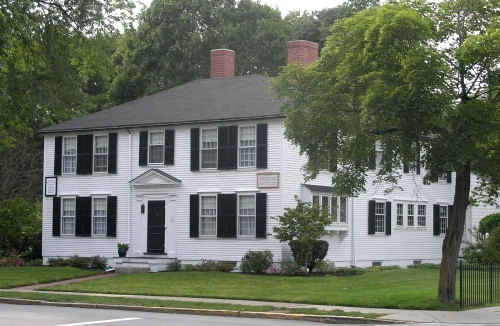
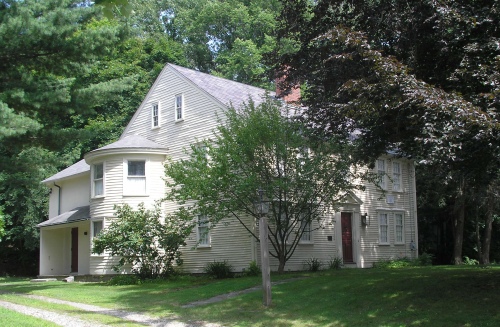
The earliest parts of the Jonathan Harrington House, on Lexington Green, date back to 1690. The house‘s most famous historic association is with the Battle of Lexington, as the historic marker on the house explains: “House of Jonathan Harrington/
who wounded on the Common/ April 19, 1775/ dragged himself to the door/ and died at his wife’s feet.” From 1811 to 1828, the Harrington House was the home of John Augustus, a shoemaker, who in 1841 convinced a judge to allow a man convicted of drunkenness into his custody for rehabilitation, finding him a job and getting him to sign a pledge not to drink. Augustus followed this by offering assistance to other convicted criminals and he is now recognized as the Father of Probation in America. In 1909, pioneering historic preservationist William Sumner Appleton expressed his outrage at modernizations being made to the Harrington House during a refurbishment (possibly by new owner Leroy Sunderland Brown?) The house remains a private home.

Grout-Heard House (1740)

by Dan/July 23, 2009September 17, 2016/Colonial, Houses, Wayland

Grout-Heard House

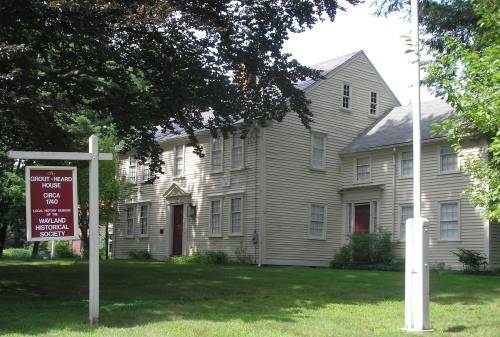
When the Town of Wayland built a new town hall in 1878, the historic Grout-Heard House had to be moved from its original location, on Cochituate Road, to a new lot nearby. The town hall was demolished in 1958 and in 1962, the house was moved back to its original location! The house was probably built around 1740 by Jonathan Grout, descendant of an early settler of Wayland (then part of Sudbury). In 1744, he sold it to his brother-in-law, Richard Heard. The house was later sold out of the family and at the time of the Battles of Lexington and Concord housed the store of Elijah Bent. In 1787, the house was acquired by Silas Grout, a blacksmith, who operated his shop just south of the house. Silas Grout enlarged the house and updated the facade. One of his daughters, Jerusaha Grout, married Newell Heard, a shopkeeper. Their son, John Augustus Heard, was a noted photographer in the nineteenth century and his wife, Sarah Hawkes Heard, was Wayland’s librarian at the end of the century. In 1955, Raytheon Corporation bought the house and donated it to the Wayland Historical Society. Now, placed just a few feet back from its original foundation, the house is open as a museum.

Gore Place (1806)

by Dan/July 22, 2009/Federal, Houses, Waltham

Gore Place

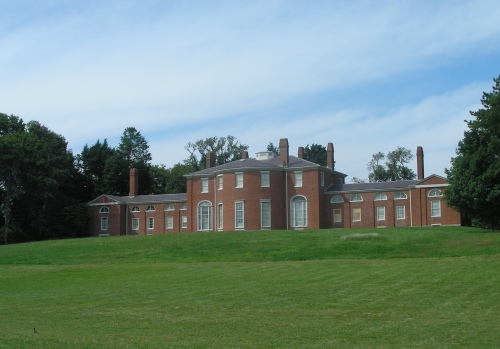
Christopher Gore, born in Boston, was a lawyer and Federalist politician, who served as Governor of Massachusetts (1808-1810) and a United States Senator (1813-1816). Earlier, Gore had spent eight years in Britain, initially as a commissioner to the Jay Treaty in 1796. It was during this time, in 1799, that his country mansion in Waltham, built in 1793, burned down. Gore and his wife, Rebecca Amory Payne, influenced by the estates they had seen in Europe, planed the construction of a new mansion after their return home in 1804. Called Gore Place, it was completed in 1805. Christopher Gore retired to his estate in 1816, but declining health led him to return to Boston in 1822, where he lived until his death in 1827. After Mrs. Gore’s death, the house was sold at auction. Other families lived there in the following years and in 1921 the house and grounds became home to a country club. The house was saved from demolition in 1935 by Gore Place Society and the restored mansion has since been open to the public.

Marrett and Nathan Munroe House (1729)

by Dan/July 21, 2009January 18, 2020/Colonial, Houses, Lexington

Marrett and Nathan Munroe house

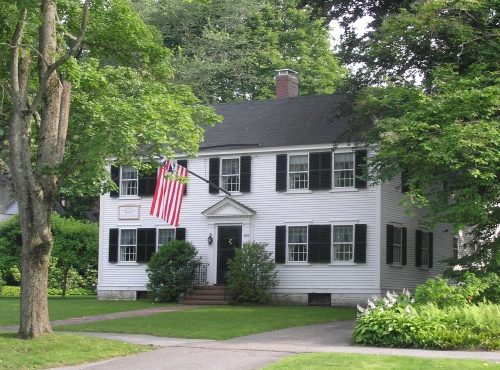
On Monument street, facing Lexington Battle Green, is the Marrett and Nathan Munroe House, which was a witness to the Battle of April 19, 1775. Built in 1729, the house was owned by Marrett Munroe at the time of the Battle and Nathan Munroe was one of the minutemen who fought in the Battle. According to Lexington, A Hand-Book of its Points Of Interest, Historical and Picturesque (1891), “Towards this house Caleb Harrington was running from the meetinghouse, where he had been to get powder, when he was shot by the British soldiers. A bullet from a British musket passed through the window over the door and lodged in a bureau, where it still remains, in the possession of one of Mr. Munroe’s descendants living in Chicopee, Mass.” The house was moved slightly when it was restored in 1915.

Posts navigation

Older posts
Newer posts
Privacy Policy

Categories

  • Architectural Style (943)
    • Art Deco (9)
    • Byzantine (3)
    • Colonial (177)
    • Colonial Revival (85)
    • Craftsman (6)
    • Egyptian Revival (1)
    • Federal (190)
    • Foursquare (6)
    • Gothic (67)
    • Greek Revival (100)
    • Italianate (82)
    • Mission Revival (2)
    • Mission/Spanish Colonial (1)
    • Modern (2)
    • Neoclassical (56)
    • Octagon (3)
    • Postmodern (1)
    • Queen Anne (46)
    • Renaissance Revival (26)
    • Romanesque Revival (53)
    • Second Empire (26)
    • Shingle Style (12)
    • Stick Style (13)
    • Tudor Revival (8)
    • Vernacular (49)
    • Victorian Eclectic (15)
  • Building Type (943)
    • Apartment Buildings (8)
    • Banks (18)
    • Churches (119)
    • Collegiate (32)
    • Commercial (102)
    • Hotels (16)
    • Houses (508)
    • Industrial (23)
    • Libraries (22)
    • Lighthouses (1)
    • Military (15)
    • Monuments (1)
    • Museums (12)
    • Organizations (39)
    • Outbuildings (17)
    • Public Buildings (50)
    • Schools (23)
    • Stations (5)
    • Synagogues (1)
    • Taverns (21)
    • Theaters (9)
  • Town (943)
    • Adams (11)
    • Agawam (4)
    • Amherst (50)
    • Boston (64)
    • Boylston (6)
    • Cambridge (30)
    • Clinton (21)
    • Concord (15)
    • Cummington (1)
    • Danvers (14)
    • Deerfield (31)
    • Gloucester (18)
    • Granville (10)
    • Great Barrington (2)
    • Hadley (9)
    • Hancock (15)
    • Harvard (32)
    • Holyoke (47)
    • Lenox (5)
    • Lexington (8)
    • Longmeadow (32)
    • Marblehead (40)
    • Marlborough (4)
    • Natick (22)
    • Newton (2)
    • Northampton (68)
    • Peabody (4)
    • Pittsfield (20)
    • Salem (110)
    • Saugus (4)
    • Sheffield (4)
    • South Hadley (8)
    • Southborough (8)
    • Southwick (4)
    • Springfield (67)
    • Stockbridge (19)
    • Stow (1)
    • Sturbridge (18)
    • Sudbury (7)
    • Waltham (11)
    • Watertown (1)
    • Wayland (8)
    • West Springfield (14)
    • Westfield (46)
    • Weston (2)
    • Worcester (26)
  • Uncategorized (1)

Recent Comments

  • Wilber Blackson on South Hadley
  • Tami Speiden on Stockbridge
  • DexGuru on Stockbridge

Tags

Alcott Amherst College Asher Benjamin Back Bay Baptist Beacon Hill Big E Black Heritage Trail bowfront Bulfinch Catholic Congregational Episcopal Freedom Trail Gambrel H.H. Richardson Harvard Hawthorne Historic Deerfield Isaac Damon lit Longfellow mansard Methodist Mount Holyoke Museum Museums NPS Old Sturbridge Village PEM Revolutionary War row houses saltbox Samuel McIntire Shakers Smith College SPNEA Springfield Armory Stephen C. Earle Storrowton Underground Railroad UU Washington William Fenno Pratt Witch Trials

Meta

  • Log in
  • Entries feed
  • Comments feed
  • WordPress.org
Proudly powered by WordPress | Theme: ShowMe by NEThemes.