Historic Buildings of Massachusetts

  • About
  • Index by Town
  • CT
  • About
  • Index by Town
  • CT

Tag: Museum

Saugus Iron Works House (1680)

by Dan/November 28, 2010/Colonial, Houses, Saugus

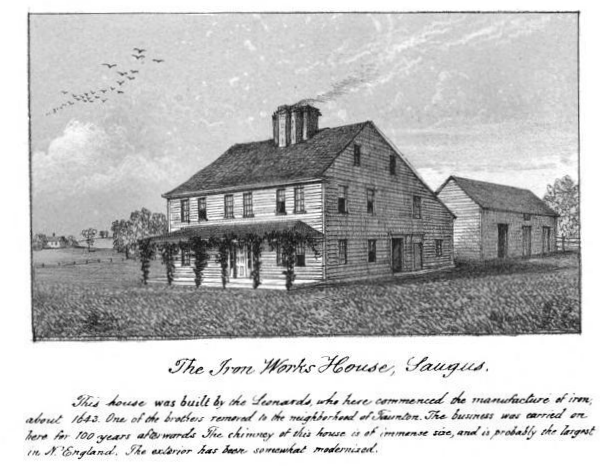
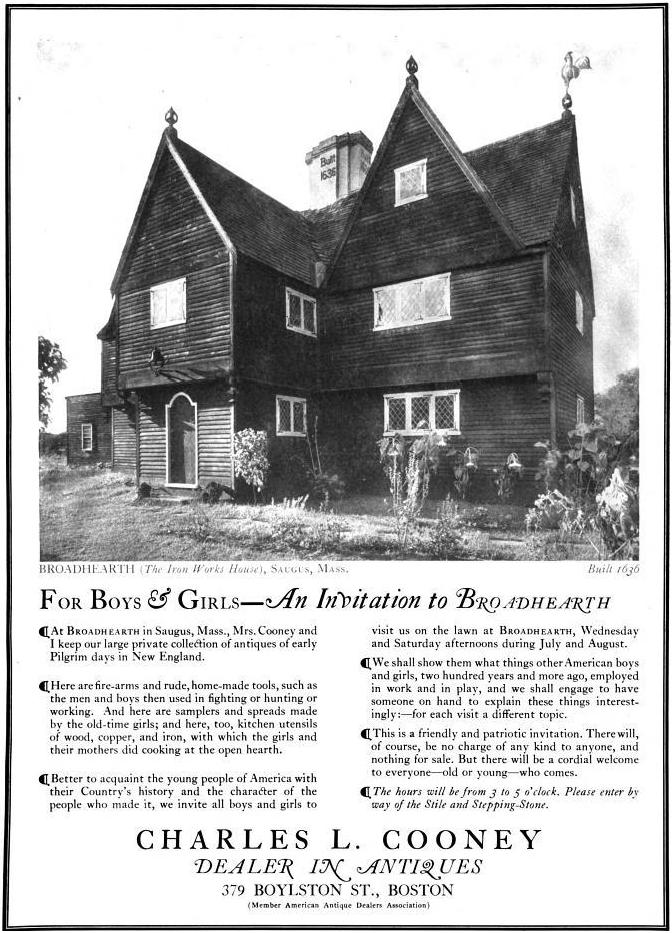
Going back to 1646, the Saugus Iron Works were the first integrated ironworks in North America. Various buildings of the Iron Works complex were reconstructed in the 1950s on their original sites and are today part of the Saugus Iron Works National Historic Site. A timber-framed seventeenth-century house, traditionally called the “Old Iron Works House,” is also located on the site. It was once believed to have been built in 1646, but is now thought to have been constructed in the 1680s, about a decade after the Iron Works ceased production in 1668. The first known resident of the house, from 1681 to 1688, was Samuel Appleton. By the early twentieth century, the house had become a tenement and had been much altered. In 1915, it was purchased by Wallace Nutting, antiquarian and entrepreneur, who hired Boston architect Henry Charles Dean to restore the house. Nutting renamed the restored house “Broadhearth” and it became part of his chain of colonial homes. As with his other properties, Nutting took photographs of his models posing in the house, which he marketed through a catalog. He soon hired a blacksmith to work at the site, but eventually decided to sell the property to an antiques dealer from Boston.
George Peabody House (1790)

by Dan/November 22, 2010January 17, 2020/Colonial, Houses, Peabody

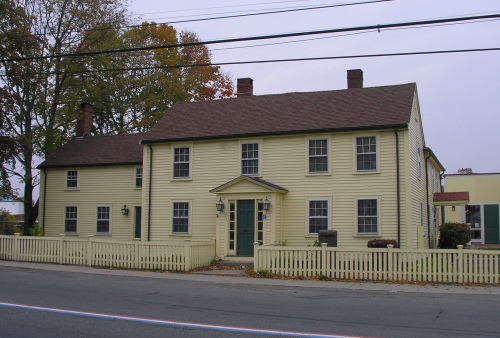
Peabody, originally South Danvers, is named after George Peabody, a merchant, financier and philanthropist. He spent his early career in Baltimore and in 1837 took up residence in London, where he remained until his death in 1869. During his lifetime he was the benefactor of numerous institutions, including the Peabody Institute Library (1852), the Peabody Institute Library of Danvers (1856), the Peabody Institute of the Johns Hopkins University (1857), the Peabody Museum of Archaeology and Ethnology at Harvard University (1866), the Peabody Museum of Natural History at Yale University (1866) and the Peabody Essex Museum in Salem (1867). George Peabody was born in South Danvers in 1795 in a house his father Thomas rented and soon purchased at 205 Washington Street. Built around 1790, the house passed to George Peabody’s older brother David in 1811, who took out two mortgages on the property the following year. In 1816, George Peabody purchased the house, where his mother resided until her death in 1830. Peabody sold it two years later and it has had many owners over the years. In the twentieth century, it housed workers of the American Glue Company (later Eastman Gelatin). In 1989, the City of Peabody purchased the house and restored it to become the George Peabody House Museum.

Jeremiah Page House (1754)

by Dan/November 9, 2010January 18, 2020/Colonial, Danvers, Houses

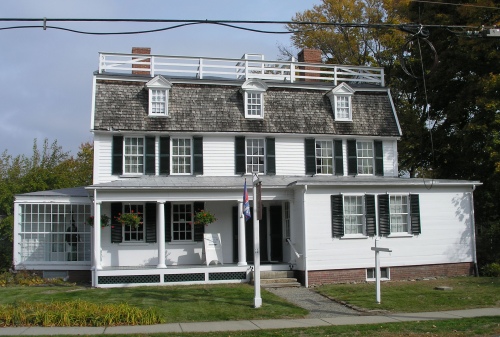
The Page House in Danvers was built in 1754 by Jeremiah Page, a brick maker, who also fought in the Revolutionary War. During the tea embargo in 1770, Page declared that “no tea would be drunk in his house.” As related in Lucy Larcom‘s poem, “A Gambrel Roof,” Page’s wife invited her lady friends to gather for tea on the roof, since it was “Upon a house is not within it.” In 1774, a room in the house was used as an office by General Thomas Gage, who was then the British military governor of Massachusetts. Jeremiah’s son, John Page, and then his granddaughter, Ann Lemist Page, later lived in the house. In 1850, a grandson of Jeremiah Page attempted to break into the Village Bank next to the house and was shot and killed by a night guard. Various additions were made in the nineteenth century. The building, as explained by Mary H. Northend in Colonial Homes and their Furnishings (1912), originally “consisted of four rooms, but these were later moved back and a new front added, the ell being replaced by a larger one.” Ann Lemist Page, who lived in the home until her death in 1913, was a pioneer in the kindergarten movement and, for a time, she ran a school in her home. In her will, she requested that the house be demolished to prevent its falling into disrepair. The Danvers Historical Society challenged the will in court and was able to purchase the property and move it from Elm Street to Page Street to serve as their headquarters.

Gedney House (1665)

by Dan/October 29, 2010January 25, 2020/Colonial, Houses, Salem

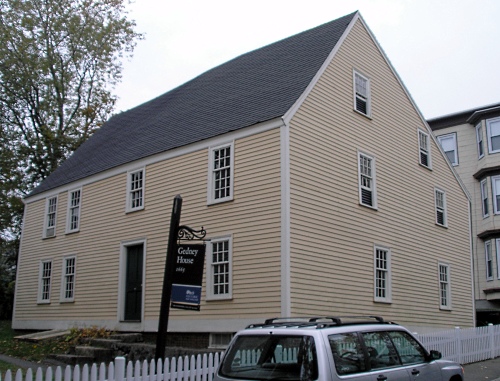
Gedney House in Salem is believed to have been built as early as 1665. As originally built by shipwright Eleazer Gedney, the house had two stories with a gabled attic to the left and a parlor with lean-to roof to the right. Gedney, who was married to the sister of John Turner, builder of the House of Seven Gables, passed the house on to his descendants, who made alterations in 1712. The Gedney family later sold the home to Benjamin Cox, who added two town house ells to the building around 1800, thus converting it to a multi-family residence. In later years, the house served as a boarding house and tenement in what became an Italian-American neighborhood. In 1967, when the house was being prepared for demolition, it was acquired by Historic New England. Now an unfurnished house museum, the original wood structure of the building’s interior is left exposed to display to visitors its original seventeenth-century construction.

Boardman House (1687)

by Dan/October 28, 2010January 16, 2020/Colonial, Houses, Saugus

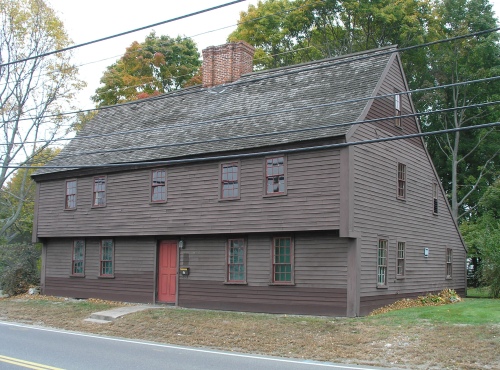
The Boardman House in Saugus is believed to have been built around 1687 (or as late as 1692) by William Boardman, a Boston-trained joiner. The house is sometimes referred to as the Scotch House because it was later confused with an earlier building on the site that once housed indentured Scottish prisoners who worked at the Saugus Iron Works. Boardman may have occupied that building before constructing the current home. A lean-to was added to the house by 1696, giving the structure a saltbox profile. Around 1725, William Boardman, Jr. made changes to the house, including replacing the original casement windows with sash windows. At some point, the building’s original two front gables were also removed. The house remained in the Boardman family until 1911, when it faced danger from modern development. In 1914, it was acquired by the Society for the Preservation of New England Antiquities (now Historic New England). While some necessary repairs were made, SPNEA founder William Sumner Appleton left the house in unspoiled condition to preserve its seventeenth-century structural fabric.

Noble and Cooley Drum Factory (1872)

by Dan/September 30, 2010October 28, 2010/Granville, Industrial, Vernacular

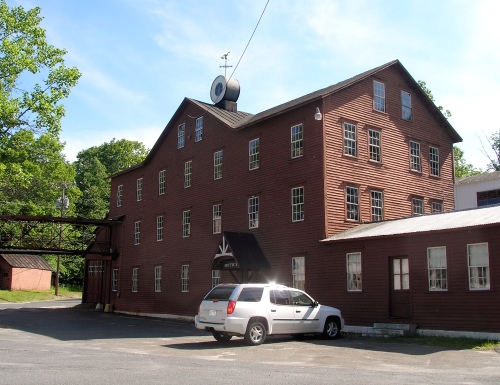
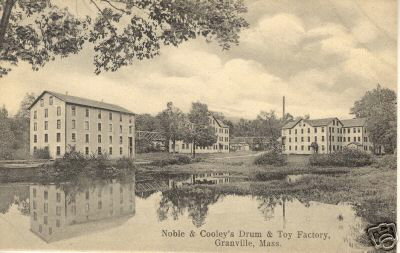
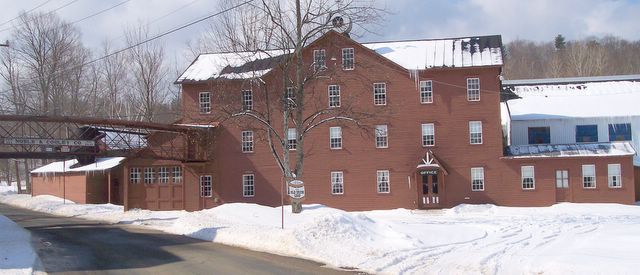
In 1852, master mechanic Silas Noble began manufacturing toy drums in his kitchen. In 1854, Noble and his partner, James Cooley (who handled the business side of their operation and whose descendants still run the business), built a factory in Granville (the current structure dates to 1872). Taking advantage of nearby water power (an electric generator was installed in 1915), the Noble & Cooley Drum Company prospered. They made marching drums for the Union Army during the Civil War, but their main business continued to be the production of toy drums. In the 1980s, the company entered the professional drum market, producing a highly regarded single-ply solid shell snare drum using an original steam bending machine from the nineteenth century. The factory, which has a drum weathervane, is now also home to a museum, the Noble & Cooley Center for Historic Preservation.

Flagg School, Southborough (1859)

by Dan/July 24, 2010/Greek Revival, Schools, Southborough

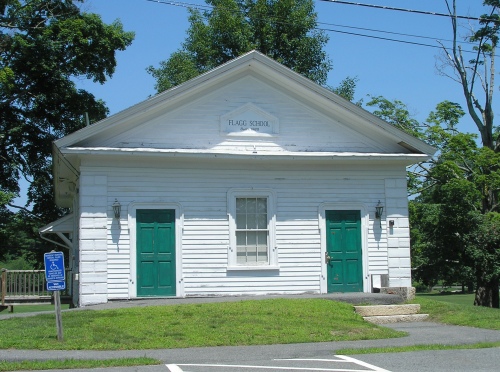
In 1859, the Town of Southborough built five school houses in different parts of town, with the District 5 School house being located at the intersection of Flagg and Deerfoot Roads. In 1894, with the school house at Southborough Centre having fallen into disrepair, the District 5 school house was moved (and extended by ten feet) to replace it. After a new High School was built in 1906, the old school house, now known as the Flagg School, became home to the Southborough Fire Department until 1928. It later served the town’s Tree Department and then the Water Department. In 1998, the building was leased to the Southborough Historical Society, which renovated it. In 2000, it was dedicated as the Southborough Historical Museum.

Posts navigation

Older posts
Newer posts
Privacy Policy

Categories

  • Architectural Style (943)
    • Art Deco (9)
    • Byzantine (3)
    • Colonial (177)
    • Colonial Revival (85)
    • Craftsman (6)
    • Egyptian Revival (1)
    • Federal (190)
    • Foursquare (6)
    • Gothic (67)
    • Greek Revival (100)
    • Italianate (82)
    • Mission Revival (2)
    • Mission/Spanish Colonial (1)
    • Modern (2)
    • Neoclassical (56)
    • Octagon (3)
    • Postmodern (1)
    • Queen Anne (46)
    • Renaissance Revival (26)
    • Romanesque Revival (53)
    • Second Empire (26)
    • Shingle Style (12)
    • Stick Style (13)
    • Tudor Revival (8)
    • Vernacular (49)
    • Victorian Eclectic (15)
  • Building Type (943)
    • Apartment Buildings (8)
    • Banks (18)
    • Churches (119)
    • Collegiate (32)
    • Commercial (102)
    • Hotels (16)
    • Houses (508)
    • Industrial (23)
    • Libraries (22)
    • Lighthouses (1)
    • Military (15)
    • Monuments (1)
    • Museums (12)
    • Organizations (39)
    • Outbuildings (17)
    • Public Buildings (50)
    • Schools (23)
    • Stations (5)
    • Synagogues (1)
    • Taverns (21)
    • Theaters (9)
  • Town (943)
    • Adams (11)
    • Agawam (4)
    • Amherst (50)
    • Boston (64)
    • Boylston (6)
    • Cambridge (30)
    • Clinton (21)
    • Concord (15)
    • Cummington (1)
    • Danvers (14)
    • Deerfield (31)
    • Gloucester (18)
    • Granville (10)
    • Great Barrington (2)
    • Hadley (9)
    • Hancock (15)
    • Harvard (32)
    • Holyoke (47)
    • Lenox (5)
    • Lexington (8)
    • Longmeadow (32)
    • Marblehead (40)
    • Marlborough (4)
    • Natick (22)
    • Newton (2)
    • Northampton (68)
    • Peabody (4)
    • Pittsfield (20)
    • Salem (110)
    • Saugus (4)
    • Sheffield (4)
    • South Hadley (8)
    • Southborough (8)
    • Southwick (4)
    • Springfield (67)
    • Stockbridge (19)
    • Stow (1)
    • Sturbridge (18)
    • Sudbury (7)
    • Waltham (11)
    • Watertown (1)
    • Wayland (8)
    • West Springfield (14)
    • Westfield (46)
    • Weston (2)
    • Worcester (26)
  • Uncategorized (1)

Recent Comments

  • Wilber Blackson on South Hadley
  • Tami Speiden on Stockbridge
  • DexGuru on Stockbridge

Tags

Alcott Amherst College Asher Benjamin Back Bay Baptist Beacon Hill Big E Black Heritage Trail bowfront Bulfinch Catholic Congregational Episcopal Freedom Trail Gambrel H.H. Richardson Harvard Hawthorne Historic Deerfield Isaac Damon lit Longfellow mansard Methodist Mount Holyoke Museum Museums NPS Old Sturbridge Village PEM Revolutionary War row houses saltbox Samuel McIntire Shakers Smith College SPNEA Springfield Armory Stephen C. Earle Storrowton Underground Railroad UU Washington William Fenno Pratt Witch Trials

Meta

  • Log in
  • Entries feed
  • Comments feed
  • WordPress.org
Proudly powered by WordPress | Theme: ShowMe by NEThemes.