Historic Buildings of Massachusetts

  • About
  • Index by Town
  • CT
  • About
  • Index by Town
  • CT

Tag: Museum

Gardner-Pingree House (1804)
by Dan/March 1, 2011January 24, 2020/Federal, Houses, Salem

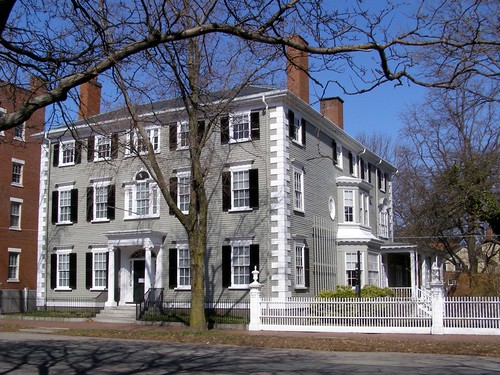
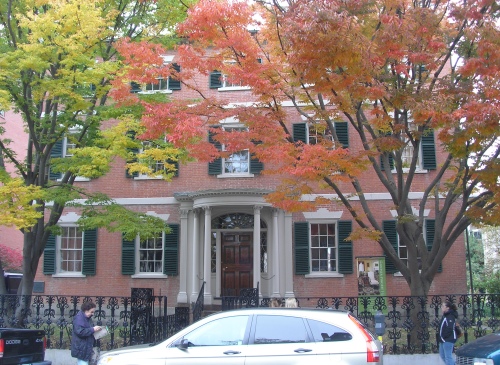
The 350th post at Historic Buildings of Massachusetts is the Gardner-Pingree House in Salem, which is considered to be New England’s greatest example of a Federal-style (or Adamesque) town house. It was erected in 1804-1805 at 128 Essex Street for merchant John Gardner, Jr. and is generally considered to be the work of Samuel McIntire, who certainly did create the mansion‘s exterior ornamentation and interior wood carving. In 1811, financial difficulties forced Gardner to sell his house to Nathaniel West, who then sold it three years later to Captain Joseph White. In 1830, Capt. White was murdered in the house, an event that shook Salem and was followed by a sensational trial with a famed oration by Daniel Webster. The story would have an influence on Poe and Hawthorne. In 1834, the house was sold to David Pingree and remained in the Pingree family until 1933. The house was donated in that year to the Essex Institute, now the Peabody Essex Museum. The restored house is open to the public for tours, usually in conjunction with the museum’s nearby John Ward and Crowninshield-Bentley houses.
Abiel Smith School (1835)

by Dan/February 20, 2011/Boston, Federal, Schools

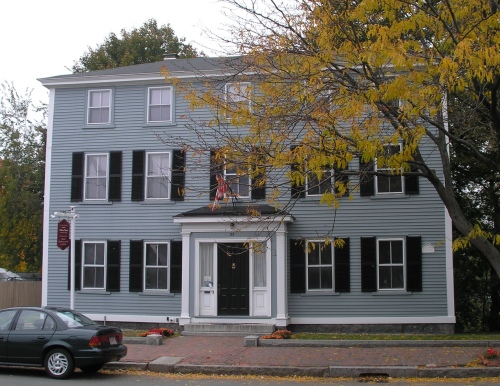
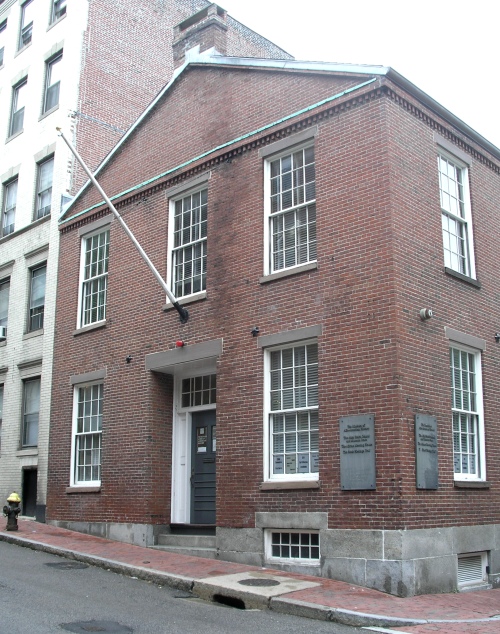
In 1798, members of Boston’s black comunity organized a grammar school that met in in the home of Primus Hall, the son of Prince Hall, a community leader whose petitions to allow black children into the city’s school system had long been denied. The school moved to the African Meeting House on Beacon Hill in 1808 and received financial upport frm the city after 1812. In the 1820s, the city finally established two schools for black children. Abiel Smith was a white businessman who died in 1815 and left $4,000 for the education of African American children in Boston. Part of this bequest was used to build the Abiel Smith School, completed in 1834 and dedicated the following year on Belknap Street, now called Joy Street, near the African Meeting House. In 1849, most African-American parents in Boston withdraw their children from the Abiel Smith School to protest the segregation of schools in the city. In 1855, the Massachusetts legislature outlawed segregation and the Abiel Smith School was closed. The building was then used to store school furniture and after 1887 as the headquarters for black Civil War veterans. The restored building is now part of the Museum of African American History. The school is also on Boston’s Black Heritage Trail.

Ropes Mansion (1727)

by Dan/January 24, 2011January 24, 2020/Colonial, Houses, Salem

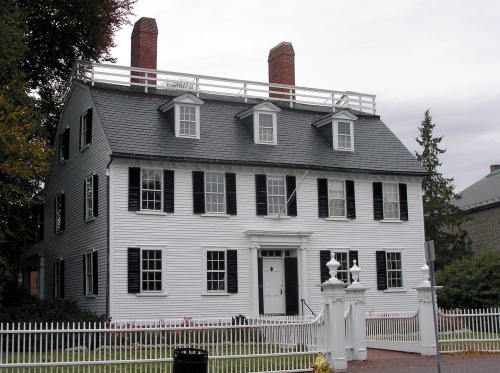
Built on Essex Street in Salem around 1727, the Ropes Mansion has been open to the public since 1912. It was built by merchant Samuel Barnard of Deerfield and sold by Barnard’s heirs to Judge Nathaniel Ropes II in 1768. He was a loyalist and died of smallpox as his house was being attacked by a mob of Patriots in 1774. His family went into exile, but reclaimed the house after the Revolutionary War. It remained in the Ropes family until 1907, when sisters Mary and Eliza Ropes bequeathed it as the Ropes Memorial. Various alterations have been made to the interior of the house over the years, most dramatically in 1894, when Colonial Revival modifications were made and the structure was moved back from the street. The building‘s current entryway dates to the 1830s and was inspired by Asher Benjamin‘s American Builder’s Companion (1827). The house also has formal gardens dating to 1912. The house has had several fires: Abigail Ropes burned to death after her dress caught fire in 1839; a disgruntled worker is believed to have started a fire which gutted an addition in 1894; and the third floor attic was damaged in a fire in 2009. Today, the Ropes Mansion is owned by the Peabody Essex Museum.

Stephen Phillips House (1821)

by Dan/January 10, 2011January 24, 2020/Federal, Houses, Salem

In 1800, Captain Nathaniel West and his wife Elizabeth, daughter of Elias Hasket Derby, hired Samuel McIntire to design a country estate in Danvers. They later divorced and Elizabeth retained the house, but Capt. West eventually inherited a third of the building. In 1821, he transported his three rooms by ox sled to Chestnut Street in Salem, where they formed the core of his new Federal-style mansion. The West family sold the house in 1863 to Malvina Tabitha Ward, who ran a boarding house and school in the residence. In 1875, the house was sold to Annie B. Webb and in 1911, Anna Wheatland Phillips and her husband, Stephen Willard Phillips, bought the house. By that time the house had been expanded and much altered over the years in various architectural styles. Anna and Stephen W. Philips hired architect William Rantoul to remodel the house to reflect its origins in the Federal style. Stephen W. Philips, who was born in Hawaii, collected Oceanic art. His father, Stephen Henry Phillips, had served as Attorney General for the Kingdom of Hawaii from 1866 to 1873. Stephen W. and Anna Phillips’s son, Stephen Phillips, who died in 1971, had wanted his childhood home to become a museum. In 1973, his wife, Betty, established the Stephen Phillips Memorial Charitable Trust for Historic Preservation, which opened the house to the public. Since 2006, the house has been owned by Historic New England. The property also includes the carriage house, which contains the family’s collection of carriages and automobiles.

Rebecca Nurse Homestead (1678)

by Dan/December 17, 2010January 18, 2020/Colonial, Danvers, Houses

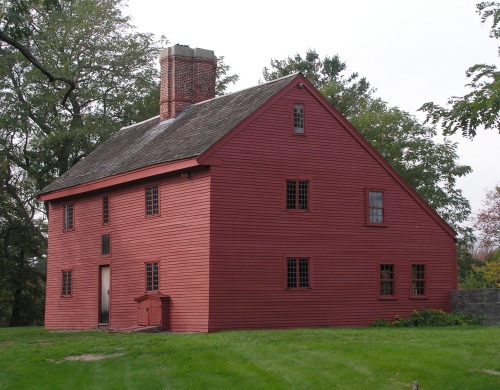
Located on a proprty of 25 acres of fields, pasture and woods at 149 Pine Street in Danvers is the Rebecca Nurse Homestead. The house was mostly likely built in 1678, when Francis Nurse, a skilled maker of wooden household items, began renting the property from owner James Allen. Nurse would eventually purchase the house, where he lived with his wife Rebecca and eight children. In 1692, during the Salem Witch Trials, the 71-year-old Rebecca Nurse was accused of practicing witchcraft. Initially found not guilty at her trial, her young accusers went into convulsive fits which led the jury to return with a guilty verdict. Rebecca Nurse was hanged and her family secretly buried her on the Homestead land. In 1885, the family dedicated a granite memorial in her honor in the Nurse family graveyard. The monument is inscribed with a poem by John Greenleaf Whittier. Francis Nurse died in 1695 and the Homestead remained in the Nurse family into the eighteenth century. Rebecca’s great-grandson, Francis, lived in the house and, as a sergeant in the Danvers Alarm Company, responded to the Lexington Alarm in 1775. The Homestead was owned by the Putnam family from 1784 to 1908. Purchased and restored by the Rebecca Nurse Memorial Asociation, the property was given to the Society for the Preservation of New England Antiquities in 1926 and, since 1981, has been a museum owned by the Danvers Alarm List Company.

Judge Samuel Holten House (1670)

by Dan/December 15, 2010January 18, 2020/Colonial, Danvers, Houses

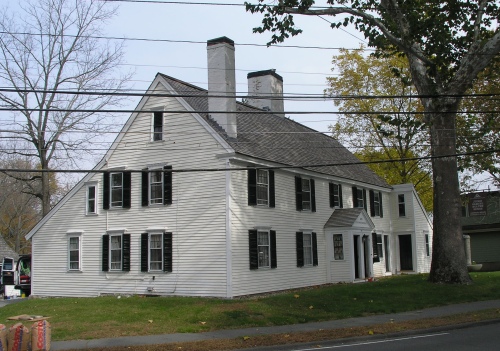
The Judge Samuel Holten House in Danvers was built in 1670 by Benjamin Holten in what was then known as Salem Village. In the house resided Sarah Holten, who testified against Rebecca Nurse during the Salem Witchcraft Hysteria of 1692. From a much smaller initial core, the house, which served as a tavern, was expanded six different times over the years, making it a prime example of the development in stages of a Colonial house. In the later eighteenth century, Judge Samuel Holten lived in the house. He was a physician and statesman who served as a member of the Continental Congress from 1778 to 1780 and again from 1782 to 1787. In 1778, he was a signer of the Articles of Confederation. Since 1921, the house been owned and restored by the General Israel Putnam Chapter of the Daughter of the American Revolution.

General Gideon Foster House (1810)

by Dan/December 8, 2010January 17, 2020/Federal, Houses, Peabody

General Gideon Foster was a leader during the Revolutionary War from South Danvers, now Peabody. Leading the militia of South Danvers, he marched to the Battle of Lexington and Concord, fighting the British during their retreat to Boston at the Battle of Menotomy. He and his men also resupplied American forces at the Battle of Bunker Hill. Foster was made a General of Militia after the War. In 1815, he purchased a house, built in 1810 on Washington Street in South Danvers, and lived there from 1818 to 1831. During this time, Foster ran the grist, bark and chocolate mills that he had inherited from his father. After his death, others owned the house, which was acquired by the Peabody Historical Society in 1916 and continues to serve as its headquarters and museum.

Posts navigation

Older posts
Newer posts
Privacy Policy

Categories

  • Architectural Style (943)
    • Art Deco (9)
    • Byzantine (3)
    • Colonial (177)
    • Colonial Revival (85)
    • Craftsman (6)
    • Egyptian Revival (1)
    • Federal (190)
    • Foursquare (6)
    • Gothic (67)
    • Greek Revival (100)
    • Italianate (82)
    • Mission Revival (2)
    • Mission/Spanish Colonial (1)
    • Modern (2)
    • Neoclassical (56)
    • Octagon (3)
    • Postmodern (1)
    • Queen Anne (46)
    • Renaissance Revival (26)
    • Romanesque Revival (53)
    • Second Empire (26)
    • Shingle Style (12)
    • Stick Style (13)
    • Tudor Revival (8)
    • Vernacular (49)
    • Victorian Eclectic (15)
  • Building Type (943)
    • Apartment Buildings (8)
    • Banks (18)
    • Churches (119)
    • Collegiate (32)
    • Commercial (102)
    • Hotels (16)
    • Houses (508)
    • Industrial (23)
    • Libraries (22)
    • Lighthouses (1)
    • Military (15)
    • Monuments (1)
    • Museums (12)
    • Organizations (39)
    • Outbuildings (17)
    • Public Buildings (50)
    • Schools (23)
    • Stations (5)
    • Synagogues (1)
    • Taverns (21)
    • Theaters (9)
  • Town (943)
    • Adams (11)
    • Agawam (4)
    • Amherst (50)
    • Boston (64)
    • Boylston (6)
    • Cambridge (30)
    • Clinton (21)
    • Concord (15)
    • Cummington (1)
    • Danvers (14)
    • Deerfield (31)
    • Gloucester (18)
    • Granville (10)
    • Great Barrington (2)
    • Hadley (9)
    • Hancock (15)
    • Harvard (32)
    • Holyoke (47)
    • Lenox (5)
    • Lexington (8)
    • Longmeadow (32)
    • Marblehead (40)
    • Marlborough (4)
    • Natick (22)
    • Newton (2)
    • Northampton (68)
    • Peabody (4)
    • Pittsfield (20)
    • Salem (110)
    • Saugus (4)
    • Sheffield (4)
    • South Hadley (8)
    • Southborough (8)
    • Southwick (4)
    • Springfield (67)
    • Stockbridge (19)
    • Stow (1)
    • Sturbridge (18)
    • Sudbury (7)
    • Waltham (11)
    • Watertown (1)
    • Wayland (8)
    • West Springfield (14)
    • Westfield (46)
    • Weston (2)
    • Worcester (26)
  • Uncategorized (1)

Recent Comments

  • Wilber Blackson on South Hadley
  • Tami Speiden on Stockbridge
  • DexGuru on Stockbridge

Tags

Alcott Amherst College Asher Benjamin Back Bay Baptist Beacon Hill Big E Black Heritage Trail bowfront Bulfinch Catholic Congregational Episcopal Freedom Trail Gambrel H.H. Richardson Harvard Hawthorne Historic Deerfield Isaac Damon lit Longfellow mansard Methodist Mount Holyoke Museum Museums NPS Old Sturbridge Village PEM Revolutionary War row houses saltbox Samuel McIntire Shakers Smith College SPNEA Springfield Armory Stephen C. Earle Storrowton Underground Railroad UU Washington William Fenno Pratt Witch Trials

Meta

  • Log in
  • Entries feed
  • Comments feed
  • WordPress.org
Proudly powered by WordPress | Theme: ShowMe by NEThemes.