Historic Buildings of Massachusetts

  • About
  • Index by Town
  • CT
  • About
  • Index by Town
  • CT

Tag: Gambrel

Annie Longfellow Thorp House (1887)

by Dan/April 4, 2009September 17, 2016/Cambridge, Colonial Revival, Houses

annie-longfellow-thorp.jpg

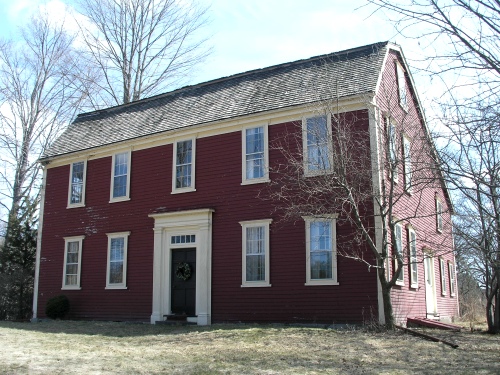
At 115 Brattle Street in Cambridge is a Colonial Revival style house built in 1887 for Annie Allegra Longfellow Thorp, a daughter of Henry Wadsworth Longfellow. Inspired by her father’s eighteenth century Georgian house nearby, the daughter’s home was designed by her cousin, Alexander Wadsworth Longfellow, Jr. Having worked in the office of H.H. Richardson, A.W. Longfellow started his own firm and was known for his Romanesque and Colonial Revival designs.
Durant-Kenrick House (1732)

by Dan/March 22, 2009September 17, 2016/Colonial, Houses, Newton

durant-kenrick-homestead.jpg

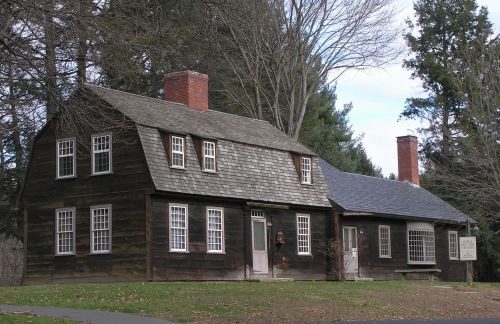
One of Newton’s few surviving pre-Revolutionary War houses is the Durant-Kenrick House on Waverly Avenue. Built in 1732 by Capt. Edward Durant, the house was constructed on land which had once been the Praying Indian Village of Nonantum, established in 1646 by Rev. John Eliot of Roxbury as the first Christian Indian community in British North America. In 1790, the Durant House and farm were acquired by John Kenrick, an abolitionist and noted horticulturist who started a commercial nursery in the 1790s. After his death, one son, William Kenrick, inherited the nursery, while another, John A. Kenrick, inherited the family homestead. William Kenrick, a founding member of the Massachusetts Horticultural Society, was even more influential than his father, authoring two important works: The New American Orchadist (1833) and The American Silk Grower’s Guide (1835). The Newton Historical Society and the Newton History Museum are seeking to acquire a the Homestead and the remaining open space on the property.

Joseph Clesson House (1814)

by Dan/February 28, 2009September 17, 2016/Colonial, Deerfield, Houses

flynt-silver-and-metalware-collection.jpg

Today part of Historic Deerfield, the Joseph Clesson House was built in 1814, probably planned to be the ell of a larger house Clesson, who died two years later, had intended to build on the site. The house was moved moved around the corner in 1872 and replaced with a Victorian-style home. Eventually, the Clesson House was moved to Greenfield. In 1960, the later Victorian house was torn down and the Clesson House returned to its original lot in Deerfield. The following year, the house opened to the public as the home of the Henry Needham Flynt Silver and Metalware Collection. The house’s kitchen was set up as an example of a silversmith’s workshop. To accommodate the collection, a fireproof wing, made of cinder blocks, was added to the house, with its exterior disguised to resemble the original section.

Narbonne House (1675)

by Dan/February 19, 2009September 17, 2016/Colonial, Houses, Salem

narbonne-house.jpg

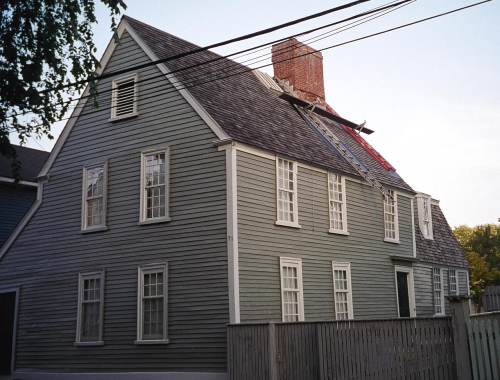
The Narbonne House, on Essex Street in Salem, is part of the Salem Maritime National Historic Site. It was built in 1675 by Thomas Ives, a butcher (or “slaughterer”). The oldest section of the house has a prominent peaked roof. Later owners added to the building, with part of the lean-to and the gambrel-roofed ell probably being constructed when Capt. John Hodges owned the house in the third quarter of the eighteenth century. In 1780, the house was purchased by Jonathan Andrew. His granddaughter, Sarah Narbonne, was born inside and lived there until her death, at age 101, in 1895. Her daughter Mary lived there until her death in 1905. The Park Service acquired the historic structure in 1963. Instead of being restored to a particular period, the Narbonne House is kept unfurnished as an architectural study house. There is a video of a talk outsidethe Narbonne House: Continue reading “Narbonne House (1675)”

Derby-Ward House (1738)

by Dan/December 14, 2008September 17, 2016/Colonial, Houses, Salem

derby-ward-house.jpg

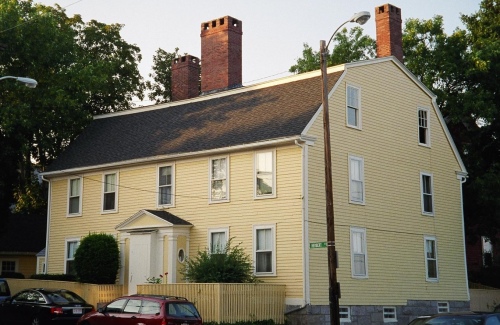
The Derby-Ward House, on Derby Street in Salem, was built around 1738 by the sea captain Richard Derby. He was the father of the wealthy and celebrated merchant Elias Hasket Derby, the statesman Richard Derby, Jr. and the ship captain John Derby. The gambrel-roofed house has an enclosed entry porch, similar to those on other homes of wealthy Salem families, which was added after the house was built. The house was purchased by the Ward family after the Revolutionary War. Update: Check out the recent article on the house at SalemPatch.

Rev. Jonathan Ashley House (1734)

by Dan/November 22, 2008September 17, 2016/Colonial, Deerfield, Houses

ashley-house.jpg

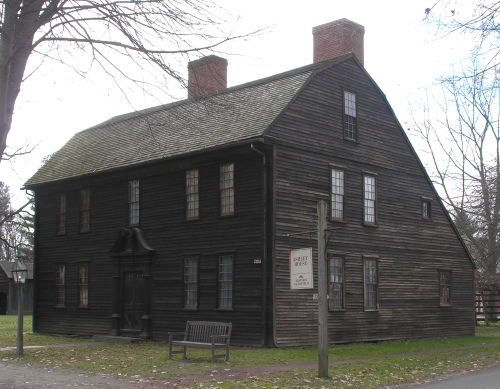
Rev. Jonathan Ashley was the second minister in Deerfield, serving from 1712 to 1780. He married Dorothy Williams, the daughter of the Rev. William Williams of Hatfield. Given a home lot in town, he constructed his house around 1734. Originally having a center chimney, the house was modified by Ashley in the 1750s into a center hallway home with a distinctive Connecticut River Valley doorway. As one of the elite Valley citizens known as “River Gods,” Ashley installed fine paneling in his home and furnished it with high style furniture. By the twentieth century, the house had been moved back on the lot and replaced with a nineteenth century Italianate style house. The former “mansion house” was now used as a tobacco barn. It was restored (the current doorway is a reproduction) and moved back to a position in the Street by the founders of Historic Deerfield, Henry and Helen Flynt. In 1948, the house became their first restoration opened to the public. It currently houses an extensive collection of Connecticut River Valley antiques.

John Nims House (1744)

by Dan/November 21, 2008September 17, 2016/Colonial, Deerfield, Houses

nims-house.jpg

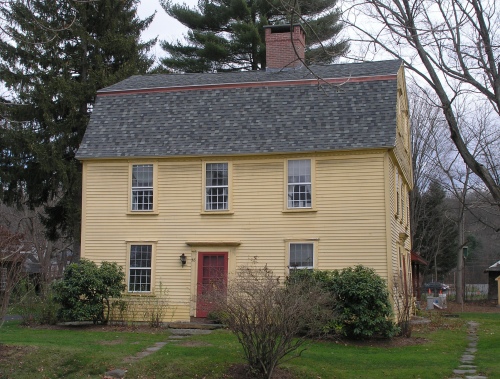
The ancestor of the Nims family in America, Godfrey Nims, a cordwainer, arrived in Deerfield around 1670. The current Nims House in Old Deerfield is the third to be built on the site. The first was constructed by Godfrey Nims around 1685. This house burned in the 1704 French and Indian raid and was rebuilt by John Nims in 1710. This second structure may have been added as an ell to the third and current house, built around 1744 (1740-1750) (this ell was significantly altered around 1808). The house served as a Post Office from 1816 to 1831. The property went out of the family in the 1890s, but was bought by two Nims descendants in 1936, who deeded it to Deerfield Academy in 1938. The house has since been used as a dormitory and faculty residence. There is HABS documentation on this house.

Posts navigation

Older posts
Newer posts
Privacy Policy

Categories

  • Architectural Style (943)
    • Art Deco (9)
    • Byzantine (3)
    • Colonial (177)
    • Colonial Revival (85)
    • Craftsman (6)
    • Egyptian Revival (1)
    • Federal (190)
    • Foursquare (6)
    • Gothic (67)
    • Greek Revival (100)
    • Italianate (82)
    • Mission Revival (2)
    • Mission/Spanish Colonial (1)
    • Modern (2)
    • Neoclassical (56)
    • Octagon (3)
    • Postmodern (1)
    • Queen Anne (46)
    • Renaissance Revival (26)
    • Romanesque Revival (53)
    • Second Empire (26)
    • Shingle Style (12)
    • Stick Style (13)
    • Tudor Revival (8)
    • Vernacular (49)
    • Victorian Eclectic (15)
  • Building Type (943)
    • Apartment Buildings (8)
    • Banks (18)
    • Churches (119)
    • Collegiate (32)
    • Commercial (102)
    • Hotels (16)
    • Houses (508)
    • Industrial (23)
    • Libraries (22)
    • Lighthouses (1)
    • Military (15)
    • Monuments (1)
    • Museums (12)
    • Organizations (39)
    • Outbuildings (17)
    • Public Buildings (50)
    • Schools (23)
    • Stations (5)
    • Synagogues (1)
    • Taverns (21)
    • Theaters (9)
  • Town (943)
    • Adams (11)
    • Agawam (4)
    • Amherst (50)
    • Boston (64)
    • Boylston (6)
    • Cambridge (30)
    • Clinton (21)
    • Concord (15)
    • Cummington (1)
    • Danvers (14)
    • Deerfield (31)
    • Gloucester (18)
    • Granville (10)
    • Great Barrington (2)
    • Hadley (9)
    • Hancock (15)
    • Harvard (32)
    • Holyoke (47)
    • Lenox (5)
    • Lexington (8)
    • Longmeadow (32)
    • Marblehead (40)
    • Marlborough (4)
    • Natick (22)
    • Newton (2)
    • Northampton (68)
    • Peabody (4)
    • Pittsfield (20)
    • Salem (110)
    • Saugus (4)
    • Sheffield (4)
    • South Hadley (8)
    • Southborough (8)
    • Southwick (4)
    • Springfield (67)
    • Stockbridge (19)
    • Stow (1)
    • Sturbridge (18)
    • Sudbury (7)
    • Waltham (11)
    • Watertown (1)
    • Wayland (8)
    • West Springfield (14)
    • Westfield (46)
    • Weston (2)
    • Worcester (26)
  • Uncategorized (1)

Recent Comments

  • Wilber Blackson on South Hadley
  • Tami Speiden on Stockbridge
  • DexGuru on Stockbridge

Tags

Alcott Amherst College Asher Benjamin Back Bay Baptist Beacon Hill Big E Black Heritage Trail bowfront Bulfinch Catholic Congregational Episcopal Freedom Trail Gambrel H.H. Richardson Harvard Hawthorne Historic Deerfield Isaac Damon lit Longfellow mansard Methodist Mount Holyoke Museum Museums NPS Old Sturbridge Village PEM Revolutionary War row houses saltbox Samuel McIntire Shakers Smith College SPNEA Springfield Armory Stephen C. Earle Storrowton Underground Railroad UU Washington William Fenno Pratt Witch Trials

Meta

  • Log in
  • Entries feed
  • Comments feed
  • WordPress.org
Proudly powered by WordPress | Theme: ShowMe by NEThemes.