Historic Buildings of Massachusetts

  • About
  • Index by Town
  • CT
  • About
  • Index by Town
  • CT

Tag: Beacon Hill

Charles Street Meeting House (1804)
by Dan/July 29, 2008/Boston, Churches, Federal

charles-street-meeting-house.jpg

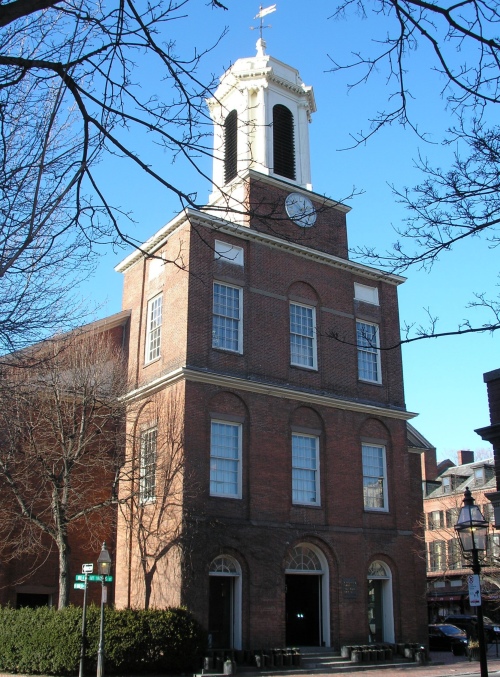
Designed by Asher Benjamin in 1804, the Charles Street Meeting House in Boston’s Beacon Hill neighborhood began as the Third Baptist Church of Boston (it was built on reclaimed land near the Charles River where baptisms could be performed). In the 1830s, abolitionist members, led by Timothy Gilbert, challenged the church’s segregationist seating arrangements and went on to found the integrated Tremont Temple Baptist Church. In the years before the Civil War, the church became a center of abolitionism, with many notable speakers addressing audiences there, including William Lloyd Garrison, Wendell Phillips, Frederick Douglass, Harriet Tubman and Sojourner Truth. From 1876 to 1939, the building was the African Methodist Episcopal Church. In 1920, the church was moved ten feet west to accommodate the widening of Charles Street. With the departure of the African-American community from the north slope of Beacon Hill, it served as an Albanian Orthodox Church and lastly a Unitarian Universalist Church to 1979. In the 1980s, the Charles Street Meeting House was converted to secular use as offices. The building is on the Black Heritage Trail.
Somerset Club (1819)

by Dan/July 25, 2008July 2, 2009/Boston, Federal, Houses

somerset-club.jpg

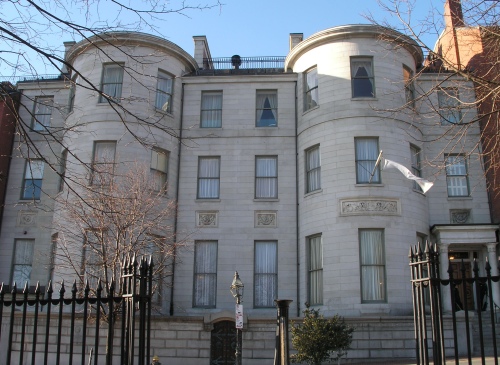
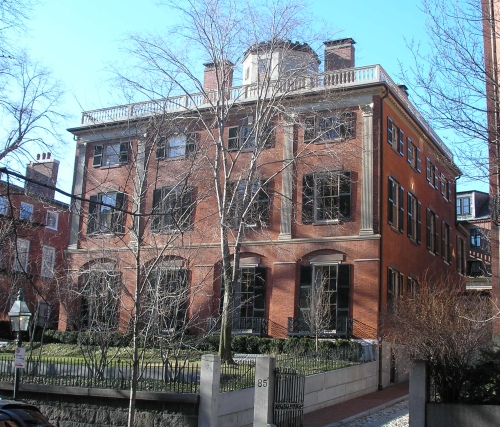
The home of David Sears, on Beacon Street in Boston, began as a 2-story bowfront house, built in 1816-1819 and designed by Alexander Parris. The left section of the house, featuring a second bowfront, was added by Sears in 1832, and in the 1830s, the house was the most expensive in Boston. The building has been home to the exclusive Somerset Club since 1872, when the third floor was added. Today, the house gives an impression of monumentality, with its large size and granite facade.

Second Harrison Gray Otis House (1802)

by Dan/June 8, 2008September 17, 2016/Boston, Federal, Houses

second-harrison-gray-otis-house.jpg

The only freestanding mansion on Boston’s Beacon Hill is the second of three houses designed by Charles Bulfinch for Harrison Gray Otis, a prominent businessman, lawyer and Federalist Party leader. Both Otis and Bulfinch were members of the Mount Vernon Proprietors, who purchased land on Beacon Hill for development. Bulfinch created an even more elegant mansion for Otis on Mount Vernon Street than the one he had created earlier, on Cambridge Street in 1796. Constructed between 1800 and 1802, Bulfinch hoped that the freestanding home on a landscaped property with outbuildings in back would be a model for the rest of Beacon Hill, but the neighborhood would end up being much more densely developed. Otis sold the house in 1806, only a few years after it was built: his growing family would require an even larger home, also to be designed by Bulfinch. Many people have owned the Second Harrison Gray Otis House over the years and undertaken various renovations and remodelings.

55-57 Mount Vernon Street, Boston (1804)

by Dan/May 6, 2008March 23, 2009/Boston, Federal, Greek Revival, Houses

002.jpg
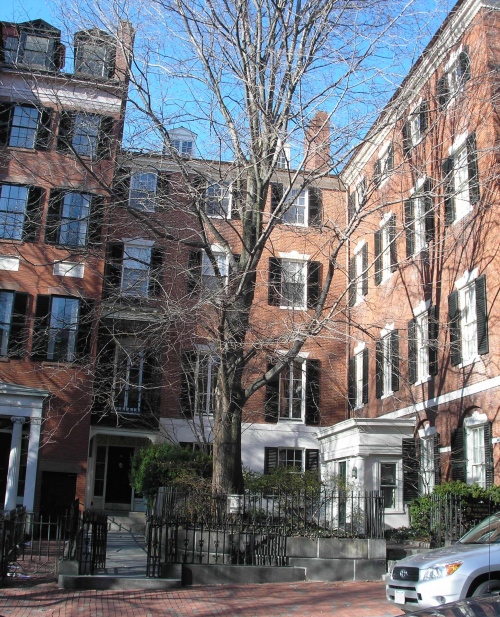
Left: 59 Mt. Vernon St.; Center: 57 Mt. Vernon St.;
Right: Nichols House Museum (55 Mt. Vernon St.);

Jonathan Mason, one of the Mount Vernon Proprietors (the group of real estate speculators who developed Boston’s Beacon Hill), commissioned the architect Charles Bulfinch to design a row of four houses (51-57 Mt. Vernon St.) for his daughters. Originally constructed in 1804, Nos. 55 & 57 both had side entrances on their west elevations, facing Mason’s mansion, which is no longer standing. In 1837, No. 59 (designed by Edward Shaw) was built to the west, blocking the entrance to No. 57, which was consequently moved to its current location on the front facade, facing Mt. Vernon St. Nos. 55-57 have had some notable residents.

Continue reading “55-57 Mount Vernon Street, Boston (1804)”

2-22 Louisburg Square (1835)

by Dan/April 7, 2008June 29, 2013/Boston, Greek Revival, Houses

louisburg-square.jpg

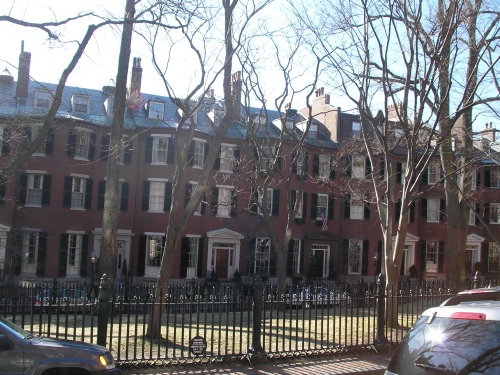
Located in the middle of Boston’s exclusive Beacon Hill neighborhood, Louisburg Square, planned in 1826, consists of a narrow park between Pinckney and Mt. Vernon Streets, which is now the last private square in Boston. By 1844, most of the Greek Revival-style row houses facing the square had been built and the Louisburg Square Proprietors formed the first homeowners association in the country. This was one of the last areas of Beacon Hill to be developed, but these new buildings honored the spirit of the Federal-style houses built elsewhere in the neighborhood earlier in the century. Those on the west side are mainly bow-fronted houses and have had a number of notable residents. It is still an exclusive neighborhood today. Read on for more about Louisa May Alcott, William Dean Howells and Jenny Lind.

Continue reading “2-22 Louisburg Square (1835)”

Posts navigation

Newer posts
Privacy Policy

Categories

  • Architectural Style (943)
    • Art Deco (9)
    • Byzantine (3)
    • Colonial (177)
    • Colonial Revival (85)
    • Craftsman (6)
    • Egyptian Revival (1)
    • Federal (190)
    • Foursquare (6)
    • Gothic (67)
    • Greek Revival (100)
    • Italianate (82)
    • Mission Revival (2)
    • Mission/Spanish Colonial (1)
    • Modern (2)
    • Neoclassical (56)
    • Octagon (3)
    • Postmodern (1)
    • Queen Anne (46)
    • Renaissance Revival (26)
    • Romanesque Revival (53)
    • Second Empire (26)
    • Shingle Style (12)
    • Stick Style (13)
    • Tudor Revival (8)
    • Vernacular (49)
    • Victorian Eclectic (15)
  • Building Type (943)
    • Apartment Buildings (8)
    • Banks (18)
    • Churches (119)
    • Collegiate (32)
    • Commercial (102)
    • Hotels (16)
    • Houses (508)
    • Industrial (23)
    • Libraries (22)
    • Lighthouses (1)
    • Military (15)
    • Monuments (1)
    • Museums (12)
    • Organizations (39)
    • Outbuildings (17)
    • Public Buildings (50)
    • Schools (23)
    • Stations (5)
    • Synagogues (1)
    • Taverns (21)
    • Theaters (9)
  • Town (943)
    • Adams (11)
    • Agawam (4)
    • Amherst (50)
    • Boston (64)
    • Boylston (6)
    • Cambridge (30)
    • Clinton (21)
    • Concord (15)
    • Cummington (1)
    • Danvers (14)
    • Deerfield (31)
    • Gloucester (18)
    • Granville (10)
    • Great Barrington (2)
    • Hadley (9)
    • Hancock (15)
    • Harvard (32)
    • Holyoke (47)
    • Lenox (5)
    • Lexington (8)
    • Longmeadow (32)
    • Marblehead (40)
    • Marlborough (4)
    • Natick (22)
    • Newton (2)
    • Northampton (68)
    • Peabody (4)
    • Pittsfield (20)
    • Salem (110)
    • Saugus (4)
    • Sheffield (4)
    • South Hadley (8)
    • Southborough (8)
    • Southwick (4)
    • Springfield (67)
    • Stockbridge (19)
    • Stow (1)
    • Sturbridge (18)
    • Sudbury (7)
    • Waltham (11)
    • Watertown (1)
    • Wayland (8)
    • West Springfield (14)
    • Westfield (46)
    • Weston (2)
    • Worcester (26)
  • Uncategorized (1)

Recent Comments

  • Wilber Blackson on South Hadley
  • Tami Speiden on Stockbridge
  • DexGuru on Stockbridge

Tags

Alcott Amherst College Asher Benjamin Back Bay Baptist Beacon Hill Big E Black Heritage Trail bowfront Bulfinch Catholic Congregational Episcopal Freedom Trail Gambrel H.H. Richardson Harvard Hawthorne Historic Deerfield Isaac Damon lit Longfellow mansard Methodist Mount Holyoke Museum Museums NPS Old Sturbridge Village PEM Revolutionary War row houses saltbox Samuel McIntire Shakers Smith College SPNEA Springfield Armory Stephen C. Earle Storrowton Underground Railroad UU Washington William Fenno Pratt Witch Trials

Meta

  • Log in
  • Entries feed
  • Comments feed
  • WordPress.org
Proudly powered by WordPress | Theme: ShowMe by NEThemes.