Historic Buildings of Massachusetts

  • About
  • Index by Town
  • CT
  • About
  • Index by Town
  • CT

Tag: Revolutionary War

Faneuil Hall (1742)

by Dan/July 4, 2008/Boston, Colonial, Public Buildings

faneuil-hall.jpg

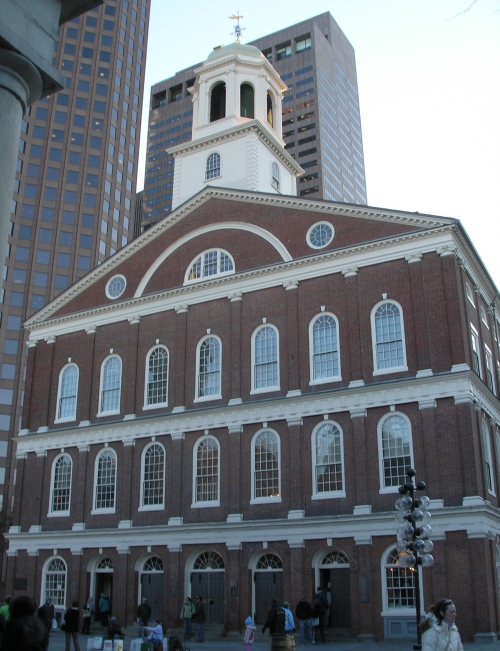
Peter Faneuil was a Boston merchant whose parents were Huguenots. In 1740, he proposed donating a market building to the town, with a marketplace below and a public meeting hall above. The original Faneuil Hall, completed in 1742, was designed by the Scottish artist John Smibert. After the building suffered in a fire in 1761, it was rebuilt the following year. The building now entered the period when it would become known as “The Cradle of Liberty.” James Otis dedicated the meeting room to the “Cause of Liberty” and it was here that the many important gatherings protesting British taxes on the colonies were held, under the leadership of such patriots as Samuel Adams and John Hancock. After the Boston Tea Party, the British closed the building to public meetings and it was used to garrison soldiers.

After the Revolutionary War, Faneuil Hall was rebuilt and enlarged in 1806 by Charles Bulfinch, who retained its colonial style, but increased its width, added a third floor and enclosed the ground floor’s open market arcades. He also added galleries to the meeting hall, which, as Peter Faneuil had requested, has continued to be used for public forums. Over the years it has heard abolitionists, suffragists and political candidates. The third floor, now a museum, is the armory of the Ancient and Honorable Artillery Company of Massachusetts, the oldest military organization in the United States which has had its headquarters in Faneuil Hall since 1746. Faneuil Hall also has a distinctive copper gilt Grasshopper weather vane, made by the artisan Shem Drowne. It was stolen, but found a few days later in 1974. In 1898-1899, the building was rebuilt using noncombustible materials. Faneuil Hall, together with the neighboring Quincy Market, is now part of the Faneuil Hall Marketplace. It is also on Boston’s Freedom Trail.
Old State House (1713)

by Dan/June 23, 2008January 19, 2020/Boston, Colonial, Public Buildings

old-state-house-01.jpg

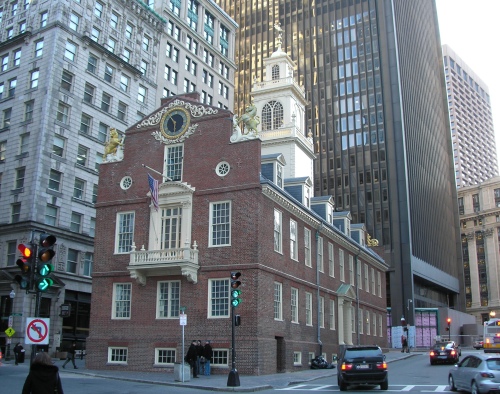
Since the 1630s, what would become the site of the Old State House in Boston was where the Puritans’ stocks and whipping posts were located and where the town’s earliest market was held. A wood Town House was built there in 1657, which had an open air market on the ground floor and a meeting place above. After this structure burned down in 1711, a new brick one was built in 1713, although the interior was gutted by fire in 1747 and had to be restored afterwards. This historic structure at the head of State Street, which became the seat of British Royal government in Massachusetts, was the site of many significant events: James Otis‘ speech against the writs of assistance in 1761; the March 5, 1770 Boston Massacre, which occurred just in front of the building; the first reading for Bostonians of the Declaration of Independence by Col. Thomas Crafts from the east balcony on July 18, 1776 (at which time the people torn down from the building the original royal lion and unicorn to be consigned to a bonfire); and the 1789 visit of President George Washington. After the Revolutionary War, it continued to serve as the State House until 1798, when it was given to the town in exchange for a new State House site on Beacon Hill. In 1830, it was altered by architect Isaiah Rogers in the Classical Revival style to serve as a City Hall until 1841. After that, it began a long decline. Housing offices and shops, the exterior was covered with advertisements. There were thoughts of demolishing it to widen the street and Chicagoans even offered to move it to Illinois! In 1882, it was eventually restored (with replicas of the old lion and unicorn) and rededicated as a museum, run by the Bostonian Society. A more recent restoration was completed by Goody, Clancy & Associates in 1991. The building is part of the Boston Freedom Trail. See below for more pictures of the Old State House:

Continue reading “Old State House (1713)”

Benjamin Wadsworth House (1726)

by Dan/June 8, 2008September 17, 2016/Cambridge, Colonial, Houses

benjamin-wadsworth-house.jpg

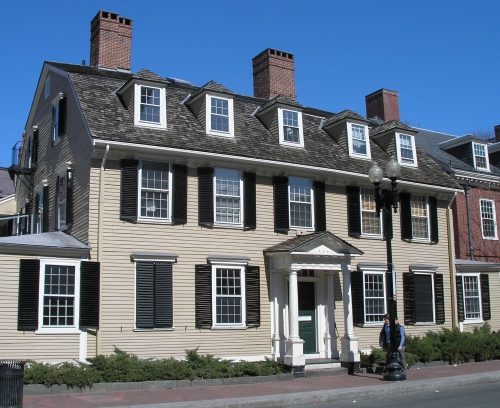
In 1726, a house was constructed on Massachusetts Avenue in Cambridge, on the site where Harvard’s earliest building, the Peyntree House, had stood. It was first occupied by Harvard’s fourth president, Benjamin Wadsworth, his family and two slaves. After Wadsworth, it would serve as the home of eight other presidents, until 1849, when president Jared Sparks chose to reside in his own Cambridge home. During the Revolutionary War, the house was Washington’s first headquarters when he came to command the army during the siege of Boston in 1775. Do to its state of disrepair at the time, Washington soon moved to other quarters. Over the years, the house would serve as lodging for visiting ministers and student boarders (including Ralph Waldo Emerson). The building now houses the Office of the University Marshal and other offices. The Wadsworth House lost its front yard when Massachusetts Avenue was widened. Today it is the second oldest of Harvard’s surviving buildings, after Massachusetts Hall.

The Old Manse (1770)

by Dan/April 6, 2008June 29, 2013/Colonial, Concord, Houses

old-manse.JPG

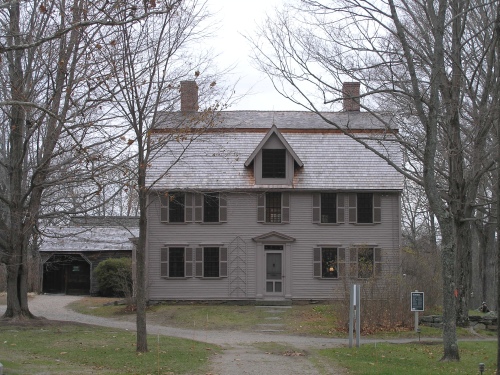
The famous house in Concord known as the “Old Manse,” has associations with the Revolutionary War and with two of America’s greatest literary figures. It was built in 1770 as a “manse”, or parsonage, for the town’s minister, William Emerson. Emerson was there, on April 19, 1775, when the Revolutionary War began at the Old North Bridge, located just behind the Manse property (and now part of Minute Man National Historical Park). Emerson went on to serve as a chaplain with the Continental Army, but died of a fever in October 1776, during the Fort Ticonderoga Expedition. In 1778, Ezra Ripley became Concord’s new minister. He boarded at the Old Manse and in 1780 married William Emerson’s widow, Phebe Bliss Emerson. William Emerson’s son, also named William, became a minister. His son was the famous Transcendentalist, Ralph Waldo Emerson, who lived in the Old Manse, his ancestral home, from 1834-1835, before purchasing his own house in Concord. It was during his residence in the Old Manse that Emerson wrote the first draft of his classic work, Nature.

Ezra Ripley died in 1841 and from 1842 to 1845, the Old Manse was rented by Nathaniel Hawthorne and his new wife, Sophia Peabody. It was during this period that Hawthorne would write many of the stories featured in his collection, Mosses from an Old Manse, including his introductory description of the Old Manse that would help make the building famous. In 1846, the Hawthorne’s left the Manse because Ezra Ripley’s son, Samuel Ripley, returned to live in his childhood home, although he died the following year. His wife, Sarah Alden Bradford Ripley, who had mastered numerous subjects and seven languages, lived on for another two decades, exchanging views with many of the intellectual leaders of the times. She lived through the Civil War, which claimed the life of her younger son, Lt. Ezra Ripley.

When Sarah and Samuel Ripley’s granddaughter, Sarah Ripley Thayer Ames, died in 1939, according to her wishes the house and its contents were sold to The Trustees of Reservations. The Old Manse is now a museum where visitors can tour this National Historic Landmark.

Vassall-Craigie-Longfellow House (1759)

by Dan/March 30, 2008September 17, 2016/Cambridge, Colonial, Houses

vassall_craigie_longfellow_house.JPG

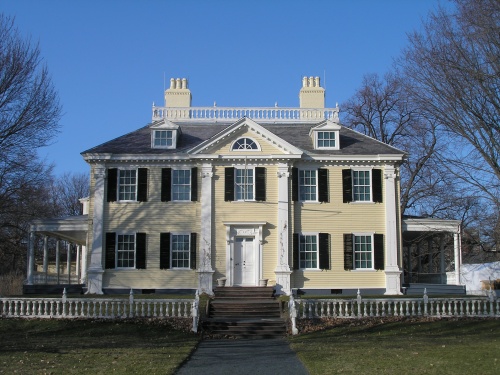
The Vassall-Craigie-Longfellow House has important associations with both the Revolutionary War and nineteenth century American literature. This impressive Georgian-style mansion was built in 1759 by Maj. John Vassall on what is now Brattle Street in Cambridge. The area was known as Tory Row because of the many houses built there by loyalists, like Vassall. When anti-Tory sentiment rose during the outbreak of the Revolutionary War in 1774, Vassall and his wife, who was the sister of the royal lieutenant governor of Massachusetts, fled to Boston and eventually left for England. The abandoned house was occupied by the Marblehead Regiment in 1775 and then became the headquarters of General George Washington from July 1775 to April 1776 (during the Siege of Boston).

After the war, the house came into the possession of Andrew Craigie, who had been the Continental Army’s first Apothecary General. He added porches to the sides of the house and an extension on the back. When he died, in 1819, he left his wife, Elizabeth in debt. Over the next two decades, she would take in boarders to make ends meet, including many Harvard students. In 1837, one of her boarders was Henry Wadsworth Longfellow, then a professor of modern languages at Harvard. In 1843, when Longfellow married Fanny Appleton, her father, the wealthy industrialist Nathan Appleton, acquired the house to give the newlyweds as a wedding gift. Longfellow would live there until his death in 1882, passing the property on to his children. His daughter, Alice Longfellow, later commissioned a new garden in the Colonial Revival style.

In 1913, his surviving children established the Longfellow House Trust to preserve the house as a monument to their father and George Washington, as well as to Georgian architecture. In 1962, the house became a National Historic Landmark and the Trust donated it to the National Park Service and it is today open to the public as the Longfellow National Historic Site.

Posts navigation

Newer posts
Privacy Policy

Categories

  • Architectural Style (943)
    • Art Deco (9)
    • Byzantine (3)
    • Colonial (177)
    • Colonial Revival (85)
    • Craftsman (6)
    • Egyptian Revival (1)
    • Federal (190)
    • Foursquare (6)
    • Gothic (67)
    • Greek Revival (100)
    • Italianate (82)
    • Mission Revival (2)
    • Mission/Spanish Colonial (1)
    • Modern (2)
    • Neoclassical (56)
    • Octagon (3)
    • Postmodern (1)
    • Queen Anne (46)
    • Renaissance Revival (26)
    • Romanesque Revival (53)
    • Second Empire (26)
    • Shingle Style (12)
    • Stick Style (13)
    • Tudor Revival (8)
    • Vernacular (49)
    • Victorian Eclectic (15)
  • Building Type (943)
    • Apartment Buildings (8)
    • Banks (18)
    • Churches (119)
    • Collegiate (32)
    • Commercial (102)
    • Hotels (16)
    • Houses (508)
    • Industrial (23)
    • Libraries (22)
    • Lighthouses (1)
    • Military (15)
    • Monuments (1)
    • Museums (12)
    • Organizations (39)
    • Outbuildings (17)
    • Public Buildings (50)
    • Schools (23)
    • Stations (5)
    • Synagogues (1)
    • Taverns (21)
    • Theaters (9)
  • Town (943)
    • Adams (11)
    • Agawam (4)
    • Amherst (50)
    • Boston (64)
    • Boylston (6)
    • Cambridge (30)
    • Clinton (21)
    • Concord (15)
    • Cummington (1)
    • Danvers (14)
    • Deerfield (31)
    • Gloucester (18)
    • Granville (10)
    • Great Barrington (2)
    • Hadley (9)
    • Hancock (15)
    • Harvard (32)
    • Holyoke (47)
    • Lenox (5)
    • Lexington (8)
    • Longmeadow (32)
    • Marblehead (40)
    • Marlborough (4)
    • Natick (22)
    • Newton (2)
    • Northampton (68)
    • Peabody (4)
    • Pittsfield (20)
    • Salem (110)
    • Saugus (4)
    • Sheffield (4)
    • South Hadley (8)
    • Southborough (8)
    • Southwick (4)
    • Springfield (67)
    • Stockbridge (19)
    • Stow (1)
    • Sturbridge (18)
    • Sudbury (7)
    • Waltham (11)
    • Watertown (1)
    • Wayland (8)
    • West Springfield (14)
    • Westfield (46)
    • Weston (2)
    • Worcester (26)
  • Uncategorized (1)

Recent Comments

  • Wilber Blackson on South Hadley
  • Tami Speiden on Stockbridge
  • DexGuru on Stockbridge

Tags

Alcott Amherst College Asher Benjamin Back Bay Baptist Beacon Hill Big E Black Heritage Trail bowfront Bulfinch Catholic Congregational Episcopal Freedom Trail Gambrel H.H. Richardson Harvard Hawthorne Historic Deerfield Isaac Damon lit Longfellow mansard Methodist Mount Holyoke Museum Museums NPS Old Sturbridge Village PEM Revolutionary War row houses saltbox Samuel McIntire Shakers Smith College SPNEA Springfield Armory Stephen C. Earle Storrowton Underground Railroad UU Washington William Fenno Pratt Witch Trials

Meta

  • Log in
  • Entries feed
  • Comments feed
  • WordPress.org
Proudly powered by WordPress | Theme: ShowMe by NEThemes.