Historic Buildings of Massachusetts

  • About
  • Index by Town
  • CT
  • About
  • Index by Town
  • CT

Tag: Revolutionary War

Frary House (1760) and Barnard Tavern (1795)
by Dan/February 26, 2009September 17, 2016/Colonial, Deerfield, Houses, Taverns

frary-house-barnard-tavern.jpg

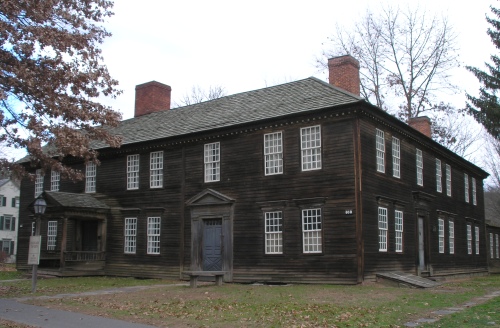
In 1890, Miss Charlotte Alice Baker purchased a colonial home in Deerfield and, assisted by the architectural firm of Shepley, Rutan & Coolidge, restored it in 1892 in one of the earliest efforts at historic preservation in Western Massachusetts. Baker also furnished the home in line with the ideas of the Colonial Revival and Arts and Crafts movements. At the time, the house was believed to have been built by the original Deerfield settler, Samson Frary, who owned the lot and built a house on it sometime after 1683. Frary was killed during the famous 1704 French and Indian Raid on Deerfield. C. Alice Baker, who was a descendant of Samson Frary, did research on the Deerfield captives and wrote a book called True Stories of New England Captives Carried to Canada During the Old French and Indian Wars (1897). She also wrote A Summer in the Azores (1882). Baker’s lifelong companion, Miss Susan Lane, died in 1893 and Miss Baker died in 1909.

The Frary House, now believed to have been built sometime in the late 1750s, is currently owned by Historic Deerfield. The Barnard Tavern is an addition to the Frary House, constructed in 1795. The home had been sold from the Frary to the Barnard families in 1752. With a large second-floor meeting room, the tavern was one of the centers of village life. At the Tavern’s bar, in 1775, Col. Benedict Arnold closed a contract to supply the expedition against Fort Ticonderoga. Recent research, though, suggests that the building may not have served the full functions of a tavern. Archeological work is also planned for the site.
King’s Chapel, Boston (1749)

by Dan/January 24, 2009March 24, 2009/Boston, Churches, Colonial

kings-chapel.jpg

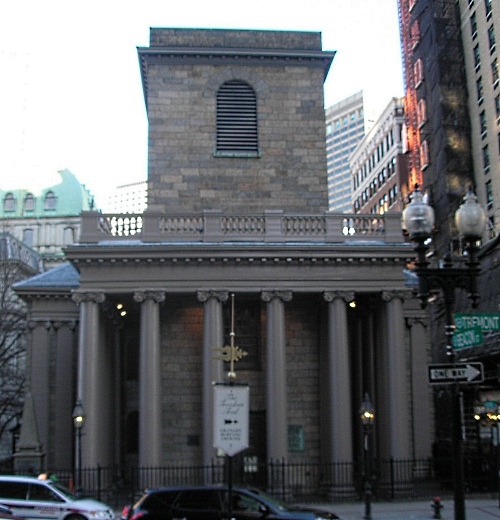
King’s Chapel, originally founded to serve British officers, was the first Anglican church in Puritan Boston. The Chapel‘s first building was a wood structure, built in 1686 on land that had been part of the town’s oldest burying ground. The current Chapel, built of Quincy granite, was constructed around the old one in 1749-1754 (the dismantled remains of the old church were then removed through the windows). The architect was Peter Harrison, of Newport, RI, considered to be America’s “first architect,” who modeled the Georgian-style building on those designed by James Gibbs in England, like St. Martin in the Fields in London, except the steeple of King’s Chapel was never built due to a lack of funds. When the British evacuated Boston during the Revolutionary War, there were few Anglican families remaining in town. James Freeman, a lay reader, became minister in 1783 and led Stone Chapel (as King’s Chapel had come to be called) to become America’s first Unitarian church in 1789 (although the congregation continued to follow a liturgy based on the Book of Common Prayer). That same year, George Washington attended an oratorio at the Chapel intended to raise funds for the construction of a portico of wood Ionic columns, painted to resemble stone. When the Chapel’s bell cracked in 1814, it was recast by Paul Revere. Both the Chapel and the adjacent King’s Chapel Burying Ground are on the Boston Freedom Trail.

Concord’s Colonial Inn (1716)

by Dan/January 12, 2009January 12, 2009/Colonial, Concord, Hotels, Houses

colonial-inn.jpg

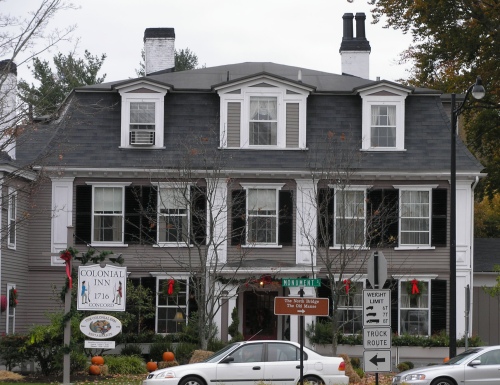
The Colonial Inn in Concord is on Monument Square. The Inn consists of three connected structures. The original East House (above), was built sometime before 1716 by Captain James Minot and deeded in that year to his son, James, Jr. The house passed to James Jr.’s son, Ephraim, and then to a cousin, Dr. Timothy Minot, Jr., a physician who tended to the wounded on April 19,1775. Some time in early 1770s, the Central Building (below) was constructed, which was used as a storehouse during the Revolution. This structure was purchased by Deacon John White in 1780 to use as a store (he added the second floor). In 1789, Dr. Minot sold the East House to Ammi White, his son-in-law and a cabinet-maker, who had killed a wounded British soldier with an axe on April 19, 1775. The very next year, White sold the house to John Thoreau, grandfather of Henry David Thoreau. John Thoreau’s wife, Rebecca Kettel, was the sister of the Deacon’s wife. Around 1820, Deacon White built the West House onto the end of his store and the eventually both the house and store was acquired by his partner, Daniel Shattuck. The young Henry David Thoreau lived in the East House with his family and his aunts from 1835 to 1837. Shattuck acquired the East House in 1839, which was leased to various tenants over the years. By the 1850s, the Central Building had become a boarding house and was then attached to the East House to become the Thoreau House hotel. Around 1900, the West House was attached to the Central Building and the entire structure became known as the Colonial Inn.
Continue reading “Concord’s Colonial Inn (1716)”

Old South Meeting House (1729)

by Dan/December 19, 2008March 29, 2013/Boston, Churches, Colonial

old-south-church.jpg

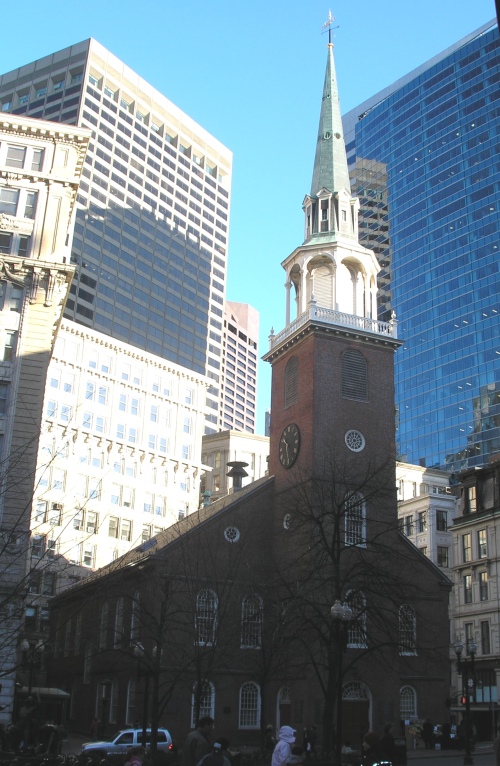
Built in 1729, Boston’s Old South Meeting House was the largest building in the colonial town. The congregation began in 1669, when it separated from Boston’s First Church (becoming the Third Church of Boston). In the years immediately preceding the outbreak of the American Revolution, citizens would gather in the Old South Meeting House to debate and argue in the aftermath of events like the Boston Massacre. On the night of December 16, 1773, over 5,000 colonists, angered over the tax on tea, met at Old South and after hours of debate, Samuel Adams gave a secret signal which began the famous Boston Tea Party. During the war, occupying British troops took revenge for the Tea Party by ripping out the church‘s pews and using the building as a riding stable. They also set up a bar on the first balcony. The church continued to be used as a house of worship, but after it was nearly destroyed in the Great Boston Fire of 1872, the congregation built the New Old South Church at Copley Square. In danger of being torn down, pioneering preservation efforts led to the restoration of the building, which has been a museum and historic site since 1877. It is also a stop on the Boston Freedom Trail. The steeple has been replaced twice, after storms in 1804 and 1954.

Henry Vassall House (1746)

by Dan/December 1, 2008/Cambridge, Colonial, Houses

henry-vassall-house.jpg

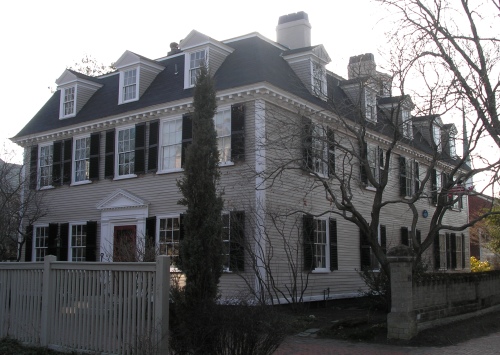
The oldest part of the Henry Vassall House, on Brattle Street in Cambridge, may date to as early as 1636, although the date usually given today is 1746. In that year, the property was sold by John Vassall Sr., who had purchased it in 1737, to his younger brother Henry Vassall. John Vassall’s son, Maj. John Vassall, built the nearby Vassall-Craigie-Longfellow House. Henry Vassall was a loyalist at the time of the Revolutionary War and the Vassall House is one of several homes belonging to loyalists along the section of Brattle Street known as Tory Row. These homes were either sold by their owners or seized during the Revolution. Vassall had died in 1769 and in 1775, his widow, Penelope Royall Vassall, fled to Boston and then to her estates in Antigua. According to the Historic Guide to Cambridge (1907):

“Just before sailing Madam Vassall petitioned the Provincial Congress, then sitting at Watertown, that she might be allowed to take with her some of her effects. Congress permitted her to take anything that she wanted except “provisions and her medicine chest.” The estate was not confiscated, as it belonged to a widow who had taken no active part against the patriots.”

The Continental Army at the time had only one other medicine chest besides the one in the Vassall House. “From these two all the regimental surgeons had to supply their needs. The fact that the medicines were here, and that there were twenty available rooms, besides halls and out-houses, may have been the reason that this house became the medical headquarters.” In 1775, Dr. Benjamin Church, who was effectively the first Surgeon General of the U.S. Army, was found to be sending secret letters to the British Commander, General Thomas Gage. Convicted of “communicating with the enemy,” Dr. Church was held for a time in the Vassall House as a prisoner. The house has remained a private home, with a number of alterations and additions being made to it over the years.

Sycamores (1788)

by Dan/November 20, 2008/Colonial, Houses, South Hadley

sycamores.jpg

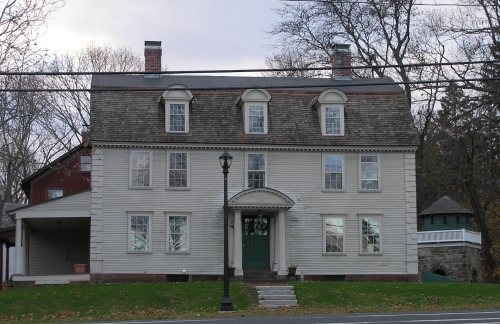
Colonel Benjamin Ruggles Woodbridge, of South Hadley, was a physician, merchant, entrepreneur and politician, who led a regiment at Bunker Hill and was a representative to the General Court. In 1788, Col. Woodbridge built his house on Woodbridge Street in South Hadley. After his death, in 1819, the house became the Woodbridge Scientific School for boys. It was later owned by the Montague family and was purchased, in 1900, by Rose Hollingsworth, who had the (recently restored) Water Tower on the property constructed. For much of the twentieth century, the house served as a dormitory for students at Mount Holyoke College. Having fallen into disrepair, in 1996 it was purchased by the Sycamores Committee of the South Hadley Historical Society, who are restoring the house to become a museum. In 2004, the 1733 Rawson House, home of South Hadley‘s first minister, Grindall Rawson, which originally stood on the Sycamores property, was donated to the Sycamore Committee. It was then moved to its current location, attached to Sycamore‘s rear ell.

John Hicks House (1762)

by Dan/July 25, 2008January 20, 2020/Cambridge, Colonial, Houses

john-hicks-house.jpg

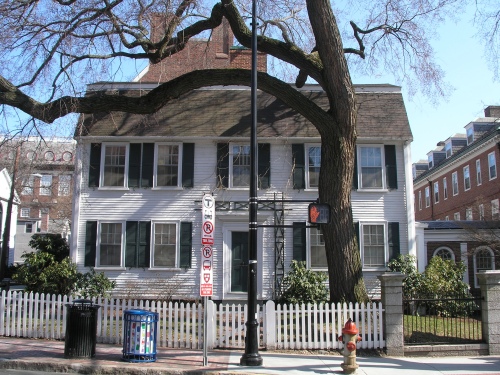
Originally located on Dunster and Winthrop in Cambridge, the 1762 John Hicks House was later moved to its current address on John F. Kennedy Street to become the library of Harvard University‘s Kirkland House. A historic marker in front of the house explains that it was the home of John Hicks, who was killed by British soldiers in 1775. He was killed near the junction of North avenue and Spruce Street by the retreating British on April 19, 1775. The marker also indicates that the house was used by General Putnam as his office during the Revolutionary War. In 1773, the house was purchased by John Foxcroft. A car crashed into the house in 2006.

Posts navigation

Older posts
Newer posts
Privacy Policy

Categories

  • Architectural Style (943)
    • Art Deco (9)
    • Byzantine (3)
    • Colonial (177)
    • Colonial Revival (85)
    • Craftsman (6)
    • Egyptian Revival (1)
    • Federal (190)
    • Foursquare (6)
    • Gothic (67)
    • Greek Revival (100)
    • Italianate (82)
    • Mission Revival (2)
    • Mission/Spanish Colonial (1)
    • Modern (2)
    • Neoclassical (56)
    • Octagon (3)
    • Postmodern (1)
    • Queen Anne (46)
    • Renaissance Revival (26)
    • Romanesque Revival (53)
    • Second Empire (26)
    • Shingle Style (12)
    • Stick Style (13)
    • Tudor Revival (8)
    • Vernacular (49)
    • Victorian Eclectic (15)
  • Building Type (943)
    • Apartment Buildings (8)
    • Banks (18)
    • Churches (119)
    • Collegiate (32)
    • Commercial (102)
    • Hotels (16)
    • Houses (508)
    • Industrial (23)
    • Libraries (22)
    • Lighthouses (1)
    • Military (15)
    • Monuments (1)
    • Museums (12)
    • Organizations (39)
    • Outbuildings (17)
    • Public Buildings (50)
    • Schools (23)
    • Stations (5)
    • Synagogues (1)
    • Taverns (21)
    • Theaters (9)
  • Town (943)
    • Adams (11)
    • Agawam (4)
    • Amherst (50)
    • Boston (64)
    • Boylston (6)
    • Cambridge (30)
    • Clinton (21)
    • Concord (15)
    • Cummington (1)
    • Danvers (14)
    • Deerfield (31)
    • Gloucester (18)
    • Granville (10)
    • Great Barrington (2)
    • Hadley (9)
    • Hancock (15)
    • Harvard (32)
    • Holyoke (47)
    • Lenox (5)
    • Lexington (8)
    • Longmeadow (32)
    • Marblehead (40)
    • Marlborough (4)
    • Natick (22)
    • Newton (2)
    • Northampton (68)
    • Peabody (4)
    • Pittsfield (20)
    • Salem (110)
    • Saugus (4)
    • Sheffield (4)
    • South Hadley (8)
    • Southborough (8)
    • Southwick (4)
    • Springfield (67)
    • Stockbridge (19)
    • Stow (1)
    • Sturbridge (18)
    • Sudbury (7)
    • Waltham (11)
    • Watertown (1)
    • Wayland (8)
    • West Springfield (14)
    • Westfield (46)
    • Weston (2)
    • Worcester (26)
  • Uncategorized (1)

Recent Comments

  • Wilber Blackson on South Hadley
  • Tami Speiden on Stockbridge
  • DexGuru on Stockbridge

Tags

Alcott Amherst College Asher Benjamin Back Bay Baptist Beacon Hill Big E Black Heritage Trail bowfront Bulfinch Catholic Congregational Episcopal Freedom Trail Gambrel H.H. Richardson Harvard Hawthorne Historic Deerfield Isaac Damon lit Longfellow mansard Methodist Mount Holyoke Museum Museums NPS Old Sturbridge Village PEM Revolutionary War row houses saltbox Samuel McIntire Shakers Smith College SPNEA Springfield Armory Stephen C. Earle Storrowton Underground Railroad UU Washington William Fenno Pratt Witch Trials

Meta

  • Log in
  • Entries feed
  • Comments feed
  • WordPress.org
Proudly powered by WordPress | Theme: ShowMe by NEThemes.