Historic Buildings of Massachusetts

  • About
  • Index by Town
  • CT
  • About
  • Index by Town
  • CT

Tag: lit

2-22 Louisburg Square (1835)
by Dan/April 7, 2008June 29, 2013/Boston, Greek Revival, Houses

louisburg-square.jpg

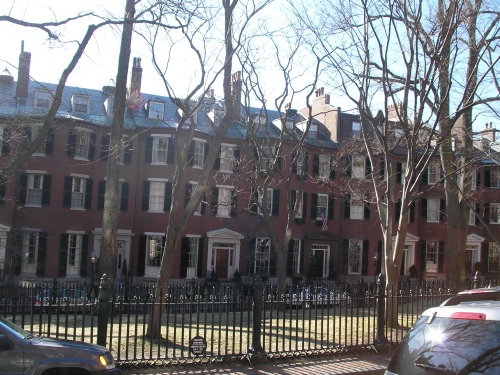
Located in the middle of Boston’s exclusive Beacon Hill neighborhood, Louisburg Square, planned in 1826, consists of a narrow park between Pinckney and Mt. Vernon Streets, which is now the last private square in Boston. By 1844, most of the Greek Revival-style row houses facing the square had been built and the Louisburg Square Proprietors formed the first homeowners association in the country. This was one of the last areas of Beacon Hill to be developed, but these new buildings honored the spirit of the Federal-style houses built elsewhere in the neighborhood earlier in the century. Those on the west side are mainly bow-fronted houses and have had a number of notable residents. It is still an exclusive neighborhood today. Read on for more about Louisa May Alcott, William Dean Howells and Jenny Lind.
Continue reading “2-22 Louisburg Square (1835)”

The Old Manse (1770)

by Dan/April 6, 2008June 29, 2013/Colonial, Concord, Houses

old-manse.JPG

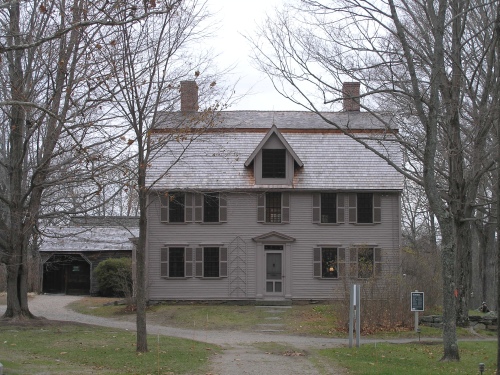
The famous house in Concord known as the “Old Manse,” has associations with the Revolutionary War and with two of America’s greatest literary figures. It was built in 1770 as a “manse”, or parsonage, for the town’s minister, William Emerson. Emerson was there, on April 19, 1775, when the Revolutionary War began at the Old North Bridge, located just behind the Manse property (and now part of Minute Man National Historical Park). Emerson went on to serve as a chaplain with the Continental Army, but died of a fever in October 1776, during the Fort Ticonderoga Expedition. In 1778, Ezra Ripley became Concord’s new minister. He boarded at the Old Manse and in 1780 married William Emerson’s widow, Phebe Bliss Emerson. William Emerson’s son, also named William, became a minister. His son was the famous Transcendentalist, Ralph Waldo Emerson, who lived in the Old Manse, his ancestral home, from 1834-1835, before purchasing his own house in Concord. It was during his residence in the Old Manse that Emerson wrote the first draft of his classic work, Nature.

Ezra Ripley died in 1841 and from 1842 to 1845, the Old Manse was rented by Nathaniel Hawthorne and his new wife, Sophia Peabody. It was during this period that Hawthorne would write many of the stories featured in his collection, Mosses from an Old Manse, including his introductory description of the Old Manse that would help make the building famous. In 1846, the Hawthorne’s left the Manse because Ezra Ripley’s son, Samuel Ripley, returned to live in his childhood home, although he died the following year. His wife, Sarah Alden Bradford Ripley, who had mastered numerous subjects and seven languages, lived on for another two decades, exchanging views with many of the intellectual leaders of the times. She lived through the Civil War, which claimed the life of her younger son, Lt. Ezra Ripley.

When Sarah and Samuel Ripley’s granddaughter, Sarah Ripley Thayer Ames, died in 1939, according to her wishes the house and its contents were sold to The Trustees of Reservations. The Old Manse is now a museum where visitors can tour this National Historic Landmark.

Orchard House (1675)

by Dan/April 3, 2008June 29, 2013/Colonial, Concord, Houses

orchard-house.JPG

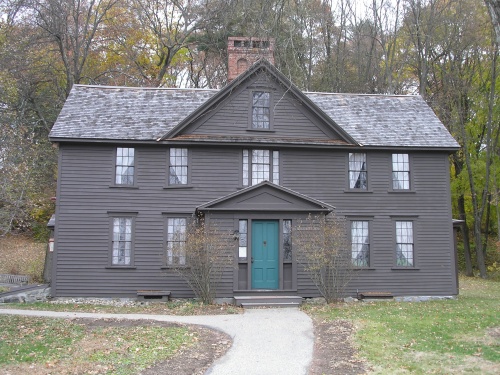
Orchard House is a home that many visitors feel they know before they even visit it. In 1857-8, Bronson Alcott, the Transcendentalist reformer and educator, purchased and combined two early eighteenth century houses, adding the smaller of the two to the rear of the main house and making many alterations to his new home. He named it “Orchard House” due to the property’s 12 acres of apple orchards. Alcott and his family made Orchard House their permanent home from 1858 to 1877. The house owes its greatest fame to fact that it was here, in 1868, that Bronson’s daughter, Louisa May Alcott, wrote the classic Little Women, loosely based on her own family. The house is now a museum, where visitors can learn about Alcott and see the room where Louisa wrote the famous book.

Vassall-Craigie-Longfellow House (1759)

by Dan/March 30, 2008September 17, 2016/Cambridge, Colonial, Houses

vassall_craigie_longfellow_house.JPG

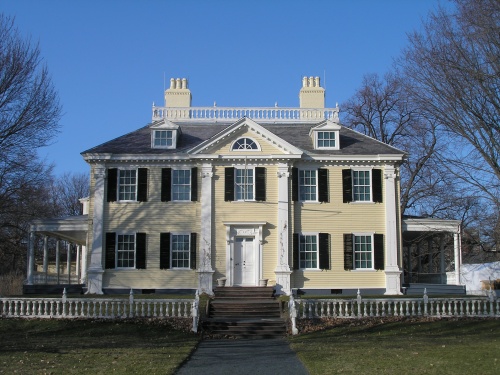
The Vassall-Craigie-Longfellow House has important associations with both the Revolutionary War and nineteenth century American literature. This impressive Georgian-style mansion was built in 1759 by Maj. John Vassall on what is now Brattle Street in Cambridge. The area was known as Tory Row because of the many houses built there by loyalists, like Vassall. When anti-Tory sentiment rose during the outbreak of the Revolutionary War in 1774, Vassall and his wife, who was the sister of the royal lieutenant governor of Massachusetts, fled to Boston and eventually left for England. The abandoned house was occupied by the Marblehead Regiment in 1775 and then became the headquarters of General George Washington from July 1775 to April 1776 (during the Siege of Boston).

After the war, the house came into the possession of Andrew Craigie, who had been the Continental Army’s first Apothecary General. He added porches to the sides of the house and an extension on the back. When he died, in 1819, he left his wife, Elizabeth in debt. Over the next two decades, she would take in boarders to make ends meet, including many Harvard students. In 1837, one of her boarders was Henry Wadsworth Longfellow, then a professor of modern languages at Harvard. In 1843, when Longfellow married Fanny Appleton, her father, the wealthy industrialist Nathan Appleton, acquired the house to give the newlyweds as a wedding gift. Longfellow would live there until his death in 1882, passing the property on to his children. His daughter, Alice Longfellow, later commissioned a new garden in the Colonial Revival style.

In 1913, his surviving children established the Longfellow House Trust to preserve the house as a monument to their father and George Washington, as well as to Georgian architecture. In 1962, the house became a National Historic Landmark and the Trust donated it to the National Park Service and it is today open to the public as the Longfellow National Historic Site.

The House of the Seven Gables (1668)

by Dan/March 29, 2008June 29, 2013/Colonial, Houses, Salem

seven_gables.jpg
The House of the Seven Gables,
aka/ the Capt. John-Turner House or the Turner-Ingersoll Mansion
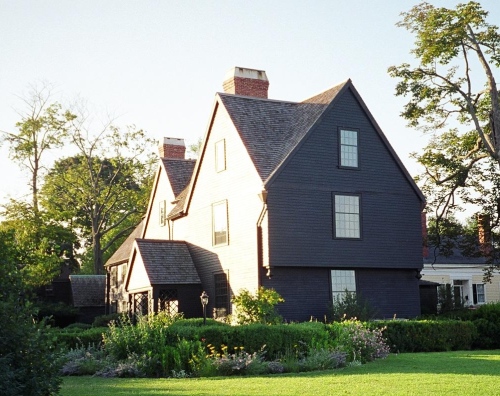
Few houses in the world have the fame and literary associations of the House of the Seven Gables. The earliest section was built on Derby Street in Salem, facing Salem Harbor in 1668 by Capt. John Turner I, a prosperous merchant. He then added a south ell to the house in 1677. After his death in 1680, his widow, Elizabeth Roberts took charge of the household, marrying Charles Redford in 1684. By the time of Redford’s death, in 1691, John Turner II was old enough to take charge of the estate. In the early eighteenth century, it was this John Turner who would have the house decorated in the new Georgian style. The third John Turner inherited the house after his father’s death in 1742, but he made few alterations to it, as his primary residence was about a half a mile away. John Turner III eventually experienced a financial decline and sold the house to Capt. Samuel Ingersoll in 1782. He would make a number of changes to the house, removing several of its gables and brining it in line with the taste of the Federal Period.

Capt. Ingersoll and his son died at sea in 1804 and the house was later inherited by his only surviving child, Susannah Ingersoll, who was unusual for a woman at the time in being a businesswoman, active in real estate. She was the cousin of Nathaniel Hawthorne and it was during his visits with her that he would have learned of the home’s past. In 1851, Hawthorne published his famous novel, The House of the Seven Gables. Susannah Ingersoll died in 1858 and the house passed through many different owners, remaining vacant during part of this period. In 1908, the house was purchased by the philanthropist, Caroline O. Emmerton, who thus saved it from becoming a tenement. She enlisted the prominent early preservation architect Joseph Everett Chandler to restore it. She founded the House of Seven Gables Settlement Association and opened the house to the public in 1910, using the admission proceeds to support the Settlement. Visitor expectations based on Hawthorne’s novel influenced the restoration at the expense of strict historical accuracy, although this approach was not uncommon for early twentieth century colonial revival preservation efforts.

The house museum is often visited today as a popular tourist attraction and is part of a compound containing other historic buildings, acquired by Emmerton and her successors, and a Colonial Revival Garden. In 2007, the house was designated a National Historic Landmark. A pdf file is available of the National Historic Landmark Nomination form.

Posts navigation

Newer posts
Privacy Policy

Categories

  • Architectural Style (943)
    • Art Deco (9)
    • Byzantine (3)
    • Colonial (177)
    • Colonial Revival (85)
    • Craftsman (6)
    • Egyptian Revival (1)
    • Federal (190)
    • Foursquare (6)
    • Gothic (67)
    • Greek Revival (100)
    • Italianate (82)
    • Mission Revival (2)
    • Mission/Spanish Colonial (1)
    • Modern (2)
    • Neoclassical (56)
    • Octagon (3)
    • Postmodern (1)
    • Queen Anne (46)
    • Renaissance Revival (26)
    • Romanesque Revival (53)
    • Second Empire (26)
    • Shingle Style (12)
    • Stick Style (13)
    • Tudor Revival (8)
    • Vernacular (49)
    • Victorian Eclectic (15)
  • Building Type (943)
    • Apartment Buildings (8)
    • Banks (18)
    • Churches (119)
    • Collegiate (32)
    • Commercial (102)
    • Hotels (16)
    • Houses (508)
    • Industrial (23)
    • Libraries (22)
    • Lighthouses (1)
    • Military (15)
    • Monuments (1)
    • Museums (12)
    • Organizations (39)
    • Outbuildings (17)
    • Public Buildings (50)
    • Schools (23)
    • Stations (5)
    • Synagogues (1)
    • Taverns (21)
    • Theaters (9)
  • Town (943)
    • Adams (11)
    • Agawam (4)
    • Amherst (50)
    • Boston (64)
    • Boylston (6)
    • Cambridge (30)
    • Clinton (21)
    • Concord (15)
    • Cummington (1)
    • Danvers (14)
    • Deerfield (31)
    • Gloucester (18)
    • Granville (10)
    • Great Barrington (2)
    • Hadley (9)
    • Hancock (15)
    • Harvard (32)
    • Holyoke (47)
    • Lenox (5)
    • Lexington (8)
    • Longmeadow (32)
    • Marblehead (40)
    • Marlborough (4)
    • Natick (22)
    • Newton (2)
    • Northampton (68)
    • Peabody (4)
    • Pittsfield (20)
    • Salem (110)
    • Saugus (4)
    • Sheffield (4)
    • South Hadley (8)
    • Southborough (8)
    • Southwick (4)
    • Springfield (67)
    • Stockbridge (19)
    • Stow (1)
    • Sturbridge (18)
    • Sudbury (7)
    • Waltham (11)
    • Watertown (1)
    • Wayland (8)
    • West Springfield (14)
    • Westfield (46)
    • Weston (2)
    • Worcester (26)
  • Uncategorized (1)

Recent Comments

  • Wilber Blackson on South Hadley
  • Tami Speiden on Stockbridge
  • DexGuru on Stockbridge

Tags

Alcott Amherst College Asher Benjamin Back Bay Baptist Beacon Hill Big E Black Heritage Trail bowfront Bulfinch Catholic Congregational Episcopal Freedom Trail Gambrel H.H. Richardson Harvard Hawthorne Historic Deerfield Isaac Damon lit Longfellow mansard Methodist Mount Holyoke Museum Museums NPS Old Sturbridge Village PEM Revolutionary War row houses saltbox Samuel McIntire Shakers Smith College SPNEA Springfield Armory Stephen C. Earle Storrowton Underground Railroad UU Washington William Fenno Pratt Witch Trials

Meta

  • Log in
  • Entries feed
  • Comments feed
  • WordPress.org
Proudly powered by WordPress | Theme: ShowMe by NEThemes.