Historic Buildings of Massachusetts

  • About
  • Index by Town
  • CT
  • About
  • Index by Town
  • CT

Tag: Revolutionary War

Longfellow’s Wayside Inn (1716)
by Dan/July 31, 2009June 29, 2013/Colonial, Sudbury, Taverns

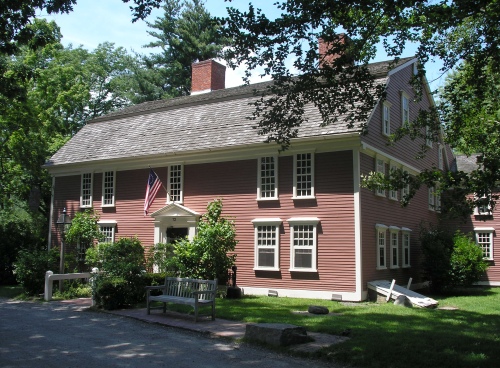
Wayside Inn

The Wayside Inn in Sudbury is the oldest operating Inn in the United States and was immortalized in Henry Wadsworth Longfellow‘s sequence of poems, Tales of a Wayside Inn (1863). Built in 1716, the Inn was first known as Howe’s Tavern, for its first innkeeper, David Howe. His descendants continued to operate the Inn, adding to the original structure over time, until 1861. These included Howe’s son, Ezekiel, who led the Sudbury militia to Concord for the battle of April 19, 1775. After passing from the Howes to new owners, the Inn served as a boarding house for temporary lodgers. In October of 1862, Longfellow and his publisher, James Fields, visited the Inn and this inspired the poet to write Tales of a Wayside Inn, which became a bestseller. Although it continued to serve as a boarding house, the Wayside Inn soon began to attract tourists, anxious to see the place which had captured the public imagination. In 1896, Edward Rivers Lemon, a wealthy Medford wool merchant, purchased the Inn as a business venture, inviting the Society of Colonial Wars to meet there in 1897. On that occasion, the orator Samuel Arthur Bent gave a speech entitled: “The Wayside Inn—Its History and Literature.” Lemon intended the Inn to be a literary and artistic retreat and a group artists, poets, and writers, known as the Paint and Clay Club, met there frequently.

The Wayside Inn entered a new phase of its existence when it was purchased by Henry Ford in 1923. He intended to create a living museum of Americana centered on the historic building and bought many acres of land around it. He built a gristmill and the non-denominational Martha-Mary Chapel on the property and and also relocated a schoolhouse from Sterling, which he believed was the actual building mentioned in Sarah Josepha Hale‘s poem “Mary Had a Little Lamb.” The property was placed in a non-profit trust in 1947, with many representatives of the Ford family on the Board, and this transitioned to governance by the National Trust for Historic Preservation in 1957. Restoration of the Inn was necessary, with help from the Ford family, after a devastating fire in December 1955. As of 1960, the Inn came under the governance of local trustees. There would be no further support coming from Ford interests and there was no endowment, but by this time the Inn had become self-sufficient as an inn, restaurant and museum.
Below are pictures of some interiors in the museum section of the Inn: Continue reading “Longfellow’s Wayside Inn (1716)”
Munroe Tavern (1695)

by Dan/July 30, 2009July 31, 2009/Colonial, Lexington, Taverns

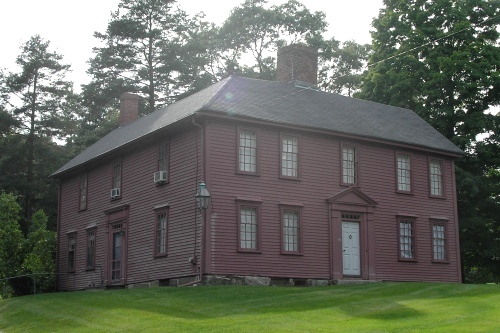
Munroe Tavern

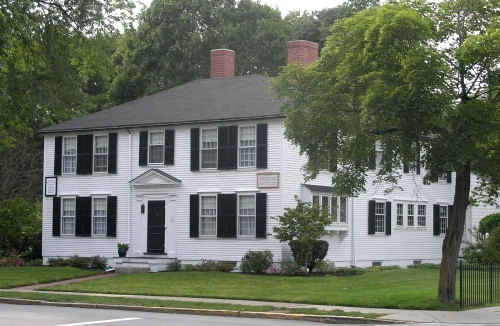
Munroe Tavern, located one mile east of Lexington Common, was built around 1695. The Tavern is named for William Munroe, who was its proprietor from 1770 to 1827. Munroe was also an orderly sergeant in Captain Parker’s minuteman company in 1775. During the Battle of Lexington, on April 19, 1775, the Tavern was occupied by the British for an hour-and-a-half. The Tavern‘s dining room became a field hospital and Brigadier General Earl Percy, who arrived with British reinforcements, used it as his headquarters. George Washington dined at the Tavern during his 1789 visit to the Lexington battlefield. The Tavern is now a museum operated by the Lexington Historical Society.

Buckman Tavern (1690)

by Dan/July 25, 2009July 25, 2009/Colonial, Lexington, Taverns

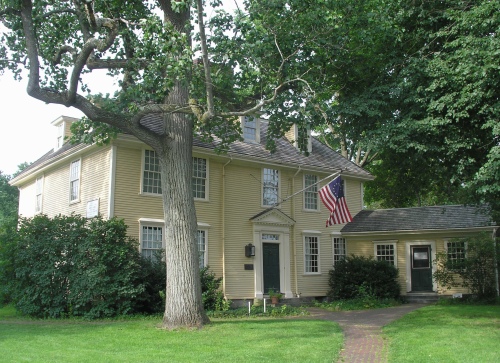
Buckman Tavern

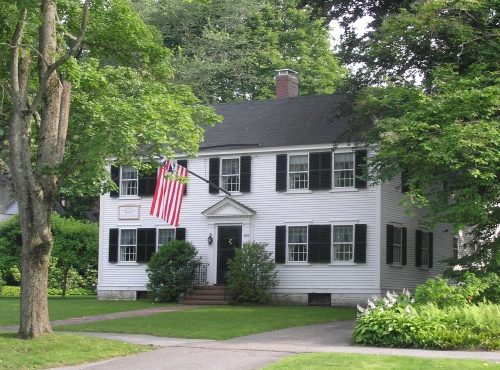
Buckman Tavern, off Lexington Green, was built in 1690 by Benjamin Muzzey and by a license granted in 1693, it became the first Public House in Lexington. In the coming years it was run by Muzzey‘s son John, then by John’s granddaughter and her husband, John Buckman. By the 1770s, Buckman Tavern had become the favored gathering place for local militia men (members of the Lexington Training Band) on the days they trained on the Green. On April 19, 1775, it was here that the militia gathered before facing the British troops, when the first shot was fired which began the Revolutionary War. The Tavern continued to be Lexington’s busiest after the war and housed the towns first village store and post office. The town of Lexington acquired the Tavern in 1913 and, by a 99-year lease, the Lexington Historical Society undertook the furnishing of the building, which is open to the public as a museum.

Jonathan Harrington House (1690)

by Dan/July 24, 2009January 18, 2020/Colonial, Houses, Lexington

Jonathan Harrington House

The earliest parts of the Jonathan Harrington House, on Lexington Green, date back to 1690. The house‘s most famous historic association is with the Battle of Lexington, as the historic marker on the house explains: “House of Jonathan Harrington/
who wounded on the Common/ April 19, 1775/ dragged himself to the door/ and died at his wife’s feet.” From 1811 to 1828, the Harrington House was the home of John Augustus, a shoemaker, who in 1841 convinced a judge to allow a man convicted of drunkenness into his custody for rehabilitation, finding him a job and getting him to sign a pledge not to drink. Augustus followed this by offering assistance to other convicted criminals and he is now recognized as the Father of Probation in America. In 1909, pioneering historic preservationist William Sumner Appleton expressed his outrage at modernizations being made to the Harrington House during a refurbishment (possibly by new owner Leroy Sunderland Brown?) The house remains a private home.

Marrett and Nathan Munroe House (1729)

by Dan/July 21, 2009January 18, 2020/Colonial, Houses, Lexington

Marrett and Nathan Munroe house

On Monument street, facing Lexington Battle Green, is the Marrett and Nathan Munroe House, which was a witness to the Battle of April 19, 1775. Built in 1729, the house was owned by Marrett Munroe at the time of the Battle and Nathan Munroe was one of the minutemen who fought in the Battle. According to Lexington, A Hand-Book of its Points Of Interest, Historical and Picturesque (1891), “Towards this house Caleb Harrington was running from the meetinghouse, where he had been to get powder, when he was shot by the British soldiers. A bullet from a British musket passed through the window over the door and lodged in a bureau, where it still remains, in the possession of one of Mr. Munroe’s descendants living in Chicopee, Mass.” The house was moved slightly when it was restored in 1915.

Hancock-Clarke House (1698)

by Dan/July 20, 2009September 17, 2016/Colonial, Houses, Lexington

Hancock-Clarke House

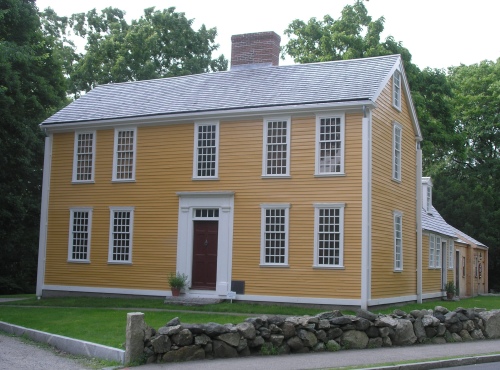
The Hancock-Clarke House in Lexington began as a small parsonage, built by the Reverend John Hancock in 1698. It was enlarged by his son Thomas, a wealthy Boston merchant, in 1738. The minister’s grandson was the John Hancock who signed the Declaration of Independence. The Reverend Jonas Clarke, Rev. Hancock’s son-in-law, occupied the house when he succeeded Hancock as minister in Lexington. Rev. Clarke was an inspiring figure for the Patriots during the period leading up to the Revolutionary War. On the evening of April 18, 1775, John Hancock and Samuel Adams were staying in the house when William Dawes and Paul Revere arrived separately to warn them that British troops were approaching. This historic home faced demolition in 1896, when it was acquired by the Lexington Historical Society and moved across the street from its original location. It is now a museum open to the public. In 2008, the house underwent a large scale structural restoration.

Wright Tavern (1747)

by Dan/May 25, 2009August 27, 2012/Colonial, Concord, Taverns

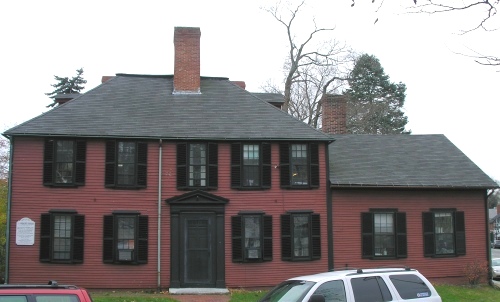
Wright Tavern, on Lexington Road in Concord, was built in 1747 by Ephraim Jones, who operated it until 1751. Standing in the center of town, it was a popular gathering place for Concord’s leading citizens. For five days in October 1774, the Massachusetts Provincial Congress met in the First Parish Church, next door, and the committees of the Congress met in the Tavern. In 1775, the Tavern was managed by Amos Wright. On the morning of the Battle of April 19, the Concord minutemen assembled at the Tavern. Later that day, the British force, under Maj. John Pitcairn, arrived and the British officers were served at the Tavern. The First Parish Unitarian Church of Concord now owns the building, which, since 1997, has been the Wright Tavern Center for Spiritual Renewal.

Posts navigation

Older posts
Newer posts
Privacy Policy

Categories

  • Architectural Style (943)
    • Art Deco (9)
    • Byzantine (3)
    • Colonial (177)
    • Colonial Revival (85)
    • Craftsman (6)
    • Egyptian Revival (1)
    • Federal (190)
    • Foursquare (6)
    • Gothic (67)
    • Greek Revival (100)
    • Italianate (82)
    • Mission Revival (2)
    • Mission/Spanish Colonial (1)
    • Modern (2)
    • Neoclassical (56)
    • Octagon (3)
    • Postmodern (1)
    • Queen Anne (46)
    • Renaissance Revival (26)
    • Romanesque Revival (53)
    • Second Empire (26)
    • Shingle Style (12)
    • Stick Style (13)
    • Tudor Revival (8)
    • Vernacular (49)
    • Victorian Eclectic (15)
  • Building Type (943)
    • Apartment Buildings (8)
    • Banks (18)
    • Churches (119)
    • Collegiate (32)
    • Commercial (102)
    • Hotels (16)
    • Houses (508)
    • Industrial (23)
    • Libraries (22)
    • Lighthouses (1)
    • Military (15)
    • Monuments (1)
    • Museums (12)
    • Organizations (39)
    • Outbuildings (17)
    • Public Buildings (50)
    • Schools (23)
    • Stations (5)
    • Synagogues (1)
    • Taverns (21)
    • Theaters (9)
  • Town (943)
    • Adams (11)
    • Agawam (4)
    • Amherst (50)
    • Boston (64)
    • Boylston (6)
    • Cambridge (30)
    • Clinton (21)
    • Concord (15)
    • Cummington (1)
    • Danvers (14)
    • Deerfield (31)
    • Gloucester (18)
    • Granville (10)
    • Great Barrington (2)
    • Hadley (9)
    • Hancock (15)
    • Harvard (32)
    • Holyoke (47)
    • Lenox (5)
    • Lexington (8)
    • Longmeadow (32)
    • Marblehead (40)
    • Marlborough (4)
    • Natick (22)
    • Newton (2)
    • Northampton (68)
    • Peabody (4)
    • Pittsfield (20)
    • Salem (110)
    • Saugus (4)
    • Sheffield (4)
    • South Hadley (8)
    • Southborough (8)
    • Southwick (4)
    • Springfield (67)
    • Stockbridge (19)
    • Stow (1)
    • Sturbridge (18)
    • Sudbury (7)
    • Waltham (11)
    • Watertown (1)
    • Wayland (8)
    • West Springfield (14)
    • Westfield (46)
    • Weston (2)
    • Worcester (26)
  • Uncategorized (1)

Recent Comments

  • Wilber Blackson on South Hadley
  • Tami Speiden on Stockbridge
  • DexGuru on Stockbridge

Tags

Alcott Amherst College Asher Benjamin Back Bay Baptist Beacon Hill Big E Black Heritage Trail bowfront Bulfinch Catholic Congregational Episcopal Freedom Trail Gambrel H.H. Richardson Harvard Hawthorne Historic Deerfield Isaac Damon lit Longfellow mansard Methodist Mount Holyoke Museum Museums NPS Old Sturbridge Village PEM Revolutionary War row houses saltbox Samuel McIntire Shakers Smith College SPNEA Springfield Armory Stephen C. Earle Storrowton Underground Railroad UU Washington William Fenno Pratt Witch Trials

Meta

  • Log in
  • Entries feed
  • Comments feed
  • WordPress.org
Proudly powered by WordPress | Theme: ShowMe by NEThemes.