Historic Buildings of Massachusetts

  • About
  • Index by Town
  • CT
  • About
  • Index by Town
  • CT

Tag: Museum

Jonathan Corwin House (1675)
by Dan/November 26, 2008September 17, 2016/Colonial, Houses, Salem

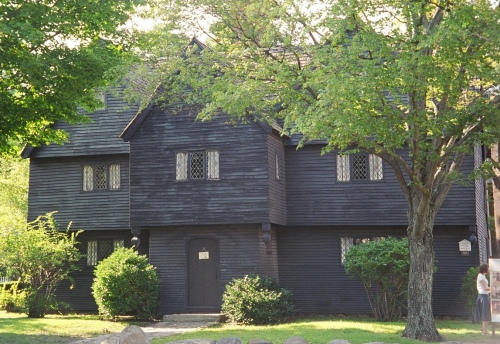
The Jonathan Corwin House, also known as the Witch House, is a seventeenth century home located on Essex Street in Salem. When Jonathan Corwin, a merchant, purchased the property in 1675, there was already a partially completed timber frame, left unfinished after being started some years earlier (older estimates put the construction date as 1642). Corwin completed the construction and moved in with his family in 1679. As a prominent citizen of Salem, Corwin served as a magistrate and was a judge during the Salem Witch Trials of 1692. The Corwin family owned the house into the nineteenth century, during which time a number of alterations were made to the home. In 1856, it was bought by a pharmacist, George Farrington, who built his shop onto one side of the building. He referred to the home as the “Witch House” and attracted tourists with his claims that the Witch Trials had occurred in the parlor. By the twentieth century, the house was being used for a shop, businesses and apartments. Threatened with demolition to accommodate the widening of North Street, Historic Salem Inc was established to return the house to a seventeenth century look and move it to the west. Given to the town, the Witch House first opened as a museum in 1946.
William Hickling Prescott House (1808)

by Dan/November 24, 2008September 17, 2016/Boston, Federal, Houses

prescott-house.jpg

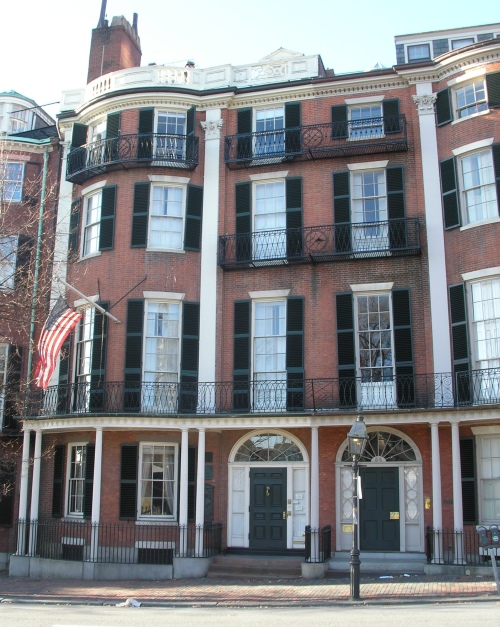
William Hickling Prescott was an important nineteenth century historian who is best known for his works, History of the Conquest of Mexico (1843) and History of the Conquest of Peru (1847). The latter work was written in a house that Prescott lived in on Beacon Street in Boston from 1845 to 1859. The 1808 house (on the left in the photo above) was designed by Asher Benjamin and features Greek design motifs and a Federal style doorway. William Makepeace Thackeray, a friend of Prescott, visited the house. Thackeray was as inspired to write his novel, The Virginians (1859), after seeing two crossed swords displayed in the home, one belonging to Prescott‘s grandfather (Col. William Prescott) and one by Prescott’s wife’s father (Capt. John Linzee), each on opposing sides at the Battle of Bunker Hill. The Prescott House is now a museum and the headquarters of the National Society of the Colonial Dames of America in the Commonwealth of Massachusetts.

Rev. Jonathan Ashley House (1734)

by Dan/November 22, 2008September 17, 2016/Colonial, Deerfield, Houses

ashley-house.jpg

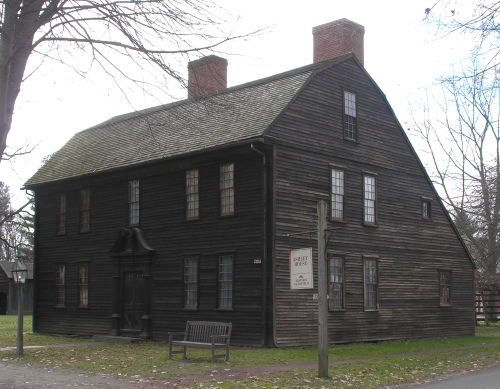
Rev. Jonathan Ashley was the second minister in Deerfield, serving from 1712 to 1780. He married Dorothy Williams, the daughter of the Rev. William Williams of Hatfield. Given a home lot in town, he constructed his house around 1734. Originally having a center chimney, the house was modified by Ashley in the 1750s into a center hallway home with a distinctive Connecticut River Valley doorway. As one of the elite Valley citizens known as “River Gods,” Ashley installed fine paneling in his home and furnished it with high style furniture. By the twentieth century, the house had been moved back on the lot and replaced with a nineteenth century Italianate style house. The former “mansion house” was now used as a tobacco barn. It was restored (the current doorway is a reproduction) and moved back to a position in the Street by the founders of Historic Deerfield, Henry and Helen Flynt. In 1948, the house became their first restoration opened to the public. It currently houses an extensive collection of Connecticut River Valley antiques.

Sycamores (1788)

by Dan/November 20, 2008/Colonial, Houses, South Hadley

sycamores.jpg

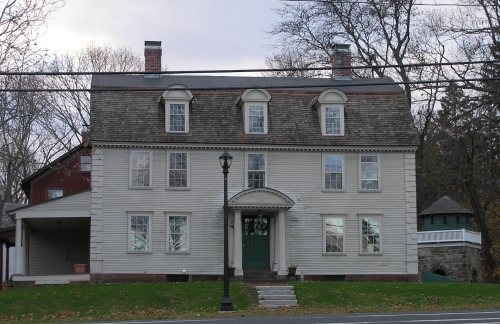
Colonel Benjamin Ruggles Woodbridge, of South Hadley, was a physician, merchant, entrepreneur and politician, who led a regiment at Bunker Hill and was a representative to the General Court. In 1788, Col. Woodbridge built his house on Woodbridge Street in South Hadley. After his death, in 1819, the house became the Woodbridge Scientific School for boys. It was later owned by the Montague family and was purchased, in 1900, by Rose Hollingsworth, who had the (recently restored) Water Tower on the property constructed. For much of the twentieth century, the house served as a dormitory for students at Mount Holyoke College. Having fallen into disrepair, in 1996 it was purchased by the Sycamores Committee of the South Hadley Historical Society, who are restoring the house to become a museum. In 2004, the 1733 Rawson House, home of South Hadley‘s first minister, Grindall Rawson, which originally stood on the Sycamores property, was donated to the Sycamore Committee. It was then moved to its current location, attached to Sycamore‘s rear ell.

Eddy Law Office (1810)

by Dan/October 20, 2008December 31, 2008/Commercial, Federal, West Springfield

eddy-law-office.jpg

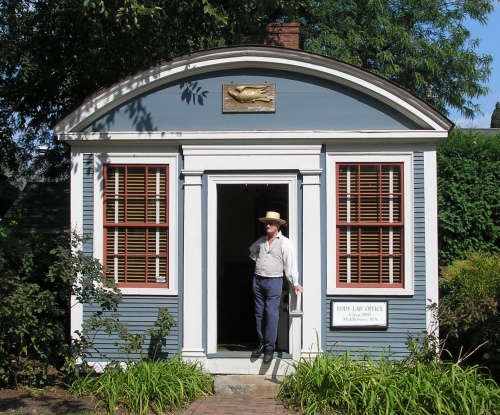
The Eddy Law Office, originally built around 1810 in the town of Middleborough, was later moved to the Eastern States Exhibition grounds in West Springfield to become part of the historical Storrowton Village. The building was the law office of Zachariah Eddy, one of the foremost lawyers of his day. In Middleborough, it stood not far from the Eddy Family Homestead, built in 1803. In town is also the later Zachariah Eddy House of 1831, now a Bed & Breakfast.

Levi Gilbert House (1794)

by Dan/October 13, 2008September 17, 2016/Federal, Houses, West Springfield

levi-gilbert.jpg

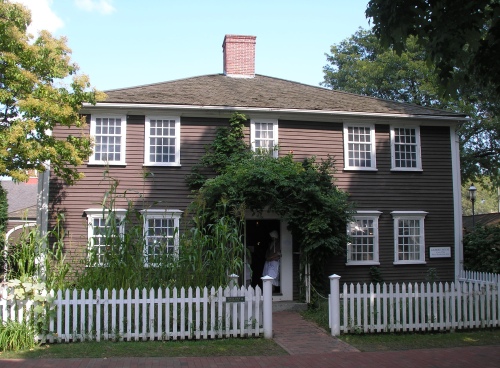
The Levi Gilbert House was built in West Brookfield around 1794. It is one of the buildings to be moved in the twentieth century to the Eastern Stares Exposition grounds, in West Springfield, to form part of Storrowton Village, a recreation of a nineteenth century village. The Gilbert House displays for visitors the life of an eighteenth century farmer.

Wells-Thorn House (1747)

by Dan/October 7, 2008September 17, 2016/Colonial, Deerfield, Houses

wells-thorn-house.jpg

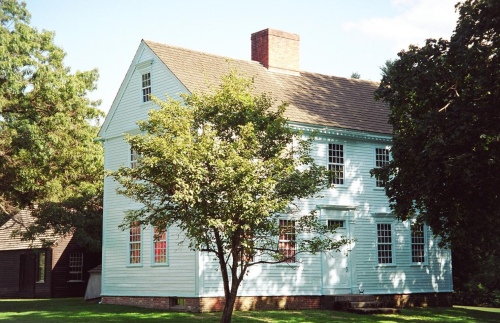
The Wells-Thorn House is one of the museum houses of Historic Deerfield. The oldest section of the house was built between 1717 and 1720 by Ebenezer Wells, a wealthy farmer. He lived in the house with his wife, Abigail Barnard wells, and two slaves, Lucy and Caesar. the building may have also have been used as a tavern from 1744-1749. This earlier section became an ell when a new section, now the main block of the house, was built in the Georgian style either between 1751 and 1757, or perhaps as early as 1747. Ebenezer Wells died in 1758 and the house passed through several different owners, eventually being purchased by Luanna Thorn in 1905. She and her husband, Dr. Edwin Thorn, were involved in the Deerfield Arts and Crafts Revival movement. Luanna ran her Deerfield Handicrafts Shop at the rear of the house. The home was acquired by Historic Deerfield in 1962. Inside, the house represents the decorative arts of different historical periods in each room. It also inspired the construction of a replica, the Benjamin Morrow House. Edit: Current research indicates that the entire house was built in 1755.

Posts navigation

Older posts
Newer posts
Privacy Policy

Categories

  • Architectural Style (943)
    • Art Deco (9)
    • Byzantine (3)
    • Colonial (177)
    • Colonial Revival (85)
    • Craftsman (6)
    • Egyptian Revival (1)
    • Federal (190)
    • Foursquare (6)
    • Gothic (67)
    • Greek Revival (100)
    • Italianate (82)
    • Mission Revival (2)
    • Mission/Spanish Colonial (1)
    • Modern (2)
    • Neoclassical (56)
    • Octagon (3)
    • Postmodern (1)
    • Queen Anne (46)
    • Renaissance Revival (26)
    • Romanesque Revival (53)
    • Second Empire (26)
    • Shingle Style (12)
    • Stick Style (13)
    • Tudor Revival (8)
    • Vernacular (49)
    • Victorian Eclectic (15)
  • Building Type (943)
    • Apartment Buildings (8)
    • Banks (18)
    • Churches (119)
    • Collegiate (32)
    • Commercial (102)
    • Hotels (16)
    • Houses (508)
    • Industrial (23)
    • Libraries (22)
    • Lighthouses (1)
    • Military (15)
    • Monuments (1)
    • Museums (12)
    • Organizations (39)
    • Outbuildings (17)
    • Public Buildings (50)
    • Schools (23)
    • Stations (5)
    • Synagogues (1)
    • Taverns (21)
    • Theaters (9)
  • Town (943)
    • Adams (11)
    • Agawam (4)
    • Amherst (50)
    • Boston (64)
    • Boylston (6)
    • Cambridge (30)
    • Clinton (21)
    • Concord (15)
    • Cummington (1)
    • Danvers (14)
    • Deerfield (31)
    • Gloucester (18)
    • Granville (10)
    • Great Barrington (2)
    • Hadley (9)
    • Hancock (15)
    • Harvard (32)
    • Holyoke (47)
    • Lenox (5)
    • Lexington (8)
    • Longmeadow (32)
    • Marblehead (40)
    • Marlborough (4)
    • Natick (22)
    • Newton (2)
    • Northampton (68)
    • Peabody (4)
    • Pittsfield (20)
    • Salem (110)
    • Saugus (4)
    • Sheffield (4)
    • South Hadley (8)
    • Southborough (8)
    • Southwick (4)
    • Springfield (67)
    • Stockbridge (19)
    • Stow (1)
    • Sturbridge (18)
    • Sudbury (7)
    • Waltham (11)
    • Watertown (1)
    • Wayland (8)
    • West Springfield (14)
    • Westfield (46)
    • Weston (2)
    • Worcester (26)
  • Uncategorized (1)

Recent Comments

  • Wilber Blackson on South Hadley
  • Tami Speiden on Stockbridge
  • DexGuru on Stockbridge

Tags

Alcott Amherst College Asher Benjamin Back Bay Baptist Beacon Hill Big E Black Heritage Trail bowfront Bulfinch Catholic Congregational Episcopal Freedom Trail Gambrel H.H. Richardson Harvard Hawthorne Historic Deerfield Isaac Damon lit Longfellow mansard Methodist Mount Holyoke Museum Museums NPS Old Sturbridge Village PEM Revolutionary War row houses saltbox Samuel McIntire Shakers Smith College SPNEA Springfield Armory Stephen C. Earle Storrowton Underground Railroad UU Washington William Fenno Pratt Witch Trials

Meta

  • Log in
  • Entries feed
  • Comments feed
  • WordPress.org
Proudly powered by WordPress | Theme: ShowMe by NEThemes.