Historic Buildings of Massachusetts

  • About
  • Index by Town
  • CT
  • About
  • Index by Town
  • CT

Tag: Museum

Hinsdale and Anna Williams House (1730)
by Dan/February 3, 2009September 17, 2016/Colonial, Deerfield, Federal, Houses

hinsdale-and-anna-williams-house.jpg

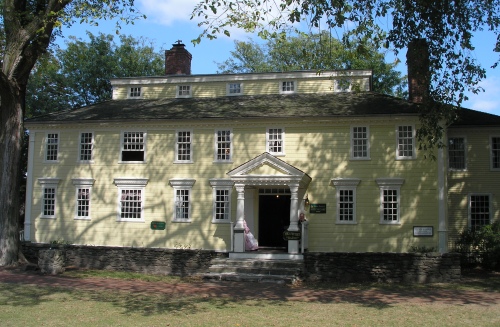
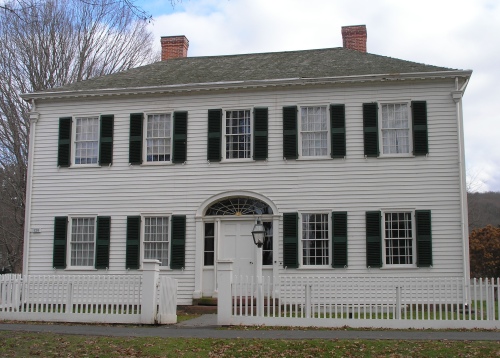
The Hinsdale and Anna Williams House in Deerfield was originally built in 1730 by Ebenezer Hinsdale, who founded Hinsdale , New Hampshire. It later passed through other owners until it came into the possession of Hinsdale’s grandnephew, Ebenezer Hinsdale Williams, whose mother was from Deerfield. In 1816, Williams extensively altered the house in the Federal style, raising the structure in order to install a fanlight above the door, raising the roof and doubling the size of the house with the addition of a two-story ell. Hinsdale Williams lived in the home, with his wife Anna and two children, until his death in 1838. From 1866-1981, the Williams House was occupied by members of the Cowles family. Russell Cowles worked to preserve the house and when the original French scenic wallpaper depicting Venetian scenes, installed by Williams in 1816, was damaged in the Flood of 1936, Cowles went to the Museum of Fine Arts in Boston to learn how to restore it. The building was restored in the 1980s as part of Historic Deerfield.
Asa Stebbins House (1799)

by Dan/February 2, 2009September 17, 2016/Deerfield, Federal, Houses

stebbins-house.jpg

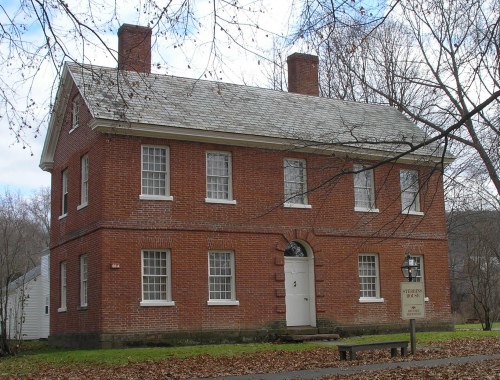
The Federal-style Asa Stebbins House, now one of the museum houses of Historic Deerfield, was built in 1799 and was the first brick house in Franklin county. Stebbins, a wealthy farmer and mill owner, was on the building committees for two other brick structures: the original building of Deerfield Academy (now the Memorial Hall Museum) and the town’s “brick church“. He was also a town selectman and state representative and built and decorated his house in the popular Federal style. Inside, the house has French scenic wallpaper by Joseph Dufour depicting the voyages of Captain Cook.

Allen House (1734)

by Dan/December 21, 2008September 17, 2016/Colonial, Deerfield, Houses

allen-house.jpg

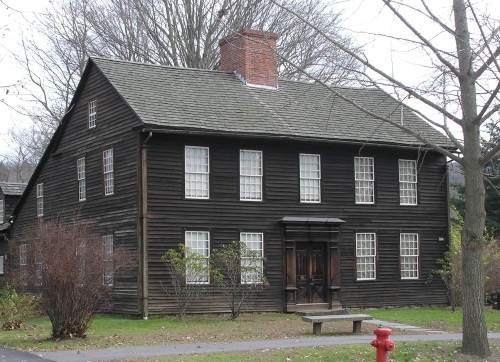
The colonial saltbox known as the Allen House was renovated in 1945 to become the Deerfield home of Henry and Helen Flynt, the founders of Historic Deerfield. They believed the house had been built around 1705, just after the Deerfield Raid of 1704. Current research indicates it was built around 1734. The land was originally owned by Simon and Hannah Beaman, who had been captured during the raid. The house was occupied by the Bardwell family and then by the Allen family, after the 1842 marriage of Catherine Elizabeth Bardwell and Caleb Allen. In 1896, Caleb Bardwell’s nieces, Frances and Mary Allen, with their mother took possession of the house. The Allen sisters were photographers, famous for their Deerfield scenes. They sold their work out of a shop in the house. During the nineteenth century, the interior of the house had been completely changed, leading the Flynts to gut it and recreate an eighteenth century plan. Open to visitors, the antiques-filled interior decoration of the house remains as it was when the Flynts were in residence.

Old South Meeting House (1729)

by Dan/December 19, 2008March 29, 2013/Boston, Churches, Colonial

old-south-church.jpg

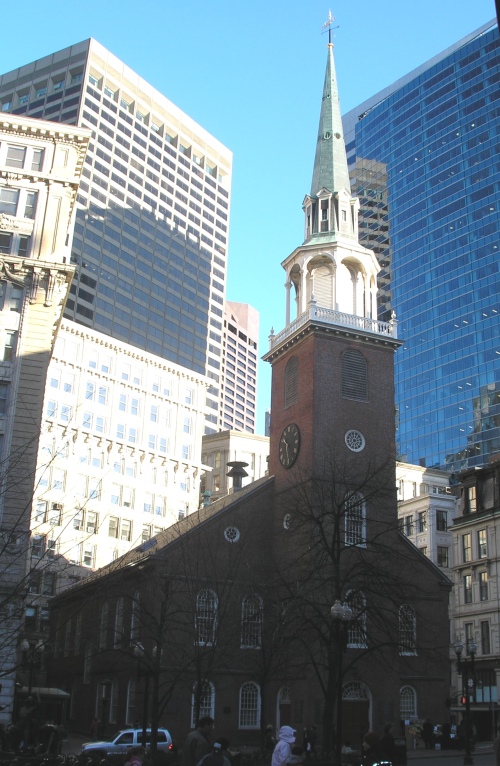
Built in 1729, Boston’s Old South Meeting House was the largest building in the colonial town. The congregation began in 1669, when it separated from Boston’s First Church (becoming the Third Church of Boston). In the years immediately preceding the outbreak of the American Revolution, citizens would gather in the Old South Meeting House to debate and argue in the aftermath of events like the Boston Massacre. On the night of December 16, 1773, over 5,000 colonists, angered over the tax on tea, met at Old South and after hours of debate, Samuel Adams gave a secret signal which began the famous Boston Tea Party. During the war, occupying British troops took revenge for the Tea Party by ripping out the church‘s pews and using the building as a riding stable. They also set up a bar on the first balcony. The church continued to be used as a house of worship, but after it was nearly destroyed in the Great Boston Fire of 1872, the congregation built the New Old South Church at Copley Square. In danger of being torn down, pioneering preservation efforts led to the restoration of the building, which has been a museum and historic site since 1877. It is also a stop on the Boston Freedom Trail. The steeple has been replaced twice, after storms in 1804 and 1954.

Josiah Day House (1754)

by Dan/December 9, 2008September 17, 2016/Colonial, Houses, West Springfield

josiah-day-house.jpg

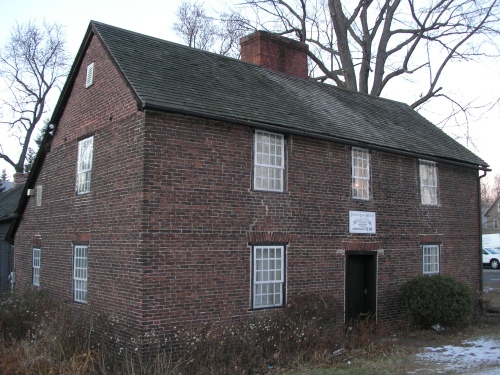
Josiah Day built his house in West Springfield by 1754 on land he had purchased in 1746. The house is the only known solid brick saltbox house of it’s period in the United States. The home remained in the Day family until 1903, when it was sold to the Ramapogue Historical Society. It is now a house museum open to the public.

North Center School (1810)

by Dan/December 6, 2008April 7, 2009/Federal, Schools, West Springfield

north-center-school.jpg

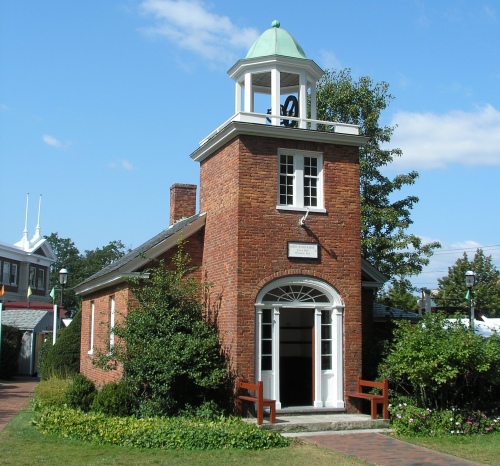
Built around 1810 in the Federal style, the North Center School is a one-room schoolhouse that originally stood in Whately. It was moved to the Eastern States Exposition grounds to become part of Storrowton. The entryway of the building was modified to resemble one in the Federal style, as seen on a schoolhouse in Vergennes, Vermont (since moved to the Shelburne Museum), by Storrowtown’s benefactor, Helen O. Storrow.

Captain John Potter House (1776)

by Dan/December 5, 2008September 17, 2016/Colonial, Houses, West Springfield

captain-john-potter-house.jpg

Captain John Potter built his house in North Brookfield, at the corner of South Main and Ward Streets, in 1776. Potter was a clockmaker and craftsman who also served as a captain in the Continental Army during the Revolutionary War. His mansion, which Potter built with his own hands, was started just before and completed just after the interruption of the war. It was constructed around Potter’s earlier house and features a faux-masonry exterior, actually made of wood. The house also had a large room for dancing on the second floor and a support pole was used in the dining room below whenever the upper room was used for dancing! Later, the Captain’s son, F.A. Potter, ran a shop attached to the house. In 1929, the Potter House, which had passed out of the Potter family’s hands in 1920, was moved to Storrowton, the recreation of a classic New England village, as imagined by benefactor Helen O. Storrow, at the Eastern States Exposition grounds in West Springfield. It is now open to the public for tours.

Posts navigation

Older posts
Newer posts
Privacy Policy

Categories

  • Architectural Style (943)
    • Art Deco (9)
    • Byzantine (3)
    • Colonial (177)
    • Colonial Revival (85)
    • Craftsman (6)
    • Egyptian Revival (1)
    • Federal (190)
    • Foursquare (6)
    • Gothic (67)
    • Greek Revival (100)
    • Italianate (82)
    • Mission Revival (2)
    • Mission/Spanish Colonial (1)
    • Modern (2)
    • Neoclassical (56)
    • Octagon (3)
    • Postmodern (1)
    • Queen Anne (46)
    • Renaissance Revival (26)
    • Romanesque Revival (53)
    • Second Empire (26)
    • Shingle Style (12)
    • Stick Style (13)
    • Tudor Revival (8)
    • Vernacular (49)
    • Victorian Eclectic (15)
  • Building Type (943)
    • Apartment Buildings (8)
    • Banks (18)
    • Churches (119)
    • Collegiate (32)
    • Commercial (102)
    • Hotels (16)
    • Houses (508)
    • Industrial (23)
    • Libraries (22)
    • Lighthouses (1)
    • Military (15)
    • Monuments (1)
    • Museums (12)
    • Organizations (39)
    • Outbuildings (17)
    • Public Buildings (50)
    • Schools (23)
    • Stations (5)
    • Synagogues (1)
    • Taverns (21)
    • Theaters (9)
  • Town (943)
    • Adams (11)
    • Agawam (4)
    • Amherst (50)
    • Boston (64)
    • Boylston (6)
    • Cambridge (30)
    • Clinton (21)
    • Concord (15)
    • Cummington (1)
    • Danvers (14)
    • Deerfield (31)
    • Gloucester (18)
    • Granville (10)
    • Great Barrington (2)
    • Hadley (9)
    • Hancock (15)
    • Harvard (32)
    • Holyoke (47)
    • Lenox (5)
    • Lexington (8)
    • Longmeadow (32)
    • Marblehead (40)
    • Marlborough (4)
    • Natick (22)
    • Newton (2)
    • Northampton (68)
    • Peabody (4)
    • Pittsfield (20)
    • Salem (110)
    • Saugus (4)
    • Sheffield (4)
    • South Hadley (8)
    • Southborough (8)
    • Southwick (4)
    • Springfield (67)
    • Stockbridge (19)
    • Stow (1)
    • Sturbridge (18)
    • Sudbury (7)
    • Waltham (11)
    • Watertown (1)
    • Wayland (8)
    • West Springfield (14)
    • Westfield (46)
    • Weston (2)
    • Worcester (26)
  • Uncategorized (1)

Recent Comments

  • Wilber Blackson on South Hadley
  • Tami Speiden on Stockbridge
  • DexGuru on Stockbridge

Tags

Alcott Amherst College Asher Benjamin Back Bay Baptist Beacon Hill Big E Black Heritage Trail bowfront Bulfinch Catholic Congregational Episcopal Freedom Trail Gambrel H.H. Richardson Harvard Hawthorne Historic Deerfield Isaac Damon lit Longfellow mansard Methodist Mount Holyoke Museum Museums NPS Old Sturbridge Village PEM Revolutionary War row houses saltbox Samuel McIntire Shakers Smith College SPNEA Springfield Armory Stephen C. Earle Storrowton Underground Railroad UU Washington William Fenno Pratt Witch Trials

Meta

  • Log in
  • Entries feed
  • Comments feed
  • WordPress.org
Proudly powered by WordPress | Theme: ShowMe by NEThemes.