Historic Buildings of Massachusetts

  • About
  • Index by Town
  • CT
  • About
  • Index by Town
  • CT

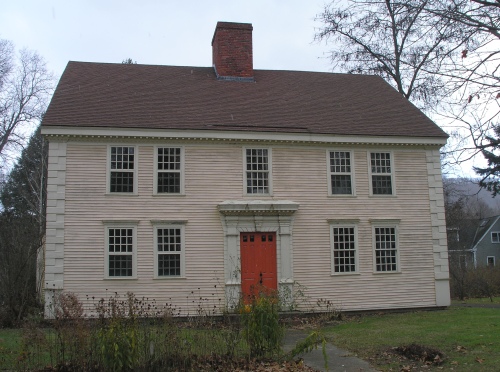
Jonathan Hoyt House (1755)
by Dan/November 25, 2008September 17, 2016/Colonial, Deerfield, Houses

deerfield-parsonage.jpg

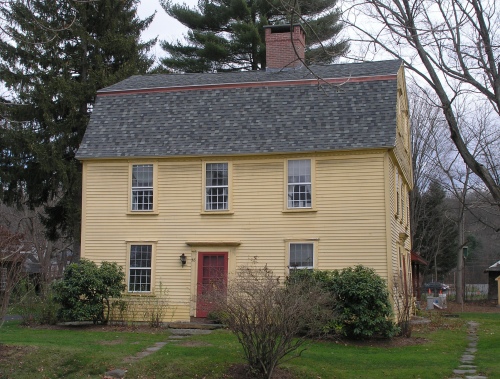
Built around 1755, in the Cheapside section of Deerfield, the Jonathan Hoyt House was once the home of Rev. Henry Colman, a prominent agriculturalist. Colman had become an ordained minister, but ill health forced him to retire as a pastor. He devoted himself to agriculture, in the 1830s purchasing the Hoyt Farm and the White Horse Inn, as the Hoyt House had come to be called. Later, the house was moved to Greenfield, but in 1965-1966, at the urging of John Radovich, who had grown up in the house, the building was moved to the Street in Old Deerfield and restored in the Colonial Revival style to serve as a parsonage for the First Church of Deerfield.
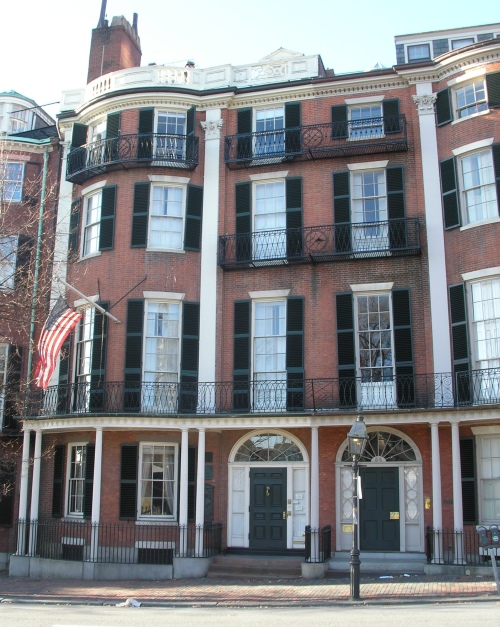
William Hickling Prescott House (1808)

by Dan/November 24, 2008September 17, 2016/Boston, Federal, Houses

prescott-house.jpg

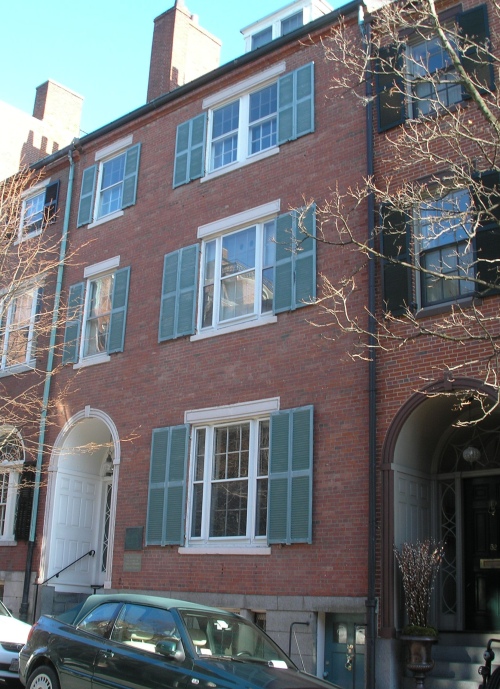
William Hickling Prescott was an important nineteenth century historian who is best known for his works, History of the Conquest of Mexico (1843) and History of the Conquest of Peru (1847). The latter work was written in a house that Prescott lived in on Beacon Street in Boston from 1845 to 1859. The 1808 house (on the left in the photo above) was designed by Asher Benjamin and features Greek design motifs and a Federal style doorway. William Makepeace Thackeray, a friend of Prescott, visited the house. Thackeray was as inspired to write his novel, The Virginians (1859), after seeing two crossed swords displayed in the home, one belonging to Prescott‘s grandfather (Col. William Prescott) and one by Prescott’s wife’s father (Capt. John Linzee), each on opposing sides at the Battle of Bunker Hill. The Prescott House is now a museum and the headquarters of the National Society of the Colonial Dames of America in the Commonwealth of Massachusetts.

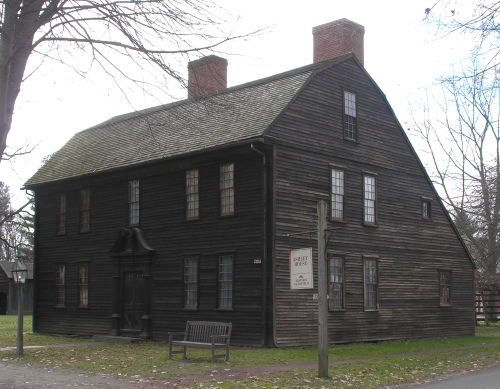
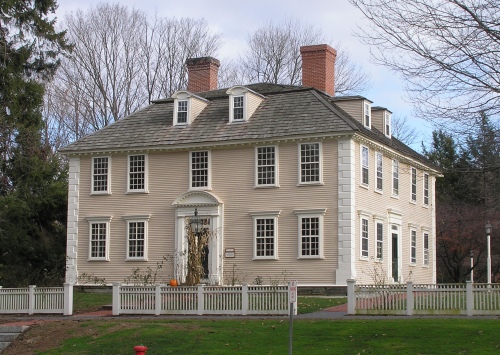
The Manse [Deerfield Academy] (1768)

by Dan/November 23, 2008January 24, 2011/Colonial, Deerfield, Houses

manse-deerfield-academy.jpg

The building in Old Deerfield known as the Manse, or the Willard House, is a 1768 Georgian mansion that was at one time the home of Rev. Samuel Willard. An earlier house, constructed in 1694, was already on the lot when the land was sold by Samuel Allen, the grandfather of Ethan Allen, to Samuel Barnard of Salem. Barnard bequeathed the land to his nephew, Joseph Barnard, who built the Manse in 1768, spending thirteen years selecting wood without knots. The earlier gambrel roofed building became the current ell. The Barnards continued to live in the house until 1795 when, facing financial difficulties, Samuel Barnard moved his family to Vermont. In 1807, the house was rented to Hosea Hildreth, preceptor at Deerfield Academy, whose son Richard Hildreth, later author of a well-known History of the United States, was born in the house. In 1811, the house was bought by Rev. Samuel Willard, who had already been living there since 1807 and would own the house until his death in 1859. Dr. Willard was the first Unitarian minister in Western Massachusetts and entertained such visitors as Charles Sumner, Horace Greeley and Ralph Waldo Emerson in the house. Willard’s heirs sold the home in 1885 and it had other owners. Today it serves as the residence of the Head of School of Deerfield Academy.
Edit (01/24/2011): A book about the house was published in 1887, Story of the Old Willard House of Deerfield, Mass., by Catharine B. Yale.

Rev. Jonathan Ashley House (1734)

by Dan/November 22, 2008September 17, 2016/Colonial, Deerfield, Houses

ashley-house.jpg

Rev. Jonathan Ashley was the second minister in Deerfield, serving from 1712 to 1780. He married Dorothy Williams, the daughter of the Rev. William Williams of Hatfield. Given a home lot in town, he constructed his house around 1734. Originally having a center chimney, the house was modified by Ashley in the 1750s into a center hallway home with a distinctive Connecticut River Valley doorway. As one of the elite Valley citizens known as “River Gods,” Ashley installed fine paneling in his home and furnished it with high style furniture. By the twentieth century, the house had been moved back on the lot and replaced with a nineteenth century Italianate style house. The former “mansion house” was now used as a tobacco barn. It was restored (the current doorway is a reproduction) and moved back to a position in the Street by the founders of Historic Deerfield, Henry and Helen Flynt. In 1948, the house became their first restoration opened to the public. It currently houses an extensive collection of Connecticut River Valley antiques.

Francis Parkman House (1830)

by Dan/November 22, 2008September 17, 2016/Boston, Federal, Houses

francis-parkman-house.jpg

Francis Parkman was one of nineteenth century America’s most noted historians. His first book, The Oregon Trail (1849), became a classic and he went on to write his multi-volume epic, France and England in North America. From 1865 until his death in 1893, Francis Parkman resided at a house at 50 Chestnut Street on Boston’s Beacon Hill. It is one of several houses built sometime in the late 1820s or 1830s by Cornelius Coolidge.

Here’s an additional photo and a list of Parkman‘s works (with links to Google Books) which, although dated in many ways, are considered to be significant literary works: Continue reading “Francis Parkman House (1830)”

Wilson Printing Office (1816)

by Dan/November 21, 2008/Commercial, Deerfield, Federal

wilson-printing-office.jpg

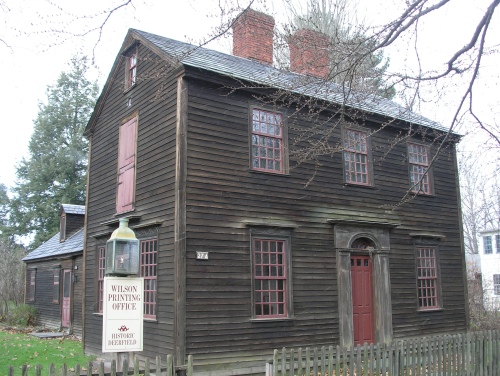
The Wilson Printing Office, in Old Deerfield, was originally built in 1816 by Col. John Wilson (1782-1869) on the lot of his father-in-law, Horatio Hoyt. In the building, he printed broadsides and reprints of popular works. Wilson also printed works by his brother-in-law, Rudolphus Dickinson, a minister and his partner at the press before 1820. In later years, the building would be moved five times within Deerfield until 1951, when Henry Flynt restored the building to its original site to become part of Historic Deerfield. In restoring the structure, Flynt referred to an 1820 sketch by Wilson’s daughter, Mary Hoyt Wilson (1809-1841).

John Nims House (1744)

by Dan/November 21, 2008September 17, 2016/Colonial, Deerfield, Houses

nims-house.jpg

The ancestor of the Nims family in America, Godfrey Nims, a cordwainer, arrived in Deerfield around 1670. The current Nims House in Old Deerfield is the third to be built on the site. The first was constructed by Godfrey Nims around 1685. This house burned in the 1704 French and Indian raid and was rebuilt by John Nims in 1710. This second structure may have been added as an ell to the third and current house, built around 1744 (1740-1750) (this ell was significantly altered around 1808). The house served as a Post Office from 1816 to 1831. The property went out of the family in the 1890s, but was bought by two Nims descendants in 1936, who deeded it to Deerfield Academy in 1938. The house has since been used as a dormitory and faculty residence. There is HABS documentation on this house.

Posts navigation

Older posts
Newer posts
Privacy Policy

Categories

  • Architectural Style (943)
    • Art Deco (9)
    • Byzantine (3)
    • Colonial (177)
    • Colonial Revival (85)
    • Craftsman (6)
    • Egyptian Revival (1)
    • Federal (190)
    • Foursquare (6)
    • Gothic (67)
    • Greek Revival (100)
    • Italianate (82)
    • Mission Revival (2)
    • Mission/Spanish Colonial (1)
    • Modern (2)
    • Neoclassical (56)
    • Octagon (3)
    • Postmodern (1)
    • Queen Anne (46)
    • Renaissance Revival (26)
    • Romanesque Revival (53)
    • Second Empire (26)
    • Shingle Style (12)
    • Stick Style (13)
    • Tudor Revival (8)
    • Vernacular (49)
    • Victorian Eclectic (15)
  • Building Type (943)
    • Apartment Buildings (8)
    • Banks (18)
    • Churches (119)
    • Collegiate (32)
    • Commercial (102)
    • Hotels (16)
    • Houses (508)
    • Industrial (23)
    • Libraries (22)
    • Lighthouses (1)
    • Military (15)
    • Monuments (1)
    • Museums (12)
    • Organizations (39)
    • Outbuildings (17)
    • Public Buildings (50)
    • Schools (23)
    • Stations (5)
    • Synagogues (1)
    • Taverns (21)
    • Theaters (9)
  • Town (943)
    • Adams (11)
    • Agawam (4)
    • Amherst (50)
    • Boston (64)
    • Boylston (6)
    • Cambridge (30)
    • Clinton (21)
    • Concord (15)
    • Cummington (1)
    • Danvers (14)
    • Deerfield (31)
    • Gloucester (18)
    • Granville (10)
    • Great Barrington (2)
    • Hadley (9)
    • Hancock (15)
    • Harvard (32)
    • Holyoke (47)
    • Lenox (5)
    • Lexington (8)
    • Longmeadow (32)
    • Marblehead (40)
    • Marlborough (4)
    • Natick (22)
    • Newton (2)
    • Northampton (68)
    • Peabody (4)
    • Pittsfield (20)
    • Salem (110)
    • Saugus (4)
    • Sheffield (4)
    • South Hadley (8)
    • Southborough (8)
    • Southwick (4)
    • Springfield (67)
    • Stockbridge (19)
    • Stow (1)
    • Sturbridge (18)
    • Sudbury (7)
    • Waltham (11)
    • Watertown (1)
    • Wayland (8)
    • West Springfield (14)
    • Westfield (46)
    • Weston (2)
    • Worcester (26)
  • Uncategorized (1)

Recent Comments

  • Wilber Blackson on South Hadley
  • Tami Speiden on Stockbridge
  • DexGuru on Stockbridge

Tags

Alcott Amherst College Asher Benjamin Back Bay Baptist Beacon Hill Big E Black Heritage Trail bowfront Bulfinch Catholic Congregational Episcopal Freedom Trail Gambrel H.H. Richardson Harvard Hawthorne Historic Deerfield Isaac Damon lit Longfellow mansard Methodist Mount Holyoke Museum Museums NPS Old Sturbridge Village PEM Revolutionary War row houses saltbox Samuel McIntire Shakers Smith College SPNEA Springfield Armory Stephen C. Earle Storrowton Underground Railroad UU Washington William Fenno Pratt Witch Trials

Meta

  • Log in
  • Entries feed
  • Comments feed
  • WordPress.org
Proudly powered by WordPress | Theme: ShowMe by NEThemes.