Historic Buildings of Massachusetts

  • About
  • Index by Town
  • CT
  • About
  • Index by Town
  • CT

Tag: Museum

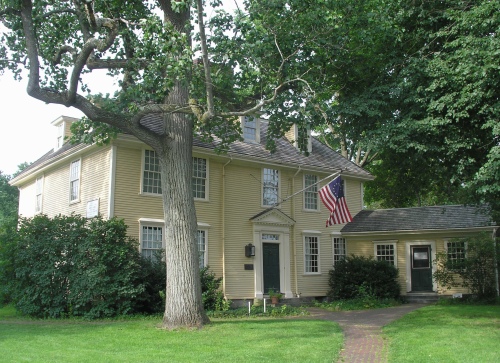
Buckman Tavern (1690)
by Dan/July 25, 2009July 25, 2009/Colonial, Lexington, Taverns

Buckman Tavern

Buckman Tavern, off Lexington Green, was built in 1690 by Benjamin Muzzey and by a license granted in 1693, it became the first Public House in Lexington. In the coming years it was run by Muzzey‘s son John, then by John’s granddaughter and her husband, John Buckman. By the 1770s, Buckman Tavern had become the favored gathering place for local militia men (members of the Lexington Training Band) on the days they trained on the Green. On April 19, 1775, it was here that the militia gathered before facing the British troops, when the first shot was fired which began the Revolutionary War. The Tavern continued to be Lexington’s busiest after the war and housed the towns first village store and post office. The town of Lexington acquired the Tavern in 1913 and, by a 99-year lease, the Lexington Historical Society undertook the furnishing of the building, which is open to the public as a museum.
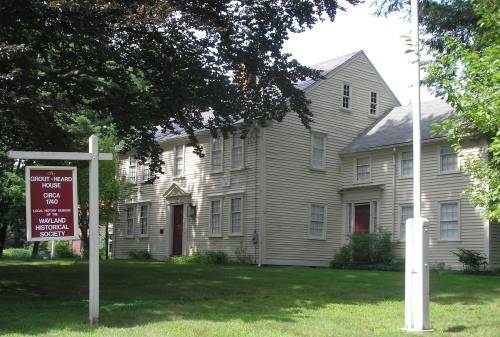
Grout-Heard House (1740)

by Dan/July 23, 2009September 17, 2016/Colonial, Houses, Wayland

Grout-Heard House

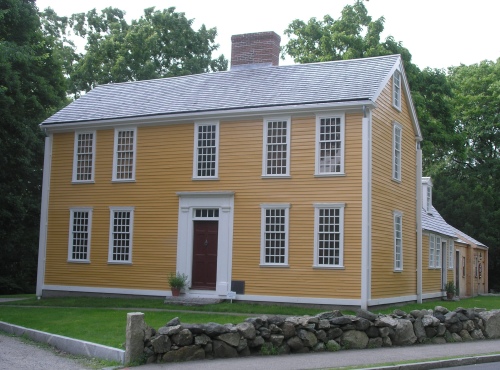
When the Town of Wayland built a new town hall in 1878, the historic Grout-Heard House had to be moved from its original location, on Cochituate Road, to a new lot nearby. The town hall was demolished in 1958 and in 1962, the house was moved back to its original location! The house was probably built around 1740 by Jonathan Grout, descendant of an early settler of Wayland (then part of Sudbury). In 1744, he sold it to his brother-in-law, Richard Heard. The house was later sold out of the family and at the time of the Battles of Lexington and Concord housed the store of Elijah Bent. In 1787, the house was acquired by Silas Grout, a blacksmith, who operated his shop just south of the house. Silas Grout enlarged the house and updated the facade. One of his daughters, Jerusaha Grout, married Newell Heard, a shopkeeper. Their son, John Augustus Heard, was a noted photographer in the nineteenth century and his wife, Sarah Hawkes Heard, was Wayland’s librarian at the end of the century. In 1955, Raytheon Corporation bought the house and donated it to the Wayland Historical Society. Now, placed just a few feet back from its original foundation, the house is open as a museum.

Gore Place (1806)

by Dan/July 22, 2009/Federal, Houses, Waltham

Gore Place

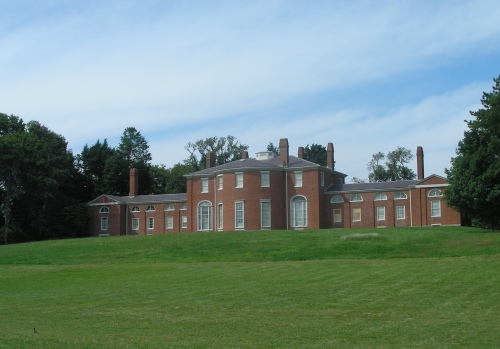
Christopher Gore, born in Boston, was a lawyer and Federalist politician, who served as Governor of Massachusetts (1808-1810) and a United States Senator (1813-1816). Earlier, Gore had spent eight years in Britain, initially as a commissioner to the Jay Treaty in 1796. It was during this time, in 1799, that his country mansion in Waltham, built in 1793, burned down. Gore and his wife, Rebecca Amory Payne, influenced by the estates they had seen in Europe, planed the construction of a new mansion after their return home in 1804. Called Gore Place, it was completed in 1805. Christopher Gore retired to his estate in 1816, but declining health led him to return to Boston in 1822, where he lived until his death in 1827. After Mrs. Gore’s death, the house was sold at auction. Other families lived there in the following years and in 1921 the house and grounds became home to a country club. The house was saved from demolition in 1935 by Gore Place Society and the restored mansion has since been open to the public.

Hancock-Clarke House (1698)

by Dan/July 20, 2009September 17, 2016/Colonial, Houses, Lexington

Hancock-Clarke House

The Hancock-Clarke House in Lexington began as a small parsonage, built by the Reverend John Hancock in 1698. It was enlarged by his son Thomas, a wealthy Boston merchant, in 1738. The minister’s grandson was the John Hancock who signed the Declaration of Independence. The Reverend Jonas Clarke, Rev. Hancock’s son-in-law, occupied the house when he succeeded Hancock as minister in Lexington. Rev. Clarke was an inspiring figure for the Patriots during the period leading up to the Revolutionary War. On the evening of April 18, 1775, John Hancock and Samuel Adams were staying in the house when William Dawes and Paul Revere arrived separately to warn them that British troops were approaching. This historic home faced demolition in 1896, when it was acquired by the Lexington Historical Society and moved across the street from its original location. It is now a museum open to the public. In 2008, the house underwent a large scale structural restoration.

Hosmer House (1793)

by Dan/July 19, 2009September 17, 2016/Federal, Houses, Sudbury

Hosmer House

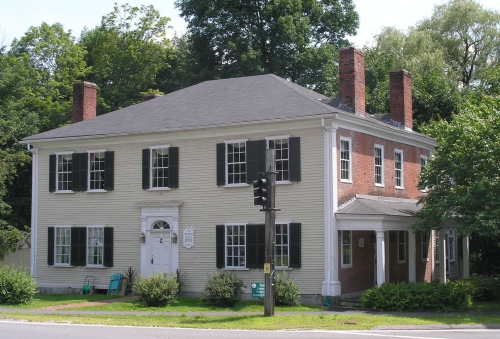
The Hosmer House, at the intersection of Concord and Old Sudbury Roads in Sudbury Center, is a 1793 Federal-style house with a brick end facing Concord Road. It was built by Elisha Wheeler and Asher Goodnow as a commercial venture and was purchased by Ella and James Willis, who ran a general store and post office out of the building, with a ballroom above and a cobbler’s shop attached on the side. A retired Congregational minister, the Rev. Edwin Barrett Hosmer, bought the house in 1897 and lived there with his wife, Abbie Louisa Ames. Their daughter, Florence Ames Hosmer, was an artist and lived in the house until her death in 1978. The historic building had already been deeded to the town as a memorial to her father, along with nearly 500 of her paintings. The house, which displays many of the paintings, is now the headquarters of the Sudbury Historical Commission and is opened to the public on many holidays and special occasions. There is a pdf brochure for the house.

Lyman Estate (1793)

by Dan/July 17, 2009September 17, 2016/Federal, Houses, Waltham

Lyman Estate

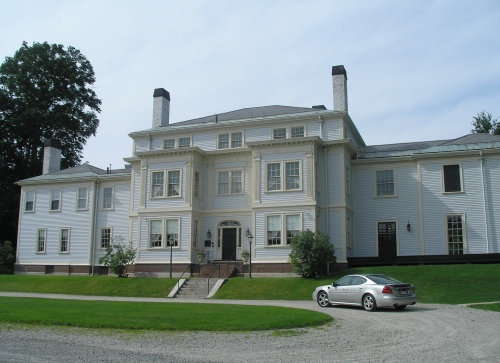
The Lyman Estate, formerly known as “The Vale,” is a country estate in Waltham, originally established in 1793 by Boston merchant Theodore Lyman. The Estate’s grand Federal-style mansion was completed in 1798 and was designed by the Salem architect, Samuel McIntire. The mansion remained in the Lyman family as a summer home for the next century-and-a-half. Lydia Lyman Paine, daughter of nineteenth century owner George Lyman, married Robert Treat Paine, who built Stonehurst on a neighboring estate. The Lyman family added an upper story to their house in 1882. The estate, now owned by Historic New England, is known for its greenhouses (the earliest of which dates to 1800), which are open to the public.

Stonehurst, the Robert Treat Paine Estate (1886)

by Dan/July 16, 2009December 30, 2012/Houses, Romanesque Revival, Second Empire, Shingle Style, Victorian Eclectic, Waltham

Stonehurst

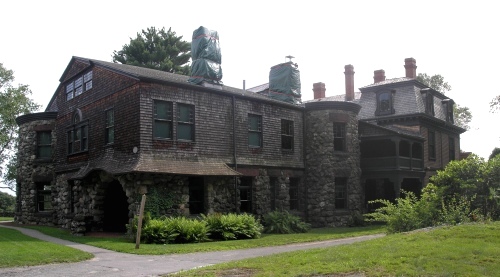
Stonehurst was the country house of Robert Treat Paine, Jr., a lawyer, housing reformer and great grandson of a signer of the Declaration of Independence. Located in Waltham, the earliest part of the house was a Second Empire building, designed by Gridley James Fox Bryant and constructed in 1866 for Paine and his wife, Lydia Lyman Paine. This house was moved to a new site atop a ridge and a large addition in the Shingle style was designed by the architect H.H. Richardson. Begun in 1884, the project was almost complete when Richardson died in 1886. In collaboration with Richardson was the great landscape architect, Frederick Law Olmsted. The organic relationship of the completed house and the landscape is a notable feature of what is considered to be an architectural masterpiece. The estate was given to the City of Waltham and is open to the public.

Posts navigation

Older posts
Newer posts
Privacy Policy

Categories

  • Architectural Style (943)
    • Art Deco (9)
    • Byzantine (3)
    • Colonial (177)
    • Colonial Revival (85)
    • Craftsman (6)
    • Egyptian Revival (1)
    • Federal (190)
    • Foursquare (6)
    • Gothic (67)
    • Greek Revival (100)
    • Italianate (82)
    • Mission Revival (2)
    • Mission/Spanish Colonial (1)
    • Modern (2)
    • Neoclassical (56)
    • Octagon (3)
    • Postmodern (1)
    • Queen Anne (46)
    • Renaissance Revival (26)
    • Romanesque Revival (53)
    • Second Empire (26)
    • Shingle Style (12)
    • Stick Style (13)
    • Tudor Revival (8)
    • Vernacular (49)
    • Victorian Eclectic (15)
  • Building Type (943)
    • Apartment Buildings (8)
    • Banks (18)
    • Churches (119)
    • Collegiate (32)
    • Commercial (102)
    • Hotels (16)
    • Houses (508)
    • Industrial (23)
    • Libraries (22)
    • Lighthouses (1)
    • Military (15)
    • Monuments (1)
    • Museums (12)
    • Organizations (39)
    • Outbuildings (17)
    • Public Buildings (50)
    • Schools (23)
    • Stations (5)
    • Synagogues (1)
    • Taverns (21)
    • Theaters (9)
  • Town (943)
    • Adams (11)
    • Agawam (4)
    • Amherst (50)
    • Boston (64)
    • Boylston (6)
    • Cambridge (30)
    • Clinton (21)
    • Concord (15)
    • Cummington (1)
    • Danvers (14)
    • Deerfield (31)
    • Gloucester (18)
    • Granville (10)
    • Great Barrington (2)
    • Hadley (9)
    • Hancock (15)
    • Harvard (32)
    • Holyoke (47)
    • Lenox (5)
    • Lexington (8)
    • Longmeadow (32)
    • Marblehead (40)
    • Marlborough (4)
    • Natick (22)
    • Newton (2)
    • Northampton (68)
    • Peabody (4)
    • Pittsfield (20)
    • Salem (110)
    • Saugus (4)
    • Sheffield (4)
    • South Hadley (8)
    • Southborough (8)
    • Southwick (4)
    • Springfield (67)
    • Stockbridge (19)
    • Stow (1)
    • Sturbridge (18)
    • Sudbury (7)
    • Waltham (11)
    • Watertown (1)
    • Wayland (8)
    • West Springfield (14)
    • Westfield (46)
    • Weston (2)
    • Worcester (26)
  • Uncategorized (1)

Recent Comments

  • Wilber Blackson on South Hadley
  • Tami Speiden on Stockbridge
  • DexGuru on Stockbridge

Tags

Alcott Amherst College Asher Benjamin Back Bay Baptist Beacon Hill Big E Black Heritage Trail bowfront Bulfinch Catholic Congregational Episcopal Freedom Trail Gambrel H.H. Richardson Harvard Hawthorne Historic Deerfield Isaac Damon lit Longfellow mansard Methodist Mount Holyoke Museum Museums NPS Old Sturbridge Village PEM Revolutionary War row houses saltbox Samuel McIntire Shakers Smith College SPNEA Springfield Armory Stephen C. Earle Storrowton Underground Railroad UU Washington William Fenno Pratt Witch Trials

Meta

  • Log in
  • Entries feed
  • Comments feed
  • WordPress.org
Proudly powered by WordPress | Theme: ShowMe by NEThemes.