Historic Buildings of Massachusetts

  • About
  • Index by Town
  • CT
  • About
  • Index by Town
  • CT

Tag: Museum

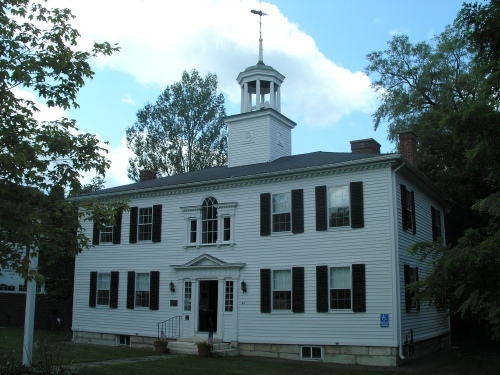
Lenox Academy (1803)
by Dan/August 11, 2009September 10, 2012/Federal, Lenox, Schools

Lenox Academy was built in 1803, on Main Street in Lenox. According to Rev. Raymond DeWitt Mallary, in Lenox and the Berkshire Highlands (1902), wrote:

To be a graduate of Lenox Academy was not only a distinction, it was a passport to any college, and often to the sophomore class of a higher institution of learning. The papers of the day within a radius of a hundred miles refer to this preparatory school with glowing commendation. Its pupils came from widely separated portions of the country and the fame of its examinations, which were of unusual rigidity, attracted visitors from long distances, who repaired to their homes to spread the report of them. The tuition was very moderate, —$7 a term of fourteen weeks; and board reached the not exorbitant sum of “$1.25 to $1.50 per week in good families.” The tradition has survived that one pupil (long a distinguished educator and only lately deceased) ” lived like a dandy because he had rooms at the hotel, for which he paid $2 per week.” Lenox Academy flourished until 1866.

The building housed various schools until the 1920s and was saved from demolition in 1947 when the town took it over. It housed various public organizations and today it is the headquarters of the Lenox Historical Society, which operates the Museum of Lenox History.
Ventfort Hall (1891)

by Dan/August 10, 2009/Houses, Lenox, Tudor Revival

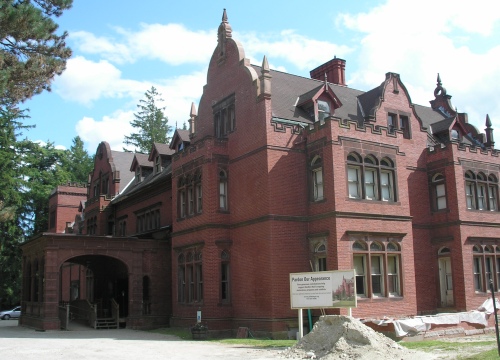
Ventfort Hall

Ventfort Hall, a Gilded Age mansion in Lenox, was built in 1891 by George Morgan and his wife, Sarah, the sister of J. Pierpont Morgan. The house was designed in the Elizabethan Revival style by the Boston architectural firm of Rotch & Tilden. The name of Venfort Hall is from vent fort, or “strong wind.” The house stands on the site once occupied by the Italianate villa owned by the Haggerty family. Annie Haggerty married Col. Robert Gould Shaw, who commanded the famous black regiment, the 54th Massachusetts, in the Civil War. After the Morgans died, the house passed through various renters and owners, eventually serving as a dormitory for Tanglewood students, a hotel, a summer ballet camp and housing for a religious community. In danger of being demolished, the Ventfort Hall Association (VHA) purchased the house in 1997, restoring it and opening it for tours and exhibits. The mansion appeared as the orphanage in the film The Cider House Rules (1998).

The Mount (1902)

by Dan/August 9, 2009June 29, 2013/Colonial Revival, Houses, Lenox, Neoclassical

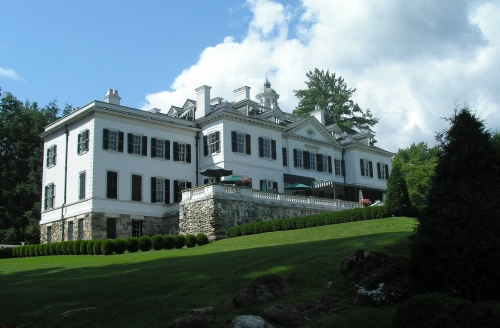
The Mount

Edith Wharton‘s first book, The Decoration of Houses (1897), written with Ogden Codman, Jr., was very influential as a guide to interior design. The work was a reaction to the Victorian style of heavily curtained and cluttered rooms, instead emphasizing the style of the harmonious and simply proportioned classical rooms of Europe. The main house of Wharton‘s country estate in the Berkshires, called the Mount and located in Lenox, was built in 1902 and displays the principles she had advocated in her book. The house, designed by Wharton with assistance from Codman, was inspired by the seventeenth century English estate, Belton House, but the Mount‘s design also drew strongly on classical Italian and French architecture. The gardens and grounds were also designed by Wharton, with the kitchen garden and drive being designed by Wharton‘s niece, Beatrix Jones Farrand.

Wharton and her husband, Edward, lived in the Mount from 1902 to 1911. The house was later used as a girls’ dormitory for the Foxhollow School, and the site of Shakespeare & Company. In the 1980s, the property was bought by Edith Wharton Restoration, which has restored the grounds and much of the house. The house was opened to the public in 2001, but in 2008 the institution, which had spent millions to acquire the surviving half of Edith Wharton’s collection of books, defaulted on loans and faced foreclosure. Please help save the Mount by visiting and spending money there! There is an online video available of Bob Villa taking a tour of the Mount. Below are some pictures and descriptions of some of the rooms at the Mount and the gardens: Continue reading “The Mount (1902)”

Arrowhead (1780)

by Dan/August 8, 2009June 29, 2013/Colonial, Houses, Pittsfield

Arrowhead 01

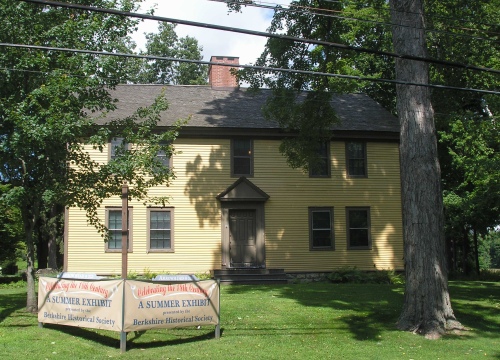
Arrowhead is the house in Pittsfield where Herman Malville wrote Moby Dick and other classic works. The house was built around 1780 by Captain David Bush and operated as an inn by Bush and his son. It originally had a much higher gambrel roof, but this was later removed, resulting in a lower roofline. There is a pdf file available of the house’s National Register of Historic Places Inventory nomination form. In the early nineteenth century, the house was the home of Melville’s Uncle Thomas and the author first visited the property, with its view of Mount Greylock, in 1832. In 1850, following the lead of his friend Hawthorne, who had also settled in nearby Lenox, Melville decided to move his family to the farm and they lived there until 1863. Melville named the house Arrowhead, because many arrowheads were dug up around the property during planting season. Shortly after buying Arrowhead, Melville added a side porch, after which his story “The Piazza” is named. These were productive years for Melville as a writer. During his time at Arrowhead, he wrote Moby Dick (1851), Pierre (1852), Israel Potter (1855), The Piazza Tales (1856), and The Confidence Man (1857). His story, “I and My Chimney,” has a description of the house as it appeared when Melville lived there. Not earning a living from his writing, Melville eventually returned to New York, taking a job as a customs inspector. He sold Arrowhead to his brother Allan and it remained in the Melville family until 1927. In 1975, the house was purchased by the Berkshire County Historical Society and restored to become a museum. Continue reading “Arrowhead (1780)”

Memorial Hall Museum, Deerfield (1799)

by Dan/August 6, 2009August 6, 2009/Deerfield, Federal, Museums, Schools

Memorial Hall

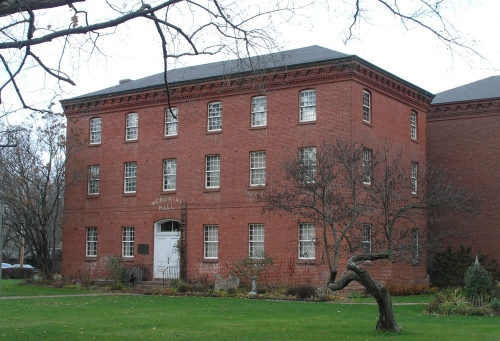
Deerfield Academy was founded in 1797 and a brick building, designed by Asher Benjamin, was built to house the school in 1799. The Academy later expanded and the Pocumtuck Valley Memorial Association purchased the old school building in 1877. The building was renovated and opened in 1880 as the Memorial Hall Museum, displaying a collection of objects gathered by antiquarian George Sheldon. Memorial Hall continues today as a museum of Deerfield history and an adjacent building houses the libraries of the PVMA and Historic Deerfield.

Longfellow’s Wayside Inn (1716)

by Dan/July 31, 2009June 29, 2013/Colonial, Sudbury, Taverns

Wayside Inn

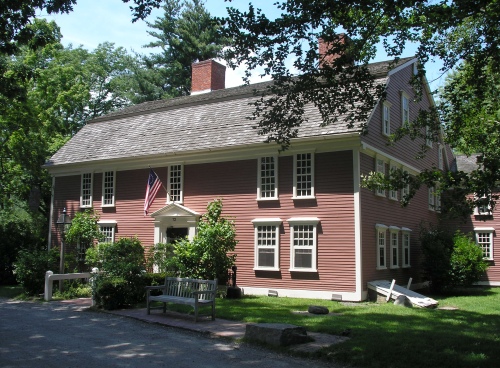
The Wayside Inn in Sudbury is the oldest operating Inn in the United States and was immortalized in Henry Wadsworth Longfellow‘s sequence of poems, Tales of a Wayside Inn (1863). Built in 1716, the Inn was first known as Howe’s Tavern, for its first innkeeper, David Howe. His descendants continued to operate the Inn, adding to the original structure over time, until 1861. These included Howe’s son, Ezekiel, who led the Sudbury militia to Concord for the battle of April 19, 1775. After passing from the Howes to new owners, the Inn served as a boarding house for temporary lodgers. In October of 1862, Longfellow and his publisher, James Fields, visited the Inn and this inspired the poet to write Tales of a Wayside Inn, which became a bestseller. Although it continued to serve as a boarding house, the Wayside Inn soon began to attract tourists, anxious to see the place which had captured the public imagination. In 1896, Edward Rivers Lemon, a wealthy Medford wool merchant, purchased the Inn as a business venture, inviting the Society of Colonial Wars to meet there in 1897. On that occasion, the orator Samuel Arthur Bent gave a speech entitled: “The Wayside Inn—Its History and Literature.” Lemon intended the Inn to be a literary and artistic retreat and a group artists, poets, and writers, known as the Paint and Clay Club, met there frequently.

The Wayside Inn entered a new phase of its existence when it was purchased by Henry Ford in 1923. He intended to create a living museum of Americana centered on the historic building and bought many acres of land around it. He built a gristmill and the non-denominational Martha-Mary Chapel on the property and and also relocated a schoolhouse from Sterling, which he believed was the actual building mentioned in Sarah Josepha Hale‘s poem “Mary Had a Little Lamb.” The property was placed in a non-profit trust in 1947, with many representatives of the Ford family on the Board, and this transitioned to governance by the National Trust for Historic Preservation in 1957. Restoration of the Inn was necessary, with help from the Ford family, after a devastating fire in December 1955. As of 1960, the Inn came under the governance of local trustees. There would be no further support coming from Ford interests and there was no endowment, but by this time the Inn had become self-sufficient as an inn, restaurant and museum.
Below are pictures of some interiors in the museum section of the Inn: Continue reading “Longfellow’s Wayside Inn (1716)”

Munroe Tavern (1695)

by Dan/July 30, 2009July 31, 2009/Colonial, Lexington, Taverns

Munroe Tavern

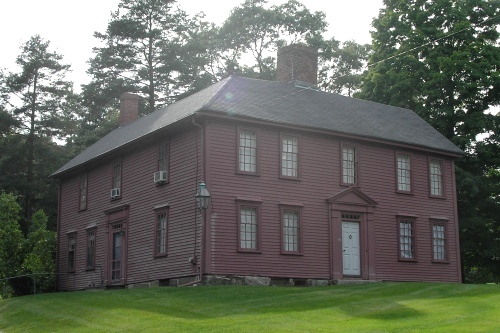
Munroe Tavern, located one mile east of Lexington Common, was built around 1695. The Tavern is named for William Munroe, who was its proprietor from 1770 to 1827. Munroe was also an orderly sergeant in Captain Parker’s minuteman company in 1775. During the Battle of Lexington, on April 19, 1775, the Tavern was occupied by the British for an hour-and-a-half. The Tavern‘s dining room became a field hospital and Brigadier General Earl Percy, who arrived with British reinforcements, used it as his headquarters. George Washington dined at the Tavern during his 1789 visit to the Lexington battlefield. The Tavern is now a museum operated by the Lexington Historical Society.

Posts navigation

Older posts
Newer posts
Privacy Policy

Categories

  • Architectural Style (943)
    • Art Deco (9)
    • Byzantine (3)
    • Colonial (177)
    • Colonial Revival (85)
    • Craftsman (6)
    • Egyptian Revival (1)
    • Federal (190)
    • Foursquare (6)
    • Gothic (67)
    • Greek Revival (100)
    • Italianate (82)
    • Mission Revival (2)
    • Mission/Spanish Colonial (1)
    • Modern (2)
    • Neoclassical (56)
    • Octagon (3)
    • Postmodern (1)
    • Queen Anne (46)
    • Renaissance Revival (26)
    • Romanesque Revival (53)
    • Second Empire (26)
    • Shingle Style (12)
    • Stick Style (13)
    • Tudor Revival (8)
    • Vernacular (49)
    • Victorian Eclectic (15)
  • Building Type (943)
    • Apartment Buildings (8)
    • Banks (18)
    • Churches (119)
    • Collegiate (32)
    • Commercial (102)
    • Hotels (16)
    • Houses (508)
    • Industrial (23)
    • Libraries (22)
    • Lighthouses (1)
    • Military (15)
    • Monuments (1)
    • Museums (12)
    • Organizations (39)
    • Outbuildings (17)
    • Public Buildings (50)
    • Schools (23)
    • Stations (5)
    • Synagogues (1)
    • Taverns (21)
    • Theaters (9)
  • Town (943)
    • Adams (11)
    • Agawam (4)
    • Amherst (50)
    • Boston (64)
    • Boylston (6)
    • Cambridge (30)
    • Clinton (21)
    • Concord (15)
    • Cummington (1)
    • Danvers (14)
    • Deerfield (31)
    • Gloucester (18)
    • Granville (10)
    • Great Barrington (2)
    • Hadley (9)
    • Hancock (15)
    • Harvard (32)
    • Holyoke (47)
    • Lenox (5)
    • Lexington (8)
    • Longmeadow (32)
    • Marblehead (40)
    • Marlborough (4)
    • Natick (22)
    • Newton (2)
    • Northampton (68)
    • Peabody (4)
    • Pittsfield (20)
    • Salem (110)
    • Saugus (4)
    • Sheffield (4)
    • South Hadley (8)
    • Southborough (8)
    • Southwick (4)
    • Springfield (67)
    • Stockbridge (19)
    • Stow (1)
    • Sturbridge (18)
    • Sudbury (7)
    • Waltham (11)
    • Watertown (1)
    • Wayland (8)
    • West Springfield (14)
    • Westfield (46)
    • Weston (2)
    • Worcester (26)
  • Uncategorized (1)

Recent Comments

  • Wilber Blackson on South Hadley
  • Tami Speiden on Stockbridge
  • DexGuru on Stockbridge

Tags

Alcott Amherst College Asher Benjamin Back Bay Baptist Beacon Hill Big E Black Heritage Trail bowfront Bulfinch Catholic Congregational Episcopal Freedom Trail Gambrel H.H. Richardson Harvard Hawthorne Historic Deerfield Isaac Damon lit Longfellow mansard Methodist Mount Holyoke Museum Museums NPS Old Sturbridge Village PEM Revolutionary War row houses saltbox Samuel McIntire Shakers Smith College SPNEA Springfield Armory Stephen C. Earle Storrowton Underground Railroad UU Washington William Fenno Pratt Witch Trials

Meta

  • Log in
  • Entries feed
  • Comments feed
  • WordPress.org
Proudly powered by WordPress | Theme: ShowMe by NEThemes.