Historic Buildings of Massachusetts

  • About
  • Index by Town
  • CT
  • About
  • Index by Town
  • CT

Tag: Museum

Bacon Free Library (1881)
by Dan/July 10, 2010June 12, 2011/Libraries, Natick, Renaissance Revival

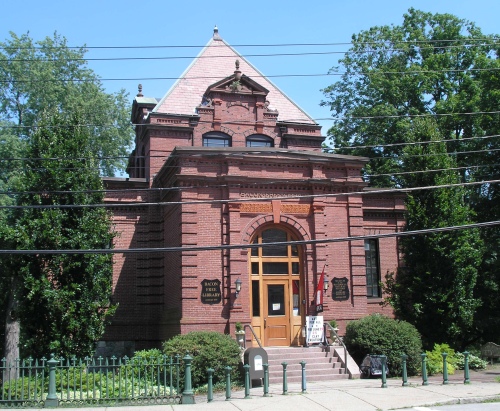
Funding for the Bacon Free Library, which overlooks the Charles River in South Natick, came from the estate of Oliver Bacon, who died in 1878, in memory of his wife. She had been the first librarian of the Bacon Library’s predecessor, which was initially located in her own home and then in a small brick building built in 1870. The Bacon Free Library, built in 1880-1881, also houses the Natick Historical Society Museum on the building’s lower level.
African Meeting House, Boston (1806)

by Dan/May 6, 2010/Boston, Churches, Federal

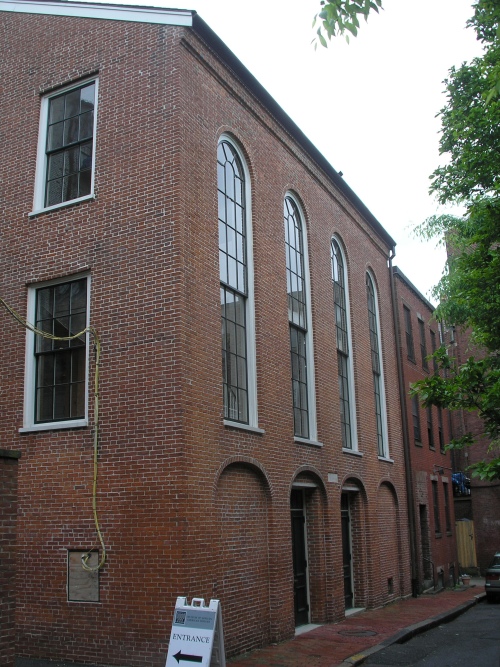
The African Meeting House on Beacon Hill in Boston was built in 1806 to house the first African Baptist Church of Boston, known as the First Independent Baptist Church. A commemorative inscription above the front door reads, “Cato Gardner, first Promoter of this Building 1806.” Cato Gardner, born in Africa, raised more than $1,500 toward the total $7,700 needed to construct the Meeting House. The building, which was constructed almost entirely with black labor, served as the cultural, educational and political center of Boston’s black community for many decades. In 1808, Primus Hall‘s school relocated from the adjacent carpenter’s shop to the Meeting House, using a schoolroom funded by Abiel Smith. It later moved to the Abiel Smith School next door. William Lloyd Garrison held the founding meeting of the New England Anti-Slavery Society in the Meeting House on January 6, 1832. The building, which has a facade adapted from the design for a townhouse published by Boston architect Asher Benjamin, was remodeled in the 1850s, with the windows being elongated and converted to having arched tops.

The Baptist congregation moved to Boston’s South End in 1898 and the Meeting House became the African Methodist Episcopal Church. By the late nineteenth century, many African Americans had moved to other neighborhoods and new immigrants occupied the neighborhood around the African Meeting House, which was sold in 1904 to the Hassidic Jewish Congregation Anshe Lebawitz. In 1972, the building was acquired by the Museum of African American History. The first phase of restoration work on the Meeting House was completed in 1987 and the building was opened to the public as a museum. The African Meeting House, the oldest surviving black church building in America, is also the last stop on the Black Heritage Trail.

First Harrison Gray Otis House (1796)

by Dan/May 5, 2010January 19, 2020/Boston, Federal, Houses

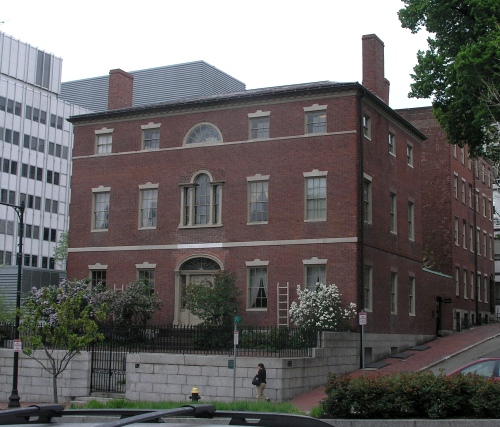
The first of three houses designed by Charles Bulfinch for Harrison Gray Otis is located on Cambridge Street in Boston. Otis was a Federalist lawyer and politician who became one of the wealthiest men in Boston in the early nineteenth century, developing the area of Beacon Hill. His brick house, with brownstone stringcourses, displays distinctive traits of the Federal style, including the semicircular window and side lights of the entryway on the first floor (added after 1801), the Palladian window on the second floor and the semicircular, or lunette, window on the shorter third floor. The Otis House‘s design was based on a house that Bulfinch saw in Philadelphia in 1789, the William Bingham House, which in turn was based on a house in London. By the 1830s, the Otis House had been subdivided and rented out and later became a boarding house. In 1916, restoration of the house was begun by the Society for the Preservation of New England Antiquities (Historic New England), which moved the house about 40 feet from its original location in 1926, to save it from a widening of Cambridge Street. Today the house is attached to additional buildings to the rear and serves as a museum and headquarters of Historic New England. Continue reading “First Harrison Gray Otis House (1796)”

Concord School of Philosophy (1880)

by Dan/November 11, 2009November 11, 2009/Concord, Schools, Vernacular

001

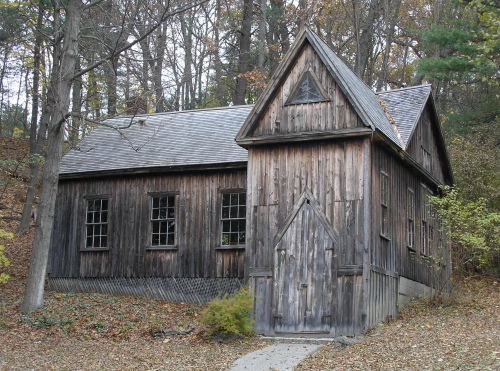
Adjacent to Orchard House (the home of A. Bronson Alcott and his family) is a building, designed and built by Alcott himself in 1880, which was originally called the Hillside Chapel and is known today as the Concord School of Philosophy. This school, which was organized by Alcott and operated from 1879 to 1888, was modeled on Plato’s Academy as series of of summer lectures for adults, with notable speakers and discussions of philosophy. For the first year, the sessions were held in Orchard House, but the following year and thereafter, the school met in Alcott’s Hillside Chapel. The school’s final meeting, in 1888, commemorated Alcott, who had died that year. Today, the building is part of the Orchard House museum. Continue reading “Concord School of Philosophy (1880)”

Joseph Moore House (1751)

by Dan/October 20, 2009January 20, 2020/Colonial, Houses, Southwick

Moore House

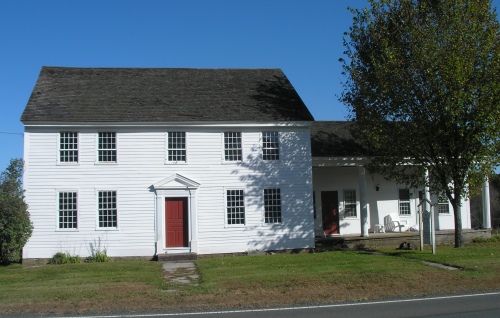
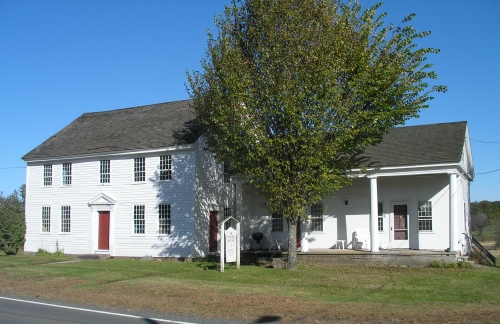
The Joseph Moore House is located in an area known as the Southwick Jog, a section of the town of Southwick that extends further south than the rest of the state border with Connecticut. The house was built in 1751 by Joseph Moore and was lived in by his son, Roger Moore (1752-1838), for his entire life. Owing to the many boundary changes which led to the creation of the Southwick Jog (which is surrounded by Connecticut on three sides), Roger Moore lived in two states, three counties, and four towns, without ever moving! The house has been restored as a museum by the Southwick Historical Society.

Richard Salter Storrs House (1786)

by Dan/August 29, 2009September 17, 2016/Colonial, Houses, Longmeadow

Storrs House 02

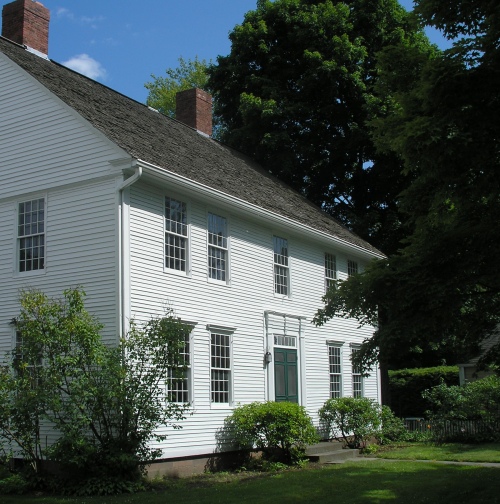
Richard Salter Storrs was the second pastor of Longmeadow’s First Congregational Church. Storrs, whose second wife, Sarah Williams, was the granddaughter of the congregation’s first pastor, Rev. Stephen Williams (one of the Deerfield captives of 1704), built his house in Longmeadow in 1786. The house remained in the Storrs family for many years and in the 1860s, Rev. Storrs granddaughter, Lucy Storrs Barber, ran a private girls’ school in the house. His grandson was Richard Salter Storrs III, minister at the Church of the Pilgrims in Brooklyn, New York. In 1907, this Rev. Storrs’ sister, Sarah Williams Storrs, left the family property in Longmeadow for use as a library (a building behind the house was used from 1916). In 1930, the Storrs House was moved to an adjacent site just to the south when a new library building was constructed (completed in 1932). At this time, the home’s original back kitchen ell was removed and not replaced. The Library continues to own the house, but in 1911, the Longmeadow Historical Society (founded in 1899) purchased the home‘s contents and offers tours of the building’s restored interiors.

Continue reading “Richard Salter Storrs House (1786)”

Waltham Museum (Old Waltham Police Station) (1892)

by Dan/August 27, 2009June 12, 2011/Public Buildings, Queen Anne, Waltham

Waltham Museum

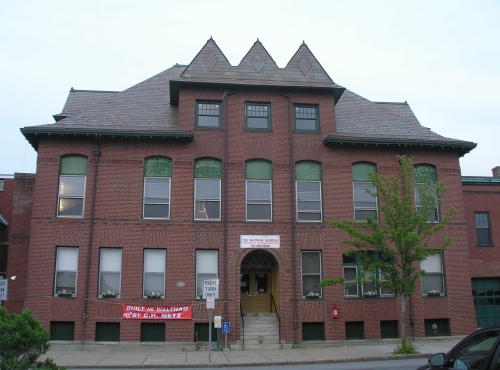
In 1871, an old schoolhouse on Lexington Street was converted to become Waltham’s Police Station. A new station was built adjacent to the earlier structure in 1892 and remained in service as a police station for seventy-two years. Afterward, it housed other city offices, but is now home to the Waltham Museum. Founded in 1971 by Al Arena, the Museum was housed for a time in the 1871 James Baker House, but from 2005 to 2007, the old Police Station was renovated to become the Museum’s new home.

Posts navigation

Older posts
Newer posts
Privacy Policy

Categories

  • Architectural Style (943)
    • Art Deco (9)
    • Byzantine (3)
    • Colonial (177)
    • Colonial Revival (85)
    • Craftsman (6)
    • Egyptian Revival (1)
    • Federal (190)
    • Foursquare (6)
    • Gothic (67)
    • Greek Revival (100)
    • Italianate (82)
    • Mission Revival (2)
    • Mission/Spanish Colonial (1)
    • Modern (2)
    • Neoclassical (56)
    • Octagon (3)
    • Postmodern (1)
    • Queen Anne (46)
    • Renaissance Revival (26)
    • Romanesque Revival (53)
    • Second Empire (26)
    • Shingle Style (12)
    • Stick Style (13)
    • Tudor Revival (8)
    • Vernacular (49)
    • Victorian Eclectic (15)
  • Building Type (943)
    • Apartment Buildings (8)
    • Banks (18)
    • Churches (119)
    • Collegiate (32)
    • Commercial (102)
    • Hotels (16)
    • Houses (508)
    • Industrial (23)
    • Libraries (22)
    • Lighthouses (1)
    • Military (15)
    • Monuments (1)
    • Museums (12)
    • Organizations (39)
    • Outbuildings (17)
    • Public Buildings (50)
    • Schools (23)
    • Stations (5)
    • Synagogues (1)
    • Taverns (21)
    • Theaters (9)
  • Town (943)
    • Adams (11)
    • Agawam (4)
    • Amherst (50)
    • Boston (64)
    • Boylston (6)
    • Cambridge (30)
    • Clinton (21)
    • Concord (15)
    • Cummington (1)
    • Danvers (14)
    • Deerfield (31)
    • Gloucester (18)
    • Granville (10)
    • Great Barrington (2)
    • Hadley (9)
    • Hancock (15)
    • Harvard (32)
    • Holyoke (47)
    • Lenox (5)
    • Lexington (8)
    • Longmeadow (32)
    • Marblehead (40)
    • Marlborough (4)
    • Natick (22)
    • Newton (2)
    • Northampton (68)
    • Peabody (4)
    • Pittsfield (20)
    • Salem (110)
    • Saugus (4)
    • Sheffield (4)
    • South Hadley (8)
    • Southborough (8)
    • Southwick (4)
    • Springfield (67)
    • Stockbridge (19)
    • Stow (1)
    • Sturbridge (18)
    • Sudbury (7)
    • Waltham (11)
    • Watertown (1)
    • Wayland (8)
    • West Springfield (14)
    • Westfield (46)
    • Weston (2)
    • Worcester (26)
  • Uncategorized (1)

Recent Comments

  • Wilber Blackson on South Hadley
  • Tami Speiden on Stockbridge
  • DexGuru on Stockbridge

Tags

Alcott Amherst College Asher Benjamin Back Bay Baptist Beacon Hill Big E Black Heritage Trail bowfront Bulfinch Catholic Congregational Episcopal Freedom Trail Gambrel H.H. Richardson Harvard Hawthorne Historic Deerfield Isaac Damon lit Longfellow mansard Methodist Mount Holyoke Museum Museums NPS Old Sturbridge Village PEM Revolutionary War row houses saltbox Samuel McIntire Shakers Smith College SPNEA Springfield Armory Stephen C. Earle Storrowton Underground Railroad UU Washington William Fenno Pratt Witch Trials

Meta

  • Log in
  • Entries feed
  • Comments feed
  • WordPress.org
Proudly powered by WordPress | Theme: ShowMe by NEThemes.