Historic Buildings of Massachusetts

  • About
  • Index by Town
  • CT
  • About
  • Index by Town
  • CT

Month: December 2010

Captain Samuel Fowler House (1809)
by Dan/December 10, 2010January 18, 2020/Danvers, Federal, Houses

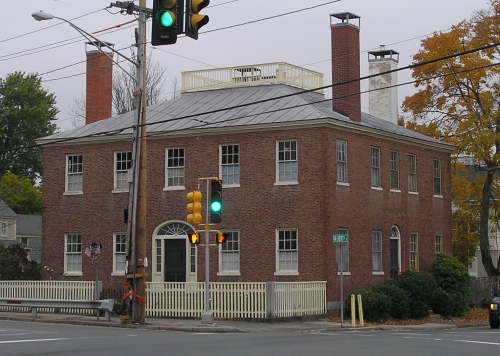
Describing Danversport, a section of Danvers, the 1916 Handbook of New England mentions that, “opposite the Baptist Church and facing the square is the Samuel Fowler house, a square brick structure built in 1809 and since 1912 the property of the Society for the Preservation of New England Antiquities. It is a fine old house in perfect preservation and occupied by the Misses Fowler, who are very liberal in the privileges they grant to callers who wish to inspect the house.” The two unmarried Fowlers had been granted life occupancy of the house, even as it was converted into a museum. Fowler was a local industrialist. As SPNEA founder, William Sumner Appleton, explained in the Society’s Bulletin, vol. III no. 1 (1912):

In 1799 he bought the land on which the house stands, and began investing in mills, two corn mills and a saw mill. His holdings of real estate were frequently added to, and he became interested in a total of five mills. He was the first to start the tanning industry in this part of Danvers, and with seven others shared the cost of building the bridge now known as Liberty Bridge. He was public-spirited and ever ready to aid financially such enterprises as tended to improve the village and town.

Some members were concerned that this second SPNEA acquisition was not grand enough for a Society purchase. In response, Appleton explained,

As might be expected, the Fowler home reflects the simple tastes of its owner. As seen from the square the house is as severely simple as it could be. It depends for its effect on its very simplicity and admirable proportions. […] The principal features of the house may be said to be simplicity, good taste, solid construction, splendid preservation, and homogeneity.

In a letter of May 1, 1923, writer H. P. Lovecraft described his visit to the house. Led by “Sibylline wraiths of decay’d gentry,” he was even able to try a coat and Capt. Fowler’s cap from the War of 1812! The house, no longer owned by the SPNEA, is now a private residence.
Col. John Page House (1793)

by Dan/December 9, 2010January 24, 2020/Colonial, Houses, Salem

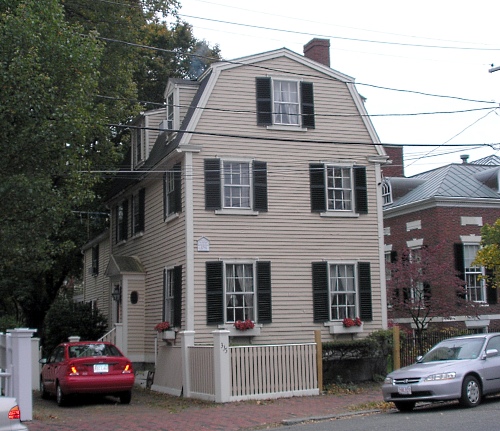
Built for Col. John Page, the gambrel-roofed house at 335 Essex Street in Salem dates to around 1793. As explained in “Early Recollections of the Upper Portion of Essex Street,” by Oliver Thayer, in Historical Collections of the Essex Institute (vol. XXI, nos. 7, 8, 9, 1884), the house was “for many years, the home of Capt. Thomas Holmes and then of Mr. Abbott Walker. It is now in the possession of Mr. Frank Cousins” Frank Cousins was a photographer and co-author of books such as The Wood-Carver of Salem: Samuel McIntire His Life and Work (1916) and The Colonial Architecture of Salem (1919). Continue reading “Col. John Page House (1793)”

General Gideon Foster House (1810)

by Dan/December 8, 2010January 17, 2020/Federal, Houses, Peabody

General Gideon Foster was a leader during the Revolutionary War from South Danvers, now Peabody. Leading the militia of South Danvers, he marched to the Battle of Lexington and Concord, fighting the British during their retreat to Boston at the Battle of Menotomy. He and his men also resupplied American forces at the Battle of Bunker Hill. Foster was made a General of Militia after the War. In 1815, he purchased a house, built in 1810 on Washington Street in South Danvers, and lived there from 1818 to 1831. During this time, Foster ran the grist, bark and chocolate mills that he had inherited from his father. After his death, others owned the house, which was acquired by the Peabody Historical Society in 1916 and continues to serve as its headquarters and museum.

William Goodwin House (1808)

by Dan/December 7, 2010January 22, 2020/Federal, Houses, Marblehead

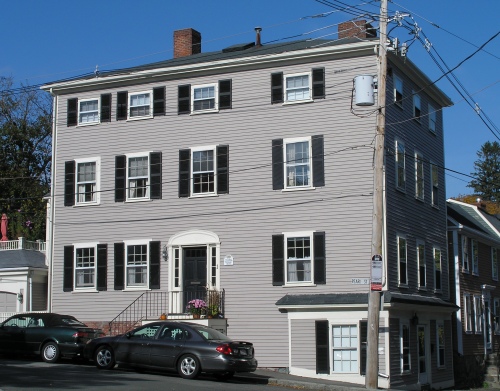
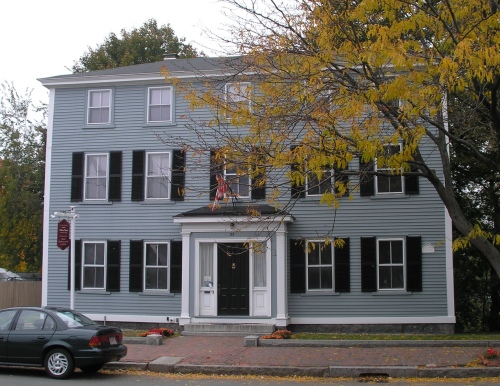
The William Goodwin House, a Federal-style residence built in 1808, is located at the intersection of Pearl and Washington streets in Marblehead. William Goodwin was a carpenter and the house was divided among his heirs after his death, remaining in the family for a century. For many years, the house’s first floor was used as a store. In more recent times, the house was renovated and made into a two family house.

Captain Stephen Phillips House (1805)

by Dan/December 6, 2010January 25, 2020/Federal, Houses, Salem

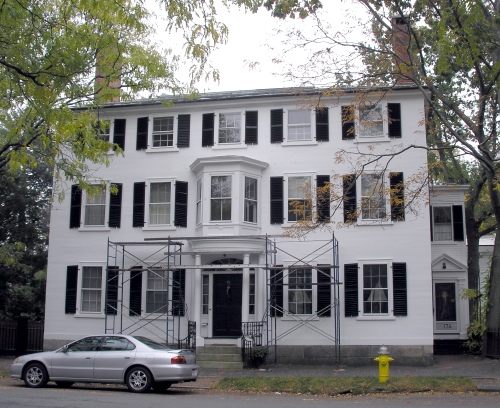
The brick Federal-style house of Captain Stephen Phillips, at 17 Chestnut Street in Salem, was built in 1804-1805, the construction being supervised by Parley Putnam. Capt. Phillips was a merchant who helped to create the neighborhood on Chestnut Street. Salem mayor and U.S. Representative Stephen C. Phillips later resided in the house, which remained in the Phillips family until 1883. It was next owned by Benjamin D. Shreve. His descendants still reside there.

Mary Fiske Stoughton House (1882)

by Dan/December 3, 2010January 20, 2020/Cambridge, Houses, Shingle Style

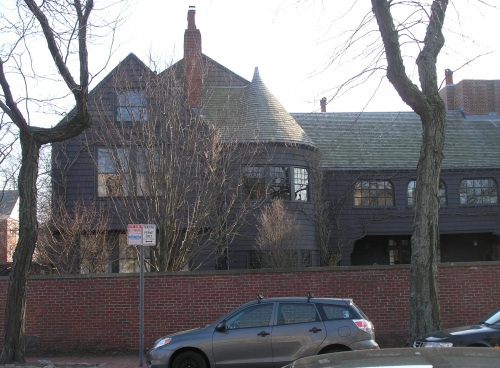
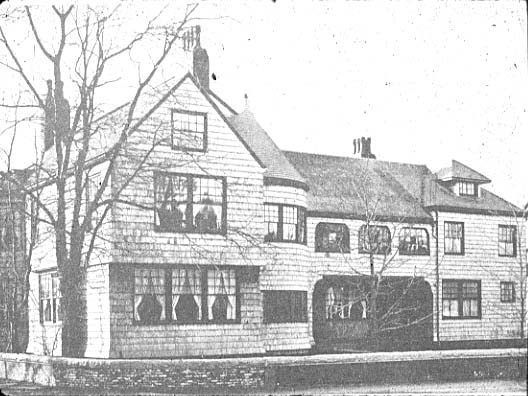
At 90 Brattle Street in Cambridge is a house, built in 1882-1883, that is considered to be the masterpiece of the Shingle style of architecture. With little exterior ornament and covered with wood shingles, it was designed by H. H. Richardson for Mary Fiske Stoughton, the mother of John Fiske, a philosopher and historian who later lived in the house. Although additions were made to the house in 1900 and 1925, it remains an icon of American architecture.

Old Brick Path (1729)

by Dan/December 2, 2010January 22, 2020/Colonial, Houses, Marblehead

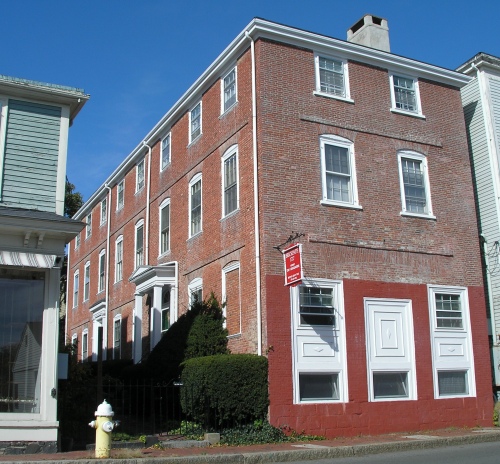
The Old Brick Path is the traditional name of an historic eighteenth-century house in Marblehead, which for many years in modern times contained a gift shop called the Brick Path. Built in 1729, it is one of the few brick colonial houses in town. It was the home and shop of Thomas Robie, a loyalist merchant, who held secret Tory meetings there during the Revolution. Robie was eventually forced to flee with his family to Nova Scotia in 1777. As explained by Samuel Roads, Jr. in his History and Traditions of Marblehead (1880):

In later years the house became the residence of Major Joseph W. Green, who for nearly thirty years was one of the most enterprising merchants in the town. A few years after the close of the War of 1812, he engaged in business with Benjamin Porter, under the firm name of Porter & Green. In a short time this firm employed fourteen vessels in the fishing trade, besides brigs and packets which were sent to New York and the West Indies. Their wharves and ware-rooms were filled with every commodity used in fitting out vessels for sea, and it is said that at one time they furnished seventy-five vessels with stores, anchors, cables, wood, and supplies of every kind necessary for a long voyage to the Banks. Through the influence of Major Green, the Grand Bank was established, and he was its first president

Posts navigation

Older posts
Newer posts
Privacy Policy

Categories

  • Architectural Style (943)
    • Art Deco (9)
    • Byzantine (3)
    • Colonial (177)
    • Colonial Revival (85)
    • Craftsman (6)
    • Egyptian Revival (1)
    • Federal (190)
    • Foursquare (6)
    • Gothic (67)
    • Greek Revival (100)
    • Italianate (82)
    • Mission Revival (2)
    • Mission/Spanish Colonial (1)
    • Modern (2)
    • Neoclassical (56)
    • Octagon (3)
    • Postmodern (1)
    • Queen Anne (46)
    • Renaissance Revival (26)
    • Romanesque Revival (53)
    • Second Empire (26)
    • Shingle Style (12)
    • Stick Style (13)
    • Tudor Revival (8)
    • Vernacular (49)
    • Victorian Eclectic (15)
  • Building Type (943)
    • Apartment Buildings (8)
    • Banks (18)
    • Churches (119)
    • Collegiate (32)
    • Commercial (102)
    • Hotels (16)
    • Houses (508)
    • Industrial (23)
    • Libraries (22)
    • Lighthouses (1)
    • Military (15)
    • Monuments (1)
    • Museums (12)
    • Organizations (39)
    • Outbuildings (17)
    • Public Buildings (50)
    • Schools (23)
    • Stations (5)
    • Synagogues (1)
    • Taverns (21)
    • Theaters (9)
  • Town (943)
    • Adams (11)
    • Agawam (4)
    • Amherst (50)
    • Boston (64)
    • Boylston (6)
    • Cambridge (30)
    • Clinton (21)
    • Concord (15)
    • Cummington (1)
    • Danvers (14)
    • Deerfield (31)
    • Gloucester (18)
    • Granville (10)
    • Great Barrington (2)
    • Hadley (9)
    • Hancock (15)
    • Harvard (32)
    • Holyoke (47)
    • Lenox (5)
    • Lexington (8)
    • Longmeadow (32)
    • Marblehead (40)
    • Marlborough (4)
    • Natick (22)
    • Newton (2)
    • Northampton (68)
    • Peabody (4)
    • Pittsfield (20)
    • Salem (110)
    • Saugus (4)
    • Sheffield (4)
    • South Hadley (8)
    • Southborough (8)
    • Southwick (4)
    • Springfield (67)
    • Stockbridge (19)
    • Stow (1)
    • Sturbridge (18)
    • Sudbury (7)
    • Waltham (11)
    • Watertown (1)
    • Wayland (8)
    • West Springfield (14)
    • Westfield (46)
    • Weston (2)
    • Worcester (26)
  • Uncategorized (1)

Recent Comments

  • Wilber Blackson on South Hadley
  • Tami Speiden on Stockbridge
  • DexGuru on Stockbridge

Tags

Alcott Amherst College Asher Benjamin Back Bay Baptist Beacon Hill Big E Black Heritage Trail bowfront Bulfinch Catholic Congregational Episcopal Freedom Trail Gambrel H.H. Richardson Harvard Hawthorne Historic Deerfield Isaac Damon lit Longfellow mansard Methodist Mount Holyoke Museum Museums NPS Old Sturbridge Village PEM Revolutionary War row houses saltbox Samuel McIntire Shakers Smith College SPNEA Springfield Armory Stephen C. Earle Storrowton Underground Railroad UU Washington William Fenno Pratt Witch Trials

Meta

  • Log in
  • Entries feed
  • Comments feed
  • WordPress.org
Proudly powered by WordPress | Theme: ShowMe by NEThemes.